The Quiet Hours: Finding Premium Infant Care in Singapore
What Quality Looks Like When No One Is Watching
If you are short on time, here is what genuine quality in infant care looks like in the moments parents never see:
- Naptime responsiveness: A caregiver notices when your child stirs—and moves closer with warmth, not urgency.
- Mealtime care: Your child is fed with attention and eye contact, learning that meals are about connection, not just nutrition.
- Transition moments: Movement between activities feels calm and purposeful, not chaotic or rushed.
- Sensory environment: The room has texture—balanced sound, natural smells, thoughtful use of limited space.
- Language: Caregivers speak to children as if their small discoveries matter, narrating the world back to them.
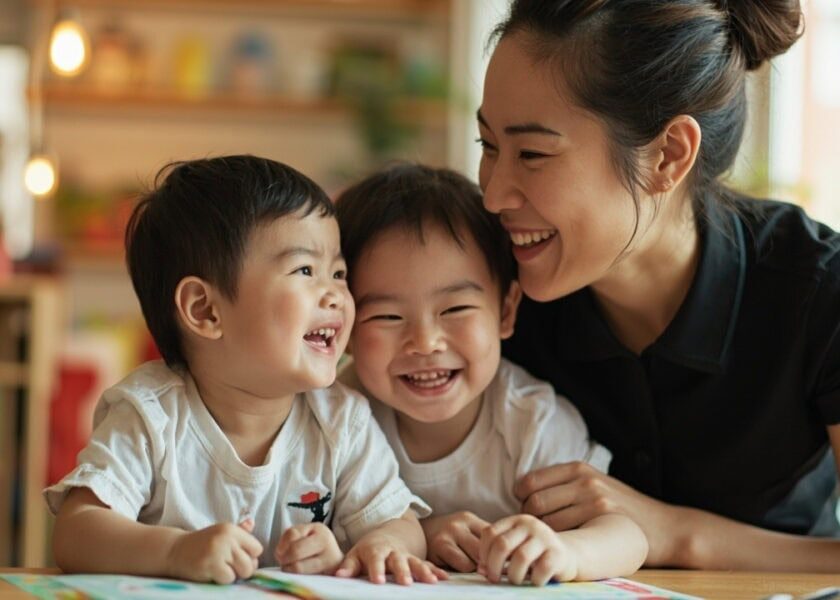
- The reunions: Your child looks up calmly when you arrive. They are glad to see you. They are not depleted.
That final point is the barometer. Everything else in this article is an attempt to help you understand why.
The Hours You Cannot See: What Singapore Parents Worry About
In Singapore, this question carries particular weight. We live in a city where kitchen space is measured in square feet. Where both parents often work. Where childcare centres sit side by side with offices and MRT stations, and the rhythm of a working week shapes the architecture of family life.
We have normalised the arrangement. We have not always named what it actually requires of us as parents—and what it should require of the people we trust with our children.
“Will my child feel abandoned?”
This is the worry that sits deepest. And the answer lives in the reunion, not in the separation. A child who returns to you calm, curious, and undepleted is a child who has not spent their day in a state of abandonment anxiety. They have spent their day in a relational environment that held them. The distress you fear is not inevitable. It is the sign of a mismatch, not of childcare itself.
“How do I know what really happens when I’m not there?”
You cannot know everything, and that is honest. But you can know more than you think. You can ask specific questions. You can observe the aftermath—the state of your child, the quality of their ease. You can ask to be updated not just with photographs but with narrative: what did they eat, how did they sleep, what seemed to delight them today?
“Is my child too young for this?”
The first thousand days are not too early for quality. They are the most important days for quality. The infant brain is wiring itself for security, for trust, for the capacity to regulate emotion—all of which depend on the quality of responsiveness in those early years. This is precisely why choosing well matters most when your child is youngest.
“I feel guilty for needing help.”
You are not a less loving parent because you cannot be with your child every hour of every day. You are not a less attentive parent because you need help. The need for childminding is not a failure of parenthood. It is an honest acknowledgement of what it means to raise a child in a city that asks a great deal of the people who live in it.
Reading the Day: What Genuine Attentiveness Looks Like
Let us walk through those ordinary hours together. The tour is designed. The pickup is curated. The moments when you are present are, by their very nature, shaped by your presence. This is not cynicism. It is simply how institutions work, and how humans behave when they know they are being observed.
What we want to help you do is see past the performance. Because the real answer about quality lives in a different register entirely—in the quiet moments, in what happens when the activity stops and the children are at their most vulnerable.
Naptime: The Trust Barometer
In a good childcare environment, naptime is not a holding pattern. It is not the time when tired caregivers sit against the wall while twenty toddlers lie on mats in varying states of consciousness. Naptime, when it is done well, is one of the most revealing hours in any childcare setting.
Watch what happens when a child stirs before they are ready. In a genuinely attentive environment, someone notices. The caregiver moves closer. There is a voice—low, unhurried, warm in a way that does not wake the others. A hand, placed gently. Not to restrain, but to settle.
The child settles. They may not return to sleep, and that is fine. But they return to a state of calm. They are not left to cry, or to wonder where everyone has gone, or to learn the exhausting lesson that no one comes when they call.
You cannot always know this from a tour. But the real answer lives in the way the room feels when you walk in at pickup, and your child does not run to you in a frenzy of desperation. They look up calmly. They are glad to see you. They are not depleted.
Mealtimes: Where Culture and Care Meet
Mealtimes in a Singapore childcare setting carry a particular weight. Food is not only nutrition here—it is culture, it is relationship, it is one of the primary ways a child learns that the world is a place that knows them and feeds them in every sense of the word.
Watch a mealtime. Not the way it is presented on a tour, where the children are arranged neatly and one of them is having their photograph taken with a spoon. Watch the way the children eat when no one is documenting it.
In a high-quality infant care environment, mealtimes are unhurried. They are relational. The caregiver sits with the children—not above them, not hovering, but with them. Food is described. It is not forced.
The child who is learning to use a spoon is allowed to be slow and messy and imperfect, because the mess is the learning. The child who is being spoon-fed is fed with attention, with eye contact, with words that name what is being eaten and who is eating it.
This is how a child learns that eating is pleasurable, that food is nourishing not just in body but in connection, that mealtimes are a place where people matter more than schedules.
Transition Moments: Where Culture Lives
Transition moments are easy to overlook but deeply important. The five minutes when one activity ends and another has not yet begun. The walk from the activity room to the outdoor space, or from mealtime to nap, or from free play to circle time. These are the moments that reveal culture more honestly than any mission statement on a wall.
Watch what happens in the transition. Is it chaotic? Are children rushing, bumping, being corralled from one space to another like small parcels? Or is there a rhythm to it—a song perhaps, a gentle cue, a calm walking pace that models for children what it means to move through the world without rushing?
In a high-quality infant care environment, transitions are intentionally designed. They are not left to chance.
This matters because early childhood is not only about activities. It is about the spaces between activities. It is about how a child learns to tolerate the ordinary gaps of a day, and whether those gaps feel safe or anxious.
Ask yourself: does the room feel like a place where children are constantly managed, or constantly guided? Managed care feels rushed. Guided care feels purposeful. You will know the difference the moment you step through the door.
The Sensory Environment and the Language of Care
There are two more details that separate genuine care from professional performance. They are things you can observe even if you are not there, if you know what to look and listen for.
The Sensory Environment
Singapore parents are uniquely positioned to notice this, because you live in a city where space is finite and noise is constant. The sensory environment of a childcare setting is not simply about whether the room is clean and well-lit, though it is about that too. It is about the accumulated sensory experience that shapes your child’s nervous system, hour by hour, day by day.
Sound: What does the room sound like when you are not there? Is it a place of constant noise—children’s voices overlapping, recorded music playing, the fluorescent hum of an inadequately ventilated space? Or is there a texture to the soundscape? Active noise balanced by calm periods. Voices that are engaged without being loud.
Smell: A childcare room should smell clean, yes. But it should also smell alive. Of the food that was just eaten, of the children who have been playing, of the natural materials that are part of the environment. It should not smell of industrial cleaner masking something else.
Space: Singapore childcare centres face real spatial constraints. A premium setting does not pretend otherwise. What it does is use space thoughtfully. There are quiet corners. There are areas for active play and areas for solitary exploration. The layout is designed so that a child who needs to be near others can be, and a child who needs to be apart can be, without either being wrong.
The Language of Care
When a child drops a toy, does the caregiver say “don’t drop that” or do they say “oh, it fell. Let’s pick it up together”?
When a child pushes another, does the caregiver say “we don’t push” in a flat, corrective tone, or do they say “that made him feel sad. Let’s see if he’s okay” in a way that helps the child understand the consequence of their action on another person?
The language of a caregiver is a window into their philosophy. It tells you whether they see discipline as control or as teaching. It tells you whether they understand that a child under three is not capable of deliberate misbehaviour in the way an older child is, and that every so-called behavioural issue in the first thousand days is a communication that has not yet been understood.
Ask the caregiver about their approach. Not in the abstract—”What is your discipline policy?”—but in the specific:
- “What happens when a child hits?”
- “What do you do when a child won’t sleep?”
The quality of their answers, and the comfort they have with nuance and uncertainty, will tell you more than any certificate on the wall.
Supervision vs Engagement: The Difference That Matters
There is one more thing that sits beneath all of these observations, and it is the thing that Singapore parents feel most deeply but are often least able to name.
It is the difference between supervision and engagement.
Supervision Is the Baseline
Supervision is necessary. It is the baseline. A child in a safe environment with adequate ratios is, at minimum, supervised. But supervision is not care. Supervision is what keeps a child from harm. Engagement is what keeps a child from loneliness.
And in the first thousand days of life, the difference between these two things is the difference between a child who is merely safe and a child who is genuinely developing.
What Engagement Looks Like
You can see engagement in the way a caregiver kneels to speak to a child at eye level. You can see it in the way a caregiver narrates what is happening—”You are building with the blocks, and the tall one is falling”—not because the child needs commentary, but because the child needs to know that their play is witnessed.
You can see it in the way a caregiver holds a child during a transition that is difficult, not as a matter of policy but as a matter of instinct.
Engagement is not a programme. It is a disposition. And the reason it matters so much in those unseen hours is precisely because it is invisible to audits and checklists and tours.
It shows up in the quality of your child’s ease when they return to you. It shows up in the way they speak about their day—or don’t, if they are not yet verbal, in the way they simply are. Calm. Curious. Undepleted.
That is what you are really looking for, when you are looking for quality.
How to Choose: A Practical Framework for Singapore Parents
So what do you do with all of this? How do you use these observations when you are standing in the pickup line at six in the evening, holding your baby’s bag, waiting for the door to open?
Observing Without Anxiety
You observe. Not anxiously. Not with the aim of finding failure. But with the aim of understanding.
- You watch your child’s face when they come to you.
- You notice whether they are genuinely glad or merely relieved.
- You ask questions that open a door rather than close one—”What was the best part of your day?” not “Was today good?”
- You notice whether your child seems settled in their body, whether they move through the world with a baseline of ease that tells you their nervous system has been regulated in your absence.
When You Are Choosing
And when you are choosing a childcare arrangement, you visit. Not just once. If possible, more than once.
- Arrive early in the morning if you can, and watch the drop-off.
- Stay for ten minutes after the nominal end of the tour, and watch what happens when the performance ends.
- Ask the questions I have described.
- Pay attention to the sensory environment.
- Notice the transitions.
The Standard to Hold
This is not about perfection. It is about knowing what good looks like, so that you can recognise it when you see it, and trust it when you have found it.
What EduNanny Singapore Stands For
Let us be clear about where we stand in this picture, because transparency matters when you are making this decision.
We are part of the ECDA Childminding Pilot, which means we are committed to a model of care that is small by design. Home-based and centre-based pathways, carefully structured around the reality that infant care in Singapore requires both flexibility and rigour.
The Ratio That Changes Everything
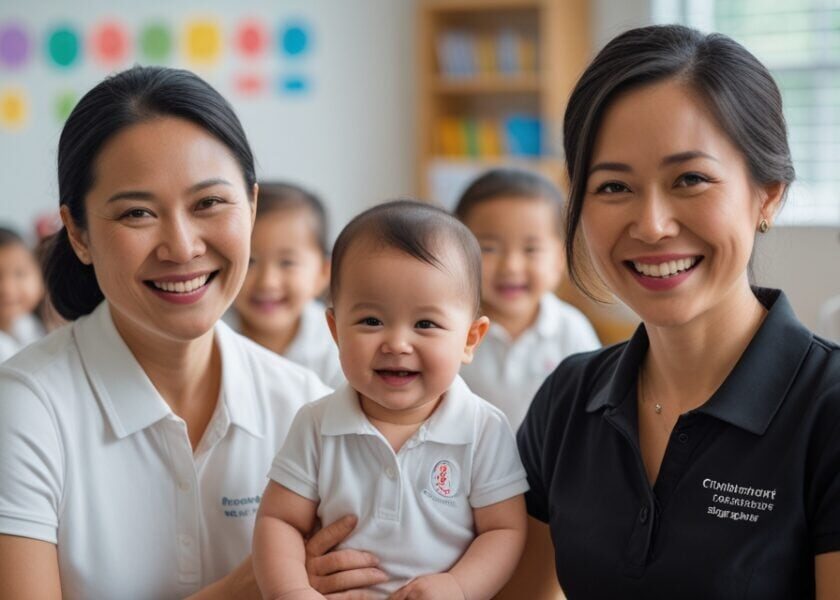
A ratio of up to one to three infants means that every child in our care is seen. Not supervised. Seen. This is not a marketing claim. It is a structural commitment that makes the kind of attentiveness described in this article possible.
How We Choose Caregivers
Our caregivers are not hired for their certificates alone, though those matter. They are chosen for the quality of their attention—for the disposition I have been describing throughout this article. We believe that the hours you are not there are the most important hours of your child’s day, and we have built our programme around the conviction that genuine engagement, relational warmth, and developmental intentionality are not extras. They are the work.
Accessibility and Trust
We know that affordability matters. The pilot fee structures, the ability to use your Child Development Account and your Baby Bonus, the Monday-to-Friday care blocks that align with the rhythm of a working Singapore week—these are not afterthoughts. They are built into the design of what we offer, because we believe that premium care should not require a premium that excludes the families who need it most.
We communicate. We are transparent. Where CCTV measures are deployed, they are deployed not as surveillance but as reassurance—not to watch over our caregivers, but to invite you into the hours you are not there. Not in a way that replaces trust, but in a way that deepens it.
Finding Quality and Trusting It
Here is the thing I want you to hold, in the place where this article finally settles.
What you are is a parent who deserves to know what quality looks like. Who deserves to walk away from a childcare arrangement with confidence rather than anxiety. Who deserves to trust the hours you are not there, not because you have been sold a promise, but because you have learned to see.
Your child is not waiting for a perfect environment. There is no such place. They are waiting for people who pay attention. Who notice when they stir at naptime. Who sit with them at mealtimes and speak to them as if their small discoveries matter. Who move with them through the ordinary hours of an ordinary day and make those hours feel safe.
Find that. Trust that. And then go home, and be the person your child runs to at the end of it.
Because that, too, is where quality lives. In the reunion. In the arms that are happy to see them. In the evening that begins when the day at childcare ends, and the long, warm work of being a family continues.
That is what we are here for. Not instead of you. Alongside you. In the hours that matter, and in the hours you will never see.
Ready to See What Quality Looks Like?
If this picture of infant care resonates with you—if you are looking for a childcare arrangement where your child is seen, not just supervised, where the ordinary hours are as carefully considered as the extraordinary ones—then we invite you to take the next step.
Visit us. Ask the questions in this article. Watch the transitions. Notice how your child looks when you arrive.
Because you deserve to trust the hours you are not there. And you deserve to know what you are looking at when you walk through the door.
Explore EduNanny Singapore’s infant care and childminding options.
#infantcaresingapore #childmindingSG #ECDAchildmindingpilot #qualitychildcare #singaporeparenting