What Siblings Really Teach Each Other in Childcare
Are Your Children Growing Together — or Just Being Kept Together?
There is a moment that many parents in Singapore will recognize, even if they have never spoken it aloud. You are collecting your children at the end of the day. Your younger one is still being buckled into the stroller when your older child begins to tell you about something that happened — a toy was taken, then returned. A friend fell, then was comforted. Someone said something kind.
And in the middle of listening, a small, quiet question surfaces: was my younger child really part of that story, or was she simply present in the same room?
That question — the one you might not voice to anyone, not even your partner in the car on the way home — is more common than the silence around it suggests. It is the unspoken tension that lives beneath so many decisions about childcare in Singapore. And it deserves more than silence. It deserves a real answer.
Because here is what the conversation about childcare often misses: we talk about ratios and curriculum and safety protocols. We talk about whether to choose centre-based or home-based care. We talk about infant massage and caregiver qualifications and how quickly photos appear on the app. All of this matters. But the question underneath all of it is simpler and, in some ways, harder:
Is my child growing through the people around her, or merely existing near them?
For parents with multiple children, a specific fear tends to haunt the margins of your thinking. It is the fear that one of your children is always slightly in the background. That the younger one receives less individualized attention because the older one is more verbal, more demanding, more present. That the older child’s needs set the rhythm and the younger child simply adjusts to it.
That somewhere between drop-off and pickup, the gift of siblinghood — the closeness, the shared history, the lifelong teacher that a brother or sister can be — is being flattened into something smaller. Not into rivalry or resentment. Just into coexistence. Two children in the same room, sharing a caregiver, but not truly sharing a developmental experience.
For parents with only one child, the worry takes a different shape but arrives at the same underlying question. Without siblings at home, will my child learn the lessons that siblings teach? Will she learn how to share when sharing costs something? Will he learn how to negotiate when he wants the same thing someone else wants? Will she develop the resilience that comes from having her blocks knocked over by a sibling and then rebuilding them anyway?
These are not small questions. They are the questions that keep parents up at night — not because they doubt their children’s capacity, but because they sense, correctly, that how children relate to the people around them in those early years is not incidental. It is foundational.
Siblings Are Not Just Family. They Are a Developmental Environment.
Here is something that child development research has shown us, and that every parent with siblings has witnessed firsthand: siblings are not just family members. They are:
- A child’s first peer group
- Their first adversary
- Their first collaborator
- Their first teacher of everything from turn-taking to conflict resolution to the quiet, complicated skill of loving someone who is sometimes infuriating
When siblings are in the right environment — one that recognizes what they can offer each other — the developmental opportunities multiply.
Learning Through Watching
A two-year-old who watches her four-year-old brother solve a puzzle is not just passing the time. She is building neural pathways that will later support her own problem-solving. She is learning what effort looks like when someone is trying hard. She is absorbing the emotional texture of concentration, of persistence, of satisfaction.
A three-year-old who sees his older sister get frustrated and then recover — who watches her put the pieces down, take a breath, and start again — is developing emotional regulation that no lesson could teach as effectively. He is learning that frustration is not the end. That the story continues.
Learning Through Conflict
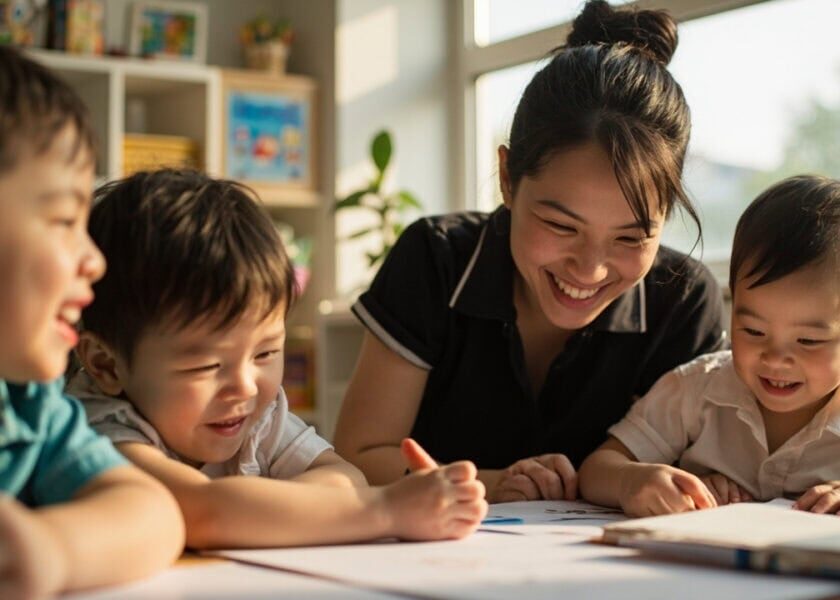
When siblings negotiate over a block tower — when they argue about whose tower it is, whose idea it was, who gets to put the last block on top — they are rehearsing the most complex human skills. They are learning that other people’s desires matter. They are learning that they can be heard and still not get everything they want. They are learning that relationships require repair after rupture, and that repair is possible.
These are not soft skills. These are the foundation of everything that comes later: how children work in teams, how they handle disagreement at work, how they build marriages and friendships across a lifetime.
Siblings are a developmental environment. Just as a child needs proper nutrition and sleep, she needs the experience of being in relationship with siblings — learning, growing, sometimes failing, sometimes winning, always becoming more human through the presence of the people she will know longest in this world.
Why Most Group Settings Undermine What Siblings Could Be Teaching Each Other
Now. Here is the question that matters for every parent: Is the childcare setting your children are in designed to support sibling development? Or is it simply a place where siblings happen to be together?
This is where the distinction becomes everything.
Most group childcare settings are organized around managing children together as a logistics problem. Keep them safe. Keep them fed. Keep them entertained. Keep them from hurting each other. This is not malicious. It is simply incomplete.
And when childcare is organized around supervision rather than development, siblings become roommates instead of collaborators. They become two children in the same room who happen to share a last name, rather than two children who are actively teaching each other what it means to be human.
The Arithmetic of Shared Attention
In most group settings, attention is a pie that gets divided. A caregiver is managing twelve children. Even with extraordinary skill, even with genuine love for the work, attention necessarily becomes a finite resource.
The child who asks loudest gets the most. The child who is quieter, easier, more compliant, gets less.
This is not intentional cruelty. It is the arithmetic of too many needs and not enough space. But it happens anyway, and siblings feel it. The younger child stops asking because asking does not work. The older child learns that demanding gets results. Neither of these is the lesson we want them to learn.
What Quality Attention Actually Looks Like
Quality childcare addresses this through ratios. Small-group ratios matter because they allow caregivers to see children not just as individuals to be managed but as members of relational systems — siblings who are learning from each other, challenging each other, becoming themselves partly through each other’s presence.
When a caregiver has space to actually see your children — not just manage them, but see them — she can notice when your two-year-old is watching her older brother with a particular kind of focus, and she can create a moment of connection between them. She can notice when your younger child is beginning to feel shadowed and quietly lift her into a different activity, a different story, a different space where her voice has room to lead.
This is developmental support. This is the difference between children being supervised together and children being supported together.
The difference between a setting that manages siblings and a setting that supports sibling development is not always visible on a tour. The toys might look the same. The caregivers might smile equally. But the difference is felt — by the children, over time, in the texture of how they relate to each other and to others.
Only Children and the Same Question
For parents with only one child, the question is not about sibling rivalry or protection. It is about what your child is learning from the people around her — and whether the childcare setting is designed to offer what siblings naturally provide.
Here is something that is often overlooked: children teach each other differently than adults do. When a caregiver models a behavior, it is instructive, but it is also somewhat formal. When a peer models a behavior, it is infectious. Young children are wired to watch other children with an intensity they rarely direct at adults.
This is how they learn what is possible. This is how they learn what the outer edges of effort and skill look like.
A three-year-old learning to climb the ladder at the playground by watching a five-year-old do it is not just learning technique. She is learning that it is possible. She is learning what she is working toward. She is learning that the people around her are sources of knowledge, not just sources of care.
For an only child in a quality group setting, this peer learning is a genuine developmental gift. It offers something that siblings sometimes cannot — the presence of children at different stages, with different temperaments, who are all learning together. An only child in a well-designed small group does not miss out on sibling learning. She accesses a different but equally valuable form of peer learning that can support her social development profoundly.
What Quality Peer Interaction Actually Looks Like
When evaluating a setting for your only child, watch how children relate to each other when there is no adult directing the interaction:
- Do they seek each other out?
- Do they watch each other with interest?
- Do they imitate each other’s actions?
- Do they borrow each other’s language?
- Do they look at each other when something surprising happens?
These are signs of genuine peer engagement — children who are learning through each other, not just near each other.
What You Can Actually Observe: A Practical Guide for Parents
Here is what to look for, practically, after childcare — in the moments when your children are together at home and the day is winding down.
Observe Their Conversation
Notice what they talk about. Notice the language they use. Are they describing a shared experience — we built something, we all went outside, something funny happened — or are they describing parallel experiences, my day and your day, as if they were in different places?
Shared narrative is a sign that their time together is being integrated. That what happens to one of them is something that belongs, in some way, to both of them.
Observe Their Conflict
Notice how they handle conflict between themselves. Not conflict that an adult manages, but conflict that they navigate. Do they have enough safety and trust to work it out? Do they argue and then repair? Do they sometimes choose to give in, and sometimes choose to stand firm, and do they come back together afterward?
The presence of conflict and repair between siblings is not a sign of dysfunction. It is a sign that the relationship has depth. It is a sign that they trust the relationship enough to be honest with each other.
Observe Your Younger Child’s Voice
Notice whether your younger child is developing her own voice, or whether she always follows her older sibling’s lead. Both can exist in a healthy sibling relationship. But if your younger child never initiates, never proposes, never has an idea that her older sibling did not have first, that is worth noticing.
That is worth asking the caregivers about. Quality childcare will have an answer for you. They will be able to tell you about the moments when your younger child led an activity, when her idea was the one that the group followed, when she was the teacher and not just the student.
Questions to Ask When Evaluating Childcare
When visiting a childcare setting, ask questions that reveal how they think about sibling dynamics:
- How do you handle situations where one child needs more attention than another?
- How do you create space for younger siblings to lead activities, not just follow older ones?
- Can you tell me about a recent moment when one child learned something by watching another?
- How do you approach conflict between siblings in your care?
- What does a typical day look like for a younger child alongside an older sibling?
Listen to how these questions are answered. Are caregivers describing intentional strategies for supporting sibling development? Or are they describing a system that manages children as individuals who happen to share space?
EduNanny Singapore: Designed for How Children Actually Grow
EduNanny by BUTLER is built around this understanding. As part of the ECDA Childminding Pilot, EduNanny is equipped to offer both home-based and centre-based pathways, with ratios that make genuine attention possible.
What the Numbers Actually Mean
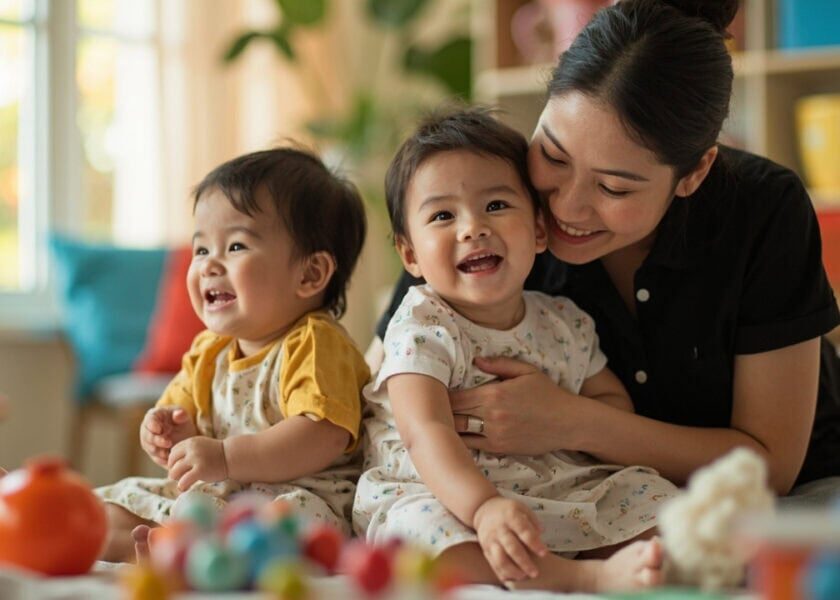
The ECDA Childminding Pilot maintains ratios of up to one caregiver to three infants in the early years. This is not a bureaucratic specification. This is the arithmetic of genuine attention.
When a caregiver has three infants instead of twelve, she has space to notice. She has time to see the quiet watcher as clearly as she sees the bold initiator. She can create moments of connection that larger groups make impossible.
When a caregiver knows both your children well enough to know that your younger child expresses interest by watching quietly rather than by reaching out, she can interpret that watching with care. She can create the conditions for your younger child to be seen, even when she is not the one speaking.
The Deeper Logic of Quality
Beyond the ratios, the deeper logic of EduNanny is this: premium childcare is not about amenities. It is about the conditions that allow children to grow.
Premium means:
- Ratios small enough that your children are not just names on a list
- Caregivers who have the time and the training to see your children as they truly are
- Peer relationships treated as essential, not incidental
- An environment designed for children in motion — reaching for each other, learning from watching, building together — not just children at rest
Addressing Common Concerns
Parents often carry specific worries that deserve honest answers:
I feel guilty for not being able to give both children equally individualized attention at home.
This guilt is understandable, but it points to an important truth: attention is not something parents need to manufacture alone. Siblings, peers, and quality childcare settings are all part of the developmental ecosystem your children need. You do not have to be everything to your children. You need to choose environments that complement what you provide.
How do I know if my younger child is being overshadowed?
Look for these signs over time: your younger child rarely initiates activities or conversations with her sibling; she always defers to her older sibling’s preferences without expressing her own; after childcare, she describes parallel days rather than shared experiences; caregivers cannot recall a moment when your younger child led an activity. If you see these patterns, ask the caregivers directly. Quality settings will have observations to share and strategies to discuss.
Is group care really better than having a caregiver just for my child?
This depends entirely on the quality of the group setting and the quality of the individual caregiver. What research consistently shows is that peer learning — learning from children who are slightly ahead, slightly behind, or simply different — offers something one-to-one care cannot replicate. The question is not group versus individual. The question is whether the group setting is designed to support developmental relationships, or whether it is simply a room full of children being managed.
Practical Supports for Singapore Families
The practical supports are built in because Singapore families should not have to choose between quality and affordability. CDA and Baby Bonus usability. Monday to Friday care blocks. Where CCTV measures are deployed, they offer an additional layer of openness and trust — not surveillance, but partnership.
Communication and transparency are foundational to the model, with regular updates and information sharing that create a genuine bridge between what happens at childcare and what you experience at home.
EduNanny’s Thomas AI Chatbot offers parents a responsive, accessible resource for navigating the real questions of infant care and childminding, from developmental milestones to practical concerns. It is one more way that EduNanny stays connected to parents, not just to children.
Your Children Deserve to Grow Together
Here is what I want you to carry with you from this conversation.
The question you have been asking — the quiet one, the one you maybe did not even realize you were carrying — is worth taking seriously. The question of whether your children are growing together or merely being kept together. The question of whether your only child is getting what she needs from the people around her. The question of whether any childcare setting is designed to nurture sibling bonds rather than treat all children as a unit.
These are not neurotic concerns. They are the right concerns.
Children who are supervised together are kept safe. Children who are developmentally supported together are being prepared for life. The difference is not always visible on a tour. But it is visible over time, in the children themselves — in how they relate to each other, in how they relate to others, in the quality of their attention and their curiosity and their resilience.
It is visible in the way they walk into a room full of children they do not yet know and extend themselves toward connection rather than retreating into isolation. It is visible in the way they handle disappointment, in the way they negotiate, in the way they recover from the small ruptures that happen every day in childhood and in life.
EduNanny exists to answer these concerns with more than reassurance. They exist to answer them with design — with ratios, with training, with intentional peer programming, with communication structures that keep parents genuinely informed, with a philosophy that sees siblings not as a logistical arrangement but as one of the most powerful developmental environments you will ever give your children.
You deserve to have your concerns taken seriously. You deserve childcare that sees your children as they truly are — not as a unit, not as a logistical problem, but as individuals who are becoming themselves partly through the people around them.
You deserve to be able to ask the hard questions and receive honest answers.
You deserve to drop your children off in the morning and feel, by the time you pick them up, that the day was used well.
The sibling question is not a secondary concern. It is a quality signal. It is the question that reveals whether a childcare setting truly understands how children grow — or whether it is simply keeping them safe until you return.
Explore EduNanny’s approach to infant care and childminding — or speak with our team about what quality sibling support looks like in practice.