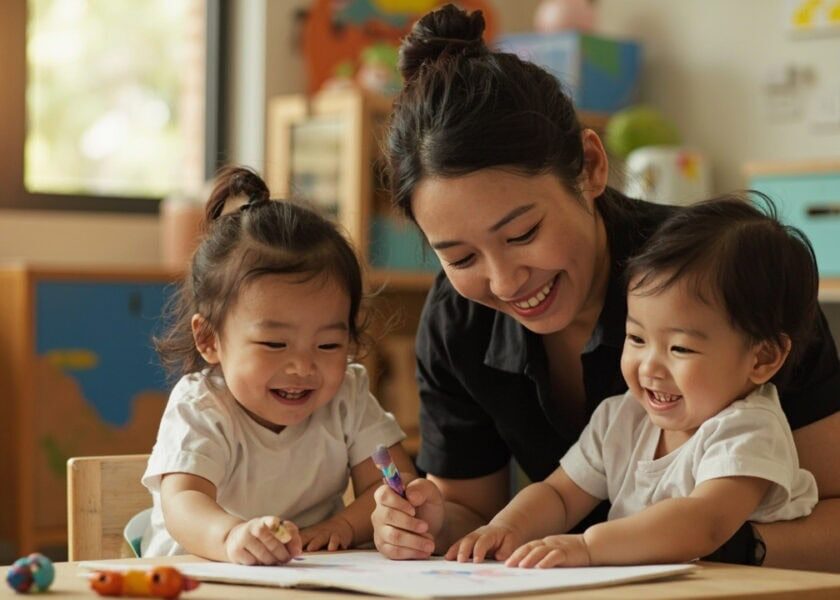
The First Thousand Days: Why Early Childhood Quality Care Matters
The First Thousand Days: Why These Years Are Different
In the first thousand days of life, a child’s brain forms more than one million new neural connections every second. This is not a statistic designed to create anxiety. It is simply the biology of early childhood—the extraordinary, time-bound opportunity that makes these years unlike any other.
Language develops. Motor control refines itself from the clumsy reaching of infancy to the confident walking, running, and climbing that follows. Social awareness awakens. The capacity to regulate emotion begins its long, essential development.
And all of this happens not in a vacuum, but in relationship. In response to consistent care. In environments shaped by attentive adults.
What this means practically is this: the first three years of your child’s life are not simply a period to be managed until they are old enough for school. They are foundational architecture. And the quality of the care your child receives during these years does not merely pass the time—it shapes the structure.
What Quality Care Builds: A Domain-by-Domain Look
Let me be specific about what this looks like, because abstract statements about early development, however accurate, do not give parents what they need. They need to know what they will see.
Language Development: Beyond Words to Meaning-Making
When a child is developing strong language foundations in a quality care environment, you will notice this not only in the words they learn—though you will notice that too—but in how they listen.
How they respond to stories. How they begin to string words together with intention. How they understand, long before they can articulate it, that words carry meaning and that they are already becoming a person who can participate in meaning-making.
A child in a language-rich environment will often begin pointing to objects and looking to you for the word, then saying it back with delight. This is not an accident. It is the product of hundreds of hours of responsive interaction, of being talked to and listened to and spoken with by adults who are genuinely engaged with their developing mind.
Cognitive Development: The Quality of Play
When cognitive development is well-supported, you will see it in the quality of a child’s play. Not the quantity of toys, but the depth of engagement.
A child who is learning to think is a child who can sustain attention, who begins to solve simple problems, who experiments with cause and effect. Who builds a tower and, when it falls, looks to understand why, and tries again.
This persistence, this curiosity in miniature form, is one of the most important things quality care cultivates. It is not a skill that can be rushed or taught through instruction. It grows from being in an environment that responds to the child’s exploration with warmth and gentle challenge.
Motor Development: Confidence in Movement
Motor development follows a recognizable pattern when it is well-supported. You will see it in the confidence of a child’s movement—in the way they navigate a staircase, in the precision of their hand when they pick up a small object and place it carefully where it belongs. In the way they run not just fast, but with the coordination to change direction without falling.
Gross motor skills and fine motor skills develop together when children have space and opportunity to move, to climb, to manipulate objects, to practice the intricate coordination that will later support their writing, their drawing, their ability to care for themselves.
A quality care environment provides not just supervision but provocation—the right materials, the right space, the right kind of encouraged challenge.
Social and Emotional Development: What Parents Least Expect
And then there is what I find parents least expect to see, and most grateful to recognize: social and emotional development.
When a child has been in a consistent, responsive care environment, you will notice this in their relationships. In their ability to separate from you in the morning with relative ease—not because they do not love you, but because they have learned that parting is survivable, even temporary, and that the adults around them will remain.
In their emerging capacity to notice the emotions of others. In the way they begin to use words for feelings rather than only expressing them through action. In the early, tentative friendships they form with other children—not perfectly, not without conflict, but with a growing sense of social belonging that will serve them for the rest of their lives.
The Critical Role of Caregiver Consistency
These outcomes do not appear because a checklist has been satisfied. They emerge over months and years of consistent, intentional care. And this is why caregiver consistency matters so profoundly.
Research across early childhood development consistently shows that children need stable, responsive relationships to thrive. The Romanian orphanage studies—dark as their context is—demonstrated graphically what happens when children are cared for adequately but without consistent, individualized attention. They developed. But not fully. Not in the ways that matter most for human flourishing.
The brain, it turns out, needs not just stimulation but relationship. Not just any care, but care that is predictable. Care where the adult knows your name, your preferences, your rhythms, your fears. Care that responds to you as a specific person, not as a task to be completed.
This is why the ratio of caregivers to children matters so deeply, especially in the infant and toddler years. When an infant is in an environment where one attentive adult is responsible for no more than three children at a time, something qualitatively different happens.
The adult can notice. Can respond. Can remember that this child is working on a particular skill, is going through a particular phase, is comforted by a particular approach.
The adult becomes not a supervisor but a knowing presence. A person who has seen this child grow over months, who can read their cues, who anticipates their needs not from a chart but from accumulated understanding.
Tracking Progress Without Comparison Anxiety
I want to pause here and speak directly to something I know many Singapore parents carry: the anxiety of wondering whether their choice is the right one. Whether the money they are spending is producing real value. Whether their child is on track, ahead, or behind compared to other children.
This comparison anxiety is understandable. Singapore is a competitive environment, and parenting here comes with an enormous amount of input about what children should be achieving and when.
But I want to offer a different frame. Tracking your child’s development should not mean hunting for evidence that they are ahead of others. It should mean watching them grow. It should mean noticing what they could not do six months ago that they can do now. It should mean taking genuine pleasure in the specific, unrepeatable person they are becoming.
When you shift from comparison to observation, something changes. The anxiety does not disappear entirely—parenting always involves uncertainty—but it becomes manageable. You are no longer looking for reassurance that you made the right choice among options. You are watching your child develop, and you are looking for what quality care is producing in them.
EduNanny by BUTLER: A Service Built for This Purpose
This is what EduNanny’s approach supports. Through consistent communication between caregivers and families, through the transparency measures that allow you to see what your child’s day includes, through regular updates that help you understand what is being built—you are not left guessing. You are invited into the developmental journey.
You can see the words emerging, the coordination refining, the social confidence growing. The investment you made becomes visible, not because you are looking for proof, but because you are watching your child become themselves.
EduNanny by BUTLER operates as part of the ECDA Childminding Pilot, which means it is recognized within Singapore’s regulatory framework as a pathway for families seeking quality home-based childminding. For parents, this is not a minor consideration. It means the service has been reviewed, evaluated, and found to meet standards that Singapore’s education authority considers essential for young children’s care and development.
The pilot structure also means that fees are designed to be affordable within the framework the government has established for childminding services, making quality care more accessible to families across Singapore.
Pathways Designed for Real Families
EduNanny offers both home-based childminding and centre-based pathways, recognizing that families have different needs and circumstances.
The home-based pathway provides something genuinely valuable: care in a familiar, smaller-scale environment, with caregiver ratios of up to one to three for infants. This is not a large-group setting. It is intimate enough for the kind of attention I have been describing—care where your child is known, not just watched.
The centre-based pathway offers community-based options that maintain these standards of quality and attention, with Monday to Friday care blocks designed to support working parents’ schedules.
Communication That Keeps You Connected
And then there is what EduNanny does in its daily practice. Communication with families is a priority—not as a feature list item, but as an ongoing commitment.
When your child learns a new word, when they master a new physical skill, when they have a day of particular joy or particular struggle, you are not left to wonder.
Transparency measures, including CCTV in deployed settings, offer additional reassurance for families who value it—not because trust is absent, but because modern parenting often involves the need for visible evidence, and EduNanny recognizes this without judgment.
Questions Worth Asking Any Provider
Not every service is the right fit for every family, and that honesty matters. If you are exploring options, here are some questions worth asking of any childminding or infant care service:
- What is the caregiver-to-child ratio, especially for infants?
- How long has the primary caregiver been working with the service?
- What does daily communication with families look like?
- How does the environment support different areas of development?
- What flexibility exists for working parents’ schedules?
- How are developmental updates shared with families?
The Question Beneath the Decision
Here is what I want you to carry with you, whether or not EduNanny becomes part of your family’s story.
That quiet question I named at the beginning—the one that surfaces in the evening when you pick up your child and notice something new—it has an answer.
The question is real. The investment is real. And what it produces, when care is truly quality care, is real too.
You will see it. Not always in dramatic moments, but in the accumulation of small developments. The way your child speaks. The way they move. The way they connect with others. The way they look at the world with curiosity and growing confidence.
These are the outcomes that matter. And they are worth every bit of the thought and care you are bringing to this decision.
EduNanny exists because someone looked at the gap between making a childcare decision and understanding what it was building—and decided to do something about it. To create a service that makes developmental investment visible. That brings caregiver consistency to the families who need it. That operates with transparency, with recognition of Singapore’s regulatory standards, with genuine attention to the ratios and environments that make quality possible.
To be a partner in the developmental journey rather than simply a provider of supervision.
Your child is building something extraordinary in these early years. The work is already underway. The only question now is whether you have the right partner to walk alongside you in it.
If you are considering your childcare options and would like to learn more about EduNanny’s approach to quality childminding, we welcome you to get in touch or explore our story and values.