The Courage to Build a Village for Your Child in Singapore
The Moment Every Singapore Parent Recognises
There is a moment — quiet, unremarkable in every way except one — when a Singapore parent stops and asks themselves whether they should be doing this alone.
It does not arrive with fanfare. It arrives at two in the morning, or on a Monday morning when the calendar will not bend, or in the pause between your child’s laugh and the sudden awareness that you have not eaten a proper meal in two days.
It arrives as a thought that you almost do not let yourself finish: Maybe I need more hands in this. Maybe I cannot be everything, right now, in this season.
And then, almost immediately, something else arrives. A quieter voice, steadier, harder to argue with. It says: But what will people think. What will it mean if I cannot do this myself. What does it say about me as a parent.
That second voice. It is not loud. It does not need to be. It carries the weight of a culture that has, for generations, placed the raising of children squarely on the shoulders of parents — and meant it as a badge of honour.
This tension — this quiet, daily negotiation between wanting help and fearing what needing help means — is not a sign that something is wrong with you. It is a sign that you care enormously. That you are paying attention. That the stakes feel impossibly high, because they are.
The Weight of Doing It Alone
Raising a child in Singapore — in this season of life, in this city that does not pause — is not a small thing. The mortgage still needs paying. The commute still happens. Grandparents may be active in their own lives, involved but not always available.
And into this already full equation comes a small person who needs everything from you, all the time, in ways that are both beautiful and exhausting.
Parents who feel the weight of that are not uncertain. They are awake. They are paying attention to what their child needs and what their family needs to meet those needs. That kind of awareness is not weakness. It is the very foundation of good parenting.
The guilt that arrives with the thought of sharing your child’s care is not a warning. It is a compass. It points to how much you love this small person. And it points, as well, to a question worth sitting with — not what will others say, but what do I actually want for my family, and what kind of village does that family need to thrive?
What a Village Actually Means
Let us start with that word: family.
We have spent a long time narrowing it down. In the modern Singapore household — with two working parents, or one, with the relentless forward motion of a city that does not pause — we have come to understand family as a very small circle. Parents. Maybe grandparents. And now, increasingly, a small child who belongs, in the most profound way, to the people inside the home and almost no one else.
And yet, if you look across cultures, across histories, across every human society that has ever raised children successfully, the circle is never that small. The anthropologist Margaret Mead described it simply: it takes a village to raise a child.
When I hear that phrase now, having sat with so many Singapore parents in this exact moment of decision, I do not hear it as a platitude. I hear it as a description of what human beings have always done — and what we have, in our modernity, quietly convinced ourselves we should be able to skip.
We cannot skip it. Not because we are not capable, but because the child does not thrive on capability alone. A child thrives on relationship. On the texture of different voices, different ways of being held, different hands that teach what warmth and curiosity and safety feel like.
When a Singapore parent welcomes a skilled, warm caregiver into their child’s life — someone trained, someone vetted, someone who will spend real hours building a genuine bond with this small person — I want to name what that actually is.
It is not outsourcing. It is not delegation. It is not a necessary inconvenience until the child is old enough for school.
It is the expansion of your child’s world. It is the building of a village, deliberately, carefully, with your values at the centre of it.
This is what I mean when I say it is an act of parenting. Because it requires you to know what matters. It requires you to be honest about what you need. It requires you to ask not just, “Is this service good?” but “Is this the right person to hold my child while I am not in the room?”
That question — the fact that you are even asking it — tells me everything about the kind of parent you are.
What Intentional Childcare Looks Like
Because philosophy without texture is just noise. Here is what this looks like in practice.
The First Weeks
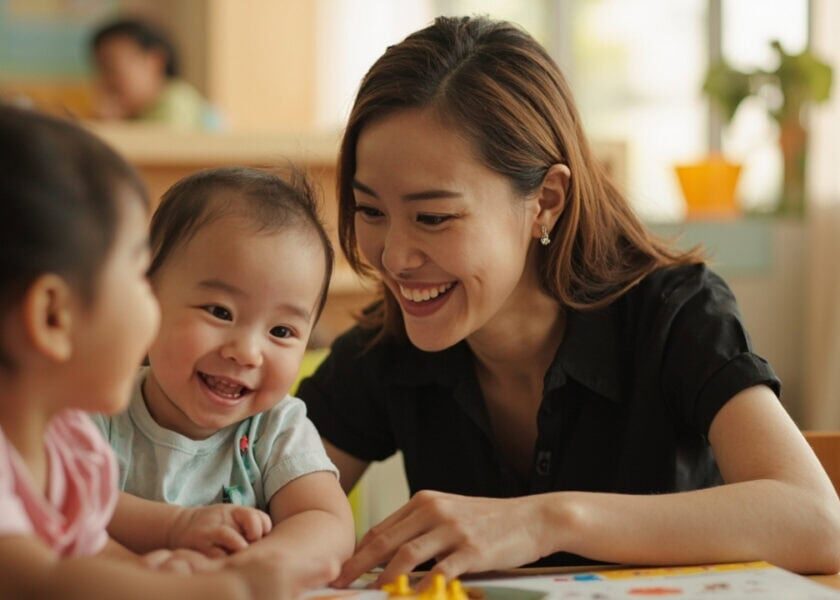
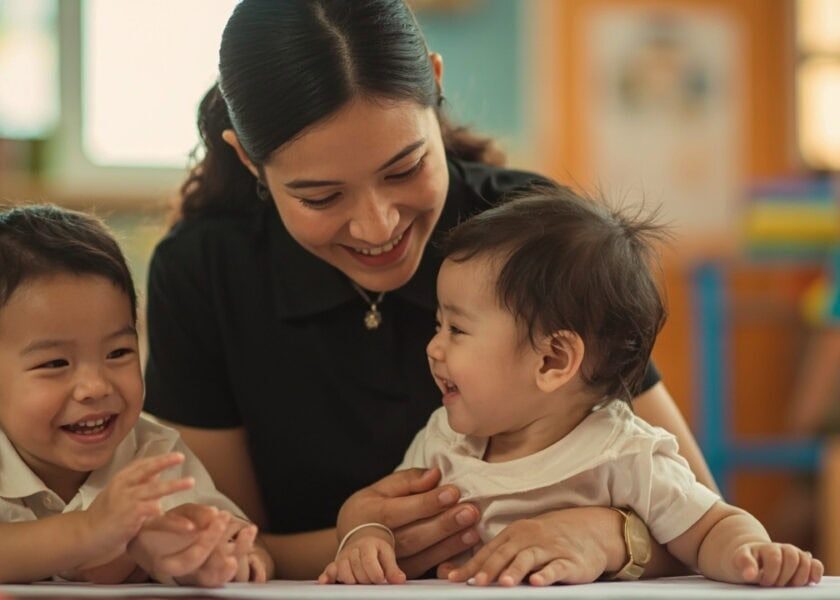
When childcare is built on intention rather than desperation, something shifts. The first days are often awkward, for everyone. The parent hovers. The child cries, or goes very quiet. The caregiver, if she is any good at all, is patient in a way that is almost impossible to describe — not just waiting, but genuinely holding space for a family that is still learning to trust.
The Shift Over Weeks
But then, over weeks, something emerges. The parent starts to see the caregiver not as a service provider but as a person — someone with her own warmth, her own way of reading a child’s moods, her own small rituals that she brings to the day.
The child starts to run to her, not away from the parent. And the parent — this is the part I find most beautiful — starts to relax into the knowledge that their child is genuinely well-cared for, and that this care is an extension of the family’s own values, not a departure from them.
How You Know It Is Working
That is the village. Not a checklist of qualifications, though those matter. Not a CCTV camera in every room, though that transparency matters too.
But the feeling — the quiet, unmistakable feeling — that the people in your child’s life are chosen. That the care your child receives when you are not in the room is continuous with the care you provide when you are.
You know because your child is curious and calm. You know because your caregiver talks about your child the way you do — noticing the small things, the things that would be invisible to anyone who was not paying deep attention.
Before you choose, ask yourself:
- Does this arrangement feel like an extension of our values, or a departure from them? The right fit should feel like expansion, not compromise.
- How does my child respond to the caregiver? Not just on the first visit, but over time. Are they curious? Calm? Running toward, or away from?
- Do I feel heard? In the process of choosing, in the communication ongoing — do the people caring for your child treat your concerns and observations as important?
The Courage to Ask for a Village
There is a particular kind of courage it takes to admit, even to yourself, that you need help raising your child. And I use the word courage deliberately.
In a society that prizes self-reliance, that celebrates the parent who juggles everything without complaint, asking for support can feel like an admission of defeat. It can feel like you are saying, quietly, I am not enough.
But I want to suggest the opposite.
The parent who looks honestly at their life, at their marriage or partnership, at the demands of work and the needs of a very young child, and says, “We need a village” — that parent has understood something about love that the parent who refuses to ask for help has not yet learned.
Love is not demonstrated by how much you can carry alone. Love is demonstrated by how carefully you build the environment in which your child will grow. And that environment requires you to be humble enough to let others in. Not carelessly. Not recklessly. But deliberately, thoughtfully, with every safeguard in place.
This is not a compromise. This is what raising a child well actually looks like in the twenty-first century. It looks like parents who are rested enough to be present. It looks like an infant who has a secure base — multiple secure bases — from which to explore the world. It looks like a family that knows itself well enough to know what it needs, and is brave enough to go and get it.
EduNanny Singapore: Built for This Moment
Intentional partnership is about alignment. It is about asking: Does this caregiver, or this programme, understand that they are entering into a relationship with my family — not filling a slot in my schedule?
EduNanny Singapore, operating under the ECDA Childminding Pilot, has been designed with exactly this in mind.
Pathways That Adapt to Families
The pilot programme offers home-based and community-based pathways, because families are not all the same. Some children settle best in a familiar home environment, with a caregiver who comes to them. Others thrive in a small, warm centre setting where they can experience a little more of the world.
The structure matters less than the principle behind it: that childcare should adapt to the family, not the other way around.
Small Ratios, Real Attention
The ratios — up to one to three infants in home-based settings — are not just regulatory language. That small number means your child is not one of many.
- Every cry is heard.
- Every milestone is noticed.
- Every conversation your child has with their caregiver is, for that brief window of time, the most important conversation in the world.
That is not a luxury. That is what early childhood actually requires.
Excellence Within Reach
The pilot makes this accessible in ways that matter. Within the fee structures, the cost is structured to be affordable. Your Child Development Account can be used. Your Baby Bonus funds can reach where they need to go.
Excellent infant care should not be a privilege reserved for families with significant financial resources. Every infant in Singapore deserves to be held by someone who is trained, warm, and paying attention.
Trust Through Transparency
The communication piece matters enormously. The transparency measures, the regular updates, the open channels between caregiver and parent — all there because trust is built in the open.
When you can see what your child’s day looks like, when the caregiver sends you small observations and genuine moments rather than just a daily log, the distance between your home and theirs shrinks.
Your Child Deserves a Village
This is not just about systems and pilots and ratios. It is about what happens in a living room or a small centre, in the ordinary hours of an ordinary Tuesday.
When a caregiver sits on the floor with a child and notices that the child is fascinated by the way light moves through a glass of water.
She does not interrupt the moment. She does not rush to show them something else. She sits with it. She names it, softly. She gives the child the word for what they are seeing.
And in that small, unscripted exchange — which will never make it into any report, any milestone checklist, any evaluation — something is being built. A relationship. A sense of being seen. A first lesson in the most important thing a child can learn: that the world is interesting, and that there are people in it who will help you understand it.
That is what EduNanny Singapore is here to do. Not to replace you. Not to diminish the bond between you and your child. But to be part of that village you are building — skilled, warm, trained, trusted — so that your child has more than one person who pays that kind of attention.
So that you, as a parent, are not the only pillar holding everything up. So that the family — this word we have been quietly shrinking — expands again to include the people who have been chosen to love and care for your child when you cannot be in the room.
Choosing well is not a lesser form of parenting. It is parenting at its most honest. And the parent who chooses this path — who sits with the discomfort, who asks the hard questions, who opens their home and their child’s life to someone they have carefully chosen — that parent is doing something extraordinary.
Not despite the difficulty of the decision, but because of the care with which the decision was made.
Your child will not remember every day. But they will remember, in some deep and wordless way, how it felt to be loved by many.
And that is everything.
If you are ready to explore what intentional infant care could look like for your family, EduNanny Singapore is here to answer your questions and walk this path alongside you.
Begin your conversation with us today.