The Foundation of Learning: Physical Development in the First Five Years
What Is Actually Happening in Those Hours You Cannot See
There is a moment, familiar to every parent who has left their child in someone else’s care, when you stand at the threshold of a door and feel the weight of what you cannot see. You hand over your child—small, trusting, still learning how to articulate what they need—and you walk away carrying the question that never fully quiets: What is happening in there?
Not the logistics. Not the meals or the nap schedules or whether the diaper was changed. You trust, or you are learning to trust, that those things are handled. The question that runs deeper is this: Is anything meaningful happening? Is your child not just supervised, but developed? Not just kept safe, but built up in ways that will matter when they are six, or sixteen, or standing in their own threshold someday, making their own decisions about what kind of life to build?
This is the anxiety that lives beneath the surface of every parent choosing childcare in Singapore. And it is a legitimate anxiety, because the answer is not always visible. When your child comes home, they cannot give you a progress report. They cannot say, “Today I learned how to coordinate my two hands to pour water from one cup to another, and my brain made a new connection that will help me hold a pencil next year.”
They cannot tell you that when they climbed the soft structure in the play area, their inner ear was sending precise messages to their brain about balance, and that this process—this invisible, elegant process—is quietly constructing the neurological architecture that will one day allow them to sit still in a classroom, focus on a teacher’s voice, and regulate their own emotional responses when something feels unfair or hard.
Children cannot tell us this. Which is why it so often goes unseen, unvalued, and undone.
Physical Development Is Not a Side Concern. It Is the Foundation.
We live in a culture that celebrates intelligence in the abstract—the quick learner, the bright child, the one who seems to absorb information effortlessly. But intelligence, in the earliest years, lives in the body.
Before a child can read, they must make sense of marks on a page. Before they can make sense of those marks, their eyes must track smoothly across a line. Before their eyes can track smoothly, the visual system must be mature enough to coordinate with the motor system, to hold focus, to shift attention.
And before any of that can happen, the sensory systems that tell the brain where the body is in space—how fast it is moving, whether it is upright or tilted, where its boundaries end and the world begins—must be functioning with enough precision and reliability to give the higher brain something coherent to work with.
What Sensory Integration Actually Means
This is sensory integration. It is not a buzzword. It is the process by which the nervous system takes in information from the body and the environment, combines it into a usable whole, and produces a response.
When an infant reaches for a toy, sensory integration is at work—their vision locates the object, their proprioceptive sense tells their hand where to go, their tactile sense confirms contact, and their brain assembles all of this into a successful grasp.
When a toddler climbs onto a chair and judges whether they can make the jump to the next one, sensory integration is at work again—their vestibular system processes balance and movement, their proprioception guides their muscles, and their brain calculates risk based on this stream of physical data.
This process is not separate from learning. It is the infrastructure of learning.
Why Struggling Children Often Struggle Everywhere
Children who struggle with sensory integration often struggle with everything else, not because they are less intelligent, but because their brains are spending enormous energy on tasks that should be automatic—staying upright, focusing their eyes, modulating their responses to sound and touch.
When we are anxious, we sometimes notice our own bodies more—the flutter in our chest, the tension in our shoulders. For a child whose sensory systems are still maturing, this background noise can be loud and constant. And it is exhausting.
It is hard to learn to read when your body feels like a source of confusion. It is hard to focus on a story when every background noise feels like an intrusion. It is hard to regulate your emotions when your nervous system is still learning to regulate itself.
This is why physical development is not a separate track from cognitive or emotional development. It is the track that carries the others.
The Developmental Journey: From Reach to Running in the First Five Years
The first five years are not a warm-up act for the real performance of school and career. They are the performance. Every hour is building something.
The First Year: Discovering Agency
In the first year, your infant is discovering what their body can do. They are learning to lift their head against gravity, to roll, to sit with support and then without it, to reach for things and miss, and then to reach and make contact.
Each of these milestones is not just a physical achievement—it is a neurological event. When a baby learns to grasp a rattle, they are not just exercising their hand. They are discovering that they have intention, that they can affect the world, that their actions produce consistent results.
This is the beginning of agency. This is the foundation of confidence.
The Second Year: Navigation and Control
In the second year, your toddler is on the move. Walking, then running, then climbing stairs, then jumping down from low surfaces. They are learning to navigate space, to judge distances, to feel the pull of gravity and test their own strength against it.
They are also developing fine motor control—the pincer grasp, the ability to stack blocks, to scribble with a crayon, to feed themselves with increasing precision. These are not trivial skills. They require the coordination of dozens of muscles, the integration of multiple sensory systems, and the ongoing refinement of the brain’s motor cortex.
When your two-year-old uses a spoon with confidence, or turns a doorknob, or builds a tower of six blocks, you are watching months of sensory-motor development crystallize into capability.
The Third Year and Beyond: Building Toward Readiness
By the third year and into the preschool years, your child is becoming a physical being with increasing sophistication. They can run with coordination, stop with control, change direction without falling. They can hop, skip, and eventually skip.
Their fine motor skills are supporting early drawing and pre-writing—they can hold a crayon with a proper grip, draw circles and crosses, and eventually letters. Their sensory systems are maturing, and they are better able to filter out irrelevant stimuli, focus their attention, and modulate their responses to sensory input.
They are building the physical infrastructure for sitting in a classroom, attending to a teacher, holding a pencil, and eventually writing with fluency and speed.
This trajectory—from reach to grasp to run—is not a series of checkboxes on a developmental chart. It is the unfolding of a human being’s capacity to inhabit their own body with confidence, to trust that their body will do what their mind intends, and to engage with the world as a capable, competent person.
Why Quality Childcare Makes the Difference
Here is what we must acknowledge: this development does not happen automatically, and it does not happen equally.
Children who do not have opportunities for movement, for sensory exploration, for the responsive interaction of a caregiver who scaffolds their physical development, will not develop as fully. This is not a matter of intelligence or genetics or family income. It is a matter of experience.
The brain builds its sensory-motor architecture based on what it encounters. Provide rich, varied, appropriately challenging physical experiences, and the architecture becomes complex and capable. Provide limited or impoverished physical experiences, and the architecture remains rudimentary—and the deficits may not become apparent until years later, when a child struggles to sit still, or to write, or to manage their emotional responses in a social setting.
This is where childcare becomes developmental, not just supervisory.
What Quality Childcare Actually Looks Like
A quality childcare environment is not just a safe space with caring adults. It is a carefully designed developmental ecology.
The play spaces are arranged to invite movement—climbing structures appropriate for different ages, open areas for running, quiet zones for focused fine motor work. The daily schedule includes not just free play but structured physical activity—music and movement sessions, outdoor time, guided activities that target specific motor skills at the appropriate developmental stage.
In the Singapore context, where indoor spaces dominate daily life, quality childcare must be intentional about creating movement opportunities that might otherwise be missed. This means purposeful use of available space, creative gross motor activities, and regular outdoor excursions when weather permits.
The Caregiver’s Role in Physical Development
The caregivers understand not just what children are doing but why it matters, and they interact with children in ways that extend and scaffold their physical development, not just supervise it.
When an infant reaches for a toy, a responsive caregiver names what is happening: “You’re reaching for the ball. You want the ball.” This verbal accompaniment to physical action helps the infant’s brain consolidate the experience, connecting the intention, the action, and the result into a coherent neural pathway.
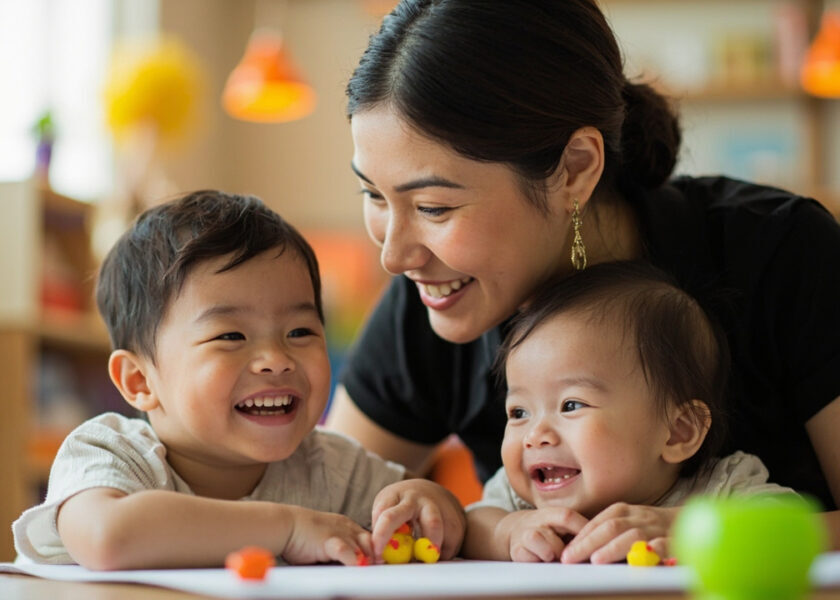
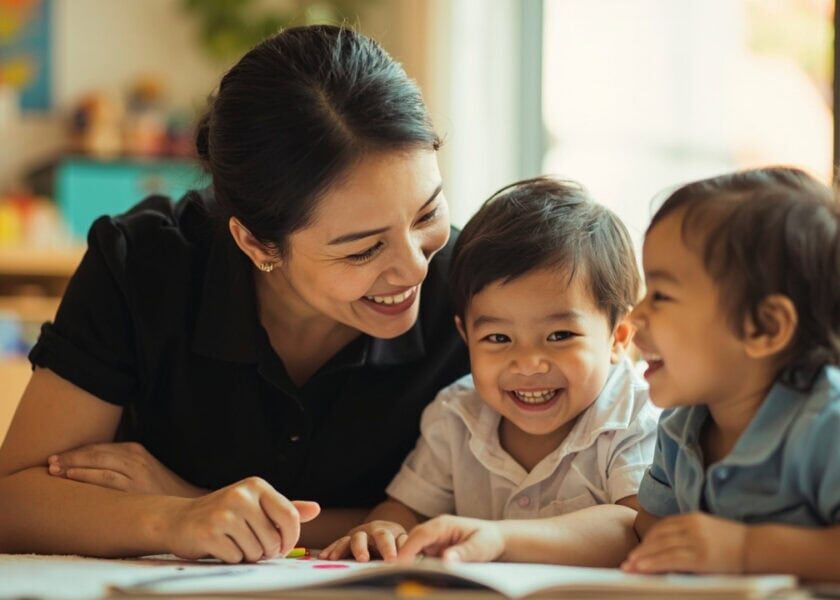
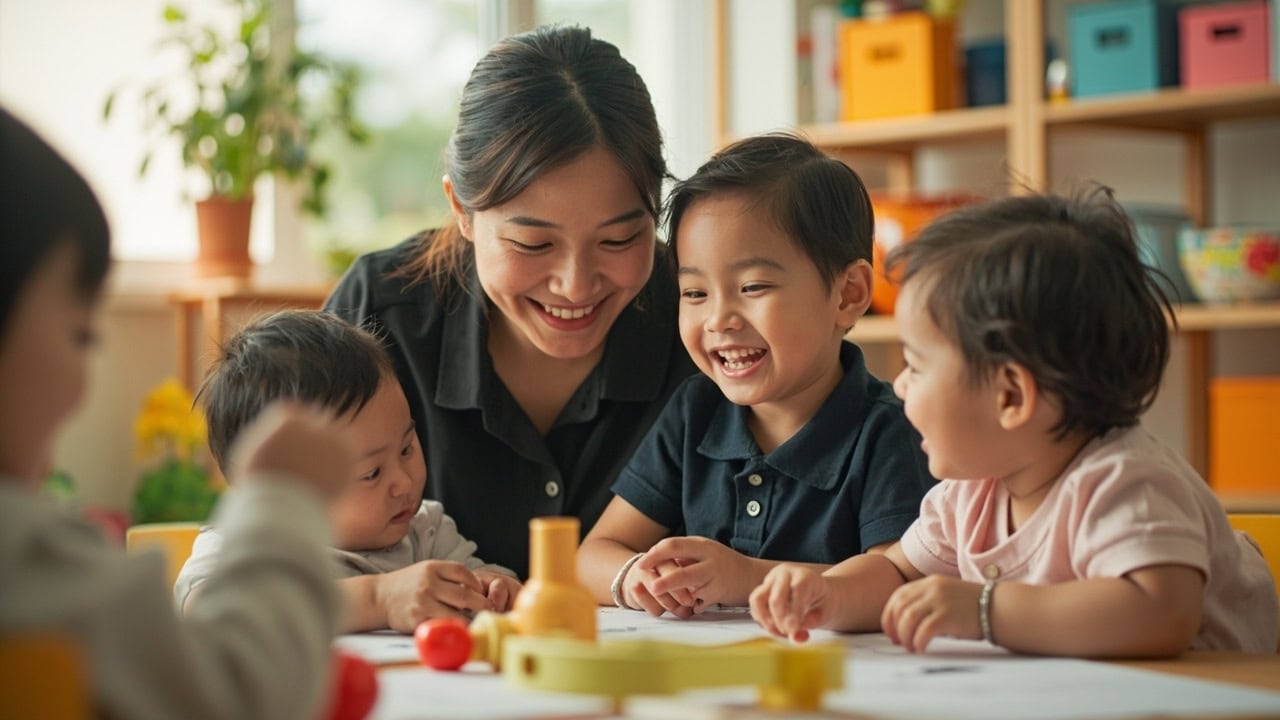
When a toddler is climbing, a responsive caregiver is nearby—not hovering, but close enough to offer a steadying hand at the right moment, to celebrate success, to offer encouragement when the climb feels hard.
This is developmental scaffolding: the caregiver provides just enough support to allow the child to succeed, and then gradually withdraws as the child’s own competence grows.
Every interaction is either building the architecture or missing an opportunity to build it. This is the difference between a childcare setting that happens to have a playground and one that understands playground use as a developmental tool. It is the difference between a caregiver who changes a diaper and one who uses diaper-changing as an opportunity for physical interaction—talking to the infant about the sensations they are feeling, moving their legs in gentle bicycle motions that stimulate the proprioceptive system, making eye contact and smiling that activates social-emotional neural pathways.
What to Look For
- Purposeful physical spaces: Climbing and crawling areas for infants, gross motor play areas for toddlers, fine motor activity tables for older children
- Daily movement opportunities: Not just occasional gym time, but children moving throughout the day
- Active caregiver engagement: Caregivers physically interacting with children—not just watching from a distance, but playing alongside them, guiding their physical exploration
- Variety in sensory experiences: Sand play, water play, textured materials, climbing, jumping, balancing
- Movement woven throughout the day: Children are not sitting for extended periods; physical activity is integrated naturally
How EduNanny Singapore Approaches Physical Development
EduNanny operates under the ECDA Childminding Pilot, combining the warmth and responsiveness of home-based care with the intentionality of professional developmental practice.
Whether through home-based care or community and centre-based pathways, EduNanny creates environments where infants and young children are not just supervised, but stimulated, supported, and systematically advanced in their physical and sensory development.
The Developmental Necessity of Small Ratios
The pilot structure allows for ratios of up to one to three for infants, ensuring that each child receives the responsive, individualized attention that developing brains require. This is not a logistical convenience. It is a developmental necessity.
An infant whose caregiver can respond within seconds to their movements, their vocalizations, their emerging attempts at communication, builds trust and security at the same time as they build motor coordination and sensory integration. The head that lifts, the hand that grasps, the gaze that tracks—it is all supported by an adult who is present, attentive, and understanding of what each movement means in the larger story of development.
Making Quality Development Accessible
The fee structures within the pilot are designed to make quality developmental care accessible, and the usability of CDA and Baby Bonus subsidies means that families across Singapore can access this level of care without bearing an unreasonable financial burden. Monday to Friday care blocks provide the consistency that developing brains need—the reliable rhythm of days that builds expectations, confidence, and a sense of security in the environment.
Transparency and Trust
For parents who want to stay connected to what is happening in those unseen hours, EduNanny has built communication and transparency into its model. Where CCTV measures are deployed, they serve not as surveillance but as a foundation for trust—closing the gap between what parents know and what they need to know, between anxiety and understanding.
The Thomas AI Chatbot available through EduNanny provides parents with a resource to answer developmental questions, navigate the often-confusing landscape of childcare choices, and access guidance on supporting their child’s growth at home.
What Parents Need to Know: Addressing Concerns and Making Your Choice
You deserve to ask hard questions and get honest answers. Developmental language is easy to use and hard to operationalize. What distinguishes quality care is the specificity of its approach: small ratios that enable responsive interaction, caregiver training that connects daily activities to developmental frameworks, and environments designed around what children actually need to grow.
Common Questions, Straight Answers
“Is this just marketing, or is it actually happening?”
Watch how caregivers interact with children during routine moments. Notice whether the environment invites movement or constrains it. Ask questions that probe why, not just what. The answers will tell you whether the caregivers understand development as a process, or whether they understand it as a checklist.
“How will I know my child is making progress?”
Children in the first five years do not produce report cards. But progress is observable if you know what to look for: new abilities emerging, increased confidence in physical tasks, growing sophistication in how children approach challenges. Ask how the programme will help you see and understand these developments.
“What if my child has sensory sensitivities or developmental concerns?”
Quality developmental care does not look the same for every child. Responsive caregivers adapt their approach to meet each child where they are, providing appropriate scaffolding and recognizing when a child’s responses indicate needs that may require additional support.
Questions to Ask During Your Visit
- Can I observe a typical morning? How much time do children spend in physical activity?
- How do caregivers support children who are at different stages of physical development?
- What does a typical day look like for an infant versus a toddler?
- How do you handle a child who needs extra sensory input or who struggles with motor coordination?
- How will you help me understand my child’s developmental progress?
What Every Parent Should Evaluate
- Movement opportunities: Is there dedicated space and time for gross motor play? Are fine motor activities available throughout the day?
- Caregiver engagement: Do caregivers interact with children during physical activities, not just supervise them?
- Responsiveness: Can caregivers articulate why specific physical activities are included? Do they understand sensory-motor development?
- Environment design: Does the space invite movement or require children to stay still?
- Communication: Will you receive insight into your child’s physical development, not just their daily routine?
A Place Where Your Child Is Being Formed
There is a phrase that sometimes gets used in discussions of early childhood development: “the body before the brain.” It is sometimes misunderstood as dismissive of intellectual development, when in fact it is the opposite.
It is saying that intellectual development begins in the body. It begins with the infant who cannot yet speak but is already learning that reaching produces results, that crying brings comfort, that the world is a place where actions matter.
It begins with the toddler who falls and gets up and falls again, learning the boundaries of their body, the sensation of gravity, the process of trying and trying again until mastery arrives.
Every physical act is a cognitive act. When your child reaches for a toy and finds it, they are building a sense of agency. When your child climbs a structure and stands at the top, looking out at the world from a new height, they are building confidence. When your child pours water from one cup to another, or stacks blocks into a tower that does not fall, or uses a crayon to make marks that look like something, they are building the neurological pathways that will one day allow them to write their name, to solve a math problem, to type an essay.
Every movement is a message from body to brain: I am here. I am capable. The world responds to me.
We live in a world that often treats childhood as a waiting room for the real thing—school, career, achievement. But for the child, there is no waiting room. There is only now, this body, this moment, these opportunities to grow or not grow.
The first five years are not a prologue. They are the story itself, unfolding in movements and sensations and the slow, miraculous construction of a human being who will carry everything they have built in these years for the rest of their lives.
EduNanny Singapore understands this. They are not just minding children. They are nurturing the architects of their own futures—building the bodies, the brains, the sensory-motor foundations that will support everything those children will ever learn, feel, and become.
If you have stood at that threshold, felt that anxiety, wondered what is happening in those hours you cannot see—know this: something important is happening. Something foundational. Something that matters more than worksheets or academic drills or the false metrics of a childhood rushed toward achievement.
Your child’s body is learning. Your child’s brain is building. Your child’s future is taking shape in ways that no test can measure and no report card can capture.
And in the right environment, with the right care, that process is not left to chance. It is tended, like a garden, with knowledge and patience and a deep respect for the slow, essential work of human growth.
Every reach, every grasp, every step is building something that will last a lifetime.
If you would like to learn more about EduNanny Singapore and their approach to infant care and childminding under the ECDA Childminding Pilot, you are welcome to reach out to discuss your family’s needs.