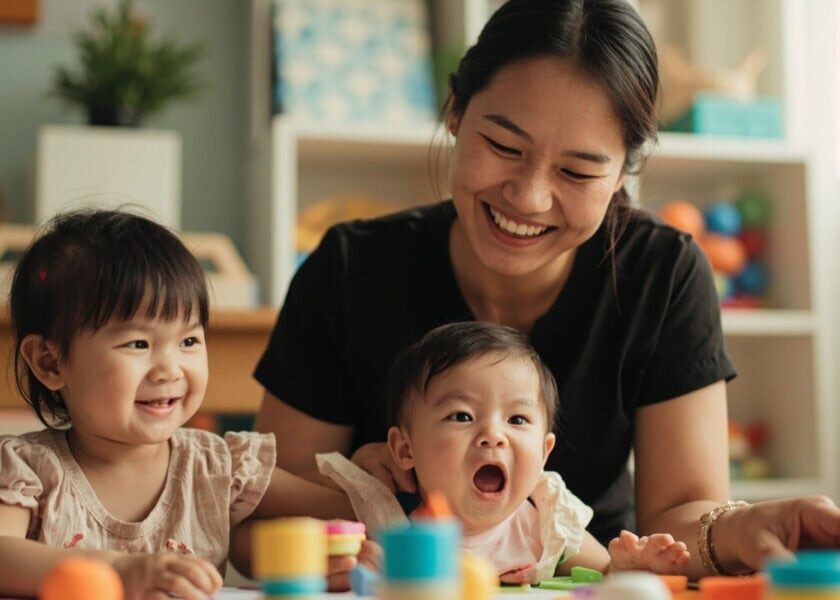
Unseen Hours: What Quality Childcare Looks Like in Singapore
Before the Children Arrive: The Environment Speaks First
The morning begins before the children arrive, and this is something most parents never consider. The environment has already been prepared—not in the way you might imagine. It is not about aesthetics or display. It is about reading the room from a child’s point of view. Literally.
In a quality setting, someone has thought about height. The mirrors are at infant eye level, not adult eye level. The shelves hold open-ended materials in clear sight, arranged so a two-year-old can reach what they want without asking. The textures on the floor change subtly between zones—not for decoration, but because a child learning to navigate space uses every sensory cue available to understand where they are and where they belong.
The lighting is warm and diffused. The noise level has been considered. Even the scent. A quality environment is a pedagogical statement. It says: we have thought about what it means to be small in this room.
The materials are chosen with intention. Open-ended materials—blocks, paint, sand, water, fabric, natural objects—offer infinite possibilities for play and learning. A child playing with wooden blocks is not just building a tower. They are learning physics, causality, persistence, problem-solving, spatial reasoning, and social negotiation if another child joins. They are expressing themselves artistically. They are practicing the fine motor skills that will later support writing. They are discovering what happens when you stack one block on top of another, and then another, and then it all falls down.
Closed-ended toys—the plastic gadgets with lights and sounds and one predetermined purpose—offer less. They may entertain, but they do not invite the same depth of engagement, the same creativity, the same problem-solving. Quality settings choose differently. They choose materials that invite the child to think, to try, to imagine, to fail, to try again.
Look at how the space is arranged. Is there a cozy corner with soft cushions and books, a place where a child can retreat for quiet? Is there a clear play zone, an art zone, a physical play zone? Is there access to nature—a patch of grass, a potted plant, sunlight streaming in? These are not luxuries. They are the basic ingredients of an environment that supports development in all domains: cognitive, physical, social, emotional, linguistic.
When a child enters, they enter into a world that has been designed with their developmental reality in mind. That is not a small thing. It is the first message of the day: you are seen. Your perspective matters. This space belongs to you too.
The Drop-Off Moment: Where Quality Is Tested in Seconds
Now watch what happens at the transition. The drop-off moment is where quality is either reinforced or undermined in a matter of seconds.
In a setting where attunement is practiced, you will see a caregiver come down to the child’s level—not metaphorically, but physically. They crouch. They make eye contact. They greet the child by name, and they greet the parent too, warmly but briefly, because the child’s transition is the priority.
There is no rush. The caregiver acknowledges the parent’s concern, receives the handoff of information about how the night went, how the child is feeling, what might be needed today. A good drop-off is a three-way handshake: parent, child, caregiver, each acknowledged.
Watch the child’s face as this happens. In a setting where this ritual is consistent, where the same faces appear each morning, where the goodbye is acknowledged rather than rushed, something shifts. The child begins to understand: this is a place. There are people here. I know what happens here.
The stress that spikes at any separation begins to lower—not because the child never feels the twinge of wanting their parent, but because the environment has promised safety and the people have proven reliable. That promise, kept thousands of times, becomes internalized. It becomes a foundation.
Why Ratio Matters More Than You Think
This is why the caregiver-to-child ratio matters. Under the ECDA Childminding Pilot, EduNanny operates with ratios that allow for genuine attunement. This is not a bureaucratic detail. It is the difference between a caregiver who knows your child’s particular rhythm of hunger and fatigue, who notices the early signs of a teething flare-up before the tears come, who can be fully present because they are not managing seven children at once.
It is the difference between a number on a certificate and the reality of your child’s daily experience.
The Rhythm of the Day: Why Predictability Is Neurological
In quality childcare, time is not managed like a factory. The schedule is not a rigid clock but a reliable pulse—a heartbeat that children learn to trust.
There is a predictable sequence to the day: arrival and free exploration, then a focused activity, then snack, then outdoor or gross motor time, then story or circle time, then lunch, then rest. The order is consistent even when the activities change. This is not accident. This is neuroscience.
Young children build security through prediction. When they know what comes next—when they internalize the rhythm of their day—they can relax into the present moment. They do not need to spend energy on anxiety about what will happen, what is expected, where they fit. They can simply be.
And it is in that being, in that relaxed presence, that actual learning occurs. Watch a child who has been in a quality setting for a few months. See how they move through the environment with ease, how they anticipate the next transition without distress, how they settle into activities with a kind of grounded contentment. That child is not just being cared for. That child is learning what it feels like to be in a predictable, safe world.
Why the Ordinary Moments Matter Most
But rhythm alone is not enough. The richness comes in what fills the time between the landmarks of the day.
Consider snack time. To a parent watching, it looks like children eating crackers and fruit, drinking water, maybe some chatter. But in a quality setting, snack time is a language classroom, a social laboratory, and a sensory education all at once.
Watch what the caregiver does. They sit with the children, not just supervise. They name what the children are eating. They comment on the color of the banana, the sound of the crunch, the way the orange feels cool and round.
They model language in context: “I’m peeling my orange now. Watch how I pull the skin off. It makes a little tearing sound.”
They ask open questions: “What does your apple taste like? Is it sweet or sour? Can you describe it to me?”
They narrate what the children are doing back to them, giving language to their experience: “Jia En is using both hands to hold her crackers. She is being so careful not to drop them.”
This is not performance. This is not scripted curriculum. This is the constant, responsive language environment that builds neural pathways in the developing brain. Research consistently shows that children who hear more varied, responsive language in their early years arrive at school with richer vocabularies, better processing speed, and stronger narrative skills. The language does not have to be special or formal. It has to be present, interactive, and attuned.
Attunement: The Thing That Separates Adequate from Exceptional
Attunement is the word worth spending a moment with, because it is the thing that separates adequate care from exceptional care, and it is almost impossible to capture in a brochure.
Attunement is the caregiver’s ability to read the child, to notice what is happening beneath the behavior, and to respond in a way that addresses the underlying need. It sounds simple. In practice, it is an extraordinary skill that requires training, self-awareness, and support.
A child who throws food is not being naughty. In a quality setting, the caregiver asks: why? Is this child testing gravity? Are they overstimulated and seeking sensory input? Are they frustrated that they cannot yet use a spoon and this is the only way they can express that? The response is different depending on the answer—a calm redirection, a demonstration, a moment of shared laughter at the flying banana—each chosen deliberately based on the reading of the child.
Attunement sounds like a caregiver who notices that one child has been lingering near the window for twenty minutes and quietly joins them. “You’re watching the rain. It does look like it’s coming down hard, doesn’t it? Shall we listen?”
It sounds like recognizing that another child needs movement, and instead of insisting on sitting for circle time, finding a way to include them while honoring their need to move.
It sounds like knowing that today, this particular child needs extra physical contact, extra words, extra presence, because of something that happened at home—something the parent mentioned during the handoff.
This is what is happening in those hours you cannot see. Not supervision. Not entertainment. Not babysitting. Attunement. Relationship. The slow, patient work of helping a small person feel known.
Emotional Safety: Where Feelings Are Welcomed
When a child feels safe—truly safe, not just physically supervised but emotionally held—they can explore. They can take the small risks that lead to growth. They can try the unfamiliar activity, approach the other child, attempt the challenging puzzle.
Safety is the prerequisite for everything else.
In quality childcare, safety is cultivated through consistency. The same caregivers, the same routines, the same expectations, the same warmth. When a child knows what to expect from their environment, they can allocate their energy to the business of being three, or two, or eighteen months old: learning, moving, feeling, discovering.
Emotional safety also means that a child’s feelings are not only tolerated but welcomed. In a quality setting, there is no expectation that children will be happy all the time. That is not realistic and it is not healthy.
Instead, there is space for crying, for frustration, for the big feelings that come with being small and learning big things. A caregiver might say: “I can see you are really angry that the block fell down. That is okay to feel angry. Let’s take a breath together.”
This is emotional coaching. This is teaching children that their feelings are valid, that they can be expressed appropriately, and that adults will stay with them through the storm.
This is profoundly developmental work. It is building the emotional regulation skills that children will carry into school, into relationships, into adulthood. It is happening in those invisible hours, in the small moments, in the patient, grounded responses of caregivers who have been trained to hold space.
What You See When They Come Home
Now let us consider you. The parent. The one standing at the gate, or sitting at your desk, or driving to work, wondering.
What should you see when your child comes home?
Not perfection. Never perfection. But you should see a child who is settled, not dysregulated. A child who has had enough food, enough attention, enough stimulation, enough rest. A child who is tired in the good way—the way that comes from learning and growing and being engaged.
You should see a child who mentions the caregiver by name, who talks about something they did during the day, who maybe shows you something—a painting, a song, a game they learned.
You should feel, over time, that your child is developing in all domains: physically stronger, more verbal, more socially aware, more confident in their own agency.
You should feel, importantly, that you are a partner. That the communication flows both ways. That you know what happened in your child’s day, not in exhaustive detail, but in the important contours. That you are receiving updates, photographs, narratives. That questions are welcomed, not deflected.
When these windows are open, your invisible moment shrinks. You begin to know, not just trust.
How to Recognize Quality: Questions to Ask, Signs to Look For
We want to give you the language of recognition—the signs you can look for, the questions you can ask, that will help you see quality when it is present and name it when you find it.
- Watch the caregivers. Are they down at children’s level? Are they speaking with children, not just at them? Do you see warmth in their faces when they interact? Are they rushed and harried, or present and engaged?
- Ask about turnover. In quality settings, caregivers stay. This is not accidental. It is because quality settings treat their staff well, invest in their training, and create conditions where relationship-based care can flourish. High turnover means children cannot form the secure attachments that undergird everything we have described.
- Ask about transitions. How does the centre handle drop-off and pick-up? Is there a consistent routine? Are you greeted by name? Is there space for you to share information about your child’s night, their mood, their needs?
- Ask about the environment. Why are the materials arranged this way? What is the philosophy behind the schedule? How is the space set up to support different kinds of play? You want answers that reflect intentionality, not just default.
- Ask about language. How do caregivers interact with children during routine moments? What kinds of books and songs are used? How is communication with parents handled? You are listening for responsiveness, for richness, for the understanding that language development happens all day, not just during designated lessons.
And finally, ask yourself: when you leave your child here, what do you feel? Not what you think you should feel. What you actually feel.
If the centre is of quality, you will feel something shift—a loosening of the invisible knot in your chest, a quiet confidence that your child is in a place that deserves the trust you are extending. That feeling is data too. Trust it.
What EduNanny Brings to This Picture
EduNanny by BUTLER operates within the ECDA Childminding Pilot, offering pathways designed with these quality principles at their foundation. But we want to be honest about what that means in practical terms for Singapore families.
It means caregivers who have been trained not just in supervision but in attunement—professionals who understand that the drop-off moment sets the tone for the entire day, that snack time is a language opportunity, that a child’s behavior is communication to be decoded rather than managed.
It means ratios that allow for genuine relationship. It means environments designed with developmental intentionality. It means communication that keeps parents connected—not just reports of accidents and meals, but actual windows into the experience: what your child was interested in, how they interacted with others, what made them laugh, what challenged them.
And it means accessibility. Monday to Friday care, fee structures within the pilot framework, CDA and Baby Bonus usability that makes financial sense for Singapore families. The early years belong to every child, and quality should not be reserved for those who can afford premium packages.
We are offering you a partner in this. A team that will communicate with you, include you, keep the windows open. A team that believes you deserve to know what your child lives during those hours. A team confident enough to show you their standards, not just describe them.
The Invisible Made Visible
There is a moment every parent in Singapore knows. It happens at the gate, in the car park, on the walkway outside the childcare centre. It is the moment you release your child’s hand, or unbuckle them from the stroller, and watch them disappear through a door you cannot follow.
You tell yourself you trust your choice. You know you researched, visited, compared. You chose this place. And yet.
What actually happens in there? During the hours you cannot see, when your child’s brain is building itself at a speed that will never come again, when the foundations of how they understand safety and connection and curiosity are being quietly, invisibly laid down—what does it look like, sound like, feel like?
You are not alone in this wondering. It is one of the quietest forms of parental anxiety, and it persists long after enrollment, long after the initial decision has been made. You chose. You committed. And still, there is that invisible space between you and your child’s day, a space you must simply trust is being filled with something worthy of the trust you are extending.
Today, we have tried to open that door with you—not to resolve your wondering entirely, because some mystery is inherent in parenting, and that is right and good. But to give you language. To give you windows. To give you the understanding that what happens in a quality childcare day is not a mystery to be feared but a world to be recognized.
Consider the child in quality childcare, any child, every child. This small person who has been entrusted to a place that has prepared for them, that sees them, that holds them in a consistent, warm, attuned relationship while you are apart.
This child is building a brain. They are building it in the specific way that human brains build: through relationships, through repetition, through the thousands of small interactions that accumulate into patterns, into expectations, into the architecture of who they will become.
The hours matter. They have always mattered. But they have often been invisible, because they happen when parents are not watching, because they are made of small moments rather than dramatic ones, because the work of early childhood is quiet work, patient work, work that does not announce itself.
When you return to pick up your child tonight, look at them. Really look. See if you can find there the evidence of a day well spent, a place that held them well, a rhythm that grounded them and a caregiver who knew their name. See if you can find there the small, quiet proof that in the hours you could not see, something good was happening.
And if you can—if that evidence is there, visible now in the settled child, the happy chatter, the satisfied tiredness—then you will know that the invisible has been made visible after all. Not through cameras or reports alone, though those matter. But through your child themselves, speaking in their own language of wellbeing, telling you everything you needed to know.
That is what quality childcare offers. That is what EduNanny is here to provide. And that is what every child in Singapore deserves: not just care in the hours their parents cannot be there, but the assurance that those hours are well-lived, richly experienced, and full of the small, steady building of a life.
If you are ready to learn more about what EduNanny can offer your family, we invite you to reach out. We are happy to answer your questions, walk you through our approach, and help you feel confident about the choice you are making for your child.
The door is open. Come and see.