The Partnership Model: How Singapore Parents and Caregivers Raise Children Together
The Frame That Changes Everything
Some of the most confident, connected parents you will meet did not get the childcare decision perfect. They understood something deeper: that choosing was not the end of their work—it was the beginning of a daily, ongoing practice of partnership.
A practice made up of intentional handoffs, honest conversations, and small moments at home that may not feel significant in the moment, but absolutely are.
So let us explore what that partnership looks like. Not in theory. In the real, specific, sometimes messy texture of a Singapore parent’s day.
The Morning Handoff: Your Child’s First Lesson
Every morning, you walk through a door. You carry your child, hold their hand, or push the stroller along a familiar route you have traced a hundred times. The handoff moment is so routine it can feel like nothing.
But it is not nothing. It is a transition your child is watching, absorbing, learning from. And it is an opportunity most parents miss—not because they do not care, but because no one has told them what that moment is actually doing.
When you arrive at EduNanny, that moment of transition is more than getting your child from point A to point B. It is a message. It tells your child: this place is safe. This person is trusted. This is where I am leaving you, and I am leaving you with confidence.
Your tone, your composure, the way you speak to the caregiver in front of your child—these are not small things. They are the earliest lessons your child learns about what it means to be in relationship with the world beyond your home.
This moment is also a quiet message to the caregiver about who you are as a partner. When you walk in present, unhurried, and treat the caregiver as a colleague in your child’s life rather than a stranger holding your child, you build something. Over days and weeks and months, that consistency becomes trust.
What Intentional Handoff Looks Like
- Making eye contact with your child before you greet the caregiver
- Speaking to the caregiver by name in front of your child
- Walking out with the same calm confidence with which you walked in
- Taking a moment to share something brief about your child’s morning or night
You are not abandoning your child to someone else’s care. You are introducing them to a partnership you are still part of.
The Evening Homecoming: What Your Child Is Really Telling You
Then there is the evening. The pick-up. The walk home, the drive home, the homecoming that follows. Here is where I want to be particularly honest with you, because this is where many parents feel most uncertain.
What do you ask your child? What do they tell you? How do you know if something happened, if something was wrong, if something was wonderful but they cannot yet find the words to say it?
Children come home from childcare with more information than they know how to share. Their days are full—full of activities, interactions, small victories, small frustrations, new songs, new friends, moments of delight they cannot describe, and moments of confusion they cannot name.
And your child, especially if they are very young, is not going to give you a debrief. They are going to come home tired, or wired, or hungry, or clingy. They are going to meltdown over something small, or go quiet in a way that worries you.
Understanding What Behavior Is Telling You
That behavior is communication. It is not a report card. It is not a sign that something went wrong or that something went right. It is your child processing a day that was full.
- The meltdown at home might be the residual overwhelm of a stimulating morning that they held together all day
- The quietness might be the satisfying tiredness of a child who was deeply engaged and has nothing left to give until they are rested and fed
- The clinginess might be the exact, appropriate need to reconnect with you after hours apart
Questions That Open Doors
The parents who thrive in this partnership are not the ones who extract detailed accounts from their toddlers. They are the ones who learn to read what is underneath the behavior.
So what do you ask? Not “what did you do today?” Not even “did you have fun?” Ask things that open a door rather than demand a report:
- “What song did you sing today?”
- “Who did you sit with at snack time?”
- “What did Miss so-and-so say this morning?”
- “Did you play with blocks or read books?”
These questions meet your child where they are, inviting them to share what they want to share without putting the burden of narration on a child who is not yet capable of it.
And when your child does not answer, or answers in their own elliptical, beautiful, incomprehensible way—that is okay too. You do not need to know everything. You need to know that you are building a habit of interest, of attention, of curiosity. That habit will serve you both for years.
The Caregiver Partnership: A Two-Way Street
Now let me speak to something that does not get talked about enough: the relationship between you and your child’s caregiver. Because this is where the partnership becomes real, and where many parents hesitate.
The caregiver is not a stranger. She is not an employee in the transactional sense. She is a person who spends more waking hours with your child than you do. She knows your child’s moods, rhythms, and specific way of asking for help or seeking comfort. She has seen your child in a context you cannot see. She has knowledge that is valuable to you.
And yet many parents feel uncertain about how to engage with caregivers beyond the pleasantries of drop-off and pick-up. They worry about overstepping, about being a nuisance, about imposing. They wait for the caregiver to reach out, or they assume that if something were wrong, they would be told.
What You Bring to the Partnership
Here is what I want you to understand: the best partnerships are two-way streets. And you are the one who has the most context about your child that the caregiver does not have.
- Your child slept poorly last night and might be irritable today
- Your family is going through a transition—a move, a new sibling, a loss
- Your child has a food preference or a sensory sensitivity you have not yet mentioned because it seemed small
These are not impositions. These are gifts. They are the information that allows your child’s caregiver to meet your child where they are.
What the Caregiver Can Offer You
Share them. Not in a long email, not in a formal report. In the small, daily exchanges that add up: a quick note in the communication book, a sentence mentioned at pick-up, a question asked with genuine curiosity.
The caregiver who is truly invested in this partnership will notice things worth sharing—not just milestones, but patterns.
- “She seems to gravitate toward the block corner when she’s overwhelmed.”
- “He lights up when we sing that particular song.”
- “She asked about you this afternoon.”
These observations are not just pleasantries. They are data. They are your child’s life, being shared with you.
This is what it means to build a two-way relationship with your child’s caregivers. It is not about oversight or surveillance or demanding transparency. It is about recognizing that your child’s development is not happening in isolation at childcare or in isolation at home. It is happening in the space between the two. And you are the bridge.
The Home Extension: Small Practices That Matter
Which brings me to what I think is the most underestimated part of this whole partnership: what happens at home. Not the big, intentional learning activities. Not the educational apps or the workbooks or the scheduled playdates. The small, ordinary, daily practices that make your home an extension of what EduNanny is building during the day.
Your child is not developing in one context and then pausing in another. They are one child, learning how to be a person, and the lessons they learn at EduNanny do not switch off when they walk through your front door. They are carrying it with them.
The question is whether your home environment invites that learning to continue, or whether it sits untouched until the next morning.
Simple Ways to Extend the Partnership
- When your child spontaneously sings a song from childcare, sing along. Ask them to teach it to you. Make space for what they want to share, even when you are tired, even when you are making dinner, even when you have a hundred other things on your mind.
- When your child tells you something about their day—their friend, their teacher, an activity, a rule they learned—receive it with the same attention you would give to any adult sharing something important to them. Do not redirect immediately. Listen, respond, build on it.
- Maintain rhythms at home that mirror, in some small way, the rhythms that give your child security at childcare. Consistent meals. Consistent bedtime routines. Predictable transitions. This is not about rigidity. It is about giving your child’s nervous system the gift of regularity, so that no matter where they are—at EduNanny or at home—they have a framework that makes the world feel organized and safe.
What you are doing when you do these things is not supplementing childcare. You are demonstrating to your child that their learning matters to you, that the world of childcare and the world of home are connected, that you are not separate from what happens during the day but woven into it.
That is what we mean when we talk about the home extension. It is not about replicating EduNanny at home. It is about recognizing that you are part of a single ecosystem, and that your presence in it—consistent, curious, engaged—is what makes the ecosystem whole.
How the Partnership Evolves Over Time
I want to close by speaking to you about time. Because this partnership does not end. It is not a phase you pass through until your child is old enough to not need childcare. It is a relationship that will evolve, deepen, and change as your child grows and as your family grows.
The Stages of Partnership
Early months ask you to build trust—in the caregiver, in the routine, in the arrangement itself.
The following months ask you to deepen communication—sharing what you observe, learning what they observe, building a fuller picture of your child together.
Later months ask you to ensure continuity—preparing your child for transitions, carrying values and habits forward into whatever comes next.
What EduNanny Was Designed to Honor
There is something else I want to name here, because if I do not, we are not having an honest conversation. And that is the fear that lives underneath so much of what parents feel after they have enrolled their child in childcare.
The fear that they are not doing enough. That someone else is raising their child. That the time spent apart is time lost.
That fear is normal. It is human. It is the fear of every parent who has ever made the choice to share their child’s care with someone else. And it is not the truth.
You are not being replaced. You are not a backup. You are not a weekend parent or a nighttime parent or a parent who only matters when childcare is closed. You are the constant. You are the anchor. You are the person your child will come home to, the person whose voice they will carry inside them, the person whose values and presence and love will shape them in ways no childcare can.
No caregiver, no matter how excellent, no matter how beloved, no matter how dedicated, takes your place. They are alongside you. They are partners.
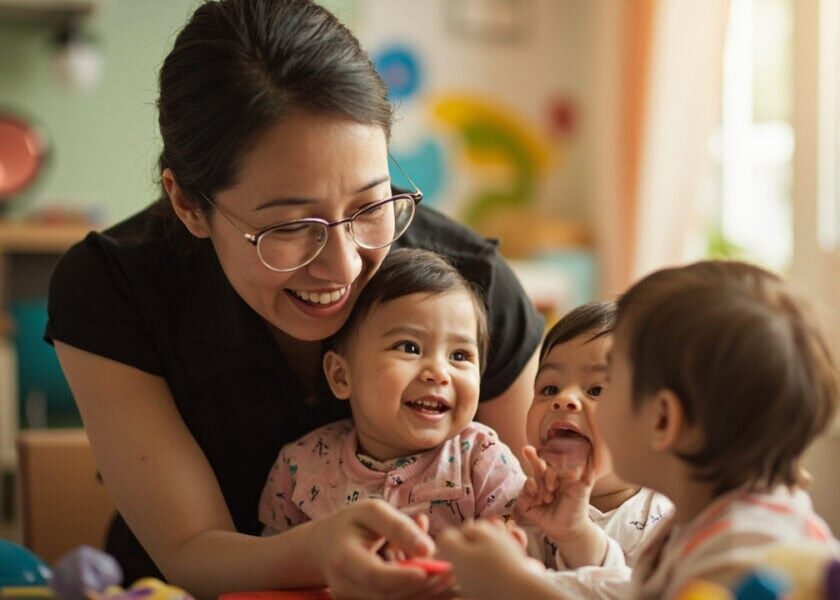
Under the ECDA Childminding Pilot, whether your child is in a home-based arrangement or a community or centre-based pathway, there is an intentional ratio—up to one to three infants—which means your child is not lost in a crowd. They are known. They are seen. The caregiver is not managing a herd; she is in relationship with a small, precious group of children, and your child is one of them.
EduNanny sustains this partnership over time not through grand gestures, but through consistency. Monday to Friday, you bring your child to people who know them. You receive updates and transparent communication. In homes where deployed, there is the reassurance of CCTV measures and open doors. You are part of a system that is accountable to you, not because it has to be, but because this is what partnership means.
There are practical dimensions too. Within the pilot fee structures, EduNanny is designed to be affordable. Your Child Development Account and Baby Bonus can be used, making this not just an educational choice but a financially accessible one. This matters. We know the pressures that Singapore parents face. EduNanny was built to be part of the answer to those pressures, not an added burden.
You Are Exactly Where You Are Supposed to Be
So here is what I want you to take with you today.
You made a choice. That choice was right. Not because the childcare you chose is perfect—no childcare is—but because you made it with love and care and the best intentions you had at the time.
And now, the choice is not over. It is not finished. It is the door you walked through, and on the other side is a relationship that will ask you to show up, day after day, in small ways and ordinary ways and ways that may not feel significant but absolutely are.
You do not have to be perfect. You do not have to have all the answers. You do not have to recreate what EduNanny does at home or match what the caregiver knows or earn a grade as a parent.
You have to be present. You have to be consistent. You have to be curious. And you have to trust that what you are doing matters, even on the days when you cannot see it.
EduNanny is alongside you. Not as a service provider waiting for your next payment. Not as an institution holding your child until you return. As a partner. In every handoff, every evening conversation, every small moment at home that reinforces what we build together.
We are not raising your child for you. We are raising your child with you.
That is what this partnership is. And that is what it has always been.
Welcome. You are exactly where you are supposed to be.
If you are a parent in Singapore exploring infant care options and would like to understand how EduNanny’s Childminding Pilot supports families through this partnership, we invite you to connect with us and learn more about our approach to walking alongside parents from that first drop-off to the years that follow.
Learn more about EduNanny Singapore