The First Five Years: Why Early Childhood Care Matters Most
The Question Singapore Parents Carry Quietly
There is a question that most Singapore parents do not ask out loud—not because they are afraid of the answer, but because they have never quite found the right words for it.
It does not arrive at the moment of choosing a childcare centre. It arrives later. Quietly. Persistently. In the small hours, or in the drive to work, or in the moment just after drop-off when you trust yourself to leave.
The question is not whether your child is safe. That, at least, you can verify—through tours, through observations, through the reassuring rhythms of a familiar routine.
The question is deeper:
Are they growing? Are they learning? Are they becoming who they are meant to be, during all those hours when I am not there?
If you have ever asked yourself this—and research tells us that most working parents in Singapore do—then you are not experiencing doubt. You are experiencing love.
Today, we want to speak directly to it. Not to offer easy reassurance. But to show you what your child is actually building in those hours, and why the environment you choose matters more than most of us ever imagined when we were standing at the beginning of this decision.
Why the Early Years Are Not a Waiting Room
The first thing to understand is that the question you carry is not a sign of doubt. It is a sign of love. It means that you understand, on some level, that the early years are not simply a prelude before the real education begins.
They are, in fact, the most consequential years your child will ever have.
Not because of what they memorize or how early they can read. But because of what is being constructed in the architecture of their mind—the foundations upon which every relationship, every learning experience, and every challenge of their life will rest.
This is not a new idea. But it is one we are only beginning to truly understand. The first thousand days of life—and the years that follow through to age five—are not a passive period. They are a period of extraordinary, active construction.
Every interaction. Every conversation overheard. Every moment of being comforted or frustrated or delighted. All of it is building something real.
A child’s brain at this age is not merely developing. It is being programmed, refined, and shaped by the quality of the experiences it encounters. And the people who provide those experiences—day after day, week after week—matter in ways that are not sentimental. They are measurable.
What Quality Early Care Actually Produces
For parents short on time, here is what decades of developmental research tells us about what happens in a quality early childhood environment:
- Secure attachment – Children who experience consistent, responsive care develop a deep internal confidence that becomes the foundation for independence, curiosity, and healthy relationships.
- Language-rich environments – The vocabulary your child builds by age three is one of the strongest predictors of reading ability at ten—which shapes their entire academic trajectory through primary school and beyond.
- Emotional regulation skills – Peer settings offer guided exposure to social and emotional challenges that parents alone often cannot replicate, teaching children to manage frustration, recover from setbacks, and persist.
- Executive function development – Daily rhythms, purposeful transitions, and cognitively stimulating environments build the planning, focus, and impulse control skills that determine how well children manage school, relationships, and eventually adult life.
These are not soft outcomes. They are measurable, compounding advantages that research consistently shows children who receive quality early care carry with them—into primary school, into adolescence, and into adulthood.
Secure Attachment as Launchpad
Consider first the question of attachment. When a child experiences consistent, responsive, warm care in their earliest years, they develop what psychologists call a secure base—a deep internal confidence that the world is navigable, that their needs matter, and that they can venture out and still come back to safety.
This is not dependency. This is the very thing that makes independence possible.
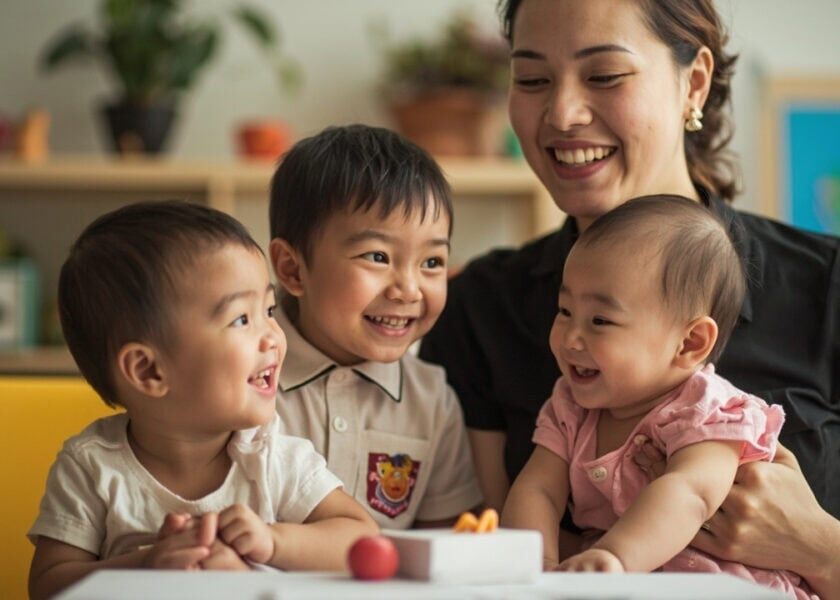
In a high-quality childcare environment with a low infant-to-caregiver ratio—something as specific as one to three—your child receives something that is genuinely difficult to replicate at home alone. They receive the experience of being seen and responded to not by one adult, but by adults who are trained, present, and intentional. They learn that the world contains people beyond their parents who can meet their needs.
This is not a diminishment of your role as a parent. It is an expansion of your child’s world.
The Language Environment That Shapes Academic Trajectory
A child’s vocabulary at age three is one of the strongest predictors of reading ability at age ten—which is one of the strongest predictors of academic trajectory through primary school and beyond. This finding has been replicated across cultures and contexts. It tells us something important: the language environment your child experiences in their earliest years is not background noise. It is the scaffolding for everything that follows.
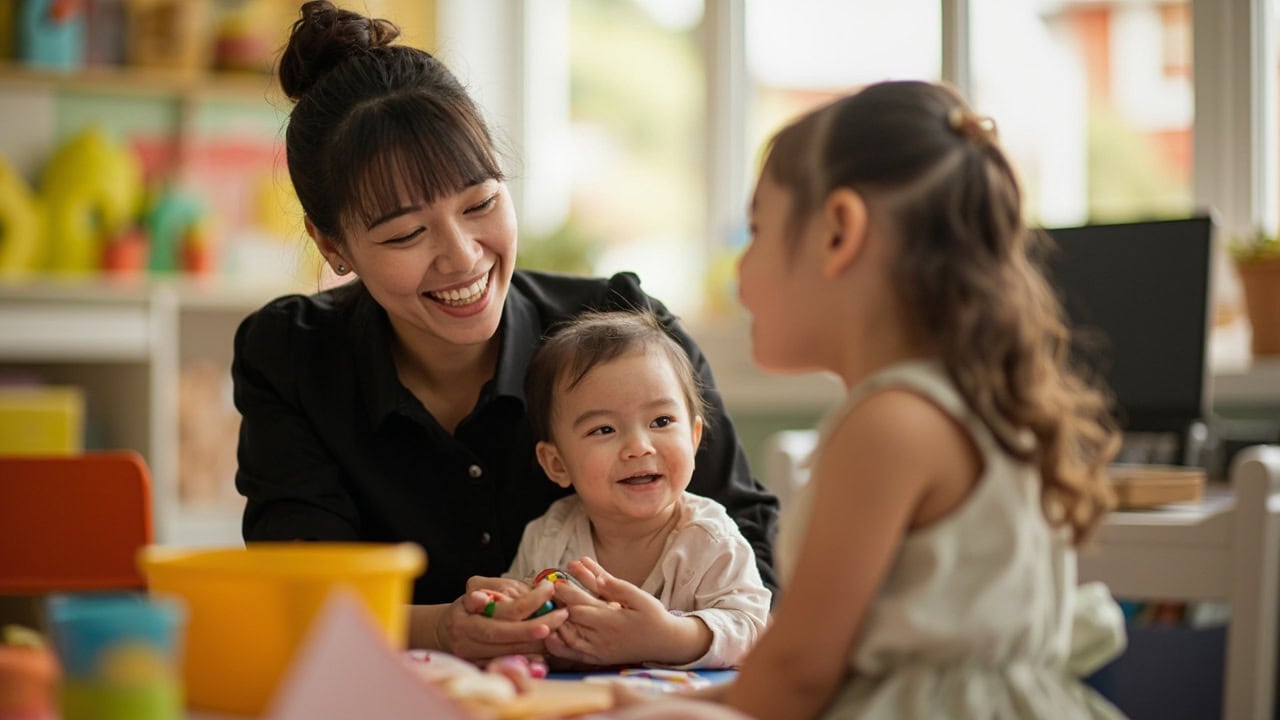
A language-rich environment is not a screen playing educational videos. It is an adult who narrates what the child is doing, who responds to their babbling with words, who reads expressions and reflects them back, who engages in conversation at eye level—not at the child, but with the child.
In adequate childcare settings, children are often supervised well. But language exchange—the rich, responsive, back-and-forth that builds neural pathways—requires something more. It requires caregivers who are trained to understand that every interaction is an opportunity. Who know how to extend a child’s communication rather than simply correct it. Who have the time to do so because they are not managing twice or three times the number of children they should be.
An infant-to-caregiver ratio of one to three is not an administrative detail. It is the difference between your child receiving twelve meaningful responses in an hour and receiving three. Over months and years, that difference becomes a difference in brain architecture.
Emotional Regulation: What Peer Settings Offer
Emotional regulation is the ability to recognize what you are feeling, to tolerate discomfort without being overwhelmed by it, and to recover from strong emotions. It is not a skill that children are born with. It is a skill that develops, and its development depends almost entirely on the quality of the early environment.
When a child is at home with a single caregiver, their emotional world is relatively manageable. The caregiver knows them, can anticipate their needs, can structure the environment to minimize frustration. This is valuable. But it is also a sheltered environment for emotional learning.
In quality childcare, children encounter something more complex: other children, the experience of sharing and waiting, frustration and competition for attention, the disappointment of not being first.
In a well-designed programme, they encounter trained educators who know how to name emotions, who model calm responses to upset, who hold boundaries with warmth, and who guide children through moments of conflict rather than removing them from difficulty.
Children who learn to regulate their emotions in these contexts develop the capacity to sit with discomfort, to problem-solve rather than escalate, to recover from setbacks. By the time they reach primary school, these children are not necessarily smarter. But they are more available for learning, because learning requires the ability to focus, to persist, and to manage the frustration of not knowing something yet.
Executive Function: The Architecture of Self-Control
Executive function—the set of mental skills that allows us to plan, focus attention, manage impulses, and adapt to changing demands—is already developing in toddlers. Working memory. Cognitive flexibility. Inhibitory control. These skills are deeply shaped by the environment a child experiences in their earliest years.
Executive function is built through daily rhythms: the experience of transition with adequate warning and support, the experience of purposeful engagement where an activity has a beginning and a satisfying completion, the experience of being in an environment where curiosity is encouraged and learning is a natural response to an interesting world.
This is what separates adequate supervision from developmental-quality care. A supervised environment keeps children safe, fed, and occupied. A developmentally intentional environment is structured around the understanding that every routine, every transition, every interaction is a building block for the executive functions that will determine how well your child manages school, relationships, and eventually the demands of adult life.
How Singapore Parents Can Recognize Quality
So how do you know if your child is thriving? This is a question every parent in quality care eventually asks, and it is worth answering directly.
Signs of Thriving
Thriving looks like engagement. Your child being interested in what is happening around them, initiating activities, exploring without constant anxiety.
Thriving looks like language. Your child talking about their day, using new words, stringing sentences together with growing complexity.
Thriving looks like emotional range. Not a child who never cries, but a child who can be comforted, who is learning that strong feelings pass and that the world still makes sense afterward.
Thriving looks like social interest. Your child noticing other children, beginning to play alongside them, learning the rhythms of give and take.
What to Look For on a Visit
You cannot see everything in a drop-off observation. But you can look for signs:
- Are children engaged and interested, or merely occupied?
- Do caregivers respond to children warmly and immediately?
- Is the language environment rich—conversation, narration, singing?
- Are children challenged appropriately, or are difficulties immediately removed?
- Do educators seem calm, present, and genuinely interested in the children in their care?
The right programme will feel alive, warm, and purposeful. Trust that feeling.
The Reframe That Changes Everything
Choosing quality childcare is not a compromise.
This is the reframe that Singapore parents need most, and it is the one that is hardest to hold onto in a culture that still sometimes suggests that children are best raised by family alone, that outsourcing care means outsourcing love, that working parents are somehow giving their children less than they deserve.
The truth is the opposite.
When you choose an intentional, high-quality environment for your child—when you choose educators who are trained, ratios that allow for genuine attention, a curriculum that understands child development, and a culture that treats your child’s early years as the foundational period they truly are—you are not choosing less. You are choosing more.
You are choosing to give your child access to experiences, relationships, and learning opportunities that they could not receive in any single home environment, however loving. You are choosing to invest in the compounding advantage that quality early care provides.
The academic pressures ahead are real. The expectations placed on children as they move through primary school, through secondary school, through the milestones of a Singapore education are significant. And the question that lurks beneath all the talk of enrichment and tuition is not just whether your child can pass a test, but whether they will arrive at those demands with the foundational capacities to meet them.
Quality childcare does not guarantee academic success. Nothing can do that, and any programme that promises otherwise is not being honest. But what it does—consistently, across decades of research—is produce children who arrive at school ready to learn, who can manage the social and emotional demands of a classroom, who have the self-regulation to persist, to try again, to not be defeated by difficulty.
The decision you make now—about where your child spends their earliest years, about who shapes those years, about the quality of the environment you choose—is not a logistical decision. It is a developmental decision. And it compounds.
What EduNanny Offers
EduNanny is part of the ECDA Childminding Pilot, which means our approach is not experimental or informal. It is structured, supported, and grounded in a vision for what early childhood care can be in Singapore—a vision that recognizes that families need real options, that children need quality, and that the early years are too important to be treated as a logistical problem to be solved.
Pathways Designed for Real Families
We offer both home-based and centre-based pathways, because we understand that different families have different needs.
In our infant programmes, we maintain ratios that allow for genuine responsiveness—one educator for every three infants—because we know what that ratio produces in language exchange, in emotional attunement, and in the building of secure attachment.
Our care is available Monday through Friday, in structured blocks that give parents reliability and children the rhythm they need for healthy development.
Accessible Quality
We also understand the financial realities of raising a child in Singapore. That is why our pilot fee structures are designed to be accessible, and why we support the use of the Child Development Account and Baby Bonus schemes.
Quality should not be a privilege available only to families with significant resources. Every child deserves an environment where they can thrive.
Trust Through Transparency
We understand that trust is not automatic. When you leave your child in someone else’s care, you need more than good intentions. You need transparency, communication, and consistency.
Where deployed, our centres maintain CCTV access and open communication channels, because we believe that parents who are reassured are parents who can focus on their own work with genuine peace of mind. This is not about surveillance. It is about partnership. When you know what is happening, you can trust what is happening—and trust is the foundation of everything.
Our Conviction
Beyond structure and systems, what EduNanny represents is a conviction: that every child in our care is being built—day by day, interaction by interaction—into the person they are becoming. That the work of childcare is not merely custodial. It is developmental.
Our educators are trained not just to care for children but to understand them. To observe, to respond, to facilitate. To know when a child needs comfort and when they need challenge. To create the language-rich, emotionally safe, cognitively stimulating environment that produces the outcomes we have been talking about.
This is not a generic promise. It is a specific commitment to developmental quality, every single day.
Questions to Ask as You Choose
If you are researching infant care or childminding options in Singapore, here are the key factors to consider:
- What is the infant-to-caregiver ratio? Look for ratios of 1:3 or better for infants. This directly affects how many meaningful responses your child receives each day.
- How do caregivers interact with children? Observe whether adults narrate activities, respond to babbling, engage at eye level, and extend language rather than simply directing.
- What does a typical day look like? Quality programmes have purposeful routines that build executive function through transitions, group times, and structured play.
- How is emotional coaching handled? Trained educators should name emotions, model calm responses, and guide children through conflict rather than removing them from difficulty.
- How does the programme communicate with parents? Look for daily updates, transparent dialogue, and genuine partnership in observing your child’s development.
- What training do educators have? Beyond basic certifications, ask about ongoing development in child development, attachment, and responsive caregiving.
Are They Growing? Are They Learning?
Let us return to that quiet question—the one that does not get asked out loud, but that most Singapore parents carry with them every time they leave their child at the door of a childcare centre.
Are they growing? Are they learning? Are they becoming who they are meant to be?
The answer is yes—if, and only if, the environment they are in is intentional about making that happen.
If the ratios allow for genuine attunement.
If the language is rich and responsive.
If the emotional challenges are guided rather than avoided.
If the daily rhythms are purposeful.
If the caregivers understand what they are building.
You cannot see it all in a drop-off observation. You cannot verify it with a checklist or a tour. What you can do is choose a programme whose values you trust, whose outcomes you can observe over time in your child’s development, and whose educators treat the work of caring for your child as the profound responsibility it is.
The first five years are not a prelude to your child’s life. They are your child’s life—and they are building something that will last.
The question is not whether quality matters. It does.
The question is only whether you will choose it, and whether you will trust that the choice you are making is not a compromise but an investment—in your child’s capacity to thrive, in their readiness for what lies ahead, and in the person they are becoming.
At EduNanny, we believe that every child deserves that investment. And we believe that when parents and caregivers are aligned in their commitment, the compounding effect is not just measurable. It is extraordinary.
Your child is building something remarkable, one day at a time.
We are honoured to be part of what they are becoming.
Ready to explore what quality early childhood care looks like at EduNanny? Connect with our team or learn more about our approach.