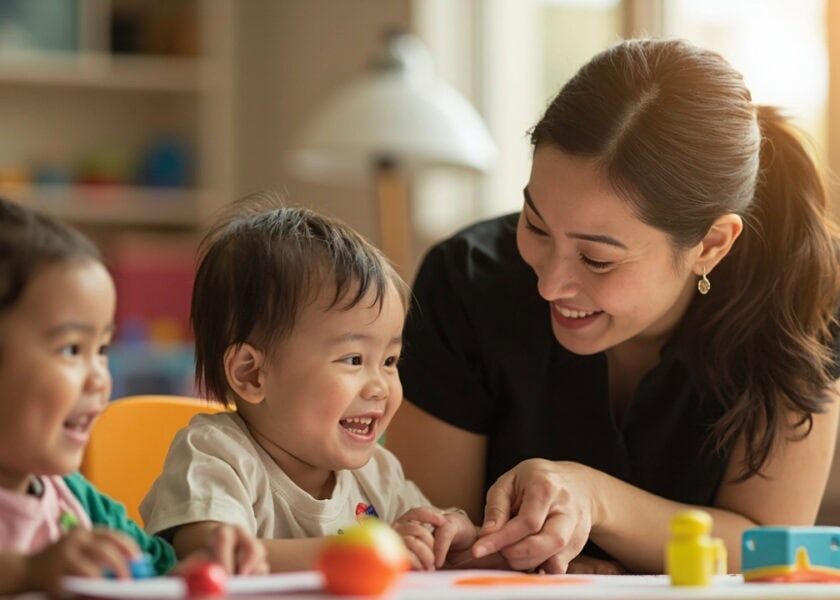
Why Your Child Is the Best Evidence of Quality Childcare
Signs of Real Development: What Quality Childcare Looks Like
Development does not always announce itself with fanfare. It arrives in small moments. A word your child did not say last month. A way of playing that has become more complex. A reaction to frustration that is different from how your child reacted six months ago. These are the signs that matter, and they are often invisible unless you know how to look for them.
The anxiety you carry is not irrational. It is a sign of your seriousness as a parent. You are not looking for reassurance in the form of a daily report or a photograph of a happy face. You are looking for evidence that your child’s mind is expanding, that your child’s capacity is growing, that the people caring for your child during the hours you are apart are doing something meaningful with those hours.
That is a completely reasonable thing to want. And it is something you can actually observe, once you know what to look for.
Language Curiosity
Not just the number of words, though that matters, but the quality of your child’s curiosity about language itself. You might hear your child start to ask questions that have never come before. Not just “what is that?” but “why is it like that?” and “what happens if it is different?” This shift from naming to wondering is not accidental.
It happens when a child has been surrounded by adults who answer with engagement rather than brevity, who extend conversations rather than close them, who treat your child’s questions as genuine invitations to explore together rather than interruptions to manage.
- Your child asks “why” questions that have no simple answer
- Your child wants to narrate what happened during the day, in detail
- Your child experiments with new words and phrases
- Your child connects ideas from different contexts
Social Confidence
Watch your child at a playground, especially after a few months of consistent care. Does your child approach other children with curiosity or hesitation? Does your child attempt to join a game, or wait to be invited, or find a way to contribute to what is already happening?
These are not personality traits that are fixed. They are social skills that are learned, and they are learned in environments where social interaction is modelled, guided, and gently scaffolded by adults who understand how children learn to be people together.
- Your child can negotiate turns and share space
- Your child expresses preferences and acknowledges others’ preferences
- Your child finds ways to contribute to group activities
- Your child shows increasing comfort with other children
Emotional Regulation
Perhaps the most quietly transformative sign of quality care. This is not about a child who never cries or never resists. It is about a child who is developing tools for managing big feelings.
You might notice this when your child becomes frustrated with something and, instead of dissolving into complete dysregulation, pauses. Takes a breath. Looks for another way. This capacity does not develop because a child is told to calm down. It develops because a child has been comforted through distress so many times that they begin to internalize the experience of being comforted.
- Your child can name what they are feeling
- Your child shows increasing ability to recover from frustration
- Your child uses words to express distress rather than just crying
- Your child seeks comfort and accepts it
Physical Confidence
The body knows things that the mind is still learning to articulate. You might notice this in the way your child’s play becomes more physical, more coordinated, more willing to take on challenges.
A child who is confident in their body is a child who has been given space and encouragement to test what their body can do. Watch your child after a few months of quality care and you might see a physicality that was not there before. A willingness to climb higher. A persistence in mastering a new skill.
- Your child attempts physical challenges with increasing confidence
- Your child shows persistence in mastering movement skills
- Your child has energy and enthusiasm for active play
- Your child navigates physical spaces with growing ease
Cognitive Flexibility
How your child thinks, not just what they know. You might see this when your child is playing and runs into an obstacle, then tries another approach without adult prompting. When your child starts to imagine possibilities rather than just responding to what is directly in front of them.
This kind of thinking does not emerge from worksheets or formal instruction. It emerges from an environment where imagination is valued, where play is taken seriously, where children are given time and materials and freedom to construct their own understandings of how things work.
- Your child tries multiple approaches when something does not work
- Your child engages in imaginative play with increasing complexity
- Your child solves problems without immediately asking for help
- Your child makes connections between unrelated things
Why Development Travels and Activity Does Not
What is remarkable about all of these signs is that they are not things that happen only at childcare, or only at home. They are portable. They travel with your child because they are not skills that exist in one context. They are ways of being that your child has internalized.
So when you see language curiosity emerging at the dinner table, when you see social confidence appearing at a playdate, when you see emotional regulation showing up in response to a disappointment, you are seeing evidence of what is happening during all the other hours too. Your observation at home is a window into the quality of care your child has received.
This is what separates genuine development from mere activity. Activity fills time. Development changes capacity. You can tell the difference because activity does not travel. It stays where it happened. But development travels everywhere. Your child brings it home. Your child brings it to the playground. Your child brings it to the supermarket and the birthday party and the long car ride on a Sunday afternoon.
When you see your child applying something they learned somewhere else in a completely new context, that is development. That is the evidence you have been looking for.
Understanding this changes how you think about choosing childcare. It shifts the question from “how do I evaluate this service?” to “what will I see in my child over time?” It moves the frame from a tour or a checklist to the daily, quiet, cumulative evidence of your child’s growth.
What Quality Looks Like in Practice
Quality childcare is not defined by its name on a door or its accreditation on a wall. It is defined by what happens in the small moments between caregivers and children throughout the day.
- Consistent relationships: Your child is known deeply by the adults who care for them, not just supervised by a rotating cast of strangers.
- Attuned responses: Caregivers notice when your child is overwhelmed, frustrated, or disengaged before these states fully emerge.
- Language-rich interaction: Conversation happens throughout the day, not just during designated circle time. Caregivers narrate, ask questions, and extend your child’s thinking.
- Emotional support: Distress is met with comfort, not correction. Your child learns that big feelings are survivable.
- Physical environment: Space and materials invite movement, exploration, and open-ended play.
- Social scaffolding: Adults model kindness, patience, and the art of being with others.
- Appropriate ratios: Fewer children per caregiver means more individual attention, more responsiveness, more of the interaction that builds capacity.
These are not luxuries. These are the conditions under which real development occurs. When they are present, you will see the evidence in your child over time.
EduNanny Singapore was built around a particular understanding of what young children need and what parents deserve to know. As part of the ECDA Childminding Pilot, EduNanny operates within a framework that values small ratios, consistent caregivers, and daily rhythms that prioritize the kind of attunement that produces real development.
Whether your child is in a home-based pathway or a community setting, the underlying philosophy is the same: children thrive when they are known deeply by the adults who care for them, when those adults have the time and capacity to respond to each child as an individual, and when the environment is designed for exploration rather than just supervision.
The ratio of caregivers to children in infant and toddler care makes a tangible difference. When a caregiver is responsible for fewer children, each child receives more attention, more responsiveness, more of the kind of interaction that builds language and social confidence and emotional security.
EduNanny’s pilot fee structures are designed to make this quality accessible, and families can use the Child Development Account and Baby Bonus funds to support their child’s care. Care operates Monday through Friday in structured blocks that give families predictability and children consistency, and communication measures help parents feel connected to what is happening during the day.
This is why EduNanny approaches childcare not as a service to be delivered but as a partnership to be cultivated. Your role as a parent does not end when you hand your child over in the morning. It continues in the conversations you have at home, the observations you make, the questions you ask, and the way you receive and reflect what your child is showing you.
Questions Parents Ask
“How will I know if it’s working?”
You will know because you will see it. Not in a daily report or a photograph, but in your child. Watch for the signs over time: language curiosity, social confidence, emotional regulation, physical engagement, cognitive flexibility. These are not mysterious milestones that require specialized knowledge to observe. They are visible in ordinary moments, once you know to look for them.
“What if my child seems fine but isn’t actually developing?”
“Fine” is not the standard. “Fine” means your child is safe and not unhappy. That is the baseline, not the goal. The goal is growth. And growth shows up as increased capacity: more words, more confidence, more flexibility, more resilience. If these are present, development is happening. If they are not, that is information worth paying attention to.
“Can I really evaluate childcare without being there during the day?”
You can, because development travels. You do not need to witness what happens at childcare directly. You need to observe what your child brings home. The evidence of quality care is visible in your child’s behaviour, language, and capacity over time.
“What if I’m being too anxious?”
You are not being too anxious. You are being attentive. There is a difference. Anxiety looks forward with worry. Attentiveness looks at what is present with curiosity. When you observe your child with openness rather than fear, you become a better reader of what is actually there.
What you can do right now
If you are currently researching childcare options, here is what matters most:
- Ask about caregiver ratios. Fewer children per caregiver means more individual attention and responsiveness.
- Ask about consistency. Will your child have the same caregiver over time, or will they face a rotating cast of faces?
- Ask about the daily rhythm. Is there space for unstructured play, or is every moment scheduled and directed?
- Ask how caregivers respond to distress. The answer tells you whether your child’s emotional development is a priority.
- Look at the environment. Is it designed for exploration, or for easy supervision?
- Trust your observations over time. After a few months, you will know. Your child will show you.
The Answer You Have Been Looking For
What EduNanny offers is not just care. It is the conditions for growth. The specific rhythms and interactions and environment qualities that, over months, produce the signs you will begin to notice at home.
The evidence of that choice will not appear immediately. Growth takes time. Development is cumulative. But it will appear, and when it does, you will recognize it because you will know what you are looking at.
You will recognize it in the way your child speaks to you about something that happened during the day, full of words and wonder. You will recognize it in the way your child navigates a conflict with another child, using language instead of just reaction. You will recognize it in the way your child handles a disappointment, with a resilience that has been built over hundreds of small moments of being comforted through distress.
The question you have been carrying is not unreasonable. It is the right question. And the answer is not complicated, though it requires patience.
You will know your childcare is working because your child will show you. Your child will show you in the words they bring home, the ways they play, the feelings they can name, the problems they try to solve. Your child will show you in the confidence that quietly accumulates when a child has been in the right environment long enough to internalize that the world is interesting and that they are capable of engaging with it.
That is what quality childcare produces. Not just a child who is safe and happy in the moment, but a child who is growing. A child whose capacity is expanding. A child who is becoming more fully themselves each day.
You chose this. You are paying attention to this. And what you are seeing, when you know how to look, is the evidence that you chose well.
Ready to explore what quality childminding looks like for your family?
Connect with EduNanny Singapore to learn about our ECDA-supported childminding pathways, caregiver ratios, and how we create the daily conditions for the kind of growth you want to see in your child.
Learn more about EduNanny · About our approach