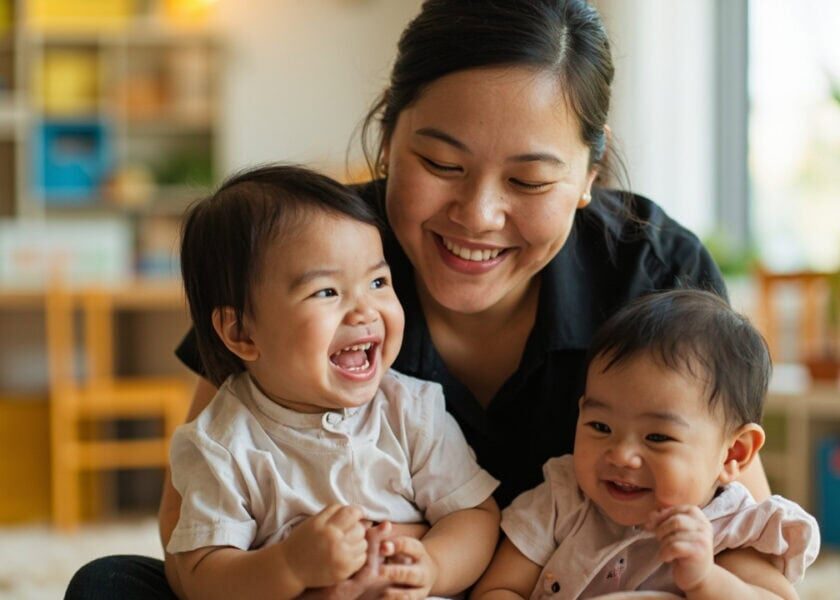
Beyond the Tour: How Singapore Parents Can Recognize Quality Childcare
The Moment Every Parent Recognises
There is a moment every parent in Singapore knows. It arrives when you schedule that first visit to a childcare centre. You walk through polished doors, are greeted by warm smiles, offered a tour of bright classrooms, and handed a brochure that speaks of holistic development and nurturing environments. You nod. You smile back. And somewhere beneath those polite exchanges, a quieter question surfaces—one you may not even fully articulate yet:
How do I actually know if this place is good?
Not good in the way brochures describe good. Good in the way that matters when your fourteen-month-old is having a difficult morning and needs someone to respond with patience rather than efficiency. Good in the way that matters when your child is learning to walk and will fall, many times, and you need to trust that the response will be steady hands and gentle words.
Here is the challenge: a well-run centre tour is designed to show you the centre at its best. Staff are prepared, the environment is tidied, answers are rehearsed. This is not dishonesty—it is human nature. But it means that if your only tool is how the visit makes you feel, you may be making one of the most significant care decisions of your child’s early life based on a performance.
What you deserve is something different. You deserve to walk into that centre and see what is actually there. You deserve to ask the questions that reveal what lies beneath the presentation. This article is designed to give you that framework.
What Quality Actually Looks Like: The Observable Indicators
Before you visit, hold these key indicators in mind:
- Children at ease in the space—not just present, but genuinely comfortable
- Caregivers kneeling, sitting, engaging eye-to-eye rather than looking down
- Active engagement in play, not just supervision at the periphery
- Intentional safety architecture—the quiet details that reveal careful thought
- Staff who seem at ease with each other and with your presence
- Clear, confident answers to direct questions about philosophy and practice
- Willingness to accommodate an unscheduled visit
A centre can have excellent facilities—imaginative learning corners, bright artwork, clean floors. These things matter, but they are the stage. The children are the performance.
When you observe, ask yourself:
- Do the children seem at ease—not forced, not merely compliant, but genuinely comfortable?
- Are they engaged in activities that match their developmental stage, or parked in front of screens or waiting for the next scheduled transition?
- Watch the infants. Are they on mats with appropriate toys within reach?
- Are caregivers kneeling or sitting at the child’s level, or standing above, looking down?
The height perspective matters more than most parents realise. A caregiver who consistently positions themselves at a child’s level is communicating something important: that they see the world from the child’s vantage point. That child, still learning language, still learning trust, is being met where they are. That is not a small thing.
Caregiver Interaction: The Difference Between Supervision and Engagement
The question is not simply whether caregivers seem friendly—of course warm interactions matter. What you want to notice is something more specific: what is the ratio of supervision to engagement?
There is a meaningful difference between a caregiver who is watching children and one who is actively engaging with them. You will see this difference in small moments:
- During free play, is the caregiver positioned at the periphery, glancing up occasionally and managing logistics?
- Or are they near the children, present and responsive, joining in a play scenario when a child initiates?
- When a toddler shows a caregiver a toy, does that caregiver pause and acknowledge the moment?
- When a baby makes a sound, does a caregiver respond with words, even if the baby cannot yet understand them?
These interactions are the building blocks of developmental support. Language exposure, social reciprocity, emotional attunement—these happen in the small moments, not just during structured circle time. The question is not whether the centre can tell you they prioritise development. The question is whether you can see it happening in real time.
This is why caregiver-to-child ratios matter profoundly. When a caregiver’s attention is not divided across a crowd, they can respond to the toddler showing a toy. They can speak to the baby who made a sound. They can be present in the way that matters.
Safety, Environment, and the Emotional Climate
Safety in infant and toddler care is not dramatic. It is the quiet architecture of prevention.
Notice the physical space:
- Are there child-proof locks on lower cabinets?
- Are electrical outlets covered?
- Are sharp corners cushioned or removed from active play areas?
- Is the flooring appropriate—soft enough for inevitable falls, clean enough for crawling infants?
- Is the nappy-changing area separate from food preparation areas?
- Is there a visible hand-washing station within reach?
These are not aesthetic choices. They are indicators of whether the centre has thought carefully about the specific vulnerabilities of the children in their care.
Beyond the physical space, notice the emergency protocols. Ask about fire drills and evacuation procedures. Ask where children sleep and what supervision looks like during nap time. Ask about illness policies and how they communicate with parents about health concerns. A centre that has thought through these details will answer clearly and without hesitation.
Pay Attention to the Adults Who Are Not Speaking to You
During your visit, there will be caregivers going about their routines, not focused on you or your tour. Notice whether they acknowledge you with brief, warm hellos—or whether they seem guarded, distracted, uncomfortable with a stranger in the space.
The emotional climate among the staff tells you something significant. Children are exquisitely attuned to adult tension, stress, and discomfort. If the adults in the room seem happy to be there, if they interact with each other with mutual respect and ease, that warmth ripples outward. If they seem harried, disconnected, or hierarchical in their interactions, that too will ripple outward—even if the centre director is charming and well-prepared for your tour.
This is also why caregiver turnover matters. High turnover is a warning sign. Children, especially infants, need consistency. They build trust through predictable relationships. A centre with frequent staff changes is a centre where children are repeatedly adjusting, never quite settling into the security they need.
The Questions That Reveal What Brochures Cannot
The questions you ask matter as much as the things you observe. These are the questions that will tell you more than any brochure can:
About caregiver consistency
- How long has the primary caregiver for this room been here?
- What is the typical turnover rate?
- Are caregivers encouraged to build primary relationships with individual children, or do children rotate through different caregivers throughout the day?
About feeding and sleep
- For infants, how are bottles prepared? Is it a calm, responsive experience or a production-line approach?
- For toddlers, what does meal time look like—is it a social experience with adult presence, or are children largely left to manage on their own?
- For sleep, what is the approach? Do children sleep on mats or cots? What does supervision look like?
There is no single right answer to these questions, but there are answers that reveal intentionality versus convenience.
About communication
- How will you know what happened during your child’s day?
- Is there an end-of-day verbal handover?
- Are there photographs or written notes?
- Will you receive alerts about significant moments—first steps, new words, friendship developments?
Regular, transparent communication is a sign that the centre sees you as a partner in your child’s care, not just a customer to serve during drop-off and pick-up.
The Question That Tells You Everything
Here is a question I encourage every parent to ask—not because you expect a particular answer, but because of what the response reveals:
Ask to see the space at an unscheduled time.
A centre that welcomes this request is a centre that has nothing to hide. A centre that deflects, that says only scheduled visits are possible, that cannot accommodate a brief pop-in—this tells you something important. It tells you that what you see on your official tour may not be what happens on an ordinary Tuesday.
Why This Matters More in Singapore—and What to Do Next
For Singapore parents, navigating this reality within one of the world’s most demanding urban environments, the stakes feel especially sharp.
We do not always have the village that earlier generations relied upon. Many families are far from extended family. We are working long hours, managing mortgages, building careers, and trying to raise children with intention and love. Childcare is not a convenience for Singapore families. It is an infrastructure of parenting itself.
And like any infrastructure, its quality determines what it can support.
The first thousand days of a child’s life are not just a phrase. They are a window of extraordinary significance—neurologically, emotionally, developmentally. The relationships formed, the environments navigated, the quality of care received during this period shapes trajectories in ways we are still learning to understand.
EduNanny by BUTLER is part of the ECDA Childminding Pilot, operating within official oversight and standards that hold care to public account. Within this framework, EduNanny offers both home-based and centre-based pathways—recognising that Singapore families are not a single profile. Some children thrive in a home environment, with the consistency and individualised attention that home-based care provides. Others benefit from the social environment and resources of a centre. What matters is not which model you choose, but whether the quality of care within that model meets the standards you now know to observe.
The practical arrangements are designed with real families in mind: Monday to Friday care blocks, fees structured within the pilot framework to remain accessible, and payment through CDA and Baby Bonus to reduce financial friction.
Your Child Deserves to Be Seen
Your child deserves to be seen, engaged, and cared for by people who understand what they are doing and why. You deserve to feel confident that you chose well.
These two things are not in tension. In fact, they go together. The care that earns your informed trust is the care that will serve your child best.
EduNanny Singapore invites you to evaluate them on these terms—not with a polished tour alone, but with the full framework you now carry. They know that quality speaks for itself when parents know what to look for.
If you are ready to visit EduNanny Singapore and see quality childcare for yourself, schedule a conversation today. Bring these questions. Bring your observations. Bring your child. The right centre will welcome them all.
Learn more about who EduNanny is and the standards behind their care.