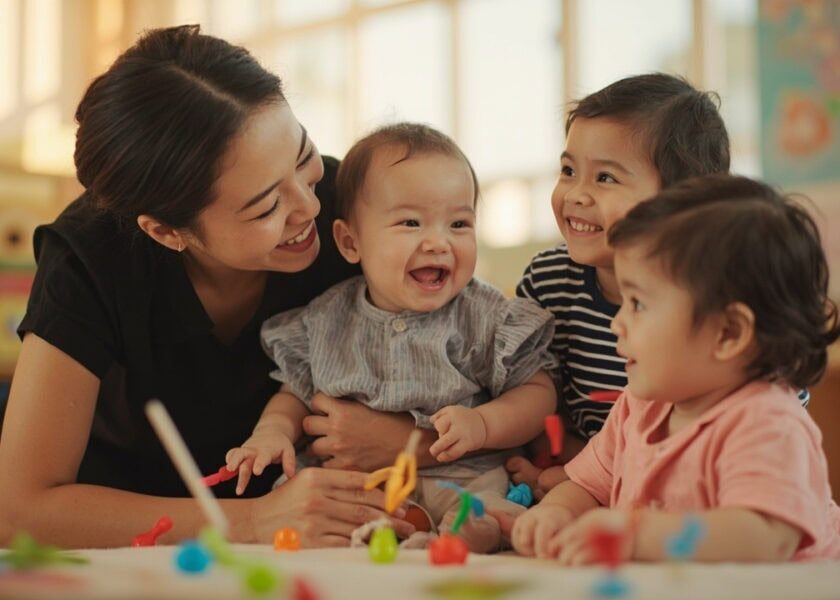
What Your Child Is Building in the Hours You Cannot See
The Science of Early Care: How Your Child Experiences Childcare
When a child enters a new environment—a childcare setting, a home with a caregiver, a room full of other children and the adults who tend them—they enter it through their senses first. Long before they understand the concept of childcare, they experience it as a sensory world.
The smell of the room. The texture of the mats beneath their feet. The particular quality of the light streaming through windows. The temperature of the air on their skin. The sounds—the cadence of voices, the rhythm of movement, the echo of other children.
In Singapore’s climate, there is also the shift: the air-conditioned cool of the centre versus the humidity outside, the transition that happens every morning and every afternoon. These sensory contrasts register in your child’s nervous system even when they cannot yet name them.
Every one of these details is telling your child’s brain something:
- Is this place familiar or strange?
- Does it smell like the people I trust?
- Does it sound like safety or noise?
- Is this light comfortable or harsh?
And the answers to these questions matter—because during the first three years of life, a child’s brain is building its fundamental architecture at a speed it will never reach again. Every experience, every sensory impression, every moment of connection or disconnection, is being processed and woven into the neural pathways that will determine how this child understands the world.
When a caregiver consistently and sensitively responds to a child’s needs—when they notice distress and respond with comfort, when they maintain a predictable rhythm, when they match the child’s emotional state—the child’s brain is learning something profound:
- It is learning that the world is a place where needs are met.
- It is learning that people are reliable.
- It is learning that it can feel safe, and then curious, and then confident.
Developmental psychologists call this an internal working model—the mental blueprint a child builds for understanding relationships, safety, and self. It is constructed in the first three years of life, primarily through the quality of caregiving. And it does not rebuild itself later. The foundations are laid, and everything else builds upon them.
What Separation Anxiety Is Actually Telling You
Separation anxiety, which so often distresses parents, is actually a sign that this system is working. It means your child has formed an attachment to you—they have internalised your presence as something real and reliable. When you leave, they feel the absence because you are real to them.
A child who shows no separation anxiety has not necessarily adapted well. They may have simply not formed the secure attachment that makes the anxiety possible.
What makes separation manageable is not the absence of attachment but the presence of another trusted figure. And in that moment of transition, when you hand your child to a caregiver and leave, the question is not whether your child will miss you—they will. The question is whether there is someone present who can help them hold that feeling until you return.
Someone who can say, with their hands and their voice and their patient, calm presence: I know. This is hard. But you are safe here, and I am here, and we will wait together.
The Secure Base: Reading Your Child’s Experience Over Time
A child who has internalised a sense of security does something remarkable in a good care environment. They use their caregiver as a launch pad.
They venture out—curious, interested, engaged—because they know they have somewhere safe to return. This is called secure base behaviour, and it is one of the most reliable indicators that a child is experiencing genuine care rather than mere containment.
You can observe this if you know to look for it:
- A child in quality care will move away from their caregiver to explore, then turn back—a glance, a smile, a small check in.
- Then they venture further.
- The distance and duration of these explorations grow over time.
The child is learning that they can move through the world and return to safety. That relationships are not chains but lifelines.
A child who is merely tolerating care may stay close, may show little spontaneous exploration, may seem listless or watchful. They are managing, not thriving. The difference is not visible on a tour. It is not captured in a photograph. But it is visible to anyone who knows how to read a child’s behaviour over time.
Learning to Read the Evening
The hours after pickup are a window into the hours of the day.
A child who has been in a caring, attuned environment all day will often come home and behave in a particular way. They will be open, engaged, able to play independently for stretches. They may be tired—children in quality care work hard, in the best way—but they will not be depleted. They will seek connection, but not desperately. They will settle.
A child who has merely been supervised, or who has been in a setting that was understaffed, overstimulating, or emotionally disconnected, may come home and fall apart. They may be clingy, whiny, unable to be put down. They may cry at small frustrations or seem unusually rigid. They may sleep poorly, or sleep too much in a way that suggests their nervous system has been on high alert all day.
The clinginess and the regression and the difficulty settling are not behavioural problems to be corrected. They are messages. They are your child’s way of telling you: something was missing today.
You know your child. You know what their good day looks like. If the evenings have become consistently hard, if the transition home is disproportionately difficult, it is worth asking what is happening during the hours you cannot see.
What Genuine Quality Care Looks Like
The conditions that create quality are not accidental. They are built into the design of care. Understanding these conditions can help you evaluate any setting you are considering.
The Three Pillars of Quality
| Pillar | What It Means | What It Looks Like |
|---|---|---|
| Attunement | The caregiver’s ability to perceive and respond to the child’s internal state | Noticing subtle cues before crying: changes in breathing, tension in shoulders, the flicker of uncertainty before a tantrum |
| Consistency | Predictable patterns in routine and relationship | Regular sequences of feeding, sleeping, greeting, and transition that allow the child to anticipate and trust |
| Ratio | The number of children per caregiver | Small enough that each child can be truly known and held in mind |
Attunement is not intuition alone—it is a skill. It is the difference between a caregiver who is doing their job and a caregiver who is doing their craft. A truly attuned caregiver notices when a child’s breathing changes, when their body stiffens, when their eyes lose focus. They do not wait for distress to become visible. They read the subtle language of the body and respond before a small discomfort becomes a big feeling.
Consistency, too, is neurological scaffolding. When feeding times, nap times, greeting rituals, and transition moments happen in a predictable sequence, the child can begin to anticipate, to prepare, to trust that what they need will come. Without this predictability, a child’s brain must remain perpetually vigilant. There is little room left for curiosity, for play, for the rich cognitive work that early development requires.
And ratio is the precondition for attunement. In the ECDA Childminding Pilot model, the ratio of caregiver to infant is never more than one to three. A caregiver who is responsible for four, five, or six infants cannot attune to each of them in the way that true quality requires. They can manage. They can supervise. They can keep children safe in the most basic sense. But they cannot hold the internal world of each child with the care that this age demands.
EduNanny’s Approach: Built Around the Relationship
EduNanny builds its entire philosophy around the caregiver-child relationship as the fundamental unit of quality—not curriculum, not facilities, not programmes.
The ECDA Childminding Pilot model establishes the ratio of one caregiver to no more than three infants. This is intentional. It creates the conditions in which attunement becomes possible.
EduNanny extends this philosophy across its pathways—home-based, community, and centre-based—recognising that different families have different needs, but that none of these pathways should compromise the fundamental relationship that builds a child’s sense of safety.
EduNanny invests in the training and development of its caregivers—not just in childcare skills, but in the art of attunement, in the science of attachment, in the understanding that every routine interaction is an opportunity to tell a child: you are safe, you are seen, you matter.
We know that placing your child in someone else’s hands requires trust. EduNanny addresses this through transparency: regular communication, updates, photographs, and where deployed, measures such as CCTV that allow parents to feel connected to their child’s day. These are not surveillance tools. They are bridges—acknowledgment that parents need to feel that they are still present in their child’s life even during the hours of separation.
Evaluating Your Options: A Practical Guide
When parents ask what to look for when choosing care, I offer this framework: look for the relationship, not the facility. Look for the caregiver who is not just doing tasks but is in a relationship with your child. Watch how they hold your child. Watch how your child responds to them over time.
Questions to Ask During a Visit
- How do you handle the transition when a parent drops off?
- What does a typical day look like for the children?
- How do you know when a child is distressed versus just tired?
- What happens if a child won’t settle for a nap?
- How do you communicate with parents during the day?
- What is the ratio of caregivers to infants in this setting?
Red Flags to Watch For
- Caregivers who seem hurried or distracted, managing multiple tasks at once
- A room where children are frequently unsupervised by an adult’s gaze
- Rigid routines that do not allow for individual child rhythms
- Caregivers who dismiss developmental concerns or attribute all crying to “adjustment”
- No system for regular parent communication
Common Concerns Addressed
“How do I know what’s really happening when I’m not there?”
No system can eliminate this uncertainty entirely. What you can do is learn to read your child’s evening behaviour as evidence, observe secure base behaviour over time, and ask specific questions about how the caregiver handles transitions, distress, and the small moments that are not in brochures.
“Is quality care affordable for working families?”
The ECDA Childminding Pilot is designed to make quality care accessible. Fee structures are developed with affordability in mind. CDA and Baby Bonus funds can be used. Monday to Friday care blocks provide the consistency that working families need. Quality and accessibility are not opposites.
“What if my child doesn’t seem to like the caregiver?”
Give it time. The first days and weeks in any new environment are overwhelming for a young child. What matters is the trajectory. Over weeks, does your child begin to show any signs of secure base behaviour? Do they venture out and return? Do they show evidence of feeling safe? If the pattern over time is one of increasing comfort rather than persistent distress, that is a positive sign.
The Question Worth Asking
Let me close by returning to that moment at the threshold.
When you hand your child to a caregiver and turn to leave, what is actually happening? Your child is beginning a passage—a daily journey through hours that will shape them.
The child who runs to greet you at the end of the day, who is glad to see you, who is also glad to have been where they were. The child who comes home and plays, who sleeps peacefully, who wakes up the next morning and walks toward the door with some measure of anticipation rather than dread. This is not a small thing.
This is the internal experience that becomes the felt sense of safety, the belief that the world is reliable, the foundation for every relationship and every learning that comes after.
You are not buying a programme. You are not buying a facility. You are buying a daily experience that your child will have—an experience that is teaching your child’s brain whether people are kind, whether routines are reliable, whether they can venture out and come back whole.
Every greeting and every feeding and every nap and every gentle transition is saying something about the world to your child. And it is being heard, in ways you cannot fully see, by the brain that will carry those messages for the rest of their life.
That is what EduNanny holds as its responsibility. Not just to supervise. Not just to develop. But to create, every day, the conditions in which your child can learn, in the deepest and most literal sense, that they are safe.
If that is what you are looking for—if that is what your child deserves—then EduNanny is here. Not as a service you hire, but as a partner in the most important work there is: the nurturing of a human being in the years when they are most malleable, most curious, most open to the world.
The hours apart are not a pause in your child’s growth. They are growth itself. And the question of what happens in those hours is not a question of logistics. It is a question of who your child is becoming.
That is a question worth asking. And it is a question worth answering with care.
If you would like to learn more about EduNanny’s approach to quality childminding and childcare, you are welcome to connect with our team. You may also explore our about us page to understand the standards and values that guide our work with families across Singapore.