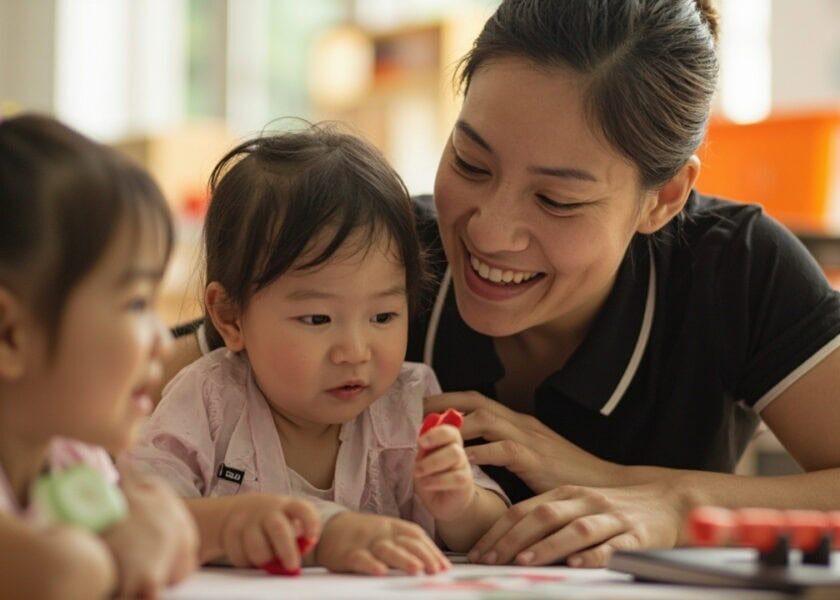
Building Confidence and Curiosity in Your Child’s First Years
What Quality Childcare Actually Does for Your Child
For busy parents, here is what matters most:
- Quality childcare is not supervision—it is development. The difference matters enormously when you are making this choice.
- Early years shape capability, not just safety. The first thousand days from birth to age three are when children build the foundations of confidence, curiosity, and social ease.
- Ratio and intentionality are everything. A caregiver who is not spread thin can truly see your child.
- Choosing quality childcare is an investment, not a compromise. You are paying for a team whose job is to notice, nurture, and build your child’s capabilities every day.
Why the Early Years Are the Real Foundation
We have come to a place in Singapore where we can talk about infant care and childminding with both honesty and confidence, because the evidence is now unambiguous. The early years—those first thousand days from birth to age three—are not a warm-up for real life. They are real life.
The architecture of a child’s social confidence, emotional resilience, capacity for curiosity, and belief in themselves as capable learners—these are not things that wait for primary school. They are built, brick by brick, in the arms of the people who hold them, in the rhythms of their days, in the quality of attention they receive when the world is still new and everything is being learned for the first time.
Consider what this looks like in practice:
- A child who feels secure learns to explore.
- A child who is responded to with warmth and consistency learns that their voice matters.
- A child who is given language, play, and meaningful interaction learns that the world is interesting and that they have a place in it.
These are not soft outcomes. These are the foundational capabilities upon which everything else rests.
What Your Child Is Actually Building
When your eighteen-month-old stacks blocks with fierce concentration, this is not incidental. When your two-year-old negotiates a turn on the swing, this is not just play. When your infant looks up at a caregiver and reaches out with complete trust—these are not ordinary moments. These are the moments in which capability is being built.
Through experience after experience, your child discovers: I can do this. I can be heard. The world responds to me. These discoveries accumulate into something profound—a quiet, bedrock belief that they are capable.
This belief does not appear at age seven. It is constructed in the earliest years, one meaningful interaction at a time.
The Difference That Changes Everything: Supervision vs. Developmental Care
Supervision keeps a child safe. It keeps them clean and fed and within sight. Supervision is not nothing—it is the absolute baseline, and every parent deserves to know their child is in safe hands.
But supervision is a floor, not a ceiling. It answers the question is my child okay? It does not answer the question is my child growing?
Developmental care answers both questions. It operates on the understanding that every interaction is an opportunity:
- A diaper change is not just a diaper change. It is a moment of eye contact, of gentle words, of a caregiver narrating what is happening so the child begins to understand the social world around them.
- A nap is not just a nap. It is a rhythm that teaches a child’s body about safety, about routine, about the predictability that allows a young nervous system to settle and grow.
- A group activity is not just a way to pass the time. It is the first classroom, the first laboratory, the first arena where a child learns about preferences, negotiation, and the give-and-take of social life.
The environment that produces these developmental experiences is not accidental. It is designed. It is intentional. And it is what separates quality care from supervision.
How to Choose Quality Infant Care in Singapore
You are not looking for babysitting. You are not looking for a pause button on parenting. You are looking for someone who will love your child the way you do, who will see what you see—that extraordinary, unrepeatable person—and who will help that person become more fully themselves.
That is not a small request. That is a profound act of trust. And it is also the question worth answering when you evaluate your options.
If you are evaluating childcare options, here is what to look for:
- Ask about ratios. How many infants per caregiver? This is not a detail—it is the variable that determines whether your child can be truly seen.
- Observe interactions. Do caregivers kneel to meet a child’s eye? Do they narrate what they are doing during routine moments? These are signs of developmental intentionality.
- Ask about training. Are caregivers trained not just in safety, but in child development? Is ongoing professional development supported?
- Consider the environment. Is it designed for exploration and development, or merely for containment? Are there textures, sounds, and materials that invite curiosity?
- Evaluate communication. Will you know what is happening in your child’s day? Is transparency built into the programme, or is it left to chance?
- Ask about affordability. Are CDA and Baby Bonus funds integrated into planning? Financial stress should not be a barrier to quality care.
What EduNanny Is Built Around
At EduNanny Singapore, this is not an aspiration. It is a structure.
Our caregivers are part of a programme that takes the ECDA Childminding Pilot Framework seriously—not as a checkbox, but as a foundation. We maintain the infant ratios that allow for genuine attunement.
EduNanny offers both home-based and centre-based pathways, both maintaining the same serious commitment to ratios designed for connection: up to one caregiver to three infants. Because a caregiver who is not spread thin can truly see your child. Quality of attention is not a luxury. It is the mechanism through which development happens.
We offer care blocks designed around the rhythms of family life in Singapore, because childcare that does not fit your life is childcare that creates its own stress. Our programme is built to be a partner to your family, not an additional demand on it.
We have built transparency into the programme itself. Where our centres have deployed CCTV measures, parents have access. Where communication protocols exist, they are robust and responsive. Trust, in this context, is not a feeling. It is a practice, and it is reflected in the actual architecture of how we operate.
We understand that for many families in Singapore, the question of affordability is real and valid. The pilot fee structures are designed to make quality care accessible. CDA and Baby Bonus usability are not afterthoughts—they are integrated into how we help families plan for care, so that financial consideration does not become a barrier to developmental quality.
For parents who need guidance between the moments of direct contact with their child’s caregiver, the Thomas AI Chatbot offers a responsive resource. The relationship between a family and their care programme extends beyond the hours of the day, and a quality provider thinks about that entire ecosystem.
Your Child’s Future Starts Here
When you choose a programme that is built on developmental intentionality—that maintains the ratios and the training and the environment that actually produce growth in young children—your child will come home having spent the day differently than they would in a room where they are one of fifteen.
They will come home having played. Having been spoken to. Having learned that adults beyond their immediate family can be trusted. Having discovered new textures and sounds and social dynamics. Having been held and noticed and responded to with skill.
And you—you will see it. You will see it in the way your child reaches for a caregiver’s hand when you drop them off. You will see it in their growing ease around other children. You will see it in the language that is suddenly appearing, in the confidence that is quietly building, in the child who is becoming more themselves every single day.
And when you choose the latter—when you choose a programme that is built on developmental intentionality—you are not compromising. You are investing. There is a profound difference, and it is a difference your child will feel every single day.
Children need love, yes. They need consistency, yes. But they also need a wide and rich social world. They need peers. They need caregivers who are not exhausted, who are not managing their own anxiety in the interaction, who bring fresh energy and deliberate intention to each day.
They need the kind of developmental richness that a quality programme provides, and that even the most devoted single caregiver, stretched across the demands of modern life, cannot always sustain in isolation.
What quality childcare offers your child is not a substitute for parental love. It is a complement to it.
The children in our care today will be navigating a world we cannot fully imagine. They will need to be curious when the landscape keeps shifting. They will need to be resilient when things do not go according to plan. They will need to trust themselves, and to trust the people around them, and to believe that they are capable of learning anything.
These are not skills that appear at age seven. They are not traits that can be retrofitted. They are built, day by day, in the first years of life, by the people who hold our children when we cannot be there to hold them ourselves.
EduNanny exists because we believe that every child in Singapore deserves a care environment that is worthy of that responsibility. Not a room. Not a service. An environment—a living, responsive, deliberately designed space in which your child is seen, nurtured, and built up into the capable, confident, curious person they are already becoming.
The right question was never will my child be okay? The right question was always will my child grow?
Choose a place where the answer to that question is not an accident. Choose a place where it is an intention.
Choose EduNanny Singapore—because your child’s confidence, curiosity, and capability are not things to be left to chance. They are things to be built, with skill, with care, and with genuine love.
And that is exactly what we are here to do.
At EduNanny, we believe that every family deserves access to thoughtful, development-oriented childcare built on trust, professionalism, and genuine care. Learn more about our approach or get in touch with our team to explore how we can support your child’s earliest and most important years.