When Grandparents Question Your Childcare Choice: A Singapore Parent’s Guide to Bridging the Gap
Understanding the Tension You Feel
There is a conversation happening in homes across Singapore that rarely gets spoken aloud. It happens in kitchens on Sunday mornings, in the back seat of cars after a grandparent visits, in the quiet moments when a parent scrolls through their phone at night instead of sleeping.
It starts with something like, “My mother asked me again why we didn’t just do what she did,” or, “My father said he doesn’t understand why we need someone else to look after our child.” It leaves parents wondering if they are failing their families even as they believe they are doing what is best for their child.
If you have been having this conversation in your head, in your marriage, in whispered arguments with your partner late at night — you are not alone. The tension you feel is not a sign that you are doing something wrong. It is a sign that you care deeply about two things that matter enormously: your family’s approval and your child’s wellbeing.
In Singapore, family is not just a social unit. It is an identity, a structure, a set of obligations that runs deeper than almost anywhere else in the world. When grandparents speak up about childcare, they are not simply offering opinions. They are expressing a lifetime of values about what it means to raise a child, about what family means, about what they owe their grandchildren and what their grandchildren owe them.
For most grandparents, their involvement is an act of love, even when it feels like an act of pressure.
The challenge is that love can feel like judgment when it comes wrapped in doubt. When a grandmother asks, “Are you sure about this childcare arrangement?” what she may actually be asking is, “Do you trust me? Do you trust what I know?” When a grandfather says, “In my day, we never needed any of this,” he may be grieving something he sees being taken away — the role he imagined for himself, the family he expected to help build.
These are not small feelings. They are real, and they matter. And if you are the parent in the middle of this, feeling pulled between what you know your child needs and what your family expects — your feelings are valid too. You are not being disloyal. You are being a parent. And parenting in Singapore today means holding complexity that no previous generation had to hold quite this way.
Why This Feels Like a Divide — and Why It Isn’t
The gap between traditional and modern childcare is not really about methods. It is not about whether one approach is better than another, or whether professional caregivers understand children better than family.
Those debates can be real, but they are not the real divide.
The real divide is simpler and more human. It is about what safety looks like in a changing world. It is about who you trust with your child and why. It is about the enormous, terrifying responsibility of raising a small human being, and the desperate hope that you are doing it right.
When your mother expresses concern about your childcare choice, she is not really questioning your competence. She is processing her own anxiety about a world that has changed faster than she expected. When your father-in-law compares your decision to what worked forty years ago, he is not dismissing your research. He is trying to find common ground in a world where the rules have shifted beneath his feet.
Here is the beautiful truth that gets lost in all of this: traditional family childcare and modern quality childcare share the same north star. Both are trying to answer the same question.
How do we help this child thrive? How do we give this little person the best possible start?
Every grandparent who expresses concern, every parent who second-guesses — they are all pointing toward the same thing. They all want the child to be safe, to be loved, to grow into someone whole.
How to Build That Bridge
It starts with something deceptively simple: listening without defending.
Before you explain your choice, before you justify your decision, before you pull out the research or the facility tour photos — pause. Ask your parent what they are worried about. Not what they disagree with, but what they are afraid might happen.
You might be surprised by what you hear.
- Sometimes the fear is about trust — whether strangers can care for a child the way family does.
- Sometimes the fear is about the child missing out — on language, on culture, on the particular way only a grandparent can pass things down.
- Sometimes the fear is more personal — it is about feeling unnecessary, about wondering if their role in their grandchild’s life is being diminished.
When you listen to the fear, something shifts. You stop arguing against their concerns and start understanding them. And when you understand them, you can address them in a way that speaks to what they actually need to hear.
Language That Opens Doors
If your mother is worried about your child learning Mandarin, and you chose a centre where English is the primary language, you can acknowledge that concern directly:
“I know how important it is to you that Aaron grows up speaking Mandarin. It matters to us too. Here is how we are making sure that happens, and I would love for you to be part of that.”
You are not dismissing her concern. You are folding her into the solution.
If your father-in-law is worried about your child being looked after by someone young, share specifics about the caregiver’s experience, their training, the philosophy that drew them to this work. Invite him to meet them, to see for himself. You are not hiding behind credentials. You are opening a door.
You are translating your choice into values your parents already hold. You are showing them that your decision flows from the same stream they taught you, even if the riverbank looks different.
A Phrase Worth Remembering
When someone says, “In my day, we did not need any of this,” try responding with:
“You are right. And the world your children grew up in was different too.”
This is not a rebuttal. It is an acknowledgment. It creates space for both things to be true at once.
From that place of mutual respect, the conversation can evolve. Ask your parents what they wish they had known when they were raising you. You might find that they have more doubt about their own choices than they have ever admitted, that they understand uncertainty better than you expected.
What they really want is often not for you to do things their way, but for you to feel confident that you are doing things right.
What Quality Childcare Actually Offers
Choosing quality childcare is not a betrayal of your family’s way. It is an evolution of it. It is taking what your parents taught you about love and dedication, and building upon it with the knowledge and resources available to you now.
When you choose professional infant care, what you are often choosing is a level of intentionality that was simply not available to your parents’ generation. Not because they did not love their children enough, but because the field of early childhood development has advanced enormously in understanding how infants learn, how their brains develop, how early experiences shape everything that comes after.
The First Thousand Days
The first thousand days of a child’s life represent a period of extraordinary neural development, when connections are forming at a rate that will never be matched again. The care an infant receives during this time matters in concrete, measurable ways that researchers continue to document and understand.
Small Ratios, Real Attention
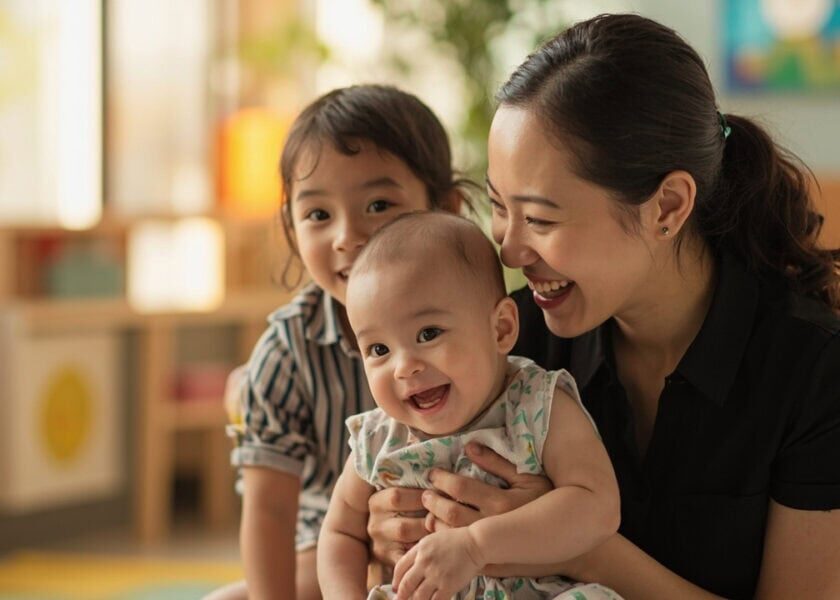
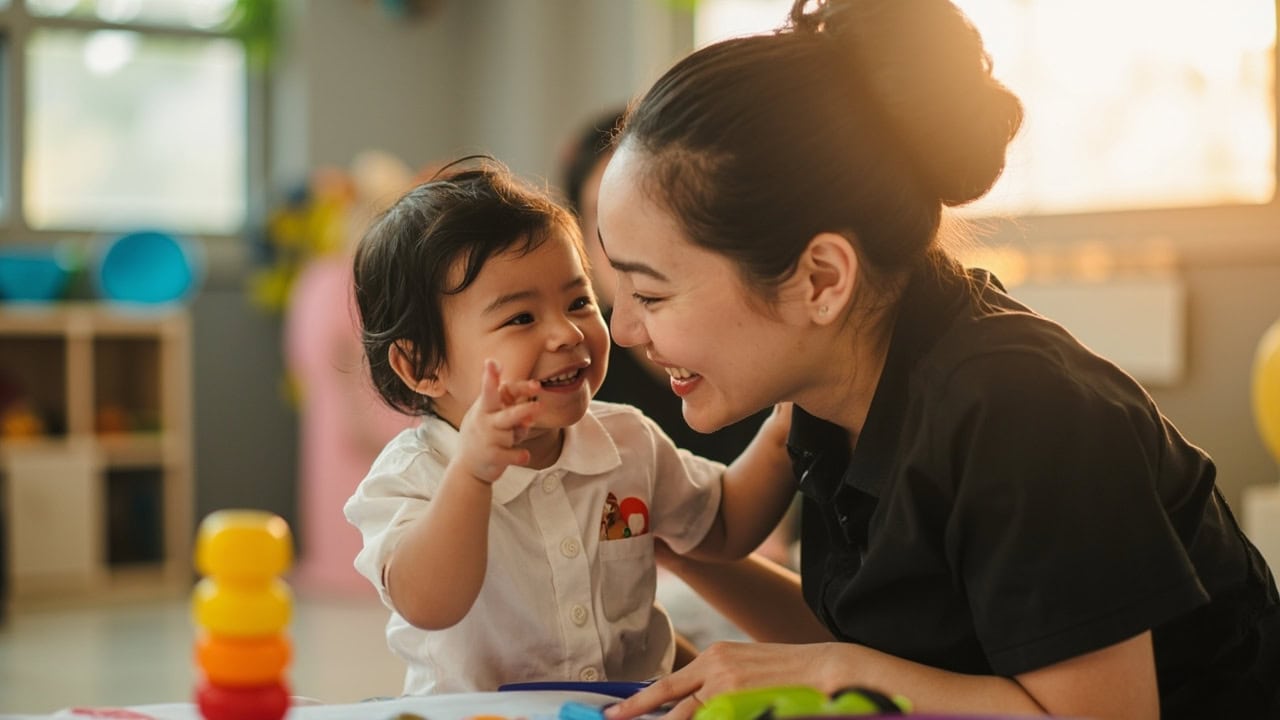
Professional infant care in Singapore today is designed with this science in mind. Small ratios, sometimes as low as one caregiver to three infants, mean that your child receives genuine, individualized attention.
When a caregiver can focus on one, two, or three infants rather than six or eight, they can notice the small things that matter enormously to a baby:
- When a child is about to get frustrated before the frustration turns to tears.
- When they are hungry, when they are tired, when they are curious about something and need it explained in a way that satisfies that curiosity.
- They can notice, and respond, and engage.
This is what quality looks like in practice. It is about the ratio of attentive eyes to small faces, and the depth of engagement that becomes possible when a caregiver is not stretched too thin.
Complement, Not Replacement
Professional infant care is not a replacement for family. It is not designed to replace the unique bond between a grandparent and a grandchild.
It is designed to complement that — to provide a safe, stimulating, professionally managed environment for the hours when parents are working, knowing that family love and family involvement continue to shape the child outside of those hours.
The grandparent who visits on weekends, who takes a child to the park, who teaches them to sing songs in their mother tongue — that grandparent is doing something irreplaceable. No centre, no caregiver, no program can replicate that. And no thoughtful parent who chooses professional care is trying to replicate it.
They are trying to ensure that the hours when they cannot be present are hours their child spends in a safe, enriching environment.
Your Questions, Answered Honestly
Some conversations will go well, and some will not. Some family members will come around, and some will hold their reservations for a long time. That is not a failure on your part. You cannot control how others respond to your choices. You can only control how you make them, communicate them, and live with them.
“What if my parents never come around?”
The goal is not to win your parents over. The goal is to make choices you can stand behind with integrity, communicate them with respect, and trust that relationships have a way of healing and evolving over time.
Many grandparents who were skeptical at first become some of the biggest advocates once they see the care their grandchildren receive, and once they see their own children thriving as confident parents.
“Am I really doing what is best for my child?”
You are not the parent your parents were, and that is exactly as it should be. You are the parent your child needs — shaped by your own experiences, informed by your own research, responsive to your own child’s unique temperament and needs.
Your parents raised you in their context. You are raising your child in yours. When you choose quality childcare, you are taking what they gave you — the values they instilled, the love they modeled — and expressing it through the choices available to you now. That is not betrayal. That is growth.
“Is something wrong with me for feeling this tension?”
No. The tension you feel, the doubt, the second-guessing, the fear of disappointing the people who raised you — that tension is not weakness. It is proof that you take this responsibility seriously. It is proof that you care about getting this right.
The parents who feel no tension are often the parents who are not paying close enough attention. Your discomfort is not a warning sign. It is evidence of your love.
Moving Forward With Confidence
So when you go home tonight and face those Sunday morning conversations, or the text messages after a visit, or the quiet silence that sometimes feels more pointed than any words — remember this:
You are doing something hard and important. You are bridging generations, holding complexity, choosing both your family’s love and your child’s wellbeing even when they seem to point in different directions. You are doing the work that this moment in Singapore requires of parents.
And you are not alone in it.
Approaches like the ECDA Childminding Pilot reflect a new kind of partnership for Singapore families — one that operates under clear standards for safety, quality, and developmental appropriateness. These programs are designed to complement, not replace, the village that family provides. They offer pathways that fit different family situations, because thoughtful parents know that every child’s needs, and every family’s circumstances, are different.
What matters most is finding a care arrangement you can trust — one where your child is safe, seen, and supported, and where you feel confident that the hours apart are hours well spent.
The child in your arms, or in your care, or on the way, is the place where all of these threads come together. Every choice you make, every tension you navigate, every conversation you have with your parents — it is all pointing toward the same thing.
A future where that child can thrive.
That is worth everything you are going through to make it possible. And you are making it possible, every day, simply by caring enough to have these conversations, to feel these doubts, to keep showing up and choosing what you believe is best.
Trust that. Trust yourself. And trust that the love your family has for you, and the love you have for your child, will find their way to each other — even across the distance of different generations and different approaches.
That bridge is there. You are building it, one conversation at a time.
For families exploring thoughtful, quality childminding options in Singapore, learn more about EduNanny’s approach or get in touch to discuss what arrangement might work best for your family.