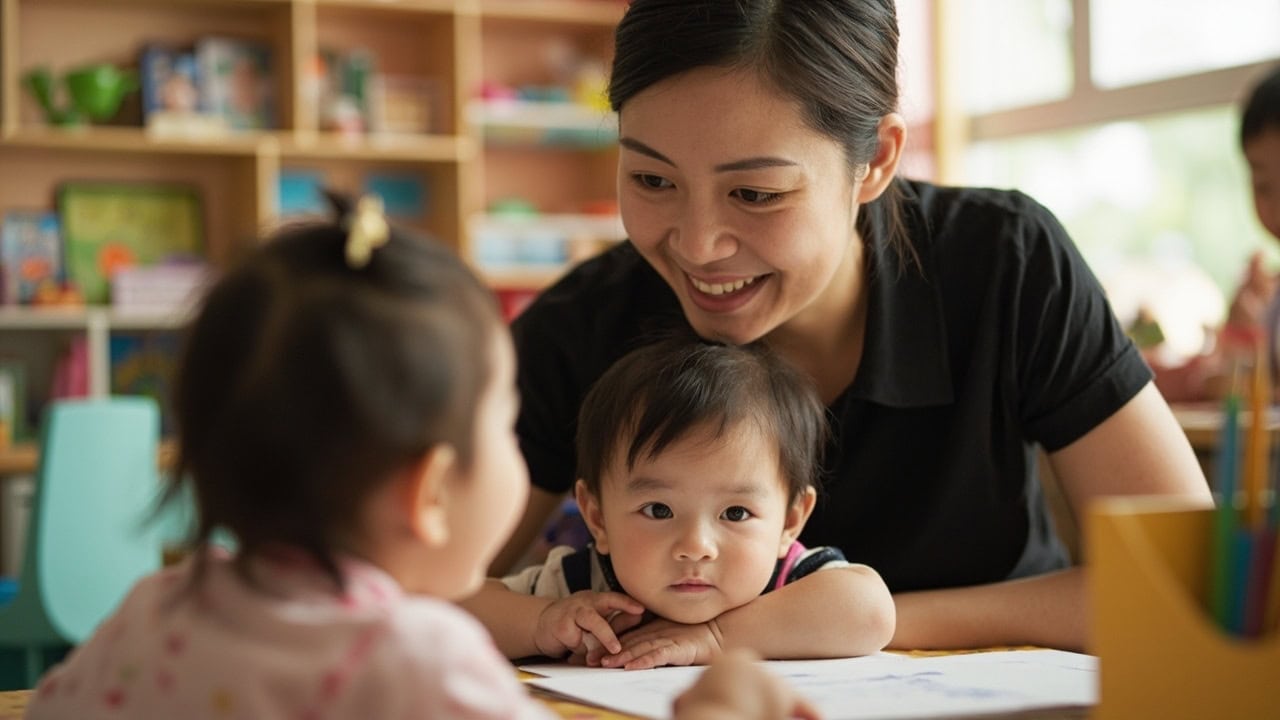
Trained Observation Changes What You Know About Your Child
The Question Behind Every Childcare Decision
Singapore parents today are some of the most informed, most intentional parents in the world. You research preschools before your child can sit up. You read about developmental milestones, sensory processing, and the science of early brain development. You have opinions — carefully considered opinions — about how your child should be spoken to, played with, and guided through the world.
And yet when it comes time to hand that child to someone outside your family, you are often asked to take a great deal on faith.
Trust us, you are told. We are experienced. Your child is in good hands.
Those words can be comforting. But they are not enough. And more and more, Singapore parents are recognizing that “experienced” and “trained” are not the same word.
Professional caregiver training means something specific. It means that the person caring for your infant has been equipped to observe developmental signals across multiple domains: how your child is beginning to express needs and respond to language, how they interact with caregivers and other children, how their physical development is unfolding, and how they respond to transitions, stimulation, and separation.
This is not intuition. It is not instinct. It is a trained, practiced, evidence-informed skill set that takes real expertise to develop and apply consistently.
What Trained Observation Looks Like in Practice
Consider for a moment what that actually means in a day with professionally trained caregivers.
A trained caregiver watches not just that your child is playing, but how they are playing. Are they experimenting with cause and effect, dropping a toy repeatedly to observe what happens? That is cognitive development in action.
Are they reaching for a caregiver’s face, mirroring expressions, beginning to respond differently to familiar voices than to strangers? Those are social and communicative milestones that emerge in the first year with striking speed — and they are easy to miss if no one is specifically trained to look for them.
A caregiver who has been trained to observe these signals does not just note that your child had a good day. They can tell you something real — something specific — about how your child’s development is unfolding, what they are curious about, and where their emerging skills are taking them.
The Partnership Between Parent and Caregiver
Trained caregivers are not simply professionals you hire to care for your child. They are developmental partners. They are trained observers who see your child in contexts you cannot — in interaction with other children, in group routines, in moments of independence that do not happen the same way at home.
And what they see, they communicate. Through structured updates, through reflective conversation, through documentation that gives you a window into your child’s day grounded in professional understanding rather than general impression.
When a caregiver tells you that your child is showing early signs of sustained attention during sensory play, or that they have noticed a change in how your infant responds to separation and reunion, that is information that matters. It helps you understand your own child more deeply — not as a score on a checklist, but as a person whose growth you are tracking together with someone whose trained eyes catch what might otherwise go unnoticed.
Here is what many parents discover: professional childcare, when done well, does not replace parental insight. It deepens it. You are learning things about your child that you could not access alone — patterns, preferences, strengths, and areas of development you want to nurture more intentionally at home. You are gaining a second pair of expert eyes on your child’s development, and you are gaining language for what you are already sensing but perhaps could not articulate.
What Makes Professional Childcare Possible
We should be honest about what this kind of expertise requires. It requires genuine investment — in training, in staffing ratios, in the systems and structures that allow caregivers to do this work properly.
Key factors that distinguish genuine professional childcare from basic supervision:
- Staffing ratios designed for observation — Caregivers who can watch, engage, and communicate rather than simply manage a large group
- Systematic training programs — Ongoing professional development in child development and observational methods
- Structured communication systems — Processes for sharing developmental observations with parents in meaningful ways
- Transparency measures — Where deployed, tools such as CCTV complement rather than replace the professional relationship you build with your caregiver
EduNanny operates under the ECDA Childminding Pilot, which reflects a serious commitment to standards that go beyond basic supervision. The pilot structure supports both home-based and community-based care pathways, giving families options that suit their circumstances. Fees are structured to be affordable within the pilot framework, and payment options reflect the practical realities of Singapore family life, including the usability of CDA funds and Baby Bonus contributions.
What Quality Childminding Looks Like
Let us be specific about what you should expect when you choose a professional childcare arrangement.
In daily updates, you should hear not just what your child ate and when, but how they engaged with mealtimes. Not just that they played, but what kinds of play held their attention and why that matters developmentally. Not just that they napped, but how they settled and any patterns in their rest cycles worth noting. Not just that they were happy, but what seemed to make them happy and what that suggests about their emerging interests.
In conversations with caregivers, you should expect specific observations about developmental milestones as they emerge, honest reflections on areas where your child is thriving and areas where they may need additional support, suggestions grounded in professional understanding, and two-way conversations where your observations as a parent are genuinely valued.
The difference often shows up in simple moments:
- Generic care: “Your child had a good day.”
Professional care: “Your child spent twenty minutes working on fitting shapes into their corresponding holes — that sustained focus is a great sign for cognitive development at this stage.” - Generic care: “She seems happy.”
Professional care: “She’s started seeking out other children during play, and today she imitated another toddler’s actions — that social imitation is a significant milestone.” - Generic care: “He ate well.”
Professional care: “He tried three different textures today and showed clear preferences — he seems to be moving toward more complex tastes.”
Your Questions Answered
How do I know if caregivers are really trained or just experienced?
This is a fair question, and you deserve a straight answer. Ask specific questions: What training has the caregiver received in child development? How do they document observations about children’s developmental progress? Can they explain developmental milestones appropriate for your child’s age? How do they communicate with parents about what they observe? If a childcare arrangement cannot answer these questions with specificity, that tells you something important.
Will professional childcare make me feel like I am not the expert on my own child?
The opposite is usually true. When caregivers are trained to observe and communicate professionally, parents consistently report feeling more capable, not less. You are gaining insight that complements your own understanding. You are not being replaced — you are being informed.
Is professional childcare worth the investment?
You are making one of the most consequential choices in your child’s early years — the period when their brain is developing faster than it ever will again. The question is not whether professional care is worth it. The question is whether you can afford to settle for less when the stakes are this high.
Choosing Professional Childcare for Your Family
In Singapore, the role of the childminder has not always been given the recognition it deserves. It has sometimes been viewed as a practical necessity rather than a profession. But professional infant and toddler care requires deep knowledge of child development, finely tuned observational skills, the ability to create environments that support emerging competencies, and relational sensitivity to respond to each child’s individual needs in real time.
That is real expertise. That is skilled, important, demanding work.
You do not have to choose between professional competence and emotional warmth. You do not have to accept vague reassurances when you can have specific, professional insight. You can expect more. You should expect more.
When you partner with a truly professional childcare arrangement, you are enlisting trained observers who will watch your child with professional attention, communicate what they see with clarity and care, and work alongside you to support your child’s growth in ways grounded in real expertise.
EduNanny is built on the belief that every child deserves caregivers who are trained to see them fully — not just to keep them safe, though safety is foundational; not just to feed them and put them down for naps, though those things matter too; but to observe them, understand them, and partner with their parents in tracking the extraordinary, incremental, often invisible process of early development.
This is what it means to be a developmental partner rather than a service provider. It is a fundamentally different relationship — one in which your caregiver is not merely executing tasks but exercising professional judgment, observing, noting, reflecting, and communicating in ways that empower you as a parent. You are not a customer receiving updates but an active participant in your child’s developmental journey, informed by expert observation and treated as a capable, intelligent partner in that process.
And your child will benefit from that in ways you may not immediately see but will certainly feel over time — in their emerging confidence, their social ease, their cognitive curiosity, their growing sense that the world is a place where attentive, capable people are helping them learn and grow.
EduNanny represents a different standard of childcare — one grounded in trained observation, developmental partnership, and genuine professionalism. If you are ready to learn more about what this kind of care looks like in practice, we would be glad to hear from you.
You can also explore more about our approach and the standards behind the care we provide.