Why Singapore’s Most Intentional Parents Choose Third Place Childcare
Quick Summary: What Quality Childcare Actually Does
- Provides a dedicated developmental space — the “third place” — where children learn social skills that neither home nor school can teach alone
- Builds social confidence through daily peer interaction, conflict navigation, and relationships with trusted adults beyond the family
- Creates emotional safety where children feel secure enough to seek attention, make mistakes, and grow
- Distinguishes between mere supervision (the floor) and intentional developmental care (the ceiling)
- Deepens rather than undermines your child’s attachment security at home
The Third Place: Where Social Confidence Is Built
Singapore parents are among the most intentional, thoughtful caregivers I have encountered. You plan. You research. You visit centres, compare environments, ask questions about curriculum and ratios and meals and rest periods. You do the work.
And yet, despite all of that preparation, an unspoken anxiety often remains — a wondering whether the choice you have made, however well-researched, is truly the right one for your child’s development. You want to trust the space you have chosen. You want to believe that your child is not simply being supervised, but being nurtured in ways that will matter for years to come.
Let me offer a way of thinking about this that may change how you see the choice you have made — or are about to make.
Three Environments, Three Lessons
There is a concept in child development sometimes called the “third place” — environments that exist outside our primary spaces of home and school, where something altogether different and equally essential takes place.
Home is where your child learns to trust, to feel secure, to explore within the safety of your presence. It is the foundation of everything — built on family bonds, unconditional love, and the intimate knowledge that comes from being known completely.
School is where learning happens — routines, knowledge acquisition, the beginning of academic identity. It teaches children to follow expectations and absorb information.
But there is a third place — neither home nor school — where children learn to be social beings. Where they navigate relationships with people who are not their parents. Where they encounter peers, manage small conflicts, share attention, take turns. Where they experience the joy of being chosen as a friend and the resilience of being told no.
This third place cannot be replicated at home, and it cannot be replaced by school. Home gives your child your love. School gives your child knowledge. But the third place gives your child the experience of becoming a person in relationship to others — and that is a skill set of profound importance that will serve them long after they have forgotten their nursery rhymes.
What Quality Care Looks Like in Practice
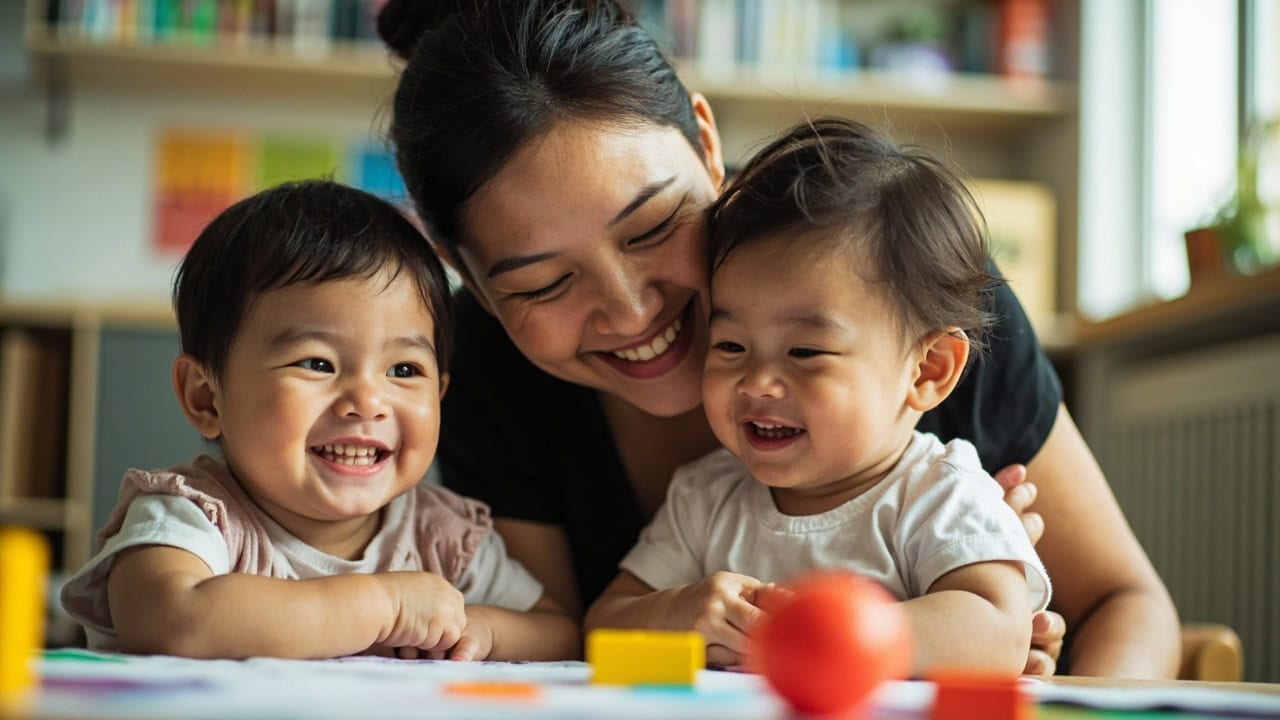
When you walk into a quality childcare environment, you should be able to observe something subtle but unmistakable: your child is at ease, but not passive. They are engaged with people beyond your household.
They look to their caregiver not with fear or mechanical compliance, but with the kind of recognition that says, “this is someone who knows me.” They may show off a little — a small triumph, a funny face, a story they cannot wait to tell.
That showing off is not trivial. It is evidence of emotional safety. It is proof that your child feels secure enough to seek attention, to perform, to risk making a mistake in front of someone whose opinion matters to them.
Signs to Watch For at Pickup Time
In a quality environment, caregivers do not rush to eliminate every conflict or smooth over every friction. They create what developmental psychologists call “scaffolding” — supporting children just enough to navigate the moment, to find words, to negotiate, to learn that relationships have texture and that discomfort is not danger.
When you hear your child say:
- “She took my toy and I asked her to give it back and she did.”
- “He didn’t want to play my game so I asked someone else.”
Those are not small moments. Those are the building blocks of social competence — and they are happening in the third place.
The Difference Between Supervision and Intentional Care
Supervision is keeping children safe. It is a floor, not a ceiling. It is necessary, but it is not sufficient.
Intentional developmental care means the adults in the room understand what they are facilitating:
- They know that a block tower falling is an opportunity to teach persistence and fine motor coordination simultaneously.
- They know that a toddler tantrum is a lesson in emotional regulation, not a disruption to be managed.
- They know that the way a caregiver speaks to a child who has just fallen — with calm reassurance and honest acknowledgment — becomes the internal voice that child will carry into future moments of distress.
Children who have secure attachments at home are actually better equipped to form additional attachments with trusted caregivers. They carry their sense of safety with them. What they learn in the third place is that the world contains many kind people, that love is not a finite resource, and that they can trust beyond the circle of their immediate family.
This is not a threat to your bond with your child. It is an enrichment of your child’s understanding of what relationships can be.
What to Look For When Choosing Infant Care in Singapore
When you find yourself standing at the door of a childcare environment, watching your child play or learn or be held, here is what you are actually looking for:
- Signs of emotional safety: Does your child seek out the caregiver? Do they show off, knowing they will be received with warmth?
- Active engagement, not just supervision: Are caregivers down at the children’s level? Are they narrating, responding, scaffolding — or just watching?
- Room for growth, not just comfort: Are children being gently challenged to navigate social moments, with support available but not intrusive?
- A sense of community: Do the children seem to know each other? Is there a sense of belonging, not just attendance?
- Caregiver-child relationship: Do caregivers speak to children with warmth and purpose? Do they acknowledge feelings, name situations, support resolution?
You are not looking for perfection. You are not looking for a clone of home. You are looking for evidence that your child is building the social confidence that neither you nor school can provide alone.
Questions Singapore Parents Actually Ask
“Am I settling for the minimum?”
When you choose quality third-place care, you are not settling for supervision while you work. You are making an active, intentional decision to expand your child’s world in a way that home and school alone cannot accomplish.
You are saying: I want my child to know how to be in relationship. I want them to feel comfortable with trusted adults beyond me. I want them to have the experience of a small community that knows their name, anticipates their needs, celebrates their small victories, and holds them with care when they are tired or frustrated or sad.
“Will this confuse my child about attachment?”
Quality third-place care deepens attachment security rather than dividing it. Children who feel securely attached at home carry that foundation into new relationships. The third place teaches them that love is expansive, not scarce.
“How will I know if it’s working?”
You will know by the signs at pickup time: your child is at ease but not passive, engaged with caregivers and peers, showing off in safe ways, navigating small social challenges with growing composure.
And you will know by what comes later. Children who have had quality third-place experiences arrive at school ready — not just academically, but socially. They know how to enter a room full of peers, how to find their place in a group, how to speak to a teacher.
EduNanny: The Bridge Between Home and School
This is where EduNanny by BUTLER enters the picture — not as a replacement for what you provide, but as a deliberate, thoughtful partner in this third-place developmental space. We are not simply offering a service. We are offering a framework for understanding why this space matters, and a commitment to filling it with intention.
EduNanny participates in the ECDA Childminding Pilot, which means our approach is grounded in recognized standards for quality childminding in Singapore. We offer both home-based care — where your child is looked after in a familiar, nurturing environment — and centre-based options, depending on what fits your family best.
Our caregiver ratios are designed to ensure that every child receives meaningful attention — up to one caregiver for every three infants in our care, so that interaction is not diluted by numbers. Our care operates during structured Monday to Friday blocks, giving families the consistency that children thrive on.
We have also built transparency measures, including communication practices and where applicable, CCTV arrangements, because we understand that trust must be both earned and visible.
Making Quality Care Accessible
We know that cost is a real consideration for Singapore families, and we have designed our pilot fee structures with accessibility in mind. Parents in our programme can utilize the Child Development Account and Baby Bonus schemes, making quality childcare a feasible investment rather than an impossible luxury.
This is not incidental to our mission. We believe that every child deserves a developmental third place, and that financial constraints should not be the reason a child misses the opportunity to build social confidence in a safe, intentional environment.
A Philosophy Made Tangible
What sets EduNanny apart is not a single feature but a philosophy made tangible.
We see ourselves as the bridge between what you provide at home and what school will eventually offer. We are the space where your child learns to share, to wait, to be disappointed and recover, to celebrate someone else’s win, to ask for help, to offer comfort.
We are the environment where your child’s social and emotional intelligence is not left to chance but is cultivated with the same seriousness you would bring to any other aspect of their development.
The Long View
Quality childcare is not a detour from your child’s development. It is a direct investment in the social fluency that will shape their schooling, their friendships, their careers, their marriages, their parenting.
It is infrastructure for being human.
This is not a small vision. It is one of the most forward-thinking decisions a parent can make — not as a concession to work, but as an intentional expansion of their child’s world.
EduNanny was created for this moment in Singapore’s parenting story — a moment when parents are ready to demand more than supervision, when they understand that their child’s development is not confined to one environment, when they are ready to choose with intention and trust with clarity.
We are honoured to walk alongside you in this chapter. We know what it means to hand your child to someone else. We know the weight of that trust.
And we take it seriously every single day.
Your child is learning to be a person in the world. Let us help them learn it well.
If you would like to learn more about how EduNanny supports families in Singapore, please get in touch or visit our about us page.