Finding Childcare That Grows With Your Child in Singapore
The Question Singapore Parents Rarely Ask Out Loud
There is a question that most Singapore parents never ask out loud. Not because they lack the words, but because asking it would mean acknowledging something that feels almost too vulnerable to name.
It sounds like this: What happens when my child grows out of the care they are in?
It sounds small when said plainly. But if you are a parent listening, you know exactly what sits beneath that question. You know the particular texture of worry that comes not from the first drop-off, not from the settling-in weeks, but from something deeper — the fear that the relationship you have worked so carefully to build, the trust you have extended to a caregiver, the routines that have finally begun to feel like second nature, might one day simply stop being enough.
That as your child changes, the care will remain fixed. That the people who know your child best will not know how to grow alongside them. That you will find yourself, once again, at the beginning — searching, evaluating, hoping, explaining your child to someone new.
This is not the fear of a bad centre. Singapore has no shortage of childcare options, and many of them are excellent. This is something more specific. It is the fear that childcare, however good, might be temporary by design — a placeholder, a service consumed and then moved on from, rather than a relationship that deepens with time.
That fear is not a sign that you are being too demanding. It is a sign that you understand what childcare can actually become — and that you are not willing to settle for anything less.
Why Childcare Should Grow With Your Child
The relationship between a parent, a caregiver, and a child is not a moment. It is not the tour you take, or the first morning you hand over your baby, or even the day your child waves goodbye without looking back. It is an arc.
The quality of a childcare partnership is not measured in the first impression it makes. It is measured in what it becomes capable of over months and years of knowing one child — not childcare as a service you use during a transition, but childcare as a sustained developmental companion that grows with your child, learns alongside them, and meets each new version of them with the same attentiveness it brought to the first.
Singapore parents face a particular kind of pressure. You are navigating one of the most competitive educational landscapes in the world, balancing demanding careers with the desire to be present, to be involved, to get this right.
You are often doing it without the village that previous generations took for granted — the extended family close at hand, the community of neighbours who watched children grow up together.
In this context, childcare is not a luxury. It is a choice made out of love and necessity intertwined, and it deserves the same seriousness and intentionality you bring to every other decision about your child’s future.
Infant Care: Where the Partnership Begins
When a baby enters infant care, something remarkable is already happening — something that most parents feel instinctively but that bears naming clearly. The baby is not simply being fed, changed, and held. The baby is learning what it means to be known.
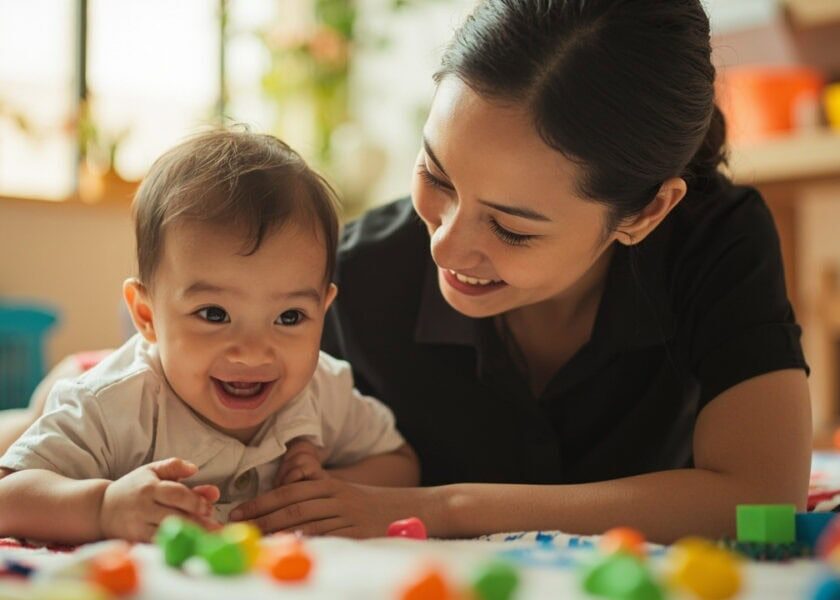
In those earliest weeks and months, infant care is built on what we might call sensory trust. Your child is learning, through the reliable rhythm of care, through the consistency of touch and voice and response, that the world is a place where their needs are anticipated and met.
This is not a passive experience. Even in infancy, your child is an active observer. They notice who picks them up, who settles them, who responds to their particular cry versus another child’s. They are building, in those small daily interactions, the foundations of security, of curiosity, of the capacity to form relationships.
Why Caregiver Ratio Matters
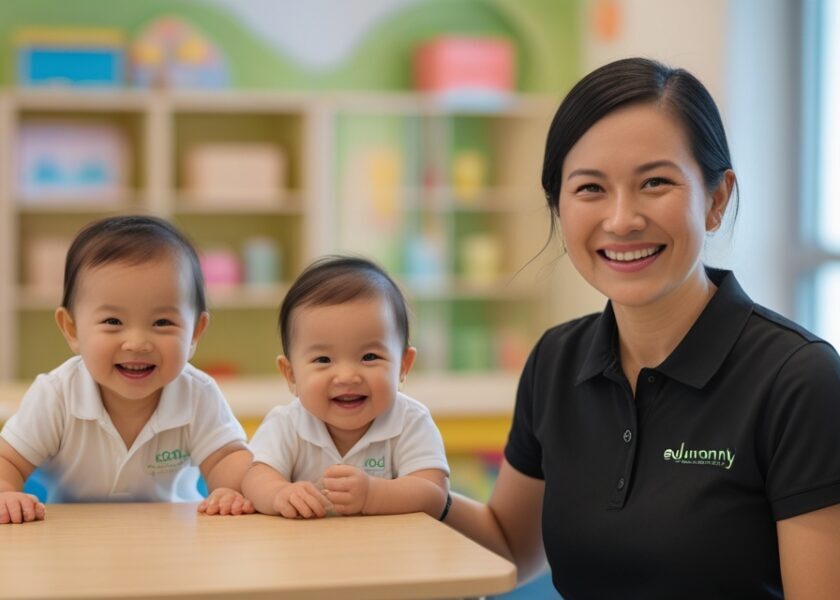
This is why the caregiver-to-infant ratio matters so profoundly. In a setting where a caregiver holds one, two, or at most three infants, that caregiver has the space to notice.
To learn that Baby A soothes differently than Baby B. That one child prefers to be rocked left, not right. That another needs a few extra minutes of stillness before the bottle.
These are not small details. They are the building blocks of genuine understanding — and they are only possible when there is time and attention enough to notice.
The Knowledge That Makes Everything After Possible
Here is what many parents do not realise: infant care is not only about what happens in those first twelve months. It is about what is built in those months that makes everything after possible.
When a caregiver has spent a year learning your child’s sleep patterns, their feeding rhythms, their particular way of expressing curiosity or distress, they have something invaluable. They have context. They have a baseline. They have the deep familiarity that allows them to notice, months or years later, when something is slightly off:
- When a toddler who usually demolishes breakfast is pushing food around the plate
- When a child who normally runs toward the door is hanging back
- When the way your child holds a crayon has shifted in a way that signals a developmental leap
This is what continuity of care means. It is not simply about your child avoiding the disruption of changing caregivers — though that matters. It is about the accumulated knowledge that makes every subsequent stage of care richer, more responsive, more attuned.
Toddlerhood: When the Partnership Must Evolve
And then comes toddlerhood, and everything changes.
The toddler who arrives at care one morning still holding a comfort toy and a parent’s hand is not the same child who will leave that same afternoon eighteen months later — running, talking, negotiating, full of opinions about which story comes first and whether the blue cup is truly superior to the red cup.
Toddlerhood is a revolution. And a genuine childcare partnership must be able to meet that revolution with something more than patience. It must be able to evolve.
What That Evolution Looks Like in Practice
It looks like a caregiver who, having spent the infant months learning to read a child’s non-verbal cues, now shifts to meet a child who is learning to use words.
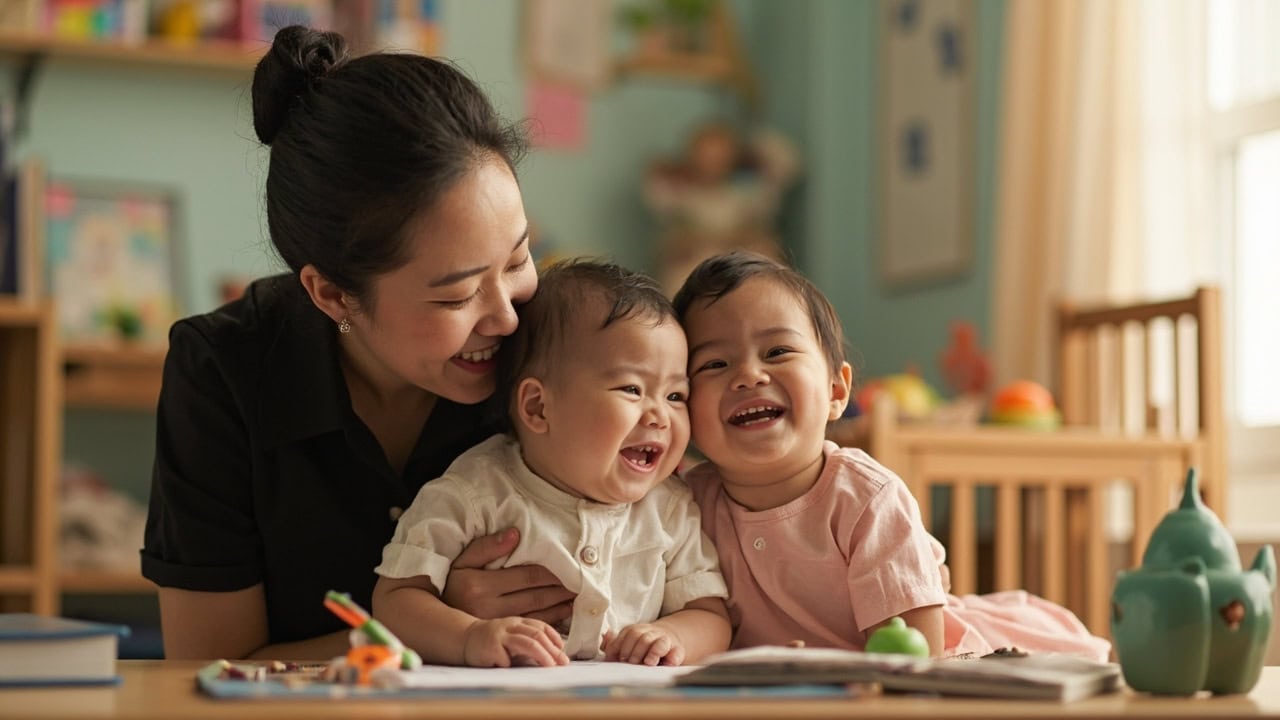
It looks like communication that expands — from daily notes and photos of milk intake and nap times, to conversations about what your child is exploring, how they are navigating peer interactions, what stories they keep asking for at circle time.
It looks like the relationship between parent and caregiver becoming a genuine partnership of observation and exchange, where both parties are contributing to the same understanding of who this child is becoming.
The True Test of Childcare Quality
This is where the true test of childcare quality reveals itself. The settling-in period is something a centre can prepare for. The first weeks can be smooth, warm, reassuring — and that matters.
But toddlerhood cannot be planned for in quite the same way. It is unpredictable. It is fast. It asks the caregiver to let go of the rhythms that worked in infancy and to find new ones that honour the child’s growing autonomy without abandoning the safety of structure.
For a caregiver who has known your child since infancy, this transition is not a disruption. It is a continuation. They have watched your child pull themselves up on furniture, take those first independent steps, reach for words instead of pointing. They have been there, in small daily ways, for every milestone. They do not have to learn your toddler anew. They are simply meeting the same child in a new phase of expression.
This is what distinguishes a transactional childcare relationship from a developmental one. In a transactional relationship, the service ends when the child’s needs exceed what was agreed upon. In a developmental relationship, the arrangement evolves because the caregiver has been paying attention — and because the structure of care itself was built to accommodate growth.
School Readiness: The Partnership’s Final, Most Beautiful Phase
And then comes school readiness, and the partnership enters its final, most beautiful phase.
School readiness is not about whether your child can recite the alphabet or count to twenty. It is about whether your child arrives at formal learning with the foundational confidence to be a learner.
What School Readiness Actually Means
It is about executive function — the ability to focus, to wait, to try again when something is hard. It is about social-emotional competence — the ability to be part of a group, to navigate conflict, to understand that other people have perspectives different from their own. It is about curiosity — the persistent, irrepressible desire to know why, how, what next.
These are not skills that can be drilled into a child in the months before Primary One. They are dispositions cultivated over years, in environments that understand child development deeply and provide the right kinds of support at the right stages.
When Care Becomes a Shared Mission
When a caregiver has known your child from infancy, has walked alongside them through toddlerhood, and is now preparing them for school, something remarkable happens. The preparation for school becomes a shared mission between home and childcare — not two separate worlds that happen to intersect, but a unified understanding of who this child is, what they need, and how they learn best.
The caregiver knows your child’s relationship with challenge — whether they need gentle encouragement or a confident push, whether they thrive with structure or need more freedom to explore. They know how your child handles transitions, how they form friendships, what makes them light up.
This knowledge, accumulated over years, becomes the most powerful tool in preparing your child for what comes next.
And the communication between parent and caregiver in this phase is at its richest. There are conversations about milestones that matter, about concerns that may arise, about the particular strengths and growing edges that will shape your child’s experience in formal education. It is a relationship that has matured alongside the child it serves.
What to Look For — And What EduNanny Offers
When evaluating childcare options, ask not only what the centre looks like on a tour. Ask what it looks like in six months, in a year, in two years. Ask how the caregiver approach evolves as children grow. Ask about continuity of care — not as a feature checkbox, but as a lived practice.
Ask what happens when your child transitions from one developmental stage to another. Ask where the communication goes from here.
These questions will tell you more than any beautifully designed classroom or impressive activity schedule. They will tell you whether you are looking at a service, or at a partnership.
What EduNanny Singapore Offers
EduNanny Singapore offers what Singapore parents have been quietly asking for: childcare that grows with your child.
EduNanny operates within the ECDA Childminding Pilot, and that context matters. The Pilot represents a deliberate investment by Singapore in reimagining what childcare can be — not as a standardised service, but as a flexible, responsive, relationship-centred approach to early childhood.
- In the infant care phase, EduNanny maintains ratios that allow for deep observation and responsiveness
- Pilot fee structures are designed to make this level of care accessible
- CDA and Baby Bonus mechanisms can be applied, extending government support into the daily reality of childcare costs
- Communication and transparency measures allow parents to stay connected to their child’s day
EduNanny also offers a Thomas AI Chatbot — a practical resource for parents navigating the real, daily complexities of childminding. From questions about developmental milestones to concerns about feeding and sleep, from the mundane logistics of care to the more uncertain moments when parents are not sure whether what they are experiencing is normal.
This is not artificial intelligence replacing human judgment. It is technology extending the reach of support, making reliable guidance available in the moment when parents need it, rather than only during scheduled consultations.
Common Questions, Direct Answers
“Will the caregiver really know my child?”
Not all childcare arrangements are designed to know your child deeply. Many are structured around efficiency, throughput, and standardised processes. The questions you ask — about ratio, about continuity, about how the caregiver approach evolves — will quickly reveal which type of arrangement you are looking at.
“What if my child has special needs or unique challenges?”
A caregiver who has known your child from infancy has context. They know your child’s baseline. They are more likely to notice subtle changes that might indicate a developmental concern — and more likely to flag them to you in a way that is helpful rather than alarming. This accumulated knowledge is particularly valuable for children with individual needs.
“Is this affordable?”
Quality care at the ratio necessary for genuine understanding is an investment. EduNanny’s pilot fee structures and the ability to apply CDA and Baby Bonus mechanisms are designed to make this level of care more accessible. The question to ask is not simply whether you can afford it, but whether you can afford not to invest in the kind of care that will serve your child across developmental stages.
“What happens when my child transitions between stages?”
Ask specifically how the caregiver prepares for and manages developmental transitions. A childcare arrangement built for growth will have thought about this carefully. A transactional arrangement may not have an answer beyond “we’ll see when we get there.”
The Long Arc: For the Road, Not Just the First Steps
There is a phrase that is often used in early childhood education circles: that the first thousand days of a child’s life are the most important for brain development. This is true, and it matters. The architecture of neural connections, the foundations of attachment and security, the seeds of curiosity and learning — so much is laid down in those earliest months and years.
But the first thousand days matter. So do the thousand days that follow. And the thousand days after that.
Child development is not a race with a finish line. It is a continuous unfolding — unpredictable in its particulars, certain in its direction. Children who were once infants are toddlers. Toddlers become preschoolers. Preschoolers become schoolchildren, adolescents, young adults.
And at every stage, what they need is to be known. To be seen. To be understood not just as they are now, but as they are becoming.
This is what the long arc of the childcare partnership offers. Not a fixed point, but a trajectory. Not a service consumed, but a relationship that gives.
I began with the question: What happens when your child grows out of the care they are in?
I believe that is the wrong question. Or rather, it is a question that assumes something about the nature of childcare that does not have to be true. It assumes that childcare is something children grow out of — that the relationship has an expiration date, that the partnership is designed to end.
But what if the right question is different?
Who will grow with my child?
Who will notice, in the toddler years, the particular way your child’s language is blossoming — the new words emerging, the longer sentences forming, the delightful neologisms that only someone paying close attention would catch?
Who will celebrate with you when your child masters the tricycle, or conquers the climbing frame, or finally sits still for a whole story?
Who will bring genuine insight to those parent-teacher conversations, not because they have read a file, but because they have been there — week after week, month after month — watching your child become more fully themselves?
If you are a parent in Singapore right now — whether your child is six months old or three years, whether you are just beginning to think about childcare or whether you have been navigating it for years — what you are looking for is real.
The partnership that grows with your child, that deepens over time, that becomes a genuine extension of your family rather than a separate institution — it exists. It is possible. And it is worth choosing.
Not because any childcare arrangement is perfect, because none are. But because the choice to invest in continuity, in attentiveness, in the slow accumulation of genuine understanding — this choice matters. It shapes not only your child’s experience of being cared for, but their understanding of what relationships can be: secure, reliable, evolving, trustworthy.
EduNanny Singapore is here for that. For the long road, not just the first steps. For the partnership that grows alongside your child, and for the parents who understand that this is what childcare, at its best, can become.
If you are ready to explore what a sustained developmental partnership could look like for your family, we invite you to connect with EduNanny Singapore to learn more about their approach to infant care and childminding within the ECDA Childminding Pilot.
You can also learn more about EduNanny and what guides their approach to thoughtful, development-oriented childcare.