What Your Child Is Really Learning While You Are Not There
The Quiet Question at the Gate
There is a moment every parent in Singapore knows. It happens at the gate of the childcare centre, in that pause between the morning goodbye and the walk back to the car or the train to the office. You have dropped your child into what you believe is quality care. You have made this choice carefully. You have weighed the options, visited the centres, asked the questions, felt the weight of the decision.
And yet, in that moment, a quiet question surfaces. Not a panic. Not guilt, not anymore. Something more specific. Something like this: What is actually happening in there? What is my child experiencing right now, while I am not there to see it?
This is not doubt about your choice. It is something more honest than that. It is the desire to understand what you have already trusted. And it is a question that deserves a real answer.
In this article, we will give you the framework to see it. Here is what we will cover:
- The most important developmental work in quality childcare happens invisibly — at the level of neural connections, language acquisition, and social-emotional processing
- Your child’s brain builds more than one million new connections every second in the first three years
- The difference between supervision and intentional developmental support is the difference between keeping a child safe and actively building their future capacity
- You can learn to see the signs of real growth — and stop relying only on “happy child at pick-up” as your measure
- Quality care, when properly designed and expertly staffed, extends what you give your child at home — it does not replace it
Understanding the Invisible Work
The visible signs are there. You see them. A bright, warm room. Your child being welcomed at the door. Perhaps a whiteboard with the day’s activities, or a play yard with slides and tricycles. When you pick up, your child is happy, fed, clean — sometimes tired in that good way that suggests real play happened. The centre sends photos, updates, notes about what was for snack.
These are not nothing. These are the signs of a place that is operating well, that is doing what it says it will do.
But here is what many parents in Singapore sense but do not always have the language for: the visible environment is not the same thing as the developmental environment.
A beautiful room is not automatically a learning architecture. A schedule is not the same as intentional teaching. And a happy child at pick-up is not the same thing as a child whose brain is actively growing, whose language is accelerating, whose sense of self and others is deepening in measurable ways.
The gap between what you can see at drop-off and what is actually unfolding throughout the day is not a failure of transparency. It is simply the nature of early childhood development itself.
Let us begin with the brain itself, because what happens in the first six years of life is nothing short of extraordinary.
A newborn arrives into the world with roughly one hundred billion neurons — nearly all the brain cells they will ever have. But they arrive without the connections between those cells. Those connections — the synapses — are built through experience, through interaction, through the environments they inhabit and the people who respond to them.
In the first three years of life, a child’s brain forms more than one million new neural connections every second. By the time a child turns three, their brain is already eighty percent of its adult size. By six, the foundations of cognitive function, emotional regulation, language capacity, and social intelligence are substantially in place.
This is not a figure of speech. This is the science of neuroplasticity, and it is the reason early childhood educators speak about the first thousand days with such urgency.
The brain is not passively waiting to be taught. It is actively seeking, absorbing, and integrating everything the environment offers. And the environment that shapes it is not just the home. It is every space where the child spends sustained time, encounters new experiences, and receives responsive interaction from adults and peers.
What Quality Looks Like in Practice
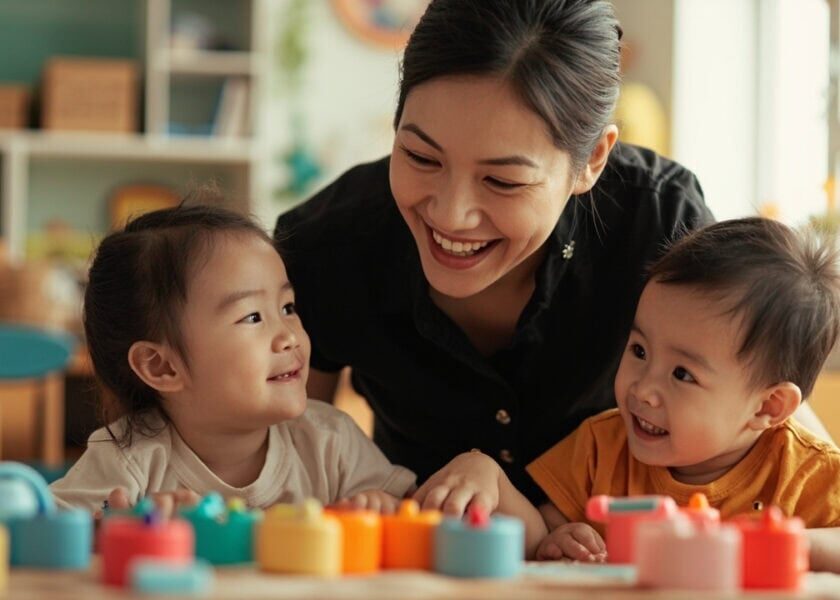
Consider what actually happens in a well-designed infant room. The ratio of caregivers to infants matters here, and it matters deeply.
When one attentive adult is responsible for no more than three infants, something changes in the quality of interaction. Each child’s cues are noticed. Each attempt at communication — whether a coo, a gesture, a reaching hand — is met with a response. The adult narrates the infant’s experience, naming what they see, reflecting back what the child is doing.
This is not decoration. This is the scaffolding of language.
Research consistently shows that infants in responsive care environments hear a significantly greater variety of words, engage in more conversational exchanges, and develop stronger language foundations than those in settings where care is attentive but not intentionally communicative.
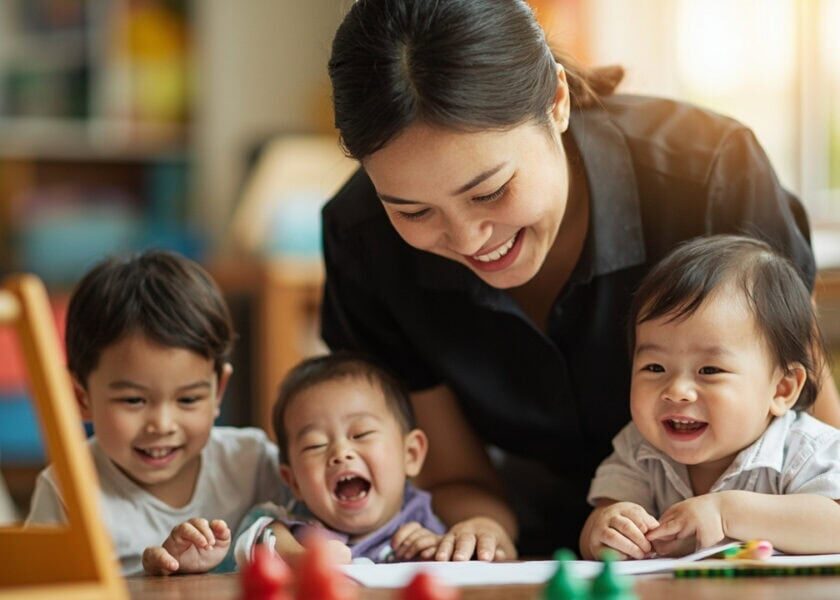
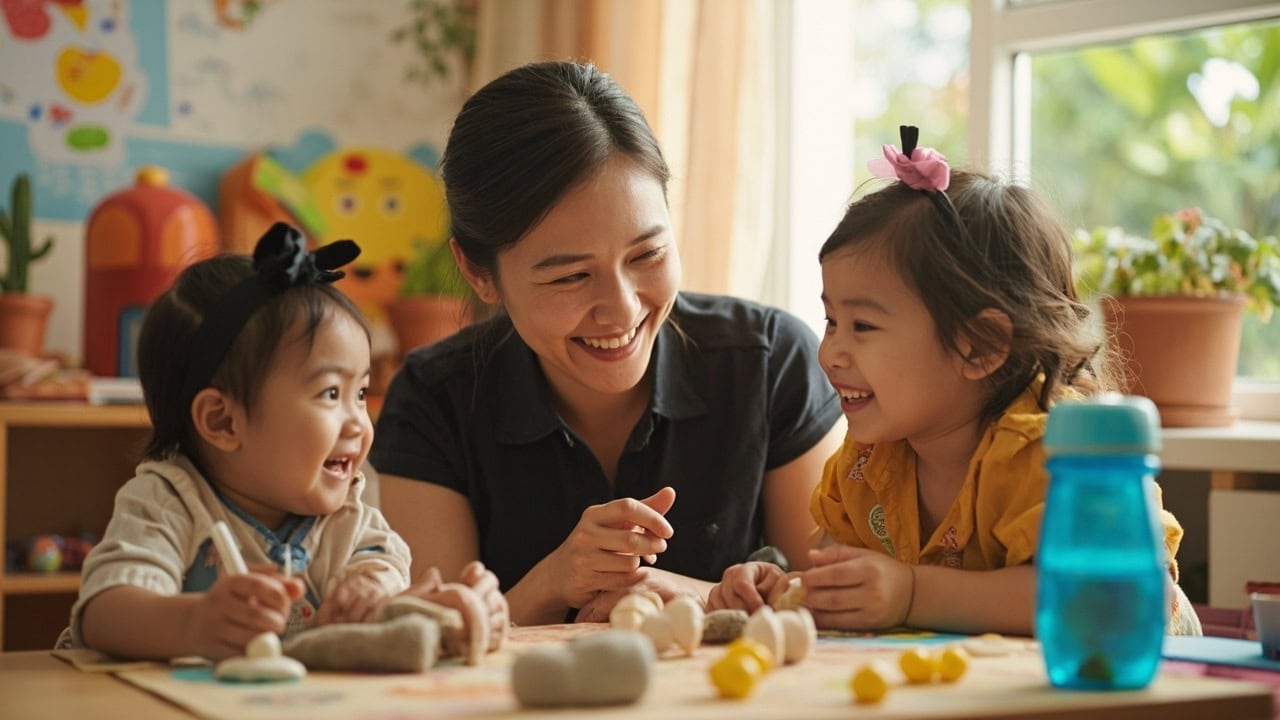
Now extend that thinking to toddlers and older infants in grouped settings. Here, peer interaction becomes an additional engine of growth. When a two-year-old watches another child solve a problem, build a tower, or negotiate over a toy, something developmental is occurring. Observational learning. Social referencing. The early grammar of give-and-take.
These are not lessons that can be scheduled into a forty-five-minute slot. They emerge naturally in environments designed to allow them to happen.
The physical environment matters too. In quality childcare settings, space is not simply space. It is architecture with intent:
- The arrangement of materials matters. Open-ended resources — those that allow multiple uses rather than a single prescribed outcome — are placed at the child’s level, accessible for independent choice.
- Gross motor spaces are designed for safe risk-taking, for the kind of climbing, balancing, and jumping that builds proprioception and coordination.
- Quiet corners exist for children who are processing, who need a sensory break, who are not ready for the stimulation of the group.
Every element has been considered — not to fill the room with activity, but to create a landscape for development.
From Supervision to Intentional Support
This is the distinction that matters most and that is rarely visible at first glance.
Supervision asks the question: Is my child safe, fed, and content?
Intentional developmental support asks a deeper set of questions:
- What is this child trying to do right now?
- What skills are emerging?
- What can I offer to extend their learning?
- Where are they in their developmental trajectory, and how do I create the next appropriate challenge?
These are the questions that qualified, trained teachers ask throughout the day in a quality programme.
This is why the word teacher matters when we talk about early childhood educators — not merely caregiver or supervisor.
The best infant and childcare teachers are trained observers. They watch not just for safety, but for the subtle indicators of growth. They notice when a child who once needed help using a spoon begins to try independently. They observe when a child’s block constructions shift from stacking to bridging. They mark the moment a child moves from parallel play — playing beside others — to cooperative play, playing with them.
None of this is magic. It is the product of intentional practice, ongoing professional development, and a genuine love of children’s learning. And it is what distinguishes quality from mere adequacy.
What Parents Can Watch For
So what does this look like from the parent’s side? What can you actually see?
Many parents are watching for the wrong signs — or at least, incomplete ones. They look for happiness, and happiness is real and important, but it is not the same as growth. They look for learning in the way they understand it from their own school experience, as worksheets or letters or numbers.
But the most significant development happening in a quality childcare setting is happening in domains that are harder to photograph and harder to summarise in a daily note.
When you receive updates from your childcare provider, whether through an app, a daily sheet, or a conversation at pick-up, start looking for these categories of observation:
Language and Communication
Does the update describe new words your child used or responded to? Does it mention your child pointing to things and naming them, asking questions, or engaging in back-and-forth conversation with a teacher or peer?
Motor Development
Does it describe your child climbing, jumping, pedalling, manipulating small objects, drawing with a fist or eventually with fingers?
Social-Emotional Growth
Does it mention your child sharing, taking turns, showing empathy, resolving conflict with words rather than actions, or seeking comfort from familiar adults?
Cognitive Exploration
Does it describe your child experimenting, testing, problem-solving, asking “why,” or showing curiosity about how things work?
These are not separate categories. They are threads of the same fabric, and in quality care, they are all being woven simultaneously throughout the day.
You may also begin to notice changes at home that you did not put there yourself:
- A new word that could only have come from a childcare setting
- A social behaviour, like handing you a cup and saying “here you go,” that emerged from watching teachers model care for other children
- A motor skill that you know your child did not have last month
These moments of recognition — when you see that something has shifted inside your child and you can trace it to the environment you chose — are the moments that transform trust from an act of faith into evidence-based confidence.
This is the invisible becoming visible. Not because the childcare centre revealed it, but because you now have the lens to see it.
What to Look For When Choosing Infant Care
If you are currently evaluating childcare options, here is a practical guide to what matters most:
| What to Observe | Why It Matters |
|---|---|
| Caregiver-to-infant ratio | Lower ratios enable responsive interaction and observation |
| Teacher qualifications and training | Trained observers notice and support emerging skills |
| Physical environment design | Intentional spaces support motor, cognitive, and social development |
| Quality of communication | Updates that describe growth, not just routine |
| Consistency of caregivers | Attachment requires predictable, familiar faces |
| Opportunities for child-led play | Open-ended resources and free exploration build creativity |
| Peer interaction opportunities | Social learning accelerates language and emotional intelligence |
You might also find yourself asking these questions — and they deserve honest answers:
“Is my child just being supervised, or are they actually learning?”
The answer lies in the ratio of caregivers to children, the training of the adults in the room, and the intentionality of the environment design. Ask about teacher qualifications. Ask about the daily structure. Ask what kind of observations are being documented and shared.
“How do I know the investment is worth it?”
The investment in quality childcare is not primarily an investment in supervision. It is an investment in neural architecture. It is an investment in the language foundations that will shape how your child thinks and speaks for the rest of their life. It is an investment in the social-emotional skills that will determine how they navigate relationships, conflict, and collaboration decades from now.
“What if I feel guilty about not being there?”
The guilt many parents feel is often a signal of high engagement, not failure. The research is clear: children thrive when they have consistent, responsive care in multiple environments. Quality childcare, when it is truly quality, extends what you give your child at home. It does not compete with your role. It complements it.
Where Philosophy Meets Practice
For families in Singapore navigating the landscape of infant and childcare options, the difference between a programme that merely supervises and one that actively supports development is not always easy to identify at first glance. It lives in decisions made before you ever walk through the door — in ratios, training frameworks, and the architecture of daily interaction.
Within the ECDA Childminding Pilot, EduNanny maintains ratios of up to one to three for infant care. This is not an administrative convenience. It is a pedagogical conviction. Every additional infant in a caregiver’s care dilutes the quality of responsive interaction. The one-to-three ratio means that each infant receives sustained attention, that their cues are noticed, that their emerging skills are observed and supported in real time.
This is the ratio that makes the invisible work possible.
The pilot framework also shapes how EduNanny approaches accessibility. Fee structures are designed to integrate CDA and Baby Bonus usability, reflecting a belief that the first thousand days should not be determined by postcode or income. This is not a subsidy programme added on — it is built into the service model.
Monday to Friday care blocks are available, because Singapore parents work, and because consistency of environment is itself a developmental factor. Children grow best when they can count on the same trusted faces, the same predictable rhythms, the same safe base from which to explore.
Communication and transparency are woven into the service design. Updates that go beyond “had a good nap” and into the territory of observation and growth. Conversations at pick-up that treat parents as partners in understanding the child’s day. Documentation that builds over time into a portrait of your child’s developmental trajectory.
For parents with questions that arise at odd hours — when you are sitting with your child after a long day and wondering whether a behaviour is typical, whether a milestone is on track — evidence-informed resources stand alongside the direct communication with caregivers. These tools support the parent’s intuition without replacing the expertise of trained educators.
Reconsidering the Childcare Day
When you drop your child at a quality programme, you are not handing them off to be kept busy while you work. You are placing them inside a learning architecture. You are giving them access to peer interaction that accelerates language. You are providing them with physical environments designed for motor development. You are Surrendering them to the attention of adults whose job is to watch, to notice, to respond, to extend.
You are giving them the experience of structured play — which is not the opposite of learning but the highest form of it.
The time your child spends in quality childcare is not time away from development. It is time inside development.
And when you pick them up in the afternoon, and they climb into your arms with that particular tiredness that comes from real exertion, real exploration, real social engagement — you are not imagining the growth. You are witnessing its visible expression. The invisible work has been happening all day. Now you are seeing its surface.
Your doubt — that quiet question at the gate — was never a sign of failure. It was a sign of engagement. You care about what is happening. You want to understand.
And now you have the framework to see it.
The brain that is forming inside your child right now, this very moment, is building the architecture for everything that comes next:
- The language they will use to think and speak
- The emotional regulation they will need for relationships and challenges
- The cognitive flexibility that will help them adapt to a world we cannot yet imagine
- The social instincts that will shape how they connect, collaborate, and contribute
Quality childcare, when it is truly quality, is not a substitute for what you give your child at home. It is an extension of it. It is a second environment, a second set of voices, a second landscape of experience, designed with intention and delivered by people who understand that the work they do in these early years echoes across decades.
EduNanny Singapore is part of the BUTLER group and operates within the ECDA Childminding Pilot framework. For families seeking consistent, development-focused care in Singapore, learn more about EduNanny’s approach or get in touch to discuss your family’s needs.