The Fear You Feel Dropping Your Child at Childcare Is Not Weakness, It Is Love
The Fear You Carry Is a Sign of Love
The quiet anxiety you feel when dropping your child at childcare is not weakness or doubt. It is the feeling of a parent who loves deeply, who is paying attention, and who understands that the early years matter.
Here is a reframe that changes everything: quality childcare does not replace what you give your child. It extends it. Children develop security through attunement — the quality of emotional responsiveness — not through the sheer number of hours spent in one person’s presence. Attachment research shows that children can form multiple secure attachments. The primary bond does not weaken. It expands.
The guilt you may feel about placing your child in someone else’s care is not evidence of a mistake. It is evidence of love. But left unexamined, that guilt can become a distortion — making you feel that your presence is the only thing that matters, that every hour apart is an hour lost, that your child will somehow be diminished by the care of another.
This is not what the research shows. And more importantly, it is not what children experience.
Choosing quality childcare is not a departure from the warmth you provide. It is an echo of it.
What Quality Childcare Actually Means
In those first years of life, a child’s brain is building itself at a speed it will never match again. Neural connections form at a remarkable rate in the earliest months. Every interaction, every response, every moment in which a child’s need is noticed and met with warmth shapes the architecture of that growing mind. This is not metaphor. This is neuroscience.
But what is often misunderstood about this process is that what matters most is not the sheer number of hours a child spends in someone’s presence. It is the quality of attention that presence carries.
Understanding Attunement
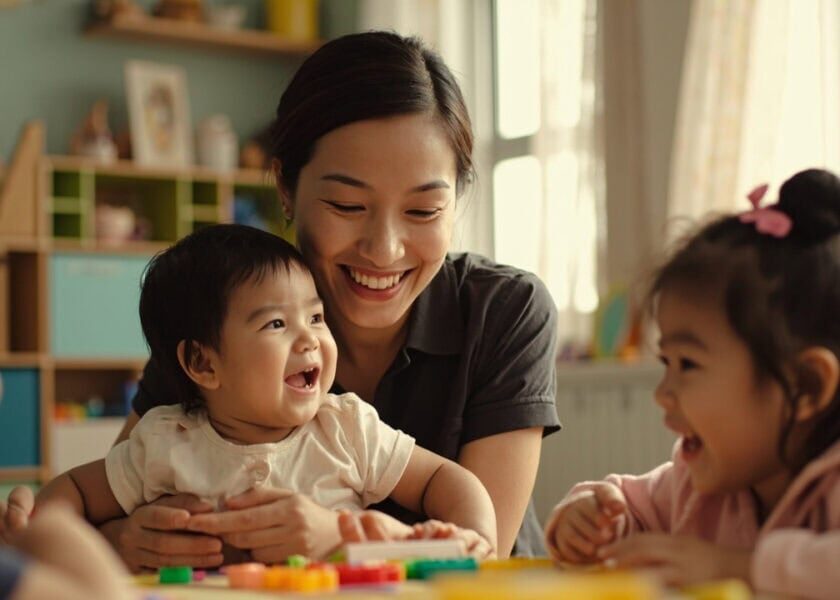
Attunement describes a kind of rhythm — a responsiveness, a meeting of minds and hearts between a caregiver and a child. When a caregiver is attuned to a child, they are reading the child’s signals, interpreting them accurately, and responding in a way that makes the child feel felt. Known. Held, not just physically but emotionally.
Consider what this looks like in everyday moments:
- When your baby fusses and a caregiver responds before the cry builds into something unmanageable, that is attunement.
- When your toddler throws a block in frustration and the caregiver names what they are feeling before redirecting them, that is attunement.
- When your child wakes from a nightmare and the caregiver is there — not just with their body but with warmth and calm — that is attunement.
Attunement is not a place or a person. It is not something that can only exist in one setting, with one face, in the hours you are physically present. Attunement is a quality of care that can be learned, practiced, and offered by anyone genuinely committed to understanding and responding to a child.
When a caregiver is attuned to your child, the same neural pathways that form in your presence begin to form in theirs. Not instead of you. Alongside you.
What the Science Says About Attachment
Decades of attachment research have shown that children can form multiple secure attachments. This is not a compromise or a lesser outcome. This is how human development works.
A child who feels securely attached to their parents has a foundation of trust and emotional regulation that allows them to reach out and connect with other attuned caregivers. The primary attachment does not weaken. It expands. It becomes a base from which the child can safely explore, knowing they have a home to return to — literally and emotionally.
Think of it this way: your child’s secure attachment to you is not a limited resource that gets depleted by time spent with others. It is a foundation. A strong foundation allows a child to build outward, to form new connections, to trust the world — because they know, at their core, that they are loved and that they belong.
Children are remarkably adaptive. They do not experience quality childcare as abandonment. They experience it as a new relationship — one layered on top of the secure base you have already established.
In attuned childcare, your child learns that the world contains people who can know them, respond to them, and help them feel safe. This is not a diminishment of you. It is an expansion of your child’s emotional world.
When your child returns to you at the end of the day, they are not returning to someone who has replaced you. They are returning to the person they know most deeply, the person whose attunement they have experienced most completely — their primary emotional home.
The bond is not eroded by the hours apart. It is reinforced by the consistency of care — the felt sense that their needs matter and will be met, whether at home or in childcare.
How to Recognise Quality Care
When you visit a childcare setting, you are right to look at safety, cleanliness, ratios, and curriculum. These things matter. But the most important thing you can look for is harder to measure and easier to feel: attunement.
What Attuned Care Looks Like
- A caregiver who notices when a child’s focus is slipping and gently shifts the activity before frustration sets in.
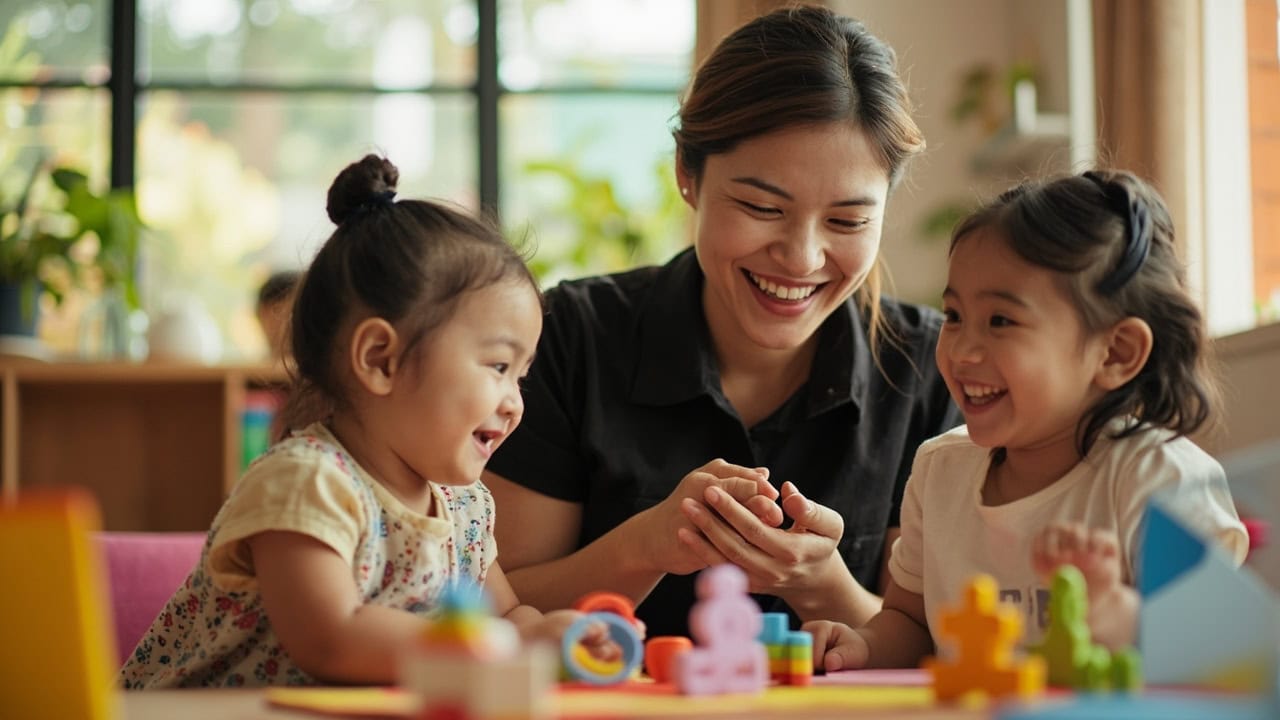
- A caregiver who bends down to a toddler’s level when they speak — not just to be seen, but to truly communicate.
- A caregiver who does not just stop a baby from crying, but who holds them in a way that communicates: I know this is hard for you. I am here. You are safe.
- Consistency — attunement is not a performance for visitors. It shows up again and again, in the ordinary moments, when no one is watching.
Questions to Ask and Things to Notice
When you ask a caregiver about their approach, listen for specificity. Listen for how they talk about the children in their care — whether they describe individual temperaments, preferences, the things that soothe them, the things that challenge them.
A caregiver who knows your child as an individual — not just as one of a group to be managed — is a caregiver who is paying attention. And attention is the raw material of attunement.
Surface Warmth vs. Genuine Responsiveness
Surface warmth is not the same as attunement.
A caregiver can be cheerful and kind and still miss the quiet signals that a child is overwhelmed, or bored, or needing something they cannot yet articulate. Warmth is necessary but not sufficient.
What you are looking for is responsiveness — the willingness and ability to read a child’s cues, to adapt, to meet them where they are, to help them feel understood rather than just comforted.
Watch how caregivers respond when a child is upset — whether they are distracted or patient; whether they are doing the minimum to stop the distress, or doing what it takes to help the child feel held.
Trust yourself. You already know what attuned care feels like, because you practice it every day. You will recognise it when you see it.
Understanding Your Options in Singapore
For parents in Singapore navigating infant care for the first time, the options can feel overwhelming. Centre-based care, home-based care, nanny services — each has its own strengths. What matters most is not the model but the quality of human connection it enables.
In Singapore’s ECDA-regulated environment, quality standards provide an important baseline. The ECDA Childminding Pilot represents a commitment to standards that go beyond the typical — lower infant ratios, meaningful caregiver training, and oversight mechanisms designed to protect your child’s wellbeing.
When evaluating options, look for providers who understand that quality childcare is defined by the quality of attention your child receives — not by facilities alone, however well-resourced they may be. A home-based arrangement with an attuned caregiver may serve your child better than a centre with excellent programmes but hurried interactions.
Our Approach
EduNanny was founded on a belief that parents deserve more than logistics — more than a place that will keep your child safe and entertained while you work. You deserve a place that understands what your child actually needs: not a curriculum alone, though learning matters; not a facility alone, though it should be clean and well-resourced — but a human being who will notice your child, respond to your child, and hold your child’s emotional world with the same care you do.
Our approach reflects what research confirms: that quality childcare is defined by the quality of attention your child receives. Our infant ratios — maintained at one to three — mean that every child in our care has the space to be known as an individual. Our caregivers are trained not just in safety and development, but in responsiveness, in attunement, in the art of understanding and meeting a child’s emotional needs.
We know that trust is earned, not assumed. That is why transparency is built into everything we do. Where deployed, our CCTV arrangements give you windows into your child’s day — not surveillance, but reassurance. Our communication practices keep you informed with real information about how your child is, what they are enjoying, where they might be struggling.
We believe you should never feel that you are handing over your child and hoping for the best. You should feel that you are entering a partnership, one in which your child’s wellbeing is a shared purpose.
Moving Forward with Confidence
If you are searching for childcare, look not just at the facilities or programmes, but at the people. Ask about their approach to responsiveness. Observe how they interact with the children in their care. Trust what you feel when you walk into a room.
You already know what attuned care looks and feels like. You practice it every single day. Look for caregivers who are genuinely curious about your child — who want to know their temperament, their preferences, their fears, their joys. Look for caregivers who respond rather than merely manage. Look for consistency, for patience, for warmth that goes deeper than the surface.
Choosing quality care is not a compromise of your love. It is an expression of it.
Quality childcare can offer your child not a substitute for your presence, but a bridge. A bridge between the intimacy of home and the wider world. A bridge that carries your child’s sense of security forward, so that they can explore, learn, grow, and then come home again — whole.
In attuned childcare, your child learns something precious: that the world is full of people who can hold them well. That safety and love are not limited to one person, one place, one set of hours. That they can venture out and trust that they will be welcomed back, understood, loved.
There is a moment — perhaps you have felt it — when you watch your child settle into someone else’s arms. What you are feeling is not a sign that something is wrong. It is a sign that you are paying attention. That you understand, at a level that cannot be measured or quantified, that your child is precious, that their wellbeing matters more than anything else, and that the choices you make in these early years have a weight and a meaning that will echo forward into their lives.
Quality childcare does not take something from your child. It adds to their sense of being held, being known, being secure. It is not a departure from the warmth you provide. It is an echo of it.
We are here to be that echo — to extend the care you give your child into the hours you are apart, so that your child carries your warmth with them wherever they go and brings it home again at the end of the day, unchanged, unbroken, more secure than before.
If you are exploring childcare options in Singapore, we welcome the conversation. Not as a transaction, but as a beginning — a partnership in caring for the person who matters most to you.
Begin your search with a team that understands both the science and the heart of what your child needs.