What Your Child’s Brain Needs From Childcare
The Science of Early Brain Development
Consider what is happening inside your child’s brain during these early years—these first months and years that feel so full of feedings and naps and tender moments, but that are also, quietly and invisibly, the most intensive construction project the human body will ever undertake.
From birth to roughly age three, your child’s brain forms neural connections at a rate of approximately one million per second. By the time that child is three years old, they will have created far more synaptic connections than they will ever have again in their lives.
This is not a statistic designed to overwhelm you. It is the key to understanding what children actually need from the people who care for them.
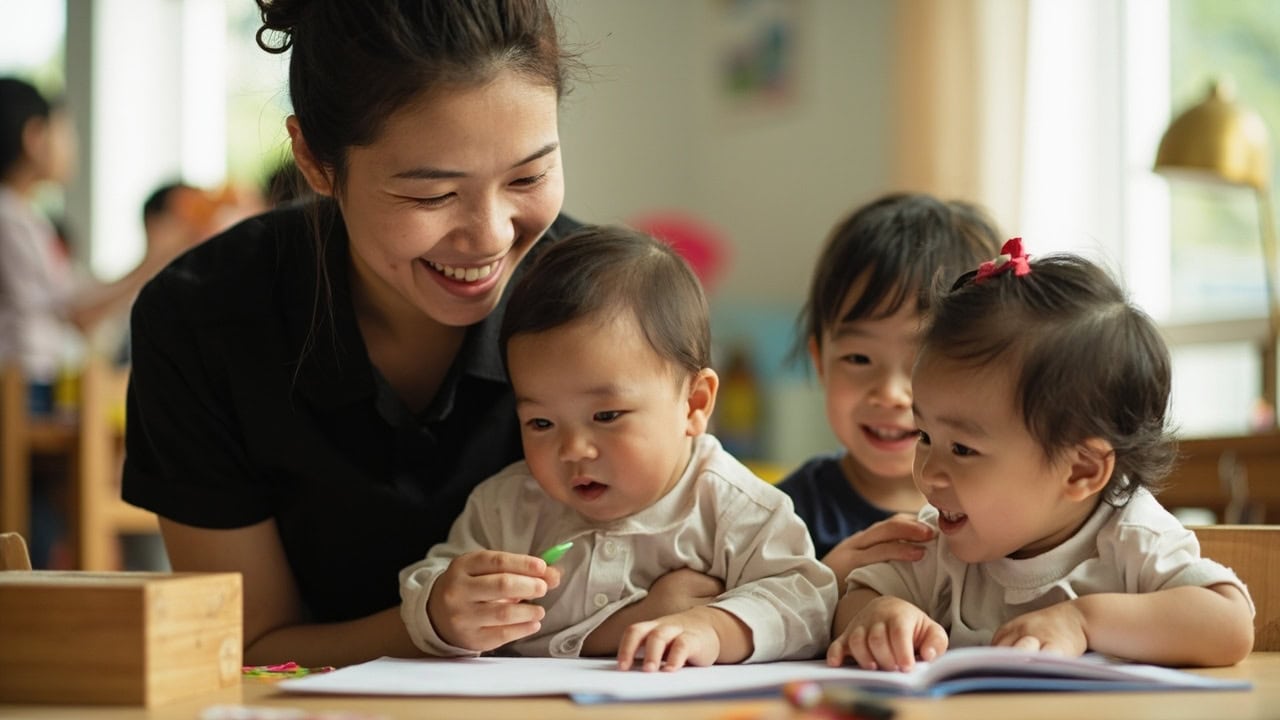
Every time a caregiver responds to an infant’s coo, every time a toddler’s reaching is acknowledged and named, every time a child’s frustration is noticed and soothed before it becomes a full collapse—that is not merely a kind act. That is a contribution to the architecture of a human mind.
Those neural pathways are literally being built in response to these interactions. The quality of early experiences doesn’t just influence development. It becomes biology.
This is why developmental scientists speak of “critical windows” and “sensitive periods”—stages when certain kinds of learning happen more easily than at any other time. Language acquisition is most fluid in the first years. Emotional regulation systems are laid down during this period. The brain’s stress-response architecture, the one that will determine whether your child learns to manage anxiety or is overwhelmed by it, is constructed in large part before they ever enter school.
When we talk about what young children need from childcare, we are not talking about an abstract ideal. We are talking about what their biology is literally demanding during these specific years.
What Quality Actually Looks Like: Observable Signs
So what does this mean for you as a parent trying to choose well?
It means you can look for something concrete. Not just vibes and first impressions, but observable evidence that your child’s development is being supported—not merely that they are being kept safe and entertained.
Caregiver-Child Interactions
Observe interactions not during circle time, when everything is structured and visible, but in the ordinary moments. Mealtimes. Transitions. The small collisions and frustrations that arise when toddlers are tired or hungry.
Ask yourself:
- Is the caregiver responding to the child’s cues?
- When an infant reaches, does the caregiver notice?
- When a toddler struggles with a toy, does the caregiver acknowledge the frustration before stepping in—or offer a word for what the child is feeling?
This is what researchers call “responsive caregiving,” and it is the single most evidence-based predictor of quality in early childhood settings. It is also something you can see with your own eyes, if you know what to look for.
Language Environment
In quality settings, language is not reserved for circle time. You should hear caregivers narrating what is happening, commenting on the child’s focus, asking questions that extend thinking.
Instead of silence or simple directives, you might hear: “You’re building a tower. How tall do you think it will go?” or “I see you’re really focused on that puzzle. What’s the colour of that piece?”
This is not small talk. This is vocabulary exposure, conversational reciprocity, and cognitive scaffolding—wrapped in what feels like ordinary conversation.
Physical Space and Movement
How are children using the space?
- Are infants given space to move, to roll, to reach?
- Are toddlers permitted to explore, to climb, to fall and try again?
- Or are children spending significant time in containers—bouncers, swings, screens—that limit the movement their developing bodies and brains require?
An environment that prioritises development will have open spaces for movement, materials that invite exploration, and children who are visibly engaged with their surroundings rather than passively contained.
Social-Emotional Dynamics
Watch how the setting handles the harder moments:
- Can children express frustration without immediate redirection?
- Are their big feelings acknowledged, or only silenced?
- When conflict arises between two toddlers, how does the caregiver intervene?
- Are children helped to name and manage their emotions, or simply distracted from them?
A setting that takes development seriously will view tantrums and conflicts as learning opportunities, not disruptions to be managed.
Developmental Quality at a Glance
| Area | What to Observe | Signs of Quality |
|---|---|---|
| Responsive Caregiving | Caregiver attention to child cues | Caregiver notices and responds to infant coos, toddler reaching, emotional shifts |
| Language Environment | Quality and quantity of speech | Caregivers narrate, ask open questions, extend conversations beyond directives |
| Physical Space | Movement and exploration | Children move freely, explore materials, face appropriate challenges |
| Emotional Support | How big feelings are handled | Emotions are named, validated, and used as teaching moments |
| Social Interaction | Peer relationships and conflict | Caregivers guide rather than resolve conflicts; children learn to negotiate |
These are the observable indicators of developmental support. They are not complicated to understand. They do not require a degree in neuroscience. But they require something that most parents are rarely offered: a framework for observation. A lens through which to see what is actually happening.
Why This Matters in Singapore
In Singapore, this framework matters for reasons beyond the universal.
Many children here navigate between caregivers, managing transitions between home and childcare with a regularity that can make adults forget how significant these switches are for a young mind. Dual-income households are the norm, not the exception, which means that for many Singapore children, the hours spent in childcare are not peripheral to their development—they are central to it.
There are also cultural dimensions worth acknowledging. The value Singaporean families place on education, on aspiration, on the future—these shape how parents think about early childhood. There is often a tendency to rush toward structured learning, toward literacy and mathematics and readiness activities.
And while these things have their place, they cannot precede the developmental foundations that make them meaningful. A child’s brain must first build the capacity for sustained attention, for emotional regulation, for curiosity—before it can truly engage with more formal learning.
What this means is that Singapore parents deserve childcare that understands both the science of child development and the specific pressures and aspirations of local families. Not just supervision, and not just acceleration. Something deeper: the kind of care that builds what needs to be built first.
The EduNanny Approach
EduNanny by BUTLER was built on a conviction that the early years are not preparation for life. They are life. And the people who care for young children during these years are doing work that matters in ways most people underestimate.
The ECDA Childminding Pilot reflects this conviction at a systemic level—recognising that childminding, when done well, is not a lesser alternative to centre-based care but a legitimate pathway designed around the developmental realities of infancy and early childhood.
Within this framework, EduNanny has designed its approach around principles that translate developmental science into daily practice.
Staff-to-Child Ratios That Allow Genuine Attention
In infant care, the difference between a one-to-three ratio and a one-to-five ratio is not merely administrative. It determines whether a caregiver can actually respond to each child as an individual—can notice each child’s cues, tune in to each child’s emerging patterns, build the kind of consistent, attentive relationship that developmental research shows is foundational for healthy attachment.
EduNanny maintains these ratios not as a box-ticking exercise, but because they believe infants deserve attention commensurate with what their development requires.
Pathways That Match Family Needs
Both home-based and centre-based options exist within the EduNanny model, because families are not uniform in their needs. Some children thrive in the intimacy of a home setting, with consistent caregivers and a domestic environment. Others benefit from the richer peer interaction available in centre settings.
What matters is that parents have genuine choice—choice grounded not in branding or convenience alone, but in understanding what environment best supports their particular child’s development.
Transparency and Communication
Parents deserve to know what is happening during the hours their child is in care. Where CCTV measures are deployed, they are deployed not as surveillance but as transparency—visible evidence that EduNanny’s practices are what they claim to be.
Regular communication between caregivers and parents ensures that development is not something that happens invisibly, but something parents can witness and understand.
Accessibility for Working Families
Quality childcare should not be a privilege available only to families with significant resources. Within the pilot fee structures, EduNanny works to keep care accessible—accepting CDA and Baby Bonus where applicable, offering Monday to Friday care blocks that provide genuine support for working families.
This is not charity. It is a conviction that children deserve developmental support regardless of their family’s income bracket.
Asking the Right Questions
The most powerful tool you have is not access to a particular centre, or even a particular caregiver. It is the knowledge to observe, to evaluate, to ask the questions that matter.
You already watch your child more closely than anyone else on earth. You notice the new word they said this morning, the way they played differently today, the fear that surfaced at bedtime. You are already a developmental observer. What you may have lacked is not the attention, but the framework—the language and understanding to make sense of what you are noticing.
Armed with that framework, you become a different kind of parent in relation to your child’s care. You are not simply hoping for the best. You are evaluating. You are asking:
- Is my child being seen?
- Is my child’s brain being built in the ways it needs?
- Is this environment supporting the development that is happening so fast, and so importantly, right now?
When you visit a childcare centre or meet with a childminder, bring these questions beyond the standard enquiries about hours and fees:
- How do caregivers respond when an infant is distressed? Look for answers that mention attunement, patience, and helping the child regulate—not just “we comfort them.”
- What does a typical day look like beyond structured activities? Quality settings will describe responsive interactions, free play, and incidental learning throughout the day.
- How do you communicate with parents about development? You want concrete examples of what they share, not vague promises about progress reports.
- How do you handle the transition periods—the drop-offs, the pick-ups? These moments matter enormously for children’s sense of security.
- Can I observe during a typical morning, not just a tour? The best settings welcome this. The ones that deflect may have something to hide.
When you understand what quality actually looks like, you can recognise it. And you can trust your own judgment—not blindly, but informedly.
Ready to Explore Your Options?
You do not need certainty to make a good choice. You need understanding. And with understanding comes something that no amount of vague reassurance can provide: the quiet, grounded confidence of a parent who knows what they are looking at.
EduNanny is here for families who want more than supervision. For parents who understand, or are beginning to understand, that these early years matter in ways that will echo across a lifetime.
The science tells us that children are extraordinary learners from the moment they are born. They are reaching, exploring, absorbing, growing—constantly, and with an intensity they will never match again. What they need during these years is not passive care. It is active support for everything their biology is trying to build.
That is what quality looks like. That is what EduNanny is working toward every day.
Because your child deserves more than supervision. They deserve to be seen.
If you are researching infant care or childminding in Singapore and want to learn more about an approach built on developmental science, speak with our team to understand which pathway may suit your family best.
Learn more about EduNanny:
- Home — Our approach to childcare and childminding
- ECDA Childminding Pilot — Understanding our framework
- About Us — Our story and values
- Contact Us — Begin a conversation