Growing With Your Child: Singapore’s Adaptive Childcare Solution
The Moment Your Baby Became Someone New
There is a moment every parent in Singapore knows. It arrives quietly, sometimes between the morning handover and the evening pickup. Your child, who just months ago could not yet lift her head, now stands at the play mat pointing at birds through the window, demanding to know their names.
And in that moment, something shifts in your chest. Not just pride, though that is there. Something closer to wonder. And beneath it, almost unspoken: the sudden awareness that the arrangement you made when she was three months old was made for a baby who no longer exists.
This is the experience we built EduNanny Singapore to hold. Not to solve in a single transaction, but to walk alongside, year after year, as your family grows and transforms in ways that are both predictable and entirely your own.
Quick Summary: What This Means for You
- Children do not develop on a gentle, linear slope. They surge and settle, burst forward and consolidate—and the care that served them beautifully at one stage can quietly fail them at the next.
- The childcare question Singapore parents should be asking is not “which option should I choose,” but “which partner will continue to choose wisely alongside me as my child changes.”
- EduNanny Singapore was designed around a single insight: that the first five years are not one developmental era, but a series of distinct ones, each requiring different priorities, different interactions, and different environmental conditions.
- The goal is not a single perfect decision. It is finding a long-term partner who will notice when the arrangement needs to evolve—and have the capability to evolve it.
The Anxiety You Might Not Have Named
When you chose your child’s care arrangement, what were you evaluating? The warmth of the environment, likely. The qualifications of the caregiver. Whether your baby seemed soothed when you arrived. Whether you felt, in your gut, that this was right.
These are reasonable criteria. They are, in fact, essential ones. But I want to suggest that they are incomplete—not because you failed to think carefully enough, but because the frameworks we use to talk about childcare in Singapore almost never ask the question that matters most for your child’s future:
Not just whether this arrangement is right for your child today, but whether it will remain right as your child becomes someone new.
This is the anxiety that most childcare marketing in Singapore ignores. Parents are offered beautiful facilities, glowing testimonials, and reassuring language about developmental milestones. What they rarely receive is an honest accounting of what their child’s care needs will look like at twelve months, twenty-four months, and forty-eight months.
They are invited to choose, to commit, and to feel confident in a single decision. But a child is not a single decision. A child is a series of unfolding possibilities, each one demanding something different from the adults who love and guide them.
What Actually Happens During These Transitions
The First Year: Building Neurological Architecture
In the first year, your infant is building the foundation that will support every future skill: trust, attachment, the ability to regulate emotion, the foundational circuits for language. The care that serves this stage prioritizes consistency, sensitive responsiveness, and the kind of unhurried interaction that allows a baby’s communication attempts to be met with warm acknowledgment.
A caregiver who can attune to an infant’s subtle cues—who can interpret a whimper differently from a cry, who can slow down when the child is overwhelmed and animate gently when the child is ready to engage—is providing something invaluable. This is not about sophisticated curricula. It is about presence. It is about the quality of attunement during a window of rapid brain development that will not open in quite the same way again.
Fifteen Months: The Revolution of Toddlerhood
Then your child turns fifteen months, and the infant you knew is gone. She is walking now, pulling open drawers, tasting everything, saying no with ferocity and delight. She needs space to move, objects to manipulate, boundaries to test.
The toddler stage is not a gentle extension of infancy. It is a revolution. Cognitive explosion meets physical autonomy, and the child who could once be soothed with a gentle voice now requires much more: environments designed for her curiosity, caregivers who can balance safety with the freedom to explore, routines that provide structure without constraining the urgent need to discover how the world works.
The child who was served beautifully by a calm, nurturing arrangement in her first year may now find that same arrangement suffocating. Too much stillness. Not enough challenge. The caregiver who knew exactly how to calm her as a baby may not know how to engage her as a wobbly, determined, fiercely independent small person.
Three to Five Years: The Threshold of School Readiness
Between three and five comes what educators call school readiness. This is not a test your child takes. It is a developmental threshold. Your preschooler is building the cognitive flexibility, the social negotiation skills, the emotional vocabulary, and the early literacy foundations that will determine how confidently she enters formal education.
The care that serves this stage must be intentionally enrichment-oriented without being rigid. It must cultivate curiosity, peer interaction, early problem-solving, and the self-regulation that allows a child to persist when a task is difficult. The passive observation of earlier years must now give way to guided engagement—not worksheets and drills, but purposeful play, meaningful conversation, and the kinds of experiences that wire a young mind for sustained attention, creative thinking, and collaborative learning.
What Singapore Parents Often Miss
These are not abstract stages. They are real children in real homes in Singapore, growing through windows of possibility that close and reopen in different forms. And the parents who brought them into the world are navigating all of this while working demanding jobs, maintaining households, supporting aging parents, and trying to preserve some sense of themselves.
They do not need to be told that childcare is important. They already know. What they need is a partner who understands the trajectory of early childhood development and can evolve alongside it.
When evaluating childcare options, Singapore parents tend to assess what a programme looks like on the day they visit. They watch how their infant responds to a caregiver’s touch. They note the cleanliness of the environment and the friendliness of the staff. These are sensible instincts—but they capture only a snapshot of what the arrangement will require across time.
Does this arrangement have the capacity to change as my child changes? Or is it designed for a single version of your child—the one who exists today?
Many childcare arrangements are excellent at one developmental stage and simply continue, unchanged, as the child moves beyond it. The caregiver who was perfect for a six-month-old may not have the training or environment to serve a confident two-year-old. The programme that felt warm and appropriate for a toddler may not build the cognitive richness a four-year-old needs for school readiness.
This is not a failure of anyone. It is a structural limitation of models that treat childcare as a static service rather than an evolving relationship.
The Real Cost of Frequent Transitions
Every time a child leaves one care arrangement for another, there is a period of disorientation. New faces, new routines, new expectations, new relational dynamics to navigate. For a child whose sense of security is still developing, these transitions carry a real developmental weight.
They are manageable. Children are resilient. But they are not cost-free.
When care arrangements are forced to change because a programme was designed for a different developmental stage, the disruption falls on the child. The relational foundation that took months to build—the specific understanding between caregiver and child, the trust that allows a toddler to explore boldly—is dismantled and must be rebuilt from scratch.
EduNanny Singapore was designed to minimise those disruptions by growing with your family. When your child’s needs shift, the model shifts. You are not starting over. You are evolving with a team that already knows your child, that has already built the relational foundation, and that is ready to meet the next chapter.
EduNanny Singapore: Built Around the Child Who Is Becoming
EduNanny, a service under the trusted banner of BUTLER, was built on a foundational recognition: that the first five years of a child’s life are not a single developmental era, but a series of distinct ones, each requiring different priorities, different interactions, and different environmental conditions.
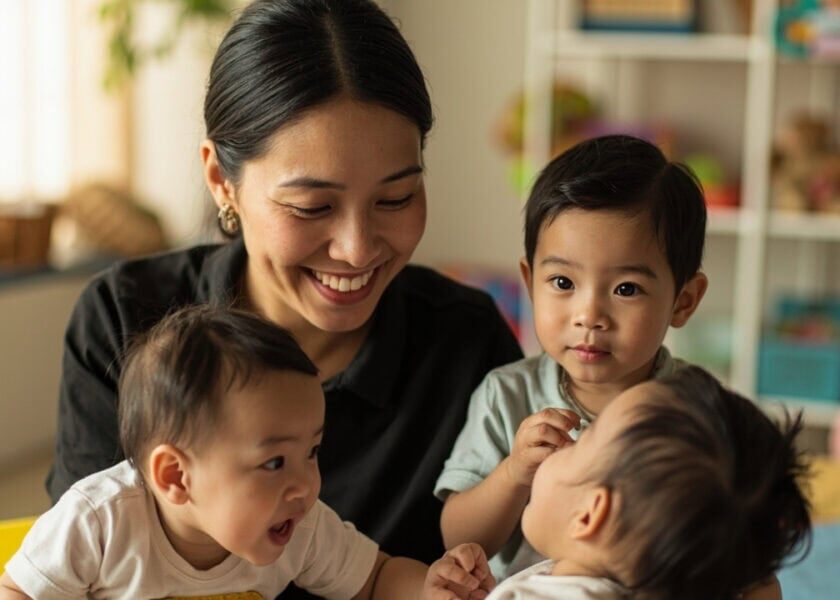
Our childminders are not executing a fixed curriculum. They are trained to observe, to assess, and to adapt. They understand the difference between what an eight-month-old needs and what a twenty-month-old needs. They know that a three-year-old’s question about why the sky is blue is not merely charming, but a genuine cognitive act that deserves a genuine response. They are equipped to make these adjustments in real time, so that the care your child receives at any given moment is a response to who your child is right now—not a relic of the care you arranged months or years ago.
Under the ECDA Childminding Pilot
We are proud to operate under the ECDA Childminding Pilot, a framework that reflects our commitment to regulated quality and our belief that professional childminding deserves the same serious recognition as centre-based pathways.
Singapore parents should not have to choose between the warmth of home-based care and the assurance of structured oversight. The pilot allows us to offer both: trained, vetted caregivers who meet ECDA standards and who understand that their role is not merely supervisory, but developmental.
How the Model Evolves Across Stages
For infants, we maintain ratios that allow for genuine attunement. Up to three infants per caregiver means that a child who is signalling a need is not waiting in a queue of demands. It means that feeding, sleeping, and play can happen at the child’s pace, not an institution’s schedule. For families, this is not a luxury. It is a developmental necessity.
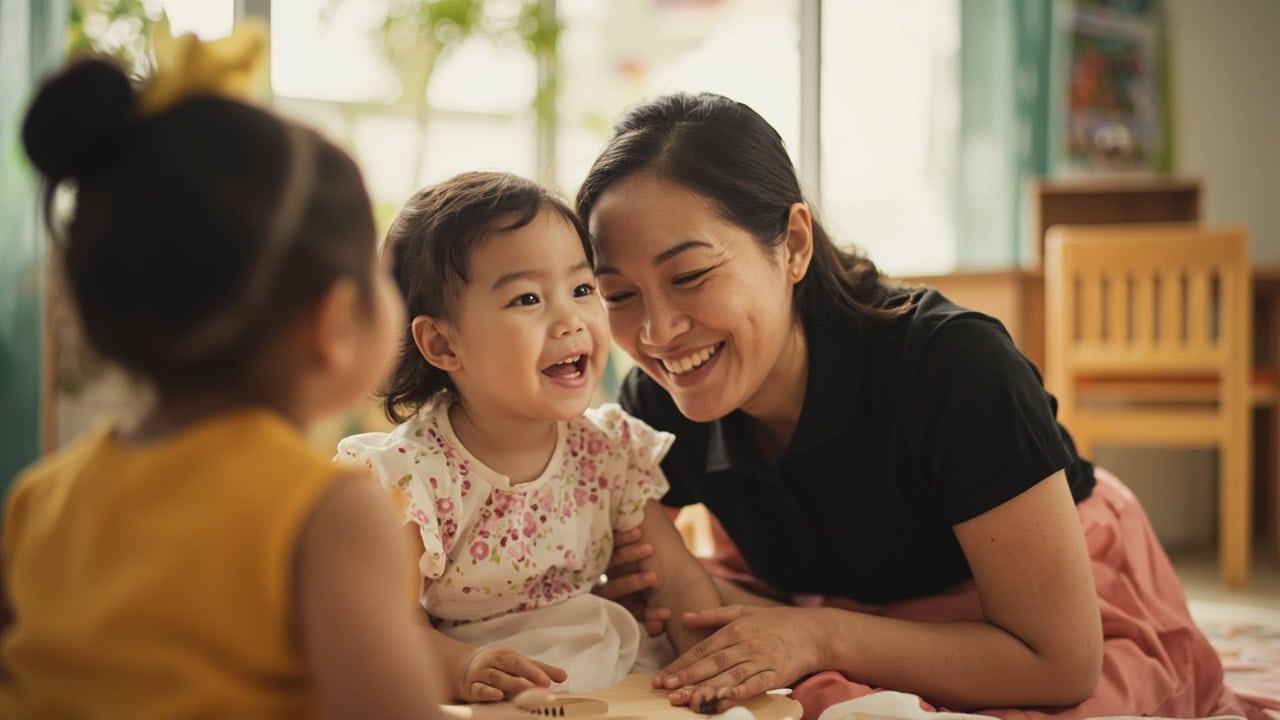
As children transition into toddlerhood, the EduNanny model shifts accordingly. Movement becomes central. Language becomes a focus. The caregiver’s role evolves from primary comfort-giver to co-explorer, creating environments where curiosity is safe and where the child’s emerging will is respected rather than suppressed. We believe that the toddler who is allowed to climb, to pour, to refuse, and to problem-solve under thoughtful supervision is building the confidence and competence that will serve her for decades.
When children reach the preschool years, enrichment takes explicit form. Not in the way of academic pressure, but in the way of rich exposure: stories, songs, early number concepts, collaborative play, social negotiation, and the kinds of sensory and creative experiences that consolidate neural pathways while remaining joyful. Our caregivers communicate with parents about where their child is developmentally—not in clinical reports, but in the kind of ongoing dialogue that allows families to extend learning at home and to make informed decisions about what comes next.
Answering What Singapore Parents Actually Worry About
“Will I be locked into the wrong choice?”
The fear is understandable: what if you commit now and your child’s needs outgrow the arrangement? With EduNanny, the model is designed to evolve. You are not choosing a static programme. You are entering a relationship with caregivers who are trained to notice developmental shifts and adjust their approach accordingly.
“Is home-based care as quality as centre-based?”
Under the ECDA Childminding Pilot, EduNanny caregivers meet regulatory standards for training, vetting, and oversight. They are not untethered from accountability. The home setting is not a compromise on quality—it is a different environment, with different advantages: smaller ratios, personalised attention, and a domestic warmth that many children find more grounding than institutional settings.
“How will I know what’s actually happening during the day?”
Transparency is central to the trust we build with families. Where CCTV measures are deployed, parents have visibility into the daily experience of their child’s care. Communication is not a periodic newsletter or a formal report. It is ongoing, responsive, and grounded in the actual details of your child’s day. What did she eat? How did she sleep? What did she discover? What challenged her?
“What about the cost?”
For families navigating the practical realities of Singapore, care must make financial and administrative sense. Our arrangements within the pilot fee structures are designed to be affordable and accessible. Payments can be made using the Child Development Account, and Baby Bonus funds are usable where applicable. This is not incidental to our mission. We believe that high-quality, adaptive childminding should not be a privilege reserved for families with significant financial resources.
“What if I have questions at 2 AM?”
Modern parenting comes with its own particular exhaustion: the endless stream of questions, the uncertainty about developmental norms, the need for reliable guidance when your toddler has a fever and you cannot remember whether teething can cause that high a temperature. EduNanny’s Thomas AI Chatbot is available to parents as a resource—not to replace professional medical advice, but to offer reliable information and the kind of immediate support that makes the difference between a panicked midnight search and a calm conversation with a tool designed to help.
What to Actually Look For When Choosing Infant Care
Rather than a checklist of features, here are the questions that tend to reveal more about a childcare arrangement’s long-term suitability:
- Can they describe how their approach would change between now and when my child turns three? If the answer sounds the same regardless of the child’s age, the model may be static.
- How do they handle developmental transitions? Do they have a plan for when an infant becomes mobile? When a toddler starts asking “why” constantly? When a preschooler needs more cognitive challenge?
- What does communication look like on an ordinary day? Not just incident reports, but genuine daily dialogue about what the child is experiencing, discovering, and struggling with.
- Are they trained to observe, not just supervise? The difference between a caregiver who notices that your child is frustrated and one who notices that your child is frustrated in a new way—that is the difference between childcare and childminding.
- What is their policy if the arrangement no longer fits? Will they work with you to adjust, or will you be starting over?
The Question Worth Carrying With You
I want to return to the moment I described at the beginning. The moment when your child transforms so visibly that you feel the ground shift beneath your expectations.
This moment is not a crisis. It is a gift. It is the reminder that your child is alive, growing, and becoming something that no one—not even you—can fully predict.
The terror that many parents feel in this moment is the terror of getting it wrong. Of committing too early. Of choosing a path that will not serve their child as she changes. And I want to tell you that this terror is not a failure of confidence. It is evidence that you are paying attention.
You understand that your child is not static. You understand that good parenting means asking, again and again, whether the structures you have built are still adequate for the person those structures were meant to serve.
That question is not a weakness. It is the beginning of wisdom.
EduNanny Singapore exists because we believe parents deserve to ask that question and receive a meaningful answer. Not a sales pitch. Not a promise that one arrangement will fit forever—because no arrangement can, because no child is static, because childhood is a living process and not a fixed state.
We exist to tell you that we understand this, and that we built our model with it as the central organising principle.
The question Singapore parents have been asking about childcare is the wrong question. They have been asking: Which option should I choose?
The better question is: Which partner will continue to choose wisely alongside me as my child changes?
That is the question EduNanny is designed to answer.
Your child will not remain who she is today. Neither should your childcare. And that is not a problem to solve. It is a journey to walk, together, with the right people beside you.
Ready to Find a Partner for the Long Road
If you are a parent in Singapore exploring infant care or childminding options, we invite you to have a conversation with us. Not to make a decision today, but to understand what it looks like to have a care arrangement that grows with your family—through the infant months, the toddler revolution, and the preschool threshold.
We are here to answer your questions honestly, to walk you through how EduNanny works, and to help you think through whether we are the right long-term partner for your family.
The right childcare choice is not the one you make once. It is the one you grow into together.
EduNanny Singapore is a childminding service under the ECDA Childminding Pilot, operated by BUTLER. Adaptive, development-oriented care from infancy through preschool—because your child is not who she was yesterday.
Learn more about how the ECDA Childminding Pilot works, or reach out to speak with our team.