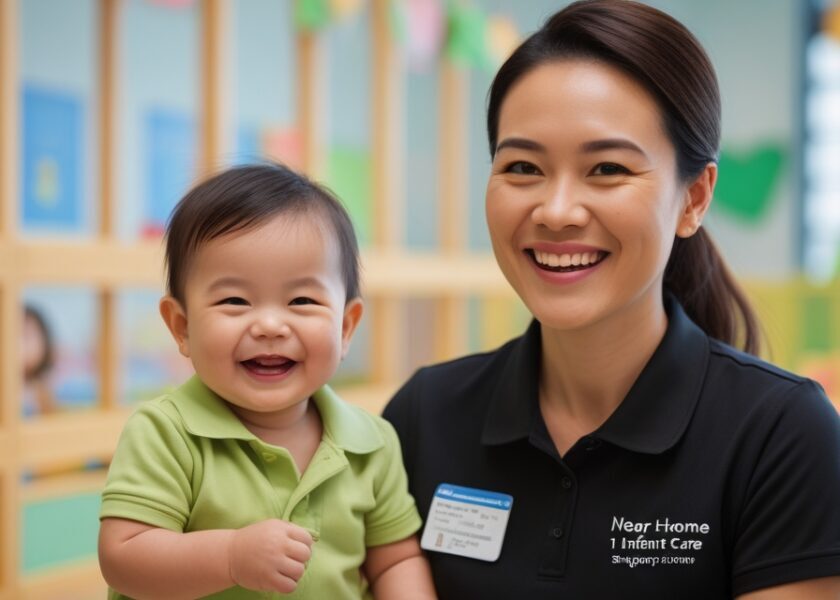
The Childcare Choice That Builds Your Child’s Quiet Confidence
The Quiet Architecture of Who Your Child Is Becoming
There is a moment, if you have been watching, when you notice it.
Not a milestone written in any book. Not a word spoken or a skill demonstrated. But something quieter. A way your child holds themselves when they return to a room they trust. A willingness to venture further from you, then look back not in fear but in confirmation. A certainty, still small, still forming, that says: I know where I belong.
If you have noticed this, you are not imagining it. You are watching the earliest architecture of a person taking shape.
Every parent in Singapore carries a quiet ambition. Not one written in certificates or measured in comparisons, but something deeper and more personal: to raise a child who knows who they are. Who enters a room and feels they belong there. Who can be alone in a crowd and not lose themselves. Who carries an inner steadiness that no external circumstance can easily shake.
We want our children to be not just successful, but solid. Not just smart, but sure of themselves.
This ambition is not new. What is new is the landscape in which we pursue it — and the question it raises that no amount of preparation fully resolves: Who is my child becoming? And who is helping them become it?
The First Thousand Days: Why Early Childhood Is Not a Waiting Room
We live in an age when the science of early childhood development has given us something extraordinary: evidence. Not theories or traditions or inherited assumptions, but findings drawn from decades of research across neuroscience, developmental psychology, and early childhood education. What this evidence tells us is both humbling and empowering.
The first thousand days of a child’s life are not simply a warm-up for the real story. They are the foundation on which the entire story is built.
In these days, the architecture of the brain is being constructed at a pace that will never be matched again. Neural connections are forming at a rate of more than one million per second. The emotional patterns that will govern how a child interprets the world, responds to challenge, and relates to others are not waiting to be taught. They are being absorbed, silently and constantly, from every interaction, every response, every environment the child inhabits.
A child in the first three years of life is not a blank slate. But they are, in a very real sense, writing themselves. They are discovering what their needs feel like. They are learning whether the world responds to those needs. They are testing whether their cry brings comfort or dismissal. They are finding out whether their curiosity is rewarded with attention or silenced with convenience.
And from all of these tiny, unremembered experiences, something is forming: a sense of self. A belief about their own worth. A working model of how relationships work. A feeling, still unarticulated, about whether they are capable or not.
This is what early childhood actually is. Not a period of waiting. Not a period of storage. A period of becoming.
Here is the part that deserves to be said plainly: who your child becomes is not shaped only by what you do in the hours you have with them. It is shaped by the entire ecosystem of care they experience. By the quality of attention they receive. By the responsiveness of the environments they inhabit. By the consistency of the relationships they form.
In the first years, identity is not taught. It is caught. It is absorbed. It is built through the accumulation of ten thousand small experiences. This is why the question of childcare is not merely logistical. It is developmental. Every decision you make about who cares for your child is, in a meaningful sense, a decision about who your child is becoming.
The Tension You Carry Is Intelligence, Not Weakness
Let us be honest about the tension you carry.
It is not a simple tension. You are not someone who doubts the importance of your career or your contribution. You are not someone who questions whether children benefit from social exposure, varied environments, and the company of other young minds. You are a modern Singapore parent who understands these things.
And yet.
There is a worry that sits beneath the practical decisions. It goes something like this: I want my child to grow into someone confident, curious, and emotionally secure. But I worry that relying on someone else for care might blur who they become rather than strengthen it. I need to know that quality childcare is actively building my child, not just filling their time.
This worry is not a weakness. It is intelligence. It is the recognition that not all childcare is the same, and that the difference matters enormously. It is the refusal to settle for supervision when what your child deserves is cultivation.
The question is not whether childcare can support your child’s development. The evidence is clear that it can. The question is whether the childcare you choose is designed to do so — whether the environment, the ratios, the training, the philosophy, and the daily practice of the caregivers are aligned with the developmental goals you hold for your child.
Whether your child is being cared for, or whether they are being seen.
There is a difference. And it matters more than any brochure can fully communicate.
The Difference Between Care and Attention
A child who is merely cared for is safe, fed, and kept occupied. That is not nothing. It is the minimum any responsible system should provide. But safety and sustenance are the floor, not the ceiling. They do not tell us anything about who the child is growing into.
A child who is seen is different. They are noticed when their frustration gives way to a new way of expressing it. They are noticed when their play shifts from parallel to collaborative. They are noticed when they try something new and fail and try again. They are noticed when they look up from their block tower not to show off, but to share a discovery. They are noticed in their sadness and in their triumph and in the small ordinary moments between.
This noticing is not passive. It is active. It requires presence, training, and genuine interest in the child’s inner life. It requires caregivers who understand that a cry is not just a noise to be soothed but a communication to be understood. It requires adults who know that behavior is never just behavior, but a window into the child’s developing self.
In environments where this happens, something changes. The child begins to feel capable. Not because they are constantly praised, but because their efforts are noticed and their persistence is respected. They begin to feel curious. Not because they are taught curiosity, but because their questions are met with engagement rather than impatience. They begin to feel emotionally regulated. Not because they are controlled, but because they have learned, through thousands of responsive interactions, that big feelings pass and that they can survive them.
This is not a theory. It is what happens when care is designed around the child’s developmental needs rather than around the convenience of the system.
What Quality Care Actually Supports
There are specific dimensions of development that quality childcare, designed with intention, can actively support. Understanding these helps you know what to look for — and what questions to ask.
Emotional Security
A child who feels emotionally secure has a base from which to explore. They can venture further because they know where home is. They can take small risks because they trust that someone will catch them if they fall.
This security is not built through grand gestures. It is built through the consistent, reliable responsiveness of caregivers who show up in the same way, day after day, creating an environment where the child can predict, and therefore trust, what will happen. In settings with low ratios, where one caregiver is responsible for only a handful of infants, this consistency becomes possible in a way it simply cannot in high-turnover, high-density environments.
Self-Regulation
This is the capacity to manage one’s own emotional and physical states. It is not a skill taught through instruction. It is a capacity developed through experience.
A child who has been soothed many times begins to internalize soothing. A child who has been helped to name their feelings begins to develop the vocabulary of emotional intelligence. A child who has been given words instead of being given silence learns that communication works. These capacities do not appear overnight. They develop gradually, through the accumulated experience of being in a responsive care environment.
Curiosity
Curiosity is the natural state of the young child. Every infant is a scientist running experiments. They drop things to see what happens. They babble to hear the response. They explore textures and temperatures and faces with an intensity that is, frankly, awe-inspiring.
The question is whether the environment supports or suppresses this curiosity. Does the caregiver have time to follow the child’s lead? Does the schedule allow for the long, unhurried play during which the most important learning happens? Does the physical space invite exploration or confine it?
Independence
Independence is the goal that all parents hold, often without fully articulating it. We want our children to be able to do things for themselves. To solve problems. To ask for what they need. To eventually leave us and thrive.
But independence does not develop in a vacuum. It develops in the context of a secure base. A child who feels confident to try new things is a child who has been supported, not pushed. A child who can separate from their parent without falling apart has learned, through consistent care, that departures are not abandonments and returns are certain.
Independence is not the opposite of dependence. It is built on the foundation of having been dependably cared for.
Identity
And finally, there is identity itself. The quiet, persistent sense of who I am. This is the outcome that is hardest to measure and most important to nurture.
A child who leaves a care environment knowing something about themselves. Knowing that they are capable of kindness, or creativity, or persistence. Knowing that their presence matters to others. Knowing that they can be themselves and still belong.
This is not taught in any lesson plan. It is caught from the quality of being valued.
How to Assess Whether Care Is Actually Supporting Development
If you are a parent evaluating childcare options, you may be wondering: How do I know if a childcare environment is actually doing this? How do I see beneath the surface of a well-presented facility?
These are the right questions to ask. Here is what to look for.
Watch the Caregivers
Not what they say, but what they do.
- Do they kneel to a child’s level when they speak?
- Do they narrate what they are doing, turning routine moments into language-rich interactions?
- Do they allow children to struggle slightly before intervening, giving them the satisfaction of small accomplishments?
- Or do they rush to solve problems, inadvertently communicating that the child is not competent to try?
The difference between these approaches is not minor. It is the difference between a child who feels capable and a child who feels dependent on others to manage their world.
Observe the Children
Do they seem at ease in their bodies? Do they move through the space with a sense of ownership? Do they engage with materials and activities with genuine interest, or do they wander looking for something to do?
A high-quality environment is one where children are meaningfully occupied, not just physically safe. Meaningful occupation looks like focus. It looks like engagement. It looks like the occasional small triumph in a child’s eyes.
Ask About Ratios
This is not a number you should feel embarrassed to ask. It is the most important structural question you can raise.
In infant care, the number of caregivers to infants determines the quality of attention each child receives. It determines whether a child’s individual needs can be noticed and met, or whether they must be managed as part of a group.
In home-based childminding arrangements under the ECDA Childminding Pilot framework, ratios of up to one caregiver to three infants can be maintained in certain configurations. That ratio is designed to allow for exactly the kind of individualized attention that supports the developmental outcomes we have been discussing.
Ask About Communication
How will you know what happened in your child’s day? Will there be regular updates? Photographs that capture more than posed smiles? Written observations that help you understand what your child is exploring, discovering, and working through?
In quality care environments, transparency is not a marketing feature. It is a practice of partnership that recognizes you as the primary knower of your child.
Notice the Environment
Is it designed for children or for the convenience of adults? Are the materials at a height where children can reach them independently? Is there space to move, to climb, to explore? Are there quiet corners for children who need to retreat and regroup?
Or is the environment designed around the needs of supervision rather than the needs of development? These questions will tell you a great deal.
Trust Your Intuition
Not the vague anxiety that tells you childcare is somehow wrong for your child. But the grounded instinct that tells you whether your child seems happier, more confident, more themselves after time in a particular environment.
Watch their face when they arrive. Watch their face when they leave. Watch what they tell you, in the limited vocabulary available to them, about their experience.
Children are honest about what they feel. They cannot lie about whether they feel seen.
What Thoughtful Childcare Looks Like in Singapore
For Singapore parents navigating this decision, there are frameworks and pathways that make quality care more accessible and more accountable than ever before.
Singapore’s own recognition that childminding is not a lesser alternative to centre-based care, but a legitimate and valuable pathway with its own strengths. Home-based childminding offers something that institutional settings often cannot:
- The intimacy of a home environment
- The consistency of a single caregiver relationship
- The flexibility to respond to individual rhythms in a way that group schedules cannot accommodate
At the same time, community and centre-based pathways offer their own advantages for families whose needs point in different directions. The ECDA Childminding Pilot framework allows families to access these pathways with the reassurance that comes from regulatory alignment and structured quality standards.
The ability to access quality care should not depend on the size of your income. Participation in the ECDA Childminding Pilot means that CDA funds and Baby Bonus payments can be used, reducing the financial barrier to developmental care. Monday to Friday care blocks provide the regularity that working parents need. This is available across Singapore, because every family in this city deserves access to environments where their child’s development is taken seriously.
Quality care providers build trust through openness, not promises. Communication tools help parents stay connected to their child’s day. Where appropriate, transparency measures provide an additional layer of reassurance for parents who need to trust the environment before they can relax into it.
Good care extends beyond the hours of physical presence. It extends to the parents themselves, who are after all the most important caregivers in any child’s life. Questions arise at odd hours. Concerns feel too small to call about but too persistent to ignore. Having a responsive channel for information and reassurance means parents are not navigating the complexities of early childhood development alone.
Choosing Thoughtfully Is an Extension of Parenting
I want to close by speaking directly to something you may be carrying.
You are doing something extraordinarily difficult. You are navigating a world that asks more of parents than any previous generation was asked. You are balancing careers and carpools, ambitions and anxieties, the pressure to perform and the deeper desire to simply get it right.
And beneath all of this, you carry the hope — the real hope — that your child will be okay. Not just physically safe, but okay in the deeper sense. Okay in who they are.
This hope is not naive. It is the most grounded thing you carry. And it is worth protecting.
Choosing childcare is not choosing between being a good parent and being a working professional. It is choosing the environment in which a significant part of your child’s development will take place. It is choosing the people who will, alongside you, shape your child’s understanding of whether the world is safe, whether they are capable, and whether they can be themselves.
This choice deserves more than convenience. It deserves deliberation. It deserves the same thoughtfulness you bring to your child’s education, their health, their future.
Because the environment in which your child’s sense of self is forming is not a backdrop. It is part of the painting.
When you choose a care environment that takes your child’s inner life seriously, you are not outsourcing your parenting. You are extending it. You are creating a space where the developmental goals you hold for your child are being actively pursued, where every interaction is designed with awareness, and where your child’s emerging sense of self is being noticed, valued, and strengthened.
You will know it is working. Not in dramatic moments, but in quiet ones. Your child will come home from care with something slightly more settled in them. They will be more willing to try. More willing to share. More willing to be who they are without apology.
They will have absorbed, without being taught, the message that they are capable and that their presence matters.
That is what quality care does. It does not simply fill time. It fills your child with the foundation of themselves.
You are raising a person. Not someday, but now. In every moment you are choosing, through your decisions, through your attention, through the environments you create and entrust, who that person will become.
That is not a small thing. It is the most important thing.
Begin With What Your Child Needs
If you are ready to explore what it looks like to choose childcare that is designed around your child’s developmental needs — where ratios allow for genuine attention, where caregivers are trained to notice rather than just manage, and where your child’s emerging sense of self is treated as the primary concern — the conversation starts with a visit.
Come with your questions. Come with your worries. Come with the same thoughtfulness you bring to everything else in your child’s life.
The goal is not to convince you. The goal is to show you what quality looks like, so that you can decide with clarity and confidence.
Because you are raising a person who will someday venture further from you, look back not in fear but in confirmation, and step into the world knowing exactly where they belong.
That person deserves the best possible foundation.
EduNanny Singapore stands alongside parents in this work — a partner who understands that the child’s inner life is not a secondary concern. It is the primary concern. Learn more about our approach or begin a conversation.