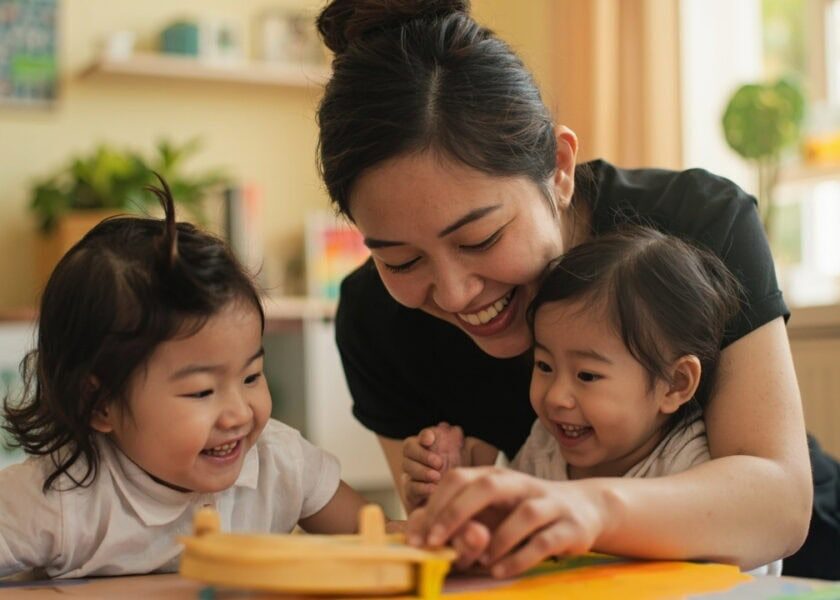
Daily Moments That Build Lasting Partnership with Your Child’s Caregivers
The Moment After the Decision: Building a Real Partnership with Your Child’s Caregivers
There is a moment, after the tour and the trial visits and the careful weighing of options, when a Singapore parent exhales and thinks, “We’ve done it. We’ve chosen.” The childcare centre has been selected. The enrollment deposit has been paid. The first morning goodbye is behind you.
And yet, if you are like most thoughtful parents in this city, that sense of relief is followed by something else. A quieter question that arrives unbidden, usually at the end of the day when your child is asleep:
Now what?
You have made the decision. But the decision was never really the point, was it?
Choosing quality childcare is an act of love and logic. It is also, if we are honest, an act of faith. You are trusting strangers with the person you love most in the world. You have done your research, walked through the corridors, watched the teachers, and read the reviews.
But choosing well is only the opening chapter. The story that matters—the one that will unfold over months and years—is the one you build together with the people you have chosen to walk alongside you in your child’s life.
The families who feel most connected to their child’s daily world, who receive care that genuinely reflects their child’s needs and rhythms—these are not families who got lucky. They are families who understood something essential:
Quality childcare is not a service you purchase and then leave alone. It is a relationship you cultivate. And like all meaningful relationships, it deepens with intention.
Daily Handoffs: The Most Important Three Minutes of Your Day
It begins, perhaps surprisingly, with the handover. That daily ritual of arrival and departure that can feel like a transactional exchange—child dropped off, quick status update given, adult leaving. Functional. Efficient. Safe.
But the handover is never just a handover. It is the pulse of the partnership. It is the moment when two worlds—home and childcare—connect and become one coherent world for your child.
When a parent says, “She didn’t sleep well last night, so she might be a little clingier than usual,” that is not small talk. That is a gift. That single piece of information allows the caregiver to read your child’s behavior through an entirely different lens. The clinginess becomes comprehensible instead of concerning. Your child feels held because the adult understands what is beneath the behavior.
And when a caregiver says, “She was so curious about the texture of the sand today, she kept wanting to touch it with her fingers after everyone else moved on”—that is not idle observation. It is a window into your child’s inner life. It tells you something about who she is becoming, something you might not see in the hours you are apart.
This is the first layer of partnership: the exchange of meaningful information through daily handoffs that serve the child, not just the logistics. It requires parents who are present enough to notice and share what they see at home. It requires caregivers who are attentive enough to observe and articulate what happens during the day. And it requires both parties to approach these brief exchanges not as box-checking, but as collaborative sense-making.
What Meaningful Handover Sharing Looks Like
- From home: Sleep quality, appetite changes, a new word your child said that morning, a milestone they reached over the weekend
- From the caregiver: A moment of curiosity your child showed, a social interaction worth noting, a skill they observed emerging
- The goal: Both environments working with the same picture of the same child
Finding the Balance: Neither Micro-Managing Nor Passive
There is a tension that lives in this space, and it is worth naming directly. Many parents oscillate between two equally unhelpful positions.
On one side: micro-management. The need to know everything, direct every detail, hover over every decision. This usually comes from a place of genuine anxiety, but it creates a dynamic that erodes trust and exhausts everyone involved.
On the other side: passivity. The assumption that you have handed off the parenting, that the caregivers know best, that your role is simply to collect your child at the end of the day and not rock the boat. This comes from a desire to respect boundaries, but it leaves parents disconnected and, paradoxically, less able to support their child.
The partnership we are describing is neither of these. It is something more like collaboration between two expert teams who share one overriding goal: your child’s wellbeing and development.
The caregivers are experts in early childhood care and pedagogy. You are the expert on your child—her history, her temperament, her quirks, her joys. Neither of you can do this alone. Both of you are needed.
What Healthy Engagement Looks Like in Practice
- Asking questions with curiosity rather than suspicion
- Sharing observations from home—her new word, her fascination with lift buttons, the way she wakes up happy now instead of crying
- Being genuinely curious about what happens during the day, not because you distrust, but because you care
- Recognizing that caregivers notice things too—a moment of persistence, a social breakthrough, a quiet preference—that deserve your attention
Monthly Conversations and the Compounding Value of Sustained Partnership
Beyond the daily exchange, there is a rhythm to deep partnership that transforms the experience for families. Monthly conversations—even brief ones—create alignment between home and childcare. A simple check-in with your child’s primary caregiver, focused on your child’s development, emerging interests, and growing skills.
These conversations help the caregivers understand what you care about, and they help you understand what the caregivers are noticing. When both environments are working toward similar goals, your child thrives on that coherence. She feels the consistency. She is not navigating two entirely different worlds with two entirely different sets of expectations.
This is what co-creation actually means. It is not about parents dictating or caregivers deciding. It is about two sets of eyes and hands and hearts, working together, noticing the same child from different angles, and building something consistent and nurturing across both settings.
There is an emotional reward to sustained partnership that goes beyond practical logistics. When you have been in relationship with your child’s teacher or childminder for six months, for a year, for longer—something shifts. You begin to know each other. You learn each other’s rhythms and styles. You develop shorthand. You trust each other with the small things because you have built a track record with the small things, and that trust becomes the foundation for navigating the larger moments when they arise.
Your child feels this. She feels the warmth between you and her caregiver. She notices that you speak to each other with ease, that you greet each other like people who share something important. She relaxes into that safety. She knows that her world at home and her world in care are connected by genuine care and mutual respect.
The early conversations you have, the habits of communication you establish, the trust you build in the quiet months when nothing dramatic is happening—all of this accrues. It becomes the capital you draw on when challenges arise. It becomes the foundation that makes difficult conversations possible.
Raising Concerns: Partnership Includes the Hard Conversations
There is something that matters deeply to every parent: the willingness to raise concerns. Because partnership includes the moments when something is not working, when your instinct is telling you something is off, when you need to speak up.
Families who navigate this well do three things consistently:
- They raise concerns early—before small issues become big ones
- They raise them specifically—with concrete observations, not general unease
- They raise them with respect—as partners who want the same thing
A phrase that opens doors: “I have noticed this. I wanted to share it with you because I trust your judgment, and I thought we could think about it together.”
That kind of communication invites collaboration. It says, “I am not here to fight. I am here to solve a problem alongside you.” When concerns are raised this way, when they are met with genuine receptivity, something remarkable happens: trust deepens. The partnership strengthens. The caregivers feel supported rather than criticized, and the parents feel heard rather than dismissed.
If you are worried about bothering caregivers by asking questions—don’t be. You are your child’s most important advocate, and the caregivers chose this work. They want to hear from you. The parents who build the strongest partnerships are not the ones who ask the most questions. They are the ones who ask questions with genuine care, receive answers with genuine gratitude, and give back what they observe at home with equal generosity.
What Quality Childminding Looks Like for Singapore Families
Parents in Singapore have several pathways for early care, and each has its own rhythm. What defines quality across all of them is not the setting—it is the quality of attention and the depth of partnership.
In centre-based care, you will likely see structured programmes, peer interaction, and a formal curriculum adapted for early learners. In home-based or childminding arrangements, the environment is often smaller, more domestic, with rhythms that can feel more tailored to your child’s individual pace.
Both pathways benefit enormously from the kind of partnership we have been describing. The question is not centre versus home—it is: how intentional is the communication? How consistent is the relationship? How well do the adults in your child’s life talk to each other?
Quality care looks like:
- A caregiver who notices your child’s cues and responds to them consistently
- Daily exchanges that give you real information about your child’s day, not just logistics
- A care environment where your child’s individual temperament and preferences are known and respected
- Regular touchpoints that help both you and the caregiver understand your child’s development as a whole
EduNanny’s Approach: Built for Partnership, Not Just Placement
EduNanny by BUTLER was built with one guiding principle: quality childcare is not a transaction. It is an ongoing relationship between families and caregivers—and that relationship needs the right structures to flourish.
As part of the ECDA Childminding Pilot, EduNanny operates within a framework designed to provide care that is both accessible and accountable. Caregiver-to-child ratios of up to one to three for infants allow for the kind of genuine attention and observation that makes real partnership possible. Whether you are exploring home-based care, where your child receives dedicated attention in a familiar environment, or community-based pathways that offer different rhythms of socialization, the pilot structure supports consistency and connection.
Fee structures within the pilot are designed to be accessible for families, and payment mechanisms like the Child Development Account and Baby Bonus are usable—removing unnecessary financial friction so you can focus on what matters most.
Communication measures are in place where CCTV is deployed, giving families visibility into the daily life of their child’s care. Not as surveillance, but as reassurance. As evidence that the partnership is real, that the door remains open even when you are not standing in it.
This Is the Work That Matters
So let us return to the question with which we began. You have chosen quality childcare. Now what?
Now you stay present. Now you show up to the handover ready to share and to listen. Now you build the monthly conversations into your rhythm. Now you notice your child at home and bring those observations to the people who care for her during the day. Now you trust the caregivers to do the same. Now you lean into the partnership when it is easy, so that it can hold you when it is hard.
This is not work you do once. It is work you do every day. It is small and it is ordinary and it is also profoundly consequential.
Because the years your child spends in early care are not a waiting room before “real” life begins. They are real life. They are the years when her brain is building at a speed it will never match again. They are the years when her sense of the world as safe or scary, as interesting or dull, as full of responsive people or indifferent ones—this is being formed. And the people who surround her during those years, the consistency of care, the quality of attention, the warmth of relationship—these are not luxuries. They are foundational.
You have already made one of the most important decisions of your parenting life. You chose care that you believe in. Now the work begins—the beautiful, ongoing, intention-filled work of being a true partner in that care.
EduNanny by BUTLER is here to walk this path with you—not just at the moment of decision, but throughout the journey. With the structures and support to make partnership possible, with the transparency to make it trustworthy, with the heart to understand that what you are building matters more than any transaction ever could.
The child who thrives in a consistent, caring, collaborative environment—this child becomes something remarkable. Not because of any single intervention, but because of the accumulated weight of thousands of small moments of attunement and care.
You have chosen this. You are choosing it, every day, by showing up, by staying engaged, by building the partnership that deepens over time.
That is not small. That is everything.
Interested in learning more about how EduNanny supports genuine partnerships between families and caregivers? Get in touch or read more about our approach.