The Hidden Classroom Inside Your Child’s Ordinary Childcare Day
The Moment Every Singapore Parent Knows
There is a moment that nearly every parent in Singapore knows intimately. It arrives at the end of a workday, in the parking basement, in the lift going up to collect your child. It is the moment just before pickup when your mind quietly asks a question you may not even consciously form: what did my child actually do today?
You walk through the gates or into the lobby. Your child runs toward you, delighted, perhaps tired, perhaps transformed in some subtle way you cannot quite name. The caregiver smiles and offers a brief summary—napped well, ate nicely, played with the blocks. You nod. You are grateful. And yet somewhere beneath the relief and the love, a small uncertainty persists.
Was today just watched? Supervised? Entertained? Or was something deeper happening in the hours when you were not there?
This question is not a failure of trust. It is the most natural thing in the world for a parent who loves their child. And it is a question that the world of infant and toddler care rarely answers with honesty or depth.
Most childcare marketing tells you about safety ratios, qualified teachers, bright classrooms, and healthy menus. These things matter. But they answer a question you were not primarily asking. The question you are asking is this: what is my child’s inner life experiencing right now? What is my child learning about the world, about themselves, about other people, in the ordinary hours of an ordinary day?
This is where we need to begin—not with credentials, not with checklists, but with a truth that changes everything about how we understand quality childcare.
The Invisible Curriculum: What Quality Childcare Actually Looks Like
Let us call this the invisible curriculum of infant and toddler care. It is the developmental architecture that operates beneath the surface of every routine, every choice, every seemingly simple exchange between a young child and their caregiver.
It is the reason that a quality childcare day is nothing like a babysitting arrangement, even when both involve a warm adult and a safe space. The difference is not visible in photographs. It is felt over months and years—in the confidence of a child, in the richness of their language, in the way they navigate new situations and new people.
It reveals itself when your toddler surprises you by managing a disappointment with unusual composure, or when your two-year-old navigates a disagreement with a peer with a skill that seems far beyond their years. Where did they learn that?
The answer, most often, is in the invisible curriculum of their care environment. And the reason most parents cannot see this happening is not because it is invisible to the eye. It is invisible because most of us were never taught to see it.
What the Research Tells Us
In the first years of life, a child’s brain is building itself around experience. This is not metaphor—it is neuroscience. Every interaction, every sensory experience, every emotional moment shapes the architecture of a developing mind.
Quality caregivers understand this. They know that a child’s brain is not waiting for instruction. It is absorbing everything, constantly—from the texture of their environment, from the tone of voice used when no one is paying attention, from the way conflicts are resolved, from the way choices are offered, from the way their own emerging competence is received and celebrated.
This is what separates quality infant and toddler care from adequate supervision. Not the presence of toys or the brightness of the walls. Not even the credentials on the wall, though those matter. It is the intentionality of the caregiver, the thoughtfulness woven into every ordinary moment.
A Day Designed for Development
Consider what actually unfolds in a quality childcare day, if you know what to look for.
The Morning Arrival: Learning Emotional Regulation
When a child arrives in the morning, there is a ritual of transition that experienced caregivers understand as a critical developmental moment. The child moves from the familiar anchor of a parent into a new environment.
For some children, this is easy. For others, it requires emotional regulation that feels enormous.
A skilled caregiver does not simply accept the handoff and move on. They acknowledge the child’s internal state with quiet presence. They offer words for what the child might be feeling. They create a bridge between the parent’s departure and the child’s entry into the group.
The child is learning that big feelings can be held, that transitions are survivable, that someone here understands what it is like to be them. This is emotional regulation being built, slowly and daily, one arrival at a time.
Free Play: A Designed Environment for Learning
Later in the morning, you might observe what looks like free play. Children moving between activities, choosing what interests them. From the outside, it appears unstructured.
But this is precisely where the invisible curriculum reveals its power.
In a quality environment, the caregiver has arranged the space with intention—not rigidly, but with a clear developmental understanding of what each area offers:
- The open shelf with wooden blocks invites spatial reasoning, persistence, and collaborative problem-solving.
- The art corner with natural materials invites sensory exploration and creative expression.
- The cozy corner with soft books invites language, imagination, and quiet self-soothing.
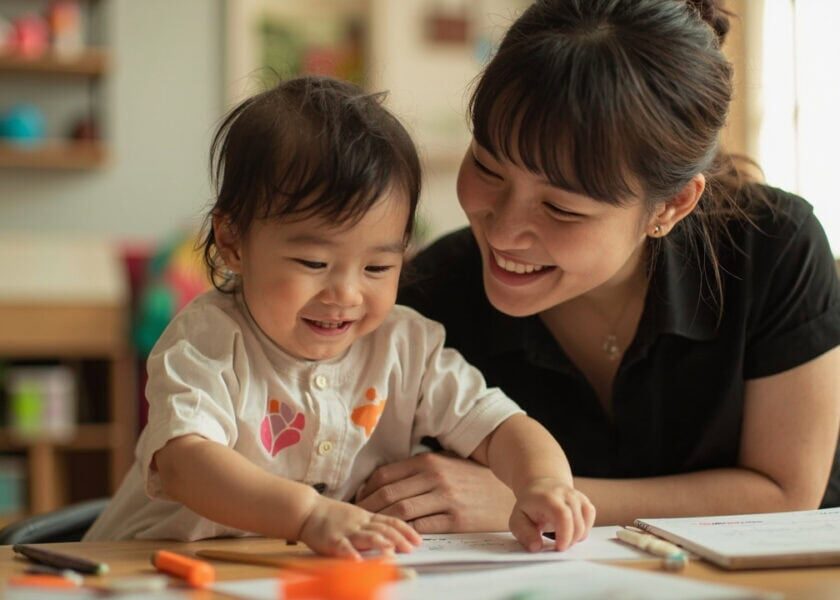
When a child chooses an activity, the caregiver does not direct or over-explain. They observe. They join when invited. They ask a question that extends thinking rather than interrupting it. They offer a word or a concept at exactly the moment the child is primed to absorb it.
This is language exposure happening in context—the most powerful way young minds build vocabulary, not through flashcards, but through meaningful exchange about meaningful things.
When Two Children Reach for the Same Toy
Now watch what happens when two children reach for the same toy.
In a setting without trained caregivers, this often becomes a quick arbitration—stop fighting, share, take turns. In a quality environment, this moment is a classroom.
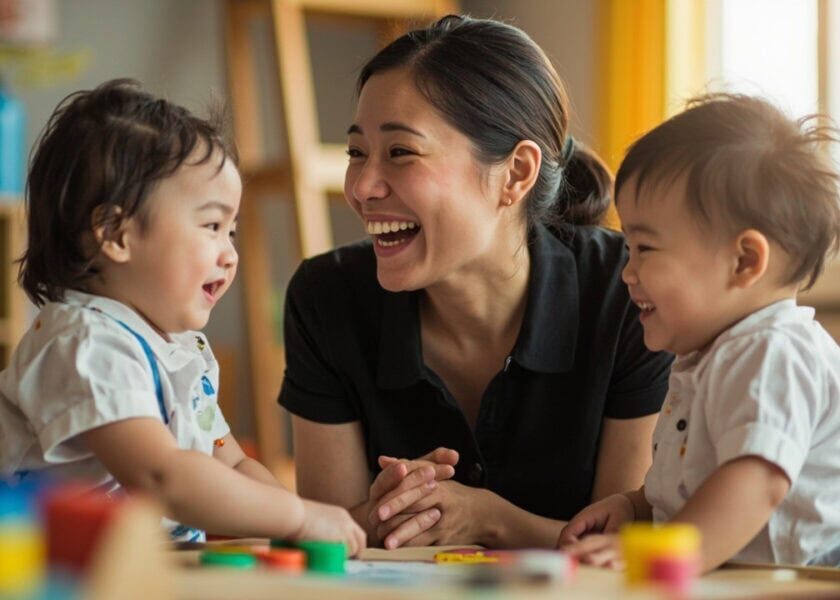
The caregiver approaches not with solutions but with facilitation. They help each child name what they want. They hold space for the disappointment. They offer language for negotiation. They allow the children to find their own resolution, with just enough support to keep it from escalating.
The child who wanted the red truck learns that their desire matters, that it can be expressed, and that the world does not end when they do not get it immediately.
The child who reached for it first learns that another person’s longing is also real.
These are the foundations of social intelligence—empathy, negotiation, emotional tolerance—being laid down in a moment that most adults would not even register as developmental.
Mealtimes: More Than Nutrition
Mealtimes are another layer of the invisible curriculum that deserves far more attention than it typically receives.
In a quality infant and toddler environment, meals are social experiences, not just nutritional ones. Children sit together. They experience the rhythms of shared eating—waiting, passing, asking, thanking. They encounter new foods in a social context where others are also trying them, which reduces resistance and increases openness.
They practice the fine motor skills of self-feeding, of using utensils, of pouring water. And crucially, they are in the company of a caregiver who narrates the experience with language, who introduces words like chunky, crunchy, and smooth, who makes mealtime a place where language grows alongside nutrition.
The Transitions Between
Then there are the transitions themselves—the moving from one activity to the next, the cleanup moments, the diaper changes, the preparations for nap.
In a quality environment, these are not interruptions to learning. They are learning.
- The caregiver uses transition songs to build rhythm and predictability, which helps children feel secure.
- Cleanup becomes a lesson in responsibility and contribution.
- Diaper changes are moments for one-to-one connection, for language, for gentle interaction that says, you matter even in the most ordinary moments.
And nap time—when a caregiver helps a child move from the high energy of morning play into the quiet restoration of sleep—is an exercise in trust. The child who learns that sleep is safe, that someone will stay close, that the world will still be here when they wake, is building the neurological architecture for calm, for self-regulation, for the ability to settle oneself when stressed.
This is not a small thing. This is foundational.
From Guilt to Confidence: Why What Your Child Experiences Matters
What we are describing is not a series of techniques. It is a philosophy made visible in hundreds of daily micro-moments.
Through play, children explore cause and effect, test boundaries, practice roles, process emotions, build physical competence, and construct their understanding of the world. Play is learning, in its deepest and most essential form for infants and toddlers.
The childminder—the caregiver who spends their days in this invisible curriculum work—deserves recognition as a professional of real significance. This is not babysitting. This is the work of nurturing developing human beings during the most critical period of their growth.
A skilled childminder is an observer, a facilitator, a language model, an emotional anchor, and a designer of developmental experiences—often simultaneously and always with attentiveness that cannot be faked or performed.
For Parents in Singapore
Singapore parents are among the most thoughtful, most engaged parents in the world. You read. You research. You worry. You want to do right by your child, and the pressure of balancing professional demands with the desire to be present for every developmental moment is real and often exhausting.
The guilt that surfaces when you drop your child at childcare in the morning is not a sign that you are doing something wrong. It is a sign that you care enormously.
But that guilt can be transformed—not by your presence at every moment, but by the knowledge that when your child is in a quality care environment, they are not missing you in a static, unchanging space. They are growing. They are learning. They are in an environment designed for their development, one micro-moment at a time.
When your child is in a quality care environment, here is what is actually happening:
- Your child practiced emotional regulation during arrival.
- Your child built language through meaningful conversation at lunch.
- Your child developed motor skills and spatial awareness through purposeful play.
- Your child learned to navigate social complexity with peers, with support that was just enough but never intrusive.
- Your child rested in a secure environment where sleep was protected and nurturing.
- Your child felt seen, valued, and responded to—not just watched.
The invisible curriculum does not disappear when the day ends. It becomes the substrate of your child’s resilience, their relationship with learning, their capacity to connect with others, their confidence in exploring the world.
What EduNanny Provides
This is precisely what EduNanny by BUTLER has been built to provide. As part of the ECDA Childminding Pilot, EduNanny represents a thoughtful response to the genuine needs of Singapore families—a pathway for infant and toddler care that is grounded in developmental understanding, accessible in structure, and committed to the invisible curriculum that we have been describing.
Pathways That Match Real Families
EduNanny offers both home-based and community-based pathways, understanding that every family has different needs, different rhythms, different circumstances.
Whether care is provided in your own home by a trained childminder or in a carefully designed community environment, the principles remain consistent.
Small Ratios Mean Real Attention
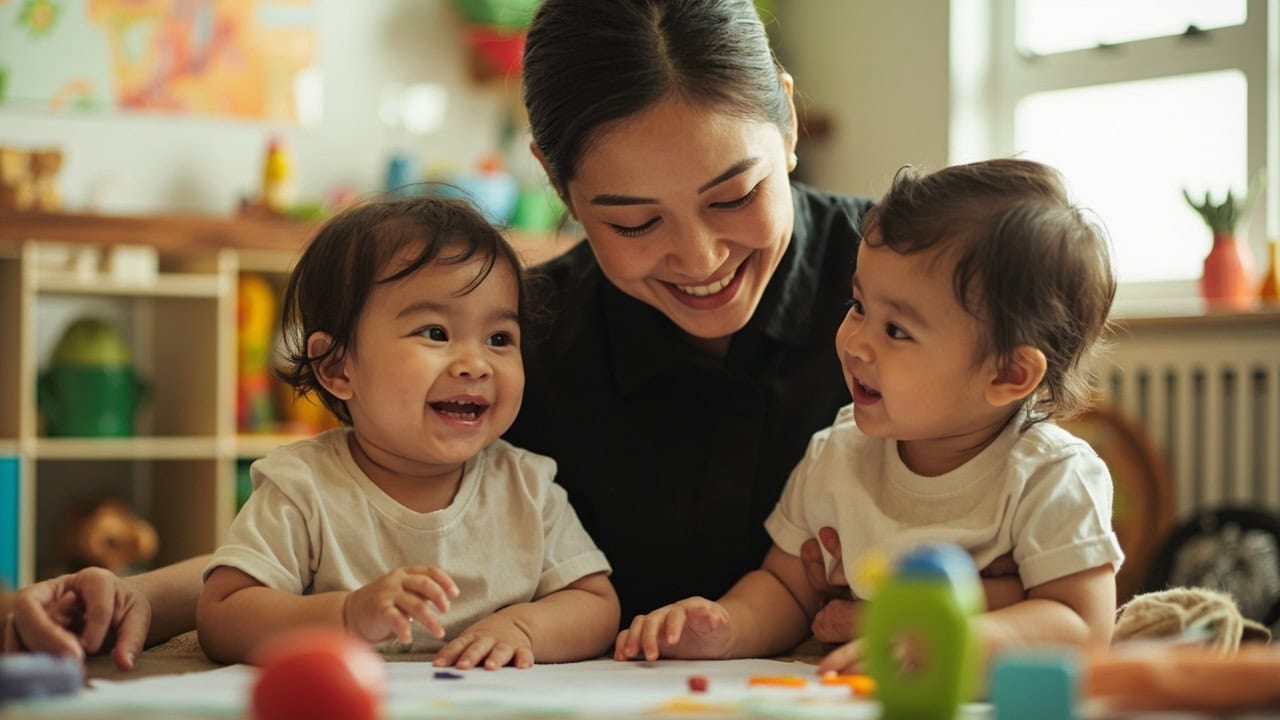
Small ratios—up to one to three infants—mean that every child is truly seen. There is no dilution of attention, no quiet overwhelm, no child slipping through the cracks of a too-large group.
In a small-ratio environment, the caregiver knows each child’s rhythms, preferences, emerging skills, and current challenges. This knowledge is the foundation of responsive, individualized care that adapts to the child rather than expecting the child to adapt to a predetermined program.
Making Quality Accessible
The pilot structure makes this quality accessible. Monday to Friday care blocks, with fee structures designed to be affordable within the pilot framework, and with CDA and Baby Bonus usability where applicable, mean that families across Singapore can access this level of intentional care without facing prohibitive costs.
This is not a luxury for the few. This is a genuine option for families who want developmental quality and who understand that the early years are not a time to compromise.
Transparency You Can Trust
Transparency is built into the EduNanny approach. For families, the question of what happens during care hours is not meant to remain a mystery.
Communication systems keep parents informed about their child’s day—not just the surface facts, but meaningful insights into their child’s experiences, discoveries, and development. Where deployed, measures such as CCTV provide an additional layer of assurance.
These are not add-ons. They reflect a deeper commitment to the trust that parents deserve and the transparency that quality care should welcome.
How to Choose Quality Infant Care in Singapore
If you are currently evaluating childcare options, here is what to look for:
Questions to Ask a Potential Provider
- How do you handle the morning transition when a child arrives?
- What does a typical morning look like in terms of activities and free play?
- How do you support children when they disagree over toys or space?
- How are mealtimes structured and what role do caregivers play?
- How do you support children during nap time transitions?
- What is the caregiver-to-child ratio?
- How do you communicate with parents about the child’s day?
What to Observe During a Visit
- Do caregivers kneel to a child’s level when speaking with them?
- Do children seem engaged and at ease, or anxious and withdrawn?
- Is the environment arranged with intentional spaces for different types of play?
- Do caregivers observe more than direct?
- Are transitions smooth, with predictable routines?
- Do caregivers narrate and name things for children during activities?
Supervision vs. Care
In a supervision-focused setting, activities are scheduled to fill time, caregivers manage behavior reactively, and transitions are efficient necessities. Children are kept safe and occupied, and parent updates are surface-level summaries.
In a quality care environment, environments are designed for developmental choice. Caregivers facilitate social and emotional learning. Transitions are opportunities for connection and language. Children are seen, known, and supported individually. And parents receive meaningful developmental insight into their child’s experiences.
Your Child Is Learning Right Now
So when you return to that moment at pickup, when you stand at the gates or in the lobby and wonder what your child did today, we want you to know the answer.
Your child was learning. Not despite the ordinary moments, but through them. Not instead of play, but through play. Not in isolation from you, but in connection with caregivers who understand their developmental needs and honor them in every interaction.
The invisible curriculum is not magic. It is intentionality. It is expertise. It is a deep respect for the extraordinary capacity of the young child’s mind and a commitment to designing every moment for growth.
It is what EduNanny by BUTLER provides—not just as a service, but as a partnership with families who understand that the early years matter more than we have ever known.
In a city like Singapore, where families navigate the demands of modern professional life while holding onto the hope of meaningful early experiences for their children, this kind of care is not a convenience. It is a contribution to the future.
Every child who receives responsive, intentional care in their earliest years carries forward a foundation of security, curiosity, and capability that shapes everything that follows.
So when you drop your child off tomorrow morning, and you feel that familiar flutter of doubt, remember this: your child is not in a static space waiting for you to return. Your child is growing. Your child is building themselves, one moment at a time, in an environment designed to help them flourish.
That is not just reassuring. It is extraordinary.
If you are ready to learn more about EduNanny’s approach to infant and toddler care in Singapore, we invite you to take the next step. Your child’s earliest years are happening now—and they deserve an environment that understands just how much is happening, even in the quietest moments.