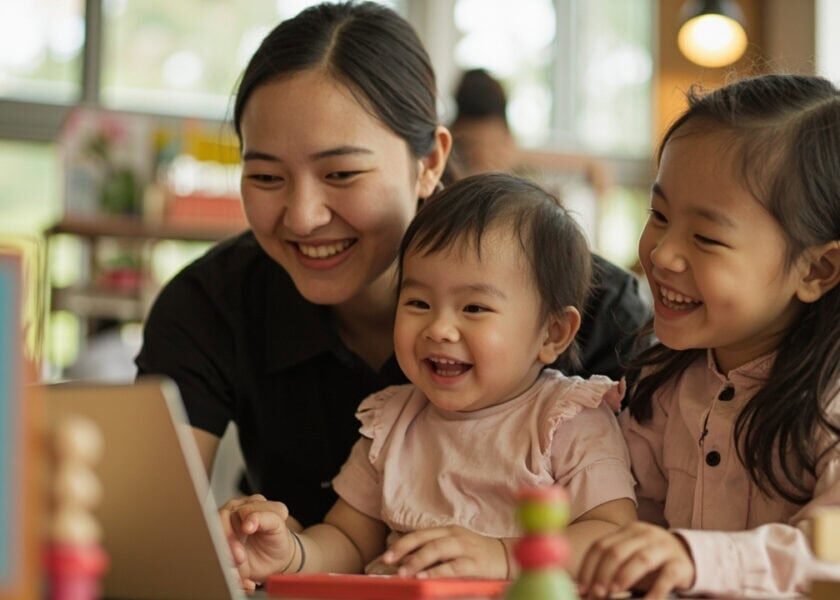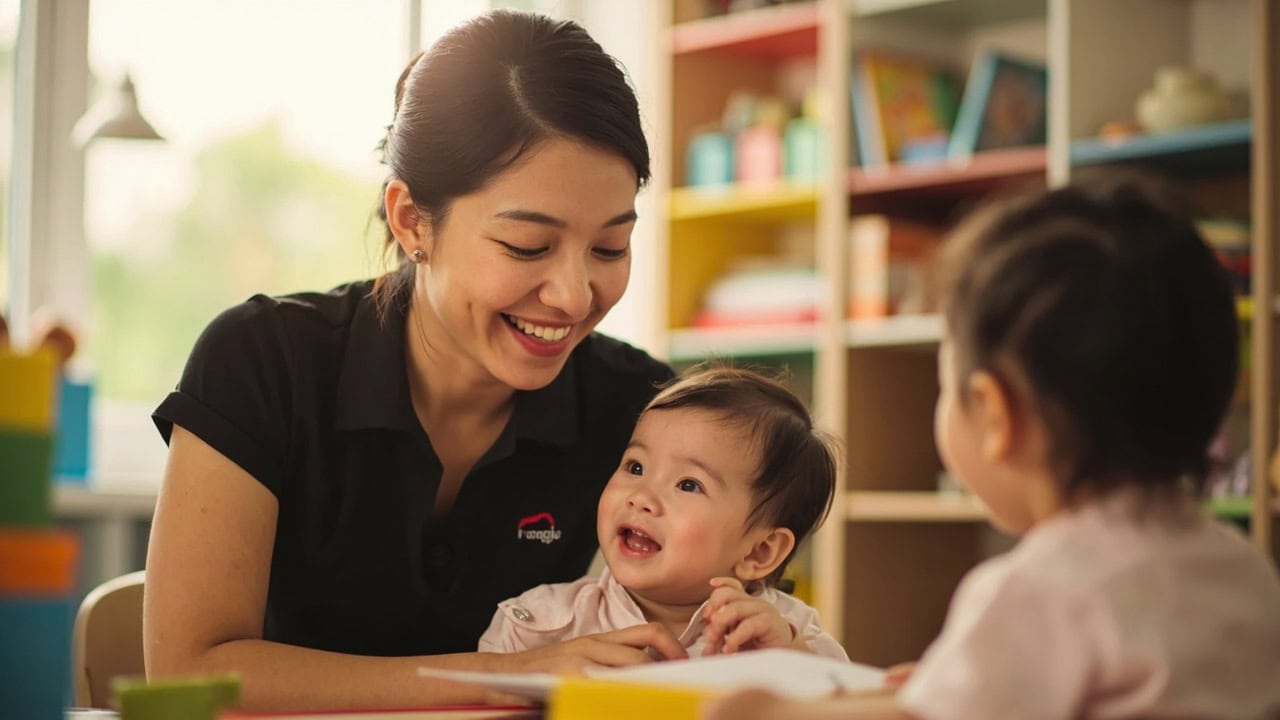
Your Siblings Will Still Thrive Together Even in Different Care
“`html
The Quiet Fear That Lives in the Hearts of Singapore Parents
It is not the same fear that first-time parents feel. It is deeper, more complex, and far less acknowledged. It is the fear that by bringing formal childcare into the life of your family, you will do something irreversible to the bond between your children.
The bond you have watched grow in stolen moments between feeds and bath times. The bond that emerged when your older child looked at your younger one and, impossibly, softened. The bond you have nurtured with your own hands and your own presence, and that you worry cannot survive the intrusion of schedules, routines, and strangers.
You love your children equally, fiercely, without condition. But you wonder, in the small hours, whether love is enough when one child is in care and another is not. Whether your youngest will feel abandoned. Whether your oldest will feel replaced. Whether the harmony you have worked so hard to build will fracture under the weight of a decision you are not even sure is right.
This fear does not make you a bad parent. It makes you an honest one. It means you understand, at a level that is both rational and visceral, that siblings are not simply people who happen to share a home. They are a relationship. A living, evolving bond that requires tending. And you are terrified of doing anything that might damage it.
You are not alone. But you have rarely been spoken to directly.
How Siblings Actually Experience Childcare Differently
Here is what no one tells you when you are navigating childcare decisions with multiple children: your children will not experience childcare the same way. They cannot. Each child enters the world with a distinct temperament, a distinct history, a distinct relationship to change.
Your firstborn may have transitioned into care with relative ease, responding to the structure and the social world with curiosity and growth. Your second may be more cautious, more attached, more sensitive to transitions. Or it may be the reverse. Each child’s experience is as individual as their fingerprint, and to treat childcare as a uniform event that affects all siblings equally is to misunderstand what siblings actually are.
Your older child in preschool does not sit at circle time wondering whether her baby brother is feeling the same thing she felt on her first day. Your younger child at home with a caregiver does not compare his experience to hers. They are living their own lives, having their own discoveries, forming their own sense of what the world is like.
The question is not whether childcare affects your children. Of course it does. The question is whether the effect is enriching or impoverishing. Whether it builds them up individually, which then builds them up together.
A child who is secure, who is seen, who is supported in growing into their fullest self, is a child who can be a better sibling. A child who is under-stimulated, anxious, or emotionally starved does not become a better sibling to compensate. They become a child who competes. Who grasps. Who needs more than any family system can sustainably provide.
When you choose quality care for your children, you are not taking something away from their bond. You are giving something to it. You are giving each child the grounding they need to show up fully when they are together.
Will your child feel replaced when a sibling enters care? Children are remarkably perceptive about what matters to them and remarkably oblivious to what does not. What your older child notices is not that her baby brother is in care. What she notices is whether she is seen. Whether her needs are met. Whether her place in the family is secure. When that security is present, a sibling’s care arrangement is simply a fact of daily life, not a threat to her identity.
The Fairness Question: When One Child Is in Care and Another Is Not
There is another fear, equally unnamed, that lives alongside the first. It is the worry that by enrolling one child in childcare and not another, you are making a choice that reveals your preference, your judgment, your implicit ranking of their worth.
Your infant needs stimulation and social interaction. Your preschooler needs curriculum and peer engagement. Your toddler needs mobility and exploration. These are not the same needs. But you fear that your children, when they are old enough to understand, will not see differentiation. They will see difference. And difference, in the minds of children, can feel like inequality.
What your children need is not the same thing. What they need is the right thing, for them, at this moment in their development.
- When you enrol your infant in a home-based care arrangement with a low ratio of infants to caregivers, you are not saying she matters more than your older child. You are saying that at this stage, this is what she needs.
- When your preschooler joins a programme that prepares her for the social and academic expectations of primary school, you are not preferring her over her siblings. You are meeting her where she is.
- A newborn thrives on sensory richness and secure attachment. A three-year-old thrives on social learning and cognitive challenge. A toddler thrives on mobility, exploration, and language discovery. These are not competing demands. They are parallel ones. And honouring them is not favouritism. It is responsiveness.
The children who struggle with sibling relationships are rarely the ones whose parents differentiated carefully. They are the ones whose parents treated all children identically, regardless of age, temperament, or developmental stage, and then wondered why each child felt unseen.
What if your children have different experiences of care and that creates distance between them? The distance that strains sibling bonds is not the distance of different experiences. It is the distance of unmet needs. A child who feels unseen will compete with a sibling. A child who feels secure will celebrate a sibling’s joys. Different care arrangements are only a problem if one arrangement leaves a child depleted—and that is a problem with the arrangement, not with the concept of childcare itself.
Logistics: When Love Alone Does Not Drive the Minivan
You know as well as anyone that love alone does not drive a minivan. You have multiple drop-offs. Multiple pick-ups. Multiple schedules that must somehow align with your own.
Your older child needs to be at school by seven-thirty. Your younger one is not ready for a full day of structured care. Your caregiver arrangement must bend to accommodate a life that does not follow a script.
This is where the gap between aspiration and reality often collapses. Parents with multiple children often choose childcare based not on what is best for each child, but on what is manageable for the whole system. They opt for a single centre that takes all ages because it is easier to coordinate. They accept a caregiver arrangement that is merely adequate because the alternative seems impossible. They compromise not because they want to, but because they do not see another way.
How do you coordinate care for children of completely different ages and needs? By choosing arrangements that are designed for complexity rather than simplicity. This may mean different care settings for different children at different times. It may mean home-based care for your infant and centre-based preschool for your toddler. What it means is that your children’s needs, not a single convenient solution, are what determines the arrangement.
What Quality Multi-Child Care Looks Like
EduNanny Singapore was designed with this complexity as the starting point, not an afterthought. The home-based pathway, developed under the ECDA Childminding Pilot and supported by BUTLER, offers families a flexible alternative to the traditional centre-based model.
| Feature | What It Means for Your Family |
|---|---|
| Small group ratios | Each child receives the attention their development requires, not just adequate supervision |
| Home setting | Warmth and consistency that infants and toddlers especially need, without the overwhelm of a large centre |
| Flexible care blocks | Monday to Friday arrangements that give families a reliable rhythm without demanding more than necessary |
| Accessible fee structures | Pilot pricing designed for families, with CDA and Baby Bonus funds applicable where eligible |
Singapore-wide in reach but personal in approach, EduNanny understands that the logistics of multiple children are not separate from the emotional questions. They are the same question, seen from different angles.
Transparency: More Than Trust Without Evidence
You deserve more than trust without evidence. When your children are in care, you need to know what their days looked like. Not in general terms. Not in vague reassurances that everything was fine.
You need specifics.
The photo of your daughter building with blocks, her face lit with concentration. The note that your son ate well today, that he laughed at something the caregiver said, that he fell asleep easily and woke calm.
EduNanny’s commitment to transparency means that parents receive regular, meaningful updates about their children’s days. Where deployed, CCTV measures provide an additional layer of assurance. This is not about surveillance. It is about partnership. It is about the knowledge that when you hand your children to someone else’s care, you are not handing over your right to know what happens in the hours you are apart.
Your peace of mind is not a luxury. It is a necessity, both for you and for your children. A parent who feels informed is a parent who can be present. And a child who senses that their parent is at ease is a child who can settle.
Signs That Your Siblings Are Thriving
There is a moment that tells you things are working. It is not dramatic. It does not announce itself. It is quiet, almost easy to miss.
It is your older child at the dinner table, saying, “You know what happened at school today?” and your younger one listening, not because he was asked to, but because he genuinely wants to know.
It is your toddler settling into the arms of his caregiver without the prolonged goodbye that used to make your chest ache. It is your preschooler, asked about her baby brother, smiling instead of sighing.
It is the sound of your children playing together not because they have to, but because they want to. Because they have enough. Because each of them has been filled up enough to have something genuine to give.
Signs that siblings are thriving include:
- Not the absence of conflict—which is neither possible nor desirable—but the presence of genuine curiosity about each other’s lives
- Not identical treatment—which is neither possible nor desirable—but the confidence that comes from being seen as an individual
- Each child grounded in themselves. Each child confident enough to be generous. Each child secure enough to love their sibling not out of obligation, but out of overflow.
Quality childcare, the kind that sees your children as individuals and your family as a whole, does not undermine the sibling bond. It cultivates it. It gives each child the nourishment they need to return to each other not depleted but enriched. It gives you the support you need to be a parent to all of them, not just the one who seems to need you most.
Your Village Is Already Taking Shape
You came to this article carrying a weight. The weight of questions you have not seen answered. The weight of fears you have not heard named. The weight of a love for your children that is so fierce it has made you cautious, even paralyzed, because you do not want to get this wrong.
EduNanny Singapore sees you. Not as a parent who needs to be reassured with platitudes, but as a thoughtful adult navigating a genuinely complex landscape. The landscape of sibling relationships, of competing developmental needs, of schedules that must bend to accommodate a life that is larger than any single arrangement can contain.
EduNanny is not here to tell you that childcare is simple. It is not. For families with multiple children, it is especially complex, and it deserves to be treated that way. EduNanny is here to walk beside you through that complexity. To offer care that adapts to your family’s rhythm rather than demanding your family adapt to its rhythm. To give each child the individual attention they deserve while honouring the family that raised them.
You have built something remarkable with your family. A bond between your children that is entirely your own, shaped by your love and your presence and your intention.
That bond does not need to be protected from quality care. It needs to be supported by it. It needs caregivers who see your children as individuals so that your children can see each other clearly. It needs structures that honour each child’s development so that the family can remain whole.
Your children are watching how you navigate this. They are learning, from you, what it means to love well. To love not by giving everything to everyone, but by giving the right thing to each person at the right time. By trusting others to support what you cannot do alone. By believing that the village you are building will raise your children better than any single family system could manage on its own.
That is not a failure of love. That is love, expressed at scale. That is parenthood, expanded to include the support you and your children deserve.
Every family’s situation is different. Your children have unique temperaments, unique needs, unique rhythms. Your schedule has constraints that no generic solution can address. And your questions deserve answers that are specific to you.
Step forward. The village is ready. And your children are in good hands.
Enquire about EduNanny Singapore for your family ›
#SiblingBonding #SingaporeChildcare #MultipleChildren #EduNannySG #ChildmindingSingapore
“`