Why Separation Anxiety Is Your Child’s Most Important Milestone
Understanding the Drop-Off: What Separation Anxiety Is Really Telling You
You know the feeling.
You’ve felt it before. And if you’re a new parent reading this, you will feel it soon—perhaps you already have. It arrives in the parking lot, in the early morning quiet before the day has properly begun. It comes in the elevator ride up, holding a small hand a little too tightly. It comes in the moment you cross the threshold and the door closes behind you, and there is your child—three years old, eighteen months, perhaps just ten months old—watching you with an expression that asks a question words cannot yet form.
In that moment, your heart does something it has never quite done before. It splits open. Because you love this child with a ferocity that still surprises you, and leaving them here, with someone else, feels like pulling against something fundamental. Like leaving a part of yourself behind.
This is the drop-off.
And here is what we rarely say out loud: it is supposed to feel heavy. This weight you carry to the door, this worry that settles in your chest, this question that loops through your mind at three in the morning—is this the right choice? Will they be okay? Will they feel abandoned?
The answer is not what you expect. The weight is not a warning sign. It is not proof that you are making a mistake. It is proof that you are a parent. It is the sound of love doing exactly what love is supposed to do.
The Paradox at the Heart of Every Goodbye
And yet—and this is the paradox that no one prepares you for—the goodbye is not really about you.
I know that sounds impossible. You are the one walking out the door. You are the one driving home with an empty car seat in the rearview mirror. You are the one who will check your phone seventeen times before noon. But the goodbye, in its deepest sense, belongs to your child.
What happens in those first minutes—the transition from your arms into the arms of another, the moment when your child must cross from the familiar world you have built together into the wider world they are only beginning to trust—this is where everything begins. Not in the curriculum. Not in the facilities. In this moment. In the transition itself.
Separation Anxiety Is a Milestone, Not a Red Flag
Here is what the science tells us, and it tells us this clearly: separation anxiety is developmental. It is not a malfunction. It is not a sign that your child is not ready for care. It is a sign that your child has formed a secure attachment to you and is now encountering the natural and necessary challenge of learning that the world contains other safe people.
This is exactly what should happen.
A child who shows no anxiety at separation, who waves you away without a second glance, may be showing us something different—adaptation, perhaps, or a pattern of attachment that developed under different circumstances. But the crying, the clinging, the moments when your child looks back at you as if you are the only thing keeping the world from spinning away? That is the sound of a healthy, attached child learning to trust beyond you.
It is developmental. It is important. And it is supposed to be managed with skill and intention—not ignored or medicated away, but held with understanding by the adults in the room.
This means that when your toddler cries at drop-off, when your infant wails as you hand them over, when your three-year-old grabs your leg and begs you not to go—these are not failures. These are milestones. Your child is telling you that what you have built together matters. That you matter. That the bond between you is real and strong and enduring.
What Actually Happens in Those First Minutes
Which brings us to what those adults must do. Because here is the truth that too many childcare arrangements miss: the drop-off is not a logistics problem to be solved. It is not a handoff to get through quickly so the day can officially begin.
The drop-off is the first minute of your child’s entire experience of care. And what happens in that minute—what the caregiver does, how they move, what they say, how they receive your child into their arms—sets the tone for everything that follows.
Think about what your child experiences in those moments. They have just left you. Their nervous system is activated. Their stress hormones are flowing. Their whole body is asking the question: is it safe here?
And into this moment walks the caregiver.
How they enter this moment matters more than almost anything else that will happen all day.
What Quality Caregiver Behaviour Looks Like
A quality caregiver does not rush the handoff. They do not usher you out the door so they can get on with their schedule. Instead, they step into the transition with intention.
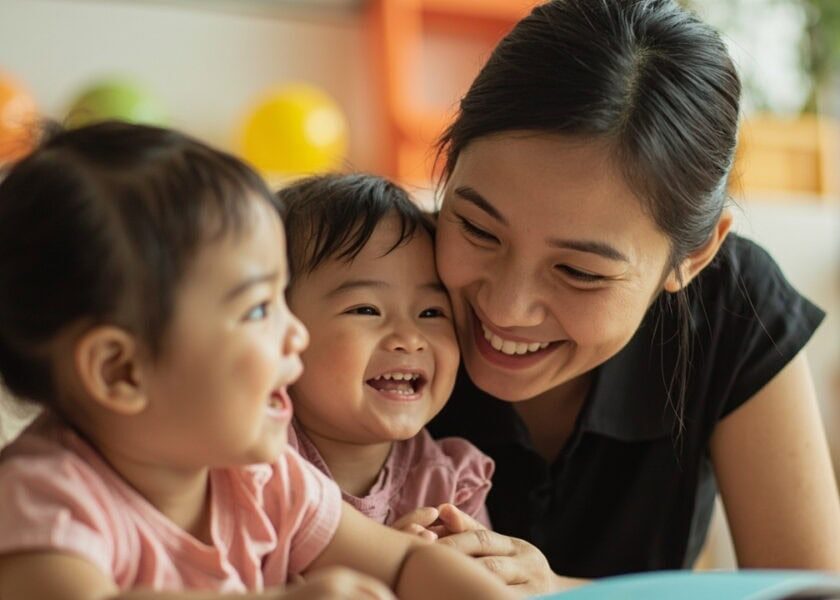
They greet your child at eye level—neither looming down nor hovering at a clinical distance. They speak warmly, specifically, by name. They receive your child into their arms with a calmness that is not performed but genuine—a calmness that says, without words: I have got this. I am present. You are safe here.
And then comes the redirect. This is the moment that separates good care from great care.
A quality caregiver does not simply hold your crying child and wait for the tears to stop, as if the crying is a problem to be endured. They hold your child, yes. They offer comfort, yes. But they also understand that your child’s attention must be gently redirected—not in a dismissive way, but in an invitation.
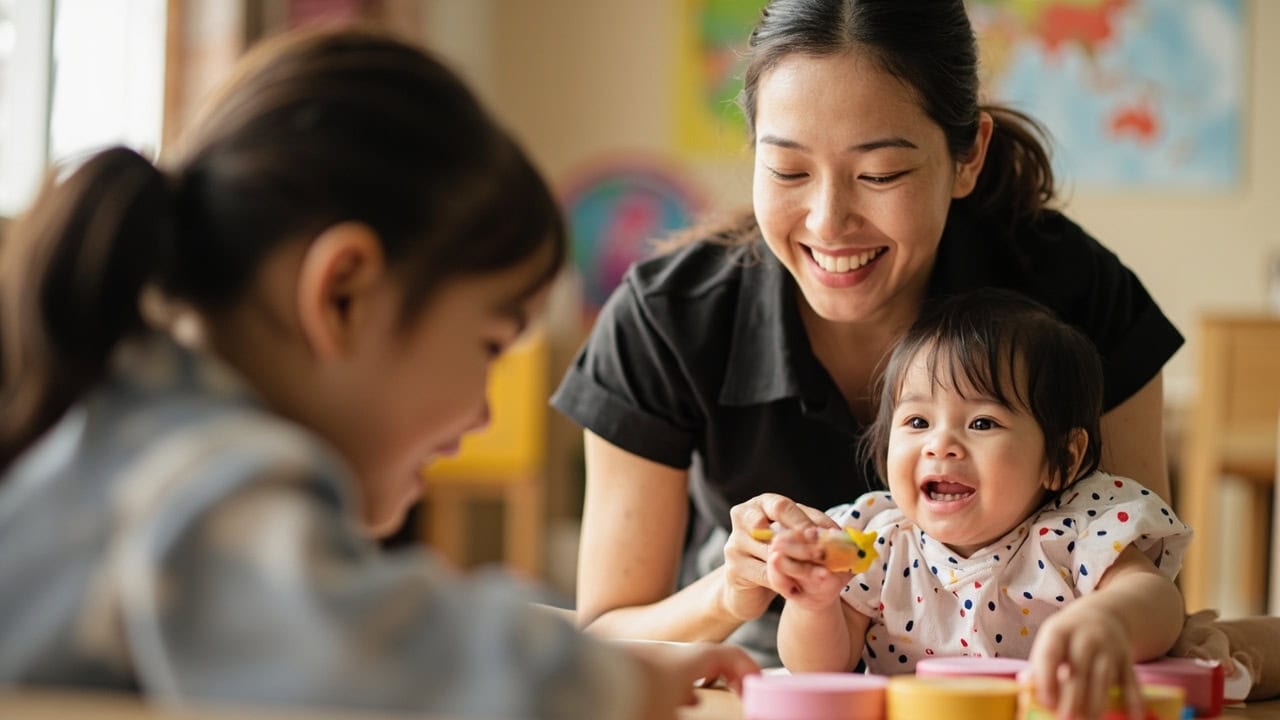
Here is something interesting. Here is something to explore. Here is a new toy, a new activity, a new person to connect with.
Slowly, carefully, the child’s focus begins to shift. The nervous system begins to settle. The message writes itself into the child’s body: the person I trusted left, but this person is here, and this place is okay, and I can be okay too.
This is not luck. This is not personality. This is training, intention, and a deep understanding of early childhood development that treats every drop-off as an opportunity to build security.
Your Role as the Parent: What Your Child Reads in You
Now here is the part we do not always want to hear, because it asks something of us.
Your child is reading you. Right now, in this moment, they are reading you with an acuity that no lie detector could match. They have not yet learned to perform emotions they do not feel. They have not yet built the social scripts that let adults mask what is underneath. Your child feels what you feel, and they feel it in their body, and they do not yet have the words to tell you that you are telegraphing anxiety into their nervous system like a radio signal.
This does not mean you must be perfect. It does not mean you must hide your feelings or perform a confidence you do not feel. That, too, would be a lie your child would sense.
What it means is this: when you walk into that space, when you hand your child to the caregiver, you are not just transferring custody. You are transmitting information. Your body is speaking. Your voice is speaking. And your child is listening with their whole being.
A Confident Drop-Off From the Parent’s Side
So what does a confident drop-off look like from your side?
It looks like a brief, warm goodbye. It looks like eye contact with your child that says I love you and you are safe and this is okay. It looks like a kiss on the forehead, a hand on the cheek, and then a calm, clear departure.
No lingering. No creeping back to the doorway to check if they have stopped crying. No emotional negotiations at the threshold that stretch the goodbye into something your child’s nervous system experiences as a series of small abandonments.
The research on this is clear: children whose parents do brief, confident, consistent drop-offs settle faster and show less distress throughout the day than children whose drop-offs are prolonged and emotionally ambiguous.
Your calmness is not just a feeling. It is a gift you give your child. It is a tool. Use it.
The 90-Day Arc: Why Consistency Compounds
There is the question of consistency, which is the foundation beneath all of this.
Your child is building a mental model of what drop-off means. They are learning the rhythm: this is how it happens, this is who brings me, this is where I go, this is who receives me.
And when that pattern is consistent—when the same caregiver is there at the door, when the same greeting happens, when the same rituals of transition unfold—the child’s nervous system begins to learn to trust the pattern itself. The pattern becomes a container for the anxiety.
The child learns: even when I do not like this, even when I cry, even when I feel afraid, the pattern holds. The same thing happens. I am safe.
Why Small Ratios Matter for Your Infant
This is why small ratios matter. This is why having the same caregiver matters. This is why the infant-to-caregiver ratio in your child’s care environment is not an administrative detail but a developmental one.
When your child is one of three infants in a home-based setting—cared for by someone who knows your child’s rhythms, your child’s cues, the specific way your child shows fear and the specific way your child shows recovery—the caregiver becomes not a stranger taking turns in a rotating schedule but a person who knows your child, who your child is beginning to know.
For infants and toddlers in the critical window of early attachment, this is the architecture of security.
What the First 90 Days Predict
Researchers who have studied early childcare over decades have found something striking: the quality of the drop-off experience in the first weeks and months predicts the trajectory of your child’s adjustment to care.
Children who experience confident, consistent, high-quality drop-offs—where the caregiver receives them well, where the transition is managed with skill, where the same patterns repeat day after day—these children do not just stop crying faster.
They show different patterns of stress hormones over time. They show more willingness to explore. They show more social engagement with caregivers and peers. They show the marks of a child who has learned, at a deep developmental level, that the world beyond home can be trusted.
And children whose drop-offs are inconsistent, rushed, handled by strangers, or experienced as chaotic or frightening? The effects compound. Not because one bad drop-off ruins a child, but because the nervous system is building its model of what to expect. Each drop-off is a data point. Over ninety days, over a hundred drop-offs, that model solidifies.
The child who learned to expect a confident handoff and a warm receiving will carry that expectation forward. The child who learned to expect uncertainty will carry that too.
What to Look For: A Practical Guide for Singapore Parents
So what does this mean for you, sitting in Singapore, perhaps still carrying a newborn, perhaps already navigating daily drop-offs?
It means that when you choose your child’s care arrangement, you are not just choosing a schedule or a curriculum or a location near your HDB or condo. You are choosing who will stand at the door when your child walks through it each morning. You are choosing what will happen in the first minute, and the second, and the fifth. You are choosing whether your child will be received by a stranger in a rotation or known by name.
Questions to Ask During Your Childcare Visit
- Who will be my child’s primary caregiver, and how often will that change?
- What does a typical morning drop-off look like? Can I observe?
- How do caregivers handle separation anxiety when a child is distressed?
- What is the infant-to-caregiver ratio?
- How do you communicate with parents during the day?
- What is the routine? Is it consistent day to day?
- How do you support parents who are struggling with the drop-off transition?
Red Flags to Watch For
- Caregivers who rush you out the door or seem impatient with crying
- High turnover or frequent rotation of caregivers
- Large infant-to-caregiver ratios that make individual attention impossible
- No clear drop-off routine or inconsistent handling of transitions
- Resistance to parent questions or lack of transparency about daily activities
- Caregivers who do not address your child by name or make eye contact
Signs of Quality
- Caregivers who kneel or sit at your child’s eye level during greetings
- A calm, unhurried transition even when a child is distressed
- Specific, warm communication that shows genuine knowledge of your child
- Consistent caregivers who have been present for weeks or months
- Clear daily rhythms that your child can anticipate
- Transparent communication channels—photos, updates, open-door policies
How EduNanny Approaches the Drop-Off Moment
This is where we arrive at what EduNanny Singapore is trying to do, and why this matters beyond philosophy and into practice.
EduNanny by BUTLER is part of the ECDA Childminding Pilot, and in that pilot sits a set of choices that are not accidental.
The home-based pathway means small ratios—up to one to three infants in a home environment where the caregiver is not a passing employee but a consistent presence. This is not coincidence. It is design. When a caregiver knows three infants rather than twelve, they can learn each child’s rhythms, each child’s cues, each child’s specific way of showing fear and recovery. They can receive your child by name every morning, not as a stranger but as a familiar face.
The Monday to Friday care blocks mean rhythm and predictability, which your child’s nervous system craves. When every Monday morning follows the same pattern, when every Friday afternoon means the same goodbye ritual, the child’s brain begins to trust what comes next. The pattern itself becomes a source of comfort.
The fee structures within the pilot are designed to be accessible, and the integration with CDA and Baby Bonus means the financial weight of quality care does not fall entirely on the shoulders of families who are already carrying so much.
The Infrastructure of Trust
When we talk about CCTV measures and communication protocols, we are not talking about surveillance for its own sake. We are talking about the transparency that lets you leave your child in the morning and carry certainty with you instead of anxiety.
We are talking about the parent who can check in during the day and see their child’s face, see them playing, see them safe—and then close the app and return to their own work with their heart a little lighter. This is not a gimmick. This is the infrastructure of trust, built into the system so that trust can actually grow.
Support When You Need It
And the Thomas AI Chatbot—that quiet, available intelligence that sits behind the EduNanny experience—that is about something specific. It is about the questions that do not fit into office hours.
The question you have at eight o’clock at night, after the house is finally quiet, after your child’s breathing has slowed into sleep, and you find yourself wondering: Is this normal? Should I be worried? What does it mean when they do this?
Thomas is there for those moments. Not to replace the wisdom of experienced caregivers, but to hold the space between questions, to offer the reassurance of accessible guidance, to remind you that you are not navigating this alone.
Making the Right Choice and Letting Go
If you are in the thick of it—the morning drop-offs that make your chest tight, the goodbyes that still, even after weeks and months, feel hard—this is not proof that you are doing something wrong. This is proof that you love your child with a ferocity that the world needs more of.
And now, with that emotional permission to feel what you feel without judgment, you can also ask the practical question:
- Who is receiving my child each morning?
- Are they ready? Are they trained?
- Do they understand what that transition means?
- Do they have the skill to hold my child’s anxiety with gentleness and patience and intention?
- Are they the kind of person who will greet my child by name and step into the transition with calm confidence?
Ask those questions. You are right to ask them.
And if the answers line up—if the caregiver is warm, consistent, trained, present, if the ratio is small, if the communication is transparent, if the whole system feels designed not just to babysit your child but to nurture their development and hold your peace of mind—then you can let some of the weight go.
You can walk to your car in the morning and breathe. You can trust that the goodbye is being handled well, and that your child is learning, one drop-off at a time, that the world is large and full of safe people, and that leaving you does not mean losing you.
The Goodbye as a Gift
This is not a small thing. This is not a simple service. This is the first thousand days of your child’s life, and in those first thousand days, the architecture of the human being is being built.
The brain is forming at a rate it will never match again. The patterns of attachment are being set. The question of whether the world is safe, whether other people can be trusted, whether I can leave the arms of the people who love me and still be okay—this question is being answered, quietly, in the small moments, in the drop-offs, in the transitions, in the way your child learns to trust.
EduNanny Singapore is here to stand in that transition with you. Not to replace what you give your child, but to be worthy of the trust you extend when you hand your child over each morning. We know the weight of that. We do not take it lightly.
We know that every parent walking through our door is carrying something profound, and that our job is not just to care for children but to care for the relationship between parent and child, to hold that relationship with the respect it deserves, to earn our place in the circle of trust that surrounds your family.
So here is what we want you to carry with you today.
Your child, in their own way, in the crying and the clinging and the looking back, is telling you that what you have built together matters. That you matter. That the bond between you is real and strong and enduring.
And that bond—the one that makes the goodbye hard—is the same bond that will carry your child through every transition you make together. It is the foundation. It is the proof. And it does not break when you walk out the door in the morning.
It holds. Because you built it. And because the people you trust to stand at that door know how to protect it.
Ready to Take the Next Step?
If what you have read here resonates with what you are feeling, we invite you to take the next step.
Explore the EduNanny programme. Visit us. Ask your questions. Watch how we receive children at the door. See whether the caregivers kneel to say hello by name. See whether the transition feels calm, unhurried, warm.
Because you deserve to walk away from that door feeling lighter. You deserve to trust the people your child is with. And your child deserves to walk through that door each morning and be met by a face that knows them, by a voice that welcomes them, by an embrace that says: I am here, and you are safe, and we are going to have a good day.
That is what we are building here. Not a service. A trust.
One goodbye at a time. One child at a time. One family at a time.
And that is work that matters.
To learn more about EduNanny’s approach to developmental childminding, visit our story or get in touch with our team.