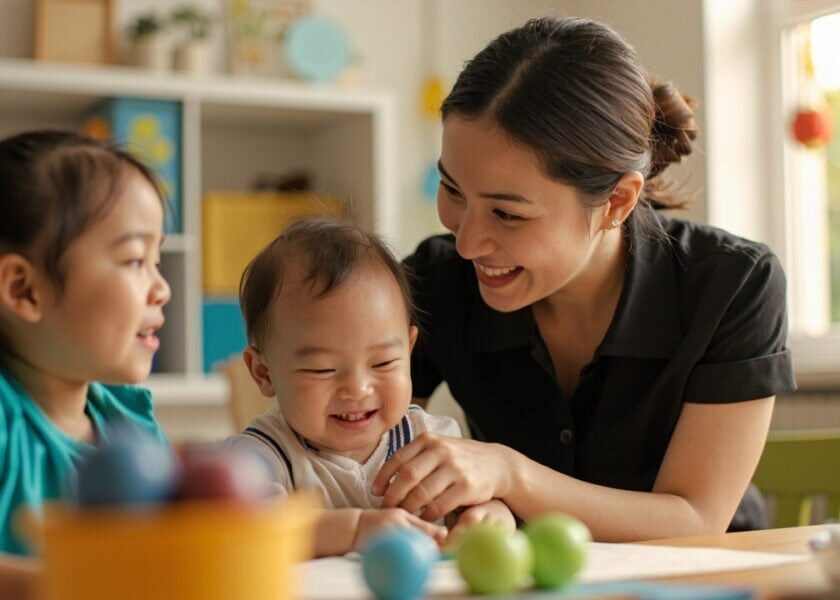
After the Decision: Growing a True Partnership With Your Caregiver
The Quiet After the Decision: Building a Real Partnership with Your Child’s Caregiver
There’s a moment that catches most parents off guard.
It doesn’t come when you’re researching options, touring centres, or interviewing caregivers. It arrives later—often at the dinner table, or in the quiet of a late evening—when you’re describing your child’s day and you realize you’re not quite sure what happened between eight in the morning and five at night.
You know something shifted during those hours. Your child came home with a new word, or a different way of holding a spoon, or a sudden affection for a song you never taught her. But you weren’t there. And the person who was there—who shaped those hours—is someone you’re still learning to know.
This is the quiet after the decision. And it is where the real work of quality childcare begins.
Most of the conversation about childcare in Singapore focuses on the choosing. How to evaluate quality. What signs to look for. How to ask the right questions during a tour. And that preparation matters. But it only tells half the story.
The moment you enroll your child in care—whether it’s a home-based setting as part of the ECDA Childminding Pilot or a community-based programme—the nature of the challenge changes. You are no longer selecting. You are building a relationship. And that relationship will shape your child’s daily experience, your own peace of mind, and the kind of partnership you create around your child’s growth and development.
This is the part that does not always get discussed: what happens after you have decided. How you talk to the person caring for your child. How you raise concerns without feeling like you’re being difficult. How you ask questions without undermining trust. How you work together on the things that matter most—the small, ordinary, extraordinary things of raising a young child.
The honest truth is that most parents find this harder than they expected. Not because they’re doing anything wrong, but because the emotional territory is genuinely complex. You love your child in a way that makes everything feel urgent. You are entrusting someone else with hours that you will never get back. And yet you also know that your child’s caregiver is a professional, doing important work, and that your role is not to hover or direct but to collaborate.
That tension—that desire to stay engaged as a parent while also trusting the process—lives in every parent-caregiver relationship. It is not a sign of something gone wrong. It is simply the nature of the work. What makes the difference is how you navigate that tension. And that is a skill, one that can be learned, practiced, and refined over time.
Quick Summary: What This Article Covers
- Why the parent-caregiver relationship is unlike any other professional relationship you have
- The common fears parents have about communicating with caregivers—and why those fears deserve honest acknowledgment
- Three practical principles that strengthen rather than strain the partnership
- How cultural and generational differences affect communication in Singapore’s childcare context
- What your child absorbs from the adult relationship around her
- How EduNanny’s model creates conditions for genuine partnership
- What to expect when you choose a childcare arrangement built for collaboration
Understanding the Relationship You’re Now In
The relationship with your child’s caregiver is unlike almost any other professional relationship in your life. Your doctor gives you advice. Your child’s caregiver lives that advice—enacts it in the hours your child is awake and learning and growing. She sees things you will not see. She notices the way your child holds a crayon, the social overtures she makes or withholds, the moments when something is not quite right before you might notice it at home.
This is enormously valuable. And it is also, if we are honest, a little unsettling. Because you are relying on someone else’s observations, someone else’s instincts, someone else’s daily presence to tell you who your child is becoming.
That requires a different kind of trust than the trust you extend to professionals you consult periodically. It requires a trust that is built over time, through repeated interactions, through the small evidences of care and competence that accumulate into something you can genuinely lean on.
Why Parents Hesitate to Speak Up
Parents often tell me they feel uncertain about how to communicate with their child’s caregiver. They worry that asking questions might come across as micromanaging. They hesitate to flag concerns because they do not want to be seen as difficult or demanding. They wonder whether they should simply trust that everything is fine unless something obviously goes wrong.
These are understandable concerns. And they point to a real skill gap that most parenting resources simply do not address.
Here is what I want you to hear: asking questions is not a sign of distrust. It is a sign of engagement. A good caregiver does not interpret thoughtful questions as criticism. She interprets them as evidence that you care, that you are paying attention, that you are invested in your child’s experience. And in turn, a good caregiver will welcome those questions, will answer them honestly, and will reach out to you with her own observations because she knows you want to hear them.
The Relay, Not the Handoff
The parent-caregiver relationship works best when it operates like a relay, not a handoff. You are not passing your child from one person to another and stepping back. You are both running alongside, passing the baton back and forth, each bringing something the other cannot.
You know your child’s history, your family’s rhythms, the things that matter in ways that no caregiver, however skilled, can fully absorb in the first months. Your caregiver knows your child in a social context you cannot replicate at home—among peers, in the rhythms of group care. Together, you form a picture of your child that neither of you could create alone.
This is why the communication strategies you use matter so much. They are not just about avoiding awkwardness or maintaining pleasant relations. They are about building the information flow that keeps your child safe, seen, and supported.
Navigating Cultural and Generational Differences
There is also a cultural dimension worth acknowledging, because it lives beneath many of the misunderstandings between parents and caregivers in Singapore.
We come from different generations, different backgrounds, different expectations about how professionals should communicate and how parents should engage. Some parents grew up in households where deference to teachers and caregivers was deeply ingrained, where questioning felt like overstepping. Others come from contexts where direct, frequent communication with caregivers is the norm. Some caregivers have trained in settings where professional boundaries meant keeping families at a measured distance. Others have instincts toward warmth and openness that they are not always sure are welcome.
None of these differences are insurmountable. But they do require intentionality. They require that someone—usually the parent, because you are the one who initiated this relationship—takes the first step toward establishing the communication culture you want.
If you want to be updated regularly, say so. If you want to know about the small moments of your child’s day, ask. If you want a relationship that feels like partnership, act like a partner. Invite the caregiver into your expectations. Be clear about what you need. And be patient as you learn together how to meet those needs.
Three Principles That Make the Difference
There are a few principles that I have seen make the greatest difference in how parents navigate this relationship. These are not guarantees of friction-free partnership—because relationships between people are never friction-free—but they create the conditions for trust to grow even when things get complicated.
1. Regularity
The best parent-caregiver partnerships have a rhythm to them—not just the daily check-ins and updates, but a structured expectation of exchange. Some families find that a brief conversation at pickup works well. Others prefer a short written update that they can read when they have a moment.
What matters is not the method but the consistency. When communication happens regularly, small issues do not have time to become big ones. Observations get shared before they crystallize into concerns. Wins get celebrated before they get forgotten. You and your caregiver are always building on a shared foundation rather than starting from zero each time.
2. Specificity
It is easy to have vague conversations about how the day went. “She had a good day.” “It was fine.” These exchanges maintain pleasant relations but do not build understanding.
It is harder, and more useful, to ask specific questions and offer specific information. Tell your caregiver that your child is going through a phase where she resists diaper changes at home—she is not misbehaving, she is testing boundaries you have set. Ask your caregiver whether she noticed your child gravitating toward the block corner today, because you have been trying to encourage more constructive play at home.
These specific exchanges build a shared understanding that vague generalities never will. They tell your caregiver that you are paying attention, that you value her observations, and that you see her as a partner in understanding your child—not just someone who is keeping her occupied during the day.
3. Generosity of Interpretation
This one is harder to practice but essential. When your caregiver mentions something about your child that surprises you, or when she shares an observation that differs from what you have seen at home, resist the urge to immediately defend or dismiss.
Instead, treat it as information. It may not be complete. It may not be perfectly calibrated to how you would describe the situation. But it is data. It is another angle on your child. And your child benefits when you can hold multiple perspectives without collapsing them into contradiction.
This is especially important when the communication involves something sensitive—a concern about development, a behavior issue, a moment when your child struggled. Parents often fear these conversations because they worry the caregiver is judging their child, or judging them. But a thoughtful caregiver raises concerns because she cares, because she has seen something that might benefit from attention, because she knows that early observation leads to early support.
When you receive a concern from your caregiver, receive it as an act of investment, not criticism.
Raising Your Own Concerns
And when you have a concern of your own? Raise it early, raise it clearly, and raise it with curiosity rather than accusation.
Not: “Why is my child always tired after coming home?”
But: “I have noticed my child seems more tired than usual after care. Is there anything during the day that might be contributing to this?”
One invites dialogue. The other invites defensiveness. The outcome for your child may be the same either way, but the quality of the partnership is not.
What Your Child Absorbs From This Dynamic
There is also something important to say about what the child herself absorbs from this relationship between the adults who care for her.
Children are exquisitely attuned to the emotional tenor of the relationships around them. They may not understand the words you exchange with your child’s caregiver, but they understand the tone. They know when adults are tense with each other. They know when there is unspoken friction. They read body language and facial expressions with a precision that most adults have long since stopped believing in.
This means that protecting your child from adult relational tension is not a sentimental concern—it is a developmental one. When parents and caregivers maintain a relationship of mutual respect, clear communication, and genuine goodwill, children feel secure in the space between them. They do not have to choose loyalties or navigate conflicts that are not theirs to carry. They can simply be children, held by adults who are working together.
This is one of the most profound gifts you can give your child through the early years. Not just the quality of the care itself, but the quality of the adult relationship surrounding it. Your child learns what partnership looks like, what it means to be part of a trusting community, by watching you and your caregiver collaborate around her wellbeing. That lesson will stay with her long after the specific memories of her childcare days have faded.
So when you invest in the quality of your relationship with your child’s caregiver, you are not just making your own life easier. You are not just ensuring better information flow or smoother logistics. You are teaching your child something fundamental about how people who care for each other behave.
Signs the Partnership Is Working
If you are wondering whether the parent-caregiver relationship you are building is healthy and functional, here are some indicators to look for:
- You feel comfortable asking questions—and your questions are answered thoughtfully, not dismissively
- Your caregiver shares observations proactively—not just when you ask, but as part of an ongoing conversation about your child
- Concerns can be raised by either party—and received with openness rather than defensiveness
- Communication has a rhythm—you know what to expect in terms of updates, and that consistency creates security
- Your child is settled and happy—children who feel secure in their care environment show it in their demeanor
- You feel like a collaborator, not a customer—the relationship feels mutual, not transactional
How EduNanny Creates the Conditions for Partnership
EduNanny was designed with these realities in mind. They understand that the parent-caregiver relationship is not a byproduct of quality care. It is a precondition for it. That is why their approach to childcare is built around conditions that make real partnership achievable—not aspirational, but actually possible given the time and attention that both parents and caregivers have available.
The Ratios That Create Space
Consider the ratios first. EduNanny maintains up to one caregiver to three infants in their care settings. That ratio creates space—space for genuine attention, space for observation, space for the kind of unhurried interaction that allows caregivers to really know each child in their care.
When ratios are stretched, communication suffers. Caregivers are managing, not nurturing. There is no surplus attention for the daily updates, the thoughtful handoffs, the collaborative problem-solving that partnership requires. EduNanny has chosen ratios that allow for the kind of care they believe children deserve—and the kind of partnership parents need.
Care Settings That Fit Families
EduNanny offers both home-based care within the ECDA Childminding Pilot framework and community-based pathways, depending on what fits your family best. Home-based care brings the intimacy and individualized attention of a home environment, with the support and oversight of a structured programme. Community-based care offers different rhythms, different social dynamics, different opportunities for your child.
Both are valid pathways. What matters is finding the fit for your family rather than adhering to a single idea of what quality should look like.
Transparency as a Foundation for Trust
Where CCTV measures are deployed, they are not there to surveil caregivers. They are there to create a foundation of clarity that allows trust to grow. When parents can see what happens in the care setting, the mysteries that breed anxiety begin to dissolve. Caregivers can work with the confidence that their practice is visible and respected. And both parents and caregivers can focus their energy on what matters—the child—rather than on the anxieties that ambiguity breeds.
An Honest Word About What to Expect
I want to be honest with you about what EduNanny cannot do, because honesty serves trust better than reassurance does.
No childcare arrangement will be perfect, because people are not perfect, and the relationship between parents and caregivers will sometimes have friction. There will be miscommunications. There will be moments when you wish something had been handled differently. There will be adjustments you need to make and adjustments your caregiver needs to make.
This is normal. This is what relationships look like when they are real.
What EduNanny offers is not a guarantee of friction-free care. What they offer is a structure, a culture, and a set of values that make it possible to work through the friction when it arises. When something is not going well, you should feel empowered to say so. You should expect that your concerns will be taken seriously and addressed with genuine effort. You should expect that your caregiver will not see you as an adversary but as a collaborator who wants the same things she does: your child safe, happy, and growing.
This is the partnership that makes quality care possible. Not perfection. Not the absence of challenge. But a relationship strong enough to hold the complexity of raising a young child in a world that does not always make it easy.
The Partnership That Lasts
The choice to invest in quality childcare is significant. But the choice you make about how to engage with your child’s caregiver after enrollment may be even more significant.
Because the caregiver relationship is not a means to an end. It is one of the foundational relationships of your child’s early life. The caregiver who holds your child every day, who sings to her, who celebrates her small victories and comforts her when she stumbles, who notices the things about her that you cannot see—she is not just a service provider. She is a person who matters to your child’s life. And the quality of the relationship between you and her matters too, because it shapes the emotional world your child inhabits.
When you choose EduNanny, you are choosing a model of care that takes this seriously. A model that gives caregivers the time and attention to know your child, that maintains ratios that allow for real presence, that builds in the communication structures that allow partnership to flourish. You are choosing a partner who understands that the relationship between parent and caregiver is not a formality but a responsibility, and who has organized their practice around honoring that responsibility.
But more than that, you are choosing to be part of something. You are choosing to engage with the ongoing, everyday, sometimes challenging, always meaningful work of raising a child in community. Of building relationships that extend beyond your family. Of trusting someone else with the most important person in your life, and earning that trust in return through your own attention, your own communication, your own willingness to show up as a partner.
That is not a small thing. In fact, it is one of the most important things you will do in these early years.
EduNanny Singapore exists to make that partnership possible. To give you the structure, the support, and the confidence to build the kind of relationship with your child’s caregiver that you have always hoped was possible. The kind where trust is not just a feeling but a practice, renewed daily through the small acts of communication and care that make up the texture of early childhood.
So yes, the decision matters. The enrollment matters. The research and the tours and the careful evaluation of options—all of it matters.
But the days after matter more. The conversations you have at pickup. The questions you ask. The concerns you raise and the concerns you celebrate. The relationship you build with the person who holds your child’s hand and calls her by name and knows the particular sound of her laughter.
That is where the real work of quality childcare lives. And that is where EduNanny will walk beside you.
If you are ready to explore a childcare arrangement built for genuine partnership, we invite you to connect with EduNanny Singapore. The conversation starts with a simple step—and we are here to answer every question along the way.