The Hours You Cannot See: Inside Singapore’s Best Childcare
The Morning Handover: What Actually Happens When You Leave Your Child at Childcare
There is a particular quality of morning light in Singapore that falls across the threshold of a childcare space. It is soft and warm, the kind that does not startle but welcomes. Standing in that light, holding your child’s hand, you feel the full weight of what you are about to do. You are about to step through a door and leave a part of yourself behind it.
This is the moment every parent knows. The handover. The breath before the goodbye. The last glance before the door closes. And it is the moment that raises a question no list of quality criteria can answer, no review rating can capture, and no inspection report can fully reassure: what happens to my child in the hours that I am not there?
You are not looking for a checklist. You are looking for a window. So let us open one.
This article walks through what quality childcare looks like from the inside — from arrival to pickup, from the neuroscience of routine to the art of responsive caregiving, from the honest realities of parental separation to what the ECDA framework and models like EduNanny are building toward. Whether you are a first-time parent researching infant care or a working family exploring childminding options in Singapore, you deserve to understand what good care actually looks and feels like.
Inside the Room: The Environment and the Responsive Adult
You walk through the door with your child, and immediately the sensory world shifts. The acoustics change. The sounds here are intentional, calibrated to the developing ear — the gentle hum of a morning routine beginning, the soft murmur of caregivers greeting children by name, the distant sound of music chosen not for entertainment but for the way certain rhythms help young brains organize themselves. The air carries the scent of breakfast being prepared, something simple and warm, the kind of smell that will later anchor your child to this place in memory.
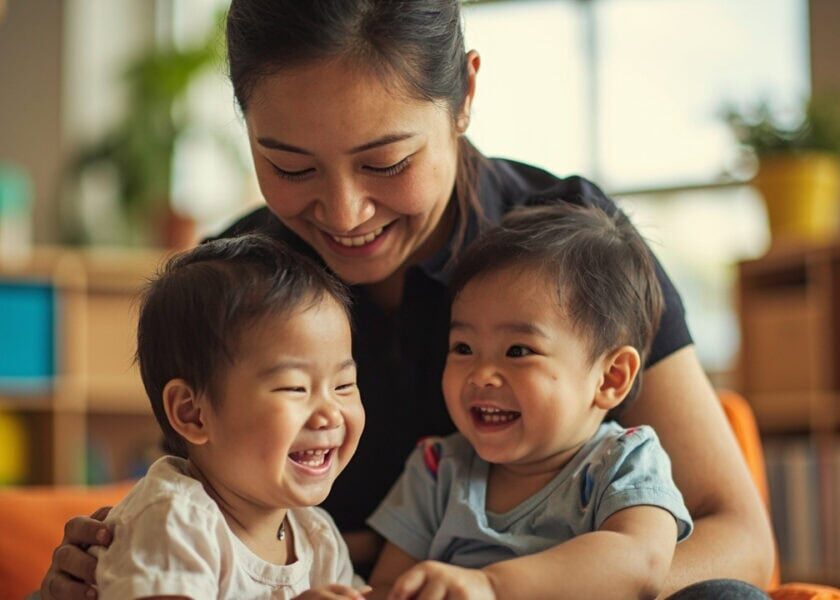
Your child looks up. There is a face — not just any face, but the face that has been waiting, that recognizes your child’s name before you have finished saying it, that kneels down to meet your child’s eyes rather than looming above. This is not a greeting performance. This is what developmental psychologists call an attuned response: the moment when one person signals to another, I see you. You are expected. You belong here.
And then something remarkable happens that you will not see. Your child lets go of your hand.
Perhaps there is a brief hesitation, a backward glance. But then curiosity arrives — the most powerful force in early childhood — and pulls your child forward into the room. Standing at the threshold, you have a choice. You can linger, holding that moment open, or you can trust what you have seen and step back into your own day, knowing that something meaningful is beginning.
The Space as Curriculum
Inside the room, the day is already taking shape. The furniture is low and accessible. The shelves hold objects that fit small hands — wooden shapes, fabric books, things that can be held, examined, mouthed, dropped, and held again.
Every one of these choices matters. The developing brain is not a passive receiver; it is an active explorer, building itself through sensory engagement with the world. When a child stacks a block and it falls, when a child drops a spoon from a high chair and watches where it goes, when a child touches rough bark and feels the difference between textures — these are not idle moments. These are neural events. Every connection between sensory experience and meaning-making is a pathway being carved in the architecture of a growing mind.
This is why the environment matters so profoundly in infant care. It is not decoration. It is curriculum. The best childcare spaces understand that every object, every texture, every color and sound has been placed with intention.
What Responsive Care Actually Looks Like
But intention alone is not enough. What transforms an environment from a collection of developmentally appropriate objects into a thriving space is the presence of a responsive adult.
Here is what that looks like. A caregiver notices a toddler who has been stacking and knocking down blocks for several minutes, growing increasingly frustrated. Instead of intervening with praise that would interrupt the learning — good job, that’s great — or solving the problem by building it for the child, the caregiver sits nearby and names what she observes: you’re working so hard on that tower. It’s tricky when it keeps falling.
The child looks up, sees recognition in the caregiver’s face, and continues. The tower falls again. The caregiver waits. The child builds again.
This is not a dramatic moment. It is not a lesson plan. It is a conversation conducted entirely in attention and presence, and it is teaching the child something profound: that persistence has value, that struggle is part of learning, that there is someone nearby who believes in your capacity to figure things out.
These are the messages that register below the level of language, in the emotional substrate where core beliefs about self and world are being formed.
The Rhythm of the Day: Why Predictability Is Neurological Necessity
Follow the rhythm of the day itself, because rhythm is not merely organizational convenience. For young children, rhythm is the architecture of safety.
Predictable routines are often discussed in parenting literature as a way to reduce parental stress, and they do. But their deeper function is neurological. Young brains are pattern-recognition systems, built to learn through repetition, to anticipate what comes next, to build internal maps of how the world works.
When a child knows that circle time follows snack time, that handwashing happens before meals, that the rest mat comes out after story time, the child is not just following instructions. The child is building a model of the world that says: this place is orderly. This place makes sense. I know what to expect, and what I expect is good.
The stress response system in young children is exquisitely sensitive. When a child cannot predict what will happen next, when transitions are abrupt or chaotic, the child’s body registers this as uncertainty — and chronic uncertainty, even low-grade uncertainty, takes a toll. It depletes the system. It makes learning harder and connection more difficult.
In a quality childcare environment, the day is composed with this understanding. There are transitions, but they are gentle. There is music before changes in activity that signals what is coming. There are verbal anchors — almost ready for lunch, then we will wash our hands — that give children time to prepare. There are moments of active movement and moments of quiet. The day breathes.
Within that breathing rhythm, there are pockets of time that look, from the outside, almost unremarkable. A caregiver helps a child wash hands, narrating the process in quiet tones: water on, hands under, soap, rub, rinse, dry. The child may not be paying attention. The child may be looking at the bubbles, at the caregiver’s hands, at the way the water runs.
And that is exactly what is supposed to happen. Because this moment is not really about handwashing. It is about the experience of being in a body, of feeling warm water and cool soap, of learning that actions have consequences, that hands go from dirty to clean, that the world follows rules we can understand and follow.
This is what developmental scientists mean when they talk about the importance of early experience. It is not that every moment must be a teaching moment, a deliberate intervention designed to produce a specific outcome. It is that every moment is an opportunity for the brain to organize itself around the data of lived experience. And the best childcare environments ensure that the data is rich, varied, repetitive, and emotionally safe.
Supervision vs. Engagement: The Distinction That Matters
There is a distinction that parents rarely get to see from inside, and it is one that makes all the difference: the difference between supervision and engagement.
Supervision is necessary. Safety is non-negotiable. A childcare space must be clean, secure, physically appropriate for young children, free from hazards. CCTV where deployed, clear communication protocols, transparent policies — these are the baseline of trust, and they should be. Parents need to know that their children are safe.
But safety is the floor, not the ceiling. What transforms supervision into something genuinely enriching is the quality of the human engagement that fills those hours.
Two Scenarios, Two Outcomes
Consider two scenarios. In the first, a caregiver sits in a room with infants, watching them, intervening only when someone cries or someone is about to climb something unsafe. The children are supervised. They are not in danger. But they are also not being seen. They are moving through their morning in parallel with an adult who is present but not really there.
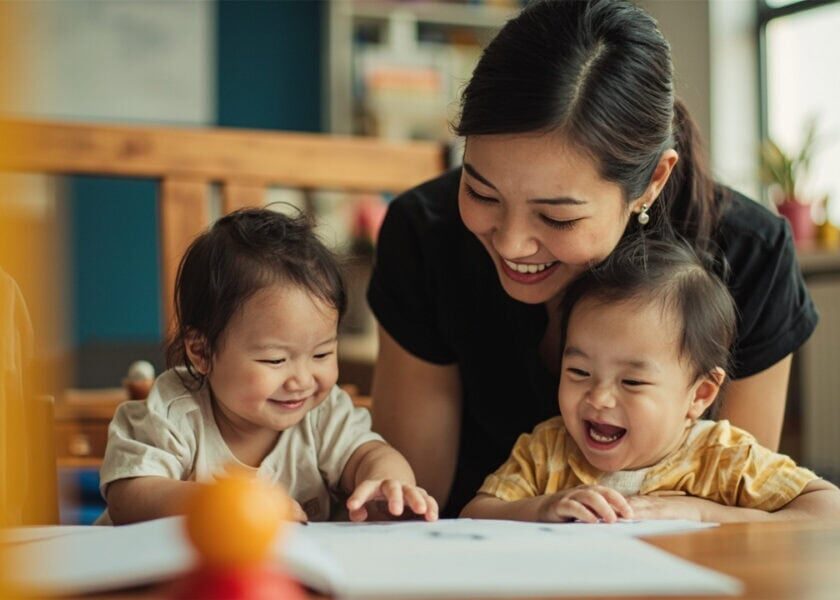
In the second scenario, a caregiver sits in that same room, but differently. She is on the floor. She is watching not just for safety but for meaning — noticing the 8-month-old who is working on the pincer grasp, placing a small Cheerio just slightly out of reach to give that baby something to practice on. She is noticing the toddler who keeps bringing books to the 2-year-old who always pushes them away, and she wonders aloud, gently, if the toddler might show the other child the pictures while he holds the book. She is noticing the quiet child who seems content but who has been watching the group from the edges, and she sits down nearby, not demanding interaction, just making herself available.
These are acts of intelligence. They require training, yes, but they also require a disposition — a genuine curiosity about who each child is, an attentiveness that does not switch off when the workday feels long. This is what attunement means in practice: a specific practice of noticing and responding that makes the difference between childcare that is adequate and childcare that is transformative.
What Caregiver Quality Really Means
When we talk about caregiver quality, this is what we mean. Not certifications alone, though those matter. Not ratios alone, though low infant ratios are crucial for allowing this kind of individual attention. We mean the quality of presence, the capacity to be fully in a moment with a child, the understanding that every interaction is either building or eroding the foundation of trust that young children need.
What Singapore Parents Carry: The Honest Truth About Separation
Now let us come back to you.
You are at work, or at an appointment, or running an errand, and your child is somewhere else, in a room you cannot see. This is the part that Singapore parents carry with them every day — the low hum of wondering that never quite goes away, no matter how much they trust the place they have chosen.
The wondering is not a sign of weakness or excessive anxiety. It is a sign of love. The bond between a parent and a young child is one of the most powerful biological forces in existence, and the discomfort of separation is a feature of that bond, not a flaw. The question is not whether you will worry. You will. The question is whether the place your child is in has earned enough of your trust that the wondering does not become corrosive, that you can do your work with something like peace.
Communication as an Act of Respect
This is where communication becomes essential — not as a feature or a selling point, but as an act of respect. You deserve to know what your child’s day has been, not in the sanitized language of attendance logs — wake, feed, sleep, change — but in the texture of lived experience.
The caregiver who can tell you, at pickup, that your daughter spent the morning fascinated by the way sand flows through her fingers, that she laughed when it fell on her feet, that she asked for more and more. The daily updates that give you a window, however brief, into the world your child has been inhabiting.
The communication protocols, the transparency measures, the regular updates that let you feel connected to your child’s day — these are not administrative extras. They are bridges between your world and your child’s world, and they matter because relationships matter.
Consider the three relationships at stake in any childcare arrangement: the relationship between you and your child, the most important thing; the relationship between your child and their caregivers, a support system for your primary bond, not a replacement for it; and the relationship between you and the people caring for your child, a partnership built on mutual respect for the profound trust you have placed in them.
Quality childcare strengthens all three. It does not ask you to diminish your role as a parent. It asks you to trust others to support you in that role.
What Quality Childminding Looks Like in Singapore
The ECDA Childminding Pilot matters beyond its structural innovations. It is building a system that takes childminding seriously as a profession, one that offers training, support, and community to caregivers, that recognizes the people who spend their days with our youngest children are not interchangeable babysitters but skilled professionals whose work shapes the brains and hearts of the next generation.
This is a dignity issue. It is also a quality issue. When caregivers are valued, trained, and supported, children thrive.
Within this framework, childminding operates under guidelines that prioritize small ratios — up to one-to-three for infants — which creates the conditions for the kind of individual attention described above. Caregivers in the pilot receive structured training, have access to ongoing professional development, and operate within a quality assurance system that includes regular assessment and support.
For families across Singapore, for whom the logistics and costs of childcare are real and pressing concerns, the accessibility of pilot fee structures and the usability of CDA and Baby Bonus are not bureaucratic details. They are the mechanisms by which quality care becomes possible for families who otherwise might struggle to find it.
EduNanny operates within this ECDA framework, bringing together the intimacy of small-group care with the professional standards the system demands. The approach is built on the understanding that childminding is not a lesser form of childcare, a fallback for those who cannot access center-based care. It is a legitimate, rich, relationship-based model that offers something distinct: the intimacy of a small environment, the flexibility of home-based or community pathways, the attention that becomes possible when ratios are kept small.
The vision at the center is simple but demanding: a child who wakes up and goes to a place that feels, in some small but real way, like an extension of home. A place with warm light and gentle sounds and a face that says your child’s name like it matters. A place where routines create order and order creates security and security creates the conditions for everything else — learning, growing, playing, becoming.
How to Choose: A Practical Guide for Anxious Parents
If you are researching infant care or childminding in Singapore, here are the questions worth asking — not as a checklist, but as a framework for observation and conversation.
Visit More Than Once
Request a visit during different parts of the day — morning arrival, midday, pickup. Observe how the space feels at each point. Notice the sounds. Notice the transitions. Notice how children move through the space.
Watch for Attunement, Not Just Activity
Look at the adults in the room. Are they on the floor at children’s level, or stationed at a distance? Do they respond to children’s cues — pauses, glances, small sounds — before a full cry? The quality of attention is visible, even in a brief visit.
Ask About the Day’s Rhythm
A quality childcare arrangement can describe its daily schedule and explain why. Predictability is not rigidity; it is a neurological gift to young children. Ask how transitions are handled, how children are prepared for changes in activity.
Notice the Environment
Look at the objects on shelves. Are they within children’s reach? Are they materials that invite manipulation, exploration, repetition? Or are they decorative? The environment reveals the philosophy.
Ask About Communication
How will you know what your child’s day has been like? What kind of updates can you expect? Daily reports, photos, verbal check-ins? Communication is not a luxury — it is how you stay connected to your child’s life when you are apart.
Trust Your Gut
After a visit, notice how you feel. Do you feel welcomed, respected, treated as a partner in your child’s care? Or do you feel like a customer being sold a product? Your instincts are worth honoring.
Returning to the Threshold: What the Hours You Cannot See Are Actually Like
Let us return, one more time, to that threshold.
You have stepped through the door. Your child has let go of your hand. And now, slowly, you have begun to build a new kind of trust — not the fragile trust of hoping, but the earned trust of witnessing.
You have seen the caregiver kneel down to meet your child’s eyes. You have heard the morning music that matches the quality of light. You have watched your child move toward an activity with the kind of focus that only happens when a child feels safe enough to be curious.
Over days and weeks, you have received the small reports — the Cheerios mastered, the song learned, the friend made, the comfort found at rest time — that add up to a picture of a child who is not merely being cared for but is being seen, known, and nurtured.
These are hours of building. The building of neural pathways, yes, but also the building of security, of confidence, of the quiet assurance that the world is a place where things make sense and people are kind and capable and trustworthy.
Every routine followed, every cry responded to, every small triumph celebrated — these are the bricks and mortar of a structure that will support your child for the rest of their life.
And you, who dropped them at the door with that particular weight in your chest, are part of that building too. You made a choice. It may not have been easy, may not have felt obvious or even ideal. Singapore parents carry unique pressures — the cost of living, the demands of careers, the expectations of a society that moves at a relentless pace.
You are doing your best with what you have, and what you have chosen is not to abandon your child to chance but to find a place that can hold them with care while you hold down the other parts of your life.
There is no shame in that. There is only courage, and pragmatism, and the fierce love that shows up every morning at the threshold.
You dropped your child at the door this morning. You were afraid. You were uncertain. You were hoping.
And somewhere inside that room you cannot enter, your child was doing what children do when they are in the right place: they were playing, exploring, resting, growing. They were learning that the world is interesting. They were learning that people are kind. They were learning, one day at a time, who they are.
That is what quality childcare gives your child. And that is what EduNanny is here to offer.
If you are ready to learn more about what EduNanny can offer your family — or if you simply want to have a conversation about what quality childminding looks like in practice — we would be glad to hear from you. We are here to answer your questions, ease your concerns, and help you find the right arrangement for your child and your family.
Start a conversation with EduNanny today.
#ChildcareSingapore #InfantCareSG #QualityChildminding #EduNannySingapore #ECDAChildmindingPilot