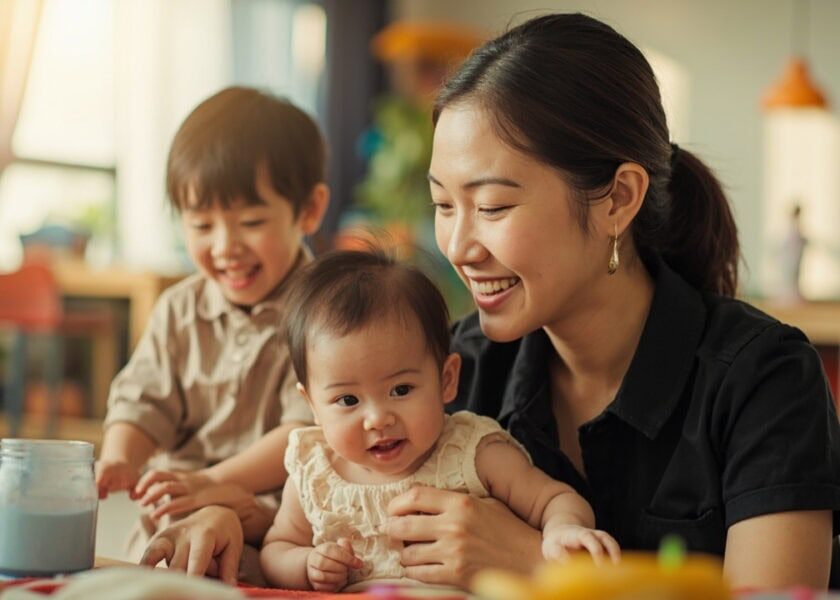
From Drop-Off Guilt to Quiet Confidence as a Singapore Working Parent
The Voice in the Drop-Off Zone
There is a moment — perhaps you know the one I mean — that happens in the driveway, the drop-off zone, or the corridor outside a childcare centre in Singapore. It is early morning. The light is already warm. Your child is in your arms, still soft with sleep, still smelling of the shampoo you used last night.
And somewhere between the car seat buckle and the door, a voice rises inside you — quiet, familiar, persistent — that says: This is wrong. I should be the one. I should be staying.
That voice follows you to the lift. It sits beside you on the MRT. It whispers beneath the presentation you are trying to give at work, the one where you are competent and composed and absolutely fine. That voice is not new. For many of you, it has been there since the first time you left your child in someone else’s arms.
Here is what I want you to know, gently and without judgment: that voice does not mean you are failing. That voice means you love your child in a way that is real, that is deep, that aches.
- The guilt you feel is real — but it is not evidence of failure. It is evidence of love.
- Choosing professional childcare is not a compromise — it is an intentional act of love that serves your whole family.
- Children read emotional safety, not just physical presence — they know they are loved through the quality of your attention, not the quantity of hours.
- The judgment you face is real too — but it often comes from a world that no longer exists.
- You are not alone — countless parents in Singapore navigate this every day, and it is possible to move from guilt to quiet confidence.
The Part of Singapore Parenting Nobody Talks About
We talk endlessly about quality childcare. We talk about ratios and curricula and whether the centre has a good reputation in the WhatsApp groups. We talk about school readiness, about developmental milestones, about whether little Chen Wei will be behind if he starts at eighteen months instead of two years.
All of that has its place. But beneath all of that, there is something else — something quieter, something that many childcare conversations in Singapore have been too careful, too polished, too hesitant to name. And that something is the emotional truth that you carry every single day.
You are not just choosing a childcare. You are choosing a story about yourself as a parent. You are choosing what it means to be loving, what it means to be present, what it means to be enough.
And somewhere in the gap between the parent you want to be and the parent you sometimes feel you are, there is guilt — not the kind that warns you of real danger, but the kind that settles in like an uninvited guest, familiar and heavy and unwelcome.
I want to talk to you about that guilt today. Not to amplify it. Not to tell you it is unjust or irrational or that you should simply shake it off, because if you could do that, you would have done it already, and you are not looking for another well-meaning person to dismiss what you feel.
I want to talk about it because it deserves to be named. Because when something is named with care, it loses some of its power over us. And because there is another story waiting on the other side of that guilt — a story that Singapore parents deserve to hear.
Choosing With Intention, Not Fear
Here is what we do not say aloud often enough: choosing professional childcare for your child in Singapore is not a compromise. It is not settling. It is not the lesser option on a menu of imperfect choices.
It is, when done with intention and care, an act of love so profound that many parents do not recognise it as such because they have been so thoroughly taught to see their absence as failure.
Think about what you are actually doing when you choose thoughtfully. You are not abandoning your child. You are building a life where your family can thrive — where you can work and provide and also be present in the evenings and on weekends with a kind of energy and fullness that you simply could not sustain if you were running on four hours of fragmented sleep and the constant anxiety of trying to do everything at once.
You are making a choice that serves your whole family, not just your child in isolation. And that choice requires courage, because it means you are willing to be misunderstood. You are willing to carry the weight of other people’s judgments. You are willing to sit with the voice that says this is wrong and choose anyway — not because you don’t love your child, but because you love your child enough to build a life where that love can be expressed in a thousand different ways, not just one.
The Judgment Is Real — And It Comes From a Different World
Let us talk about those judgments, because if you are a working parent in Singapore, you already know exactly what I mean.
There is the grandmother who sighs when you mention the childcare centre and says, in that particular tone, that in her day, grandparents raised children and children turned out fine. There is the colleague who casually mentions that she could never do it, that she quit her job the moment she found out she was pregnant, and somehow the way she says it makes you feel like a specimen under glass. There is the friend who posts on Instagram about slow mornings and home-cooked meals and the privilege of being there, always there, and you scroll past and feel something twist in your chest that you cannot name.
These voices are not malicious. Many of them come from people who love you. But they are speaking from a world that no longer exists — a world where one income was often enough, where extended families lived in the same kampong or the same shophouse, where childcare was simply what grandmothers did because that was the architecture of daily life.
You are living in a different Singapore. You are making choices for a world that has shifted beneath your feet, and the people around you may not have the framework to understand what that requires of you.
The voice that whispers leaving is failing — that voice has been handed down through generations that did not have the language to understand what modern parents are navigating. It is not a malevolent voice. It is simply an old one, speaking from a world that does not fit the world you are actually living in. You do not have to obey it. You can set it down, gently, and choose something different.
What Children Actually Read
Here is the thing that I want you to hold on to: children do not read physical presence the way we think they do. What children read is emotional safety.
They read the calm in your voice when you arrive. They read the way you put down your bag and kneel to their level and let them show you what they built with the blocks. They read the quality of your attention in the twenty minutes before sleep, when you are not checking your phone, when you are simply there, wholly and completely.
Your child knows that you are the centre of his or her world — not because you were there every single hour, but because of the way you are when you are there. The way you show up. The way you love.
A child who is in a warm, attentive, well-resourced care environment during the day — a child who is held by consistent caregivers, who has secure attachments in multiple trusted arms — that child is not being deprived. That child is being expanded.
That child is learning that the world is a place where loving adults show up, where routines are predictable, where curiosity is encouraged. And that child comes home to you — tired, yes, sometimes cranky, sometimes smelling of paint and playground dirt — and the reunion is not a loss. It is a gift.
It is the moment when your child runs to you across the room and buries his face in your neck and you feel, in that small warm body pressed against yours, the full weight of everything you have built together.
What Quality Childminding Actually Looks Like
None of this means that childcare is interchangeable. The care your child receives is not a background detail. It is foundational.
Choosing with care — not casually, not out of desperation, but thoughtfully, deliberately, with the same seriousness you would bring to any decision that shapes your child’s daily experience — that choosing is part of loving your child well.
So what does quality care actually look like?
- Small ratios — One-on-one attention in those early years is not a luxury. It is a necessity. Look for settings where caregivers are not stretched across too many children at once.
- Consistency — The same familiar faces, the same voices, the same routines let a child feel secure enough to explore. Consistency is not a small thing. It is everything.
- Communication — Regular updates, transparency, and ways to stay connected throughout the day. Whether through photos, daily notes, or open channels for questions — you should never feel cut off from your child’s day.
- Trained, valued caregivers — The people caring for your child are professionals. They should be treated that way. When caregivers are valued and supported, they can offer your child the warmth and attention that quality care requires.
Questions Parents Actually Ask
“Will my child feel abandoned?” When children are placed in warm, attentive, consistent care environments, they do not feel abandoned. They feel expanded. They learn that love comes from multiple trusted adults, and that the world is a safe place to explore.
“How do I know if the care is actually good?” Look for small ratios. Look for consistency of caregivers. Look for communication — you should feel connected to your child’s day, not shut out of it. Ask questions. Visit. Observe. And trust your instincts — if something feels off, it probably is.
The EduNanny Approach
EduNanny Singapore was built on a simple premise: that Singapore parents deserve care options that are not just adequate, but excellent. Not just safe, but warm. Not just reliable, but genuinely thoughtful about the whole family — about the child, yes, but also about the parents who are navigating something that is harder than anyone told them it would be.
We know that the word care can be used so casually. Care is on every centre sign, every advertisement, every pamphlet. But what does care actually look like when it is done well?
EduNanny is part of the ECDA Childminding Pilot — and we take that responsibility seriously. The idea of trusted others caring for children while parents work is not new. But the formal recognition of that role, the bringing of professionalism and warmth together in a single framework — that is the work we are committed to. That is what the pilot represents. And we are grateful to be part of it.
We also know that choosing care is not just about your child’s schedule. It is about your family’s financial reality. It is about whether this is something you can sustain, something that does not add to the weight you are already carrying.
That is why EduNanny participates in Childminding Pilot fee structures that make quality care accessible. It is why CDA and Baby Bonus can be used — because those schemes exist for moments exactly like this one, and you should be able to use them without navigating a maze. It is why we offer different pathways — home-based care, community options, centre-based options — because every family in Singapore is different, and the right choice is the one that fits your life, not the one that fits a template.
From Guilt to Quiet Confidence
We have sat with parents in those early days — the days when the drop-off is hard and the guilt is loud and you drive away from the centre feeling like you have left something essential behind.
We have watched parents slowly, over weeks and months, come to a different understanding. Not because someone told them to feel better. But because they began to see, in the small evidences of their child’s contentment — the way the caregiver greeted them by name, the way their child reached for the door handle with anticipation rather than fear, the way bedtime became easier because the day had been full and good — they began to see that what they had chosen was not a compromise. It was a partnership. It was an expansion of the circle of love around their child.
That transformation — from guilt to clarity, from doubt to quiet confidence — is not something that happens overnight. But it does happen. And when it does, it changes everything.
Parents who once dreaded the drop-off begin to walk in with their heads held high. They begin to trust their own judgment. They begin to understand, in their bones, that they are still the most important person in their child’s life — not because of the hours they spend, but because of the intention they bring to all of those hours.
There is a kind of confidence that is not loud. It does not announce itself. It is not the confidence of someone who has never doubted, but the confidence of someone who doubted and chose anyway, and learned, through that choosing, that they could be trusted.
That is the confidence we want for you. Not the confidence that comes from having an easy path, but the confidence that comes from walking a hard one with your eyes open.
Practical Guidance for Choosing Infant Care in Singapore
Whether you are still pregnant and thinking about childcare for the first time, or already in the thick of it with early mornings and hard drop-offs, here is what choosing well looks like in practice:
- Start with your values, not the checklist. What matters most to you? Consistency? Small ratios? Flexibility? Let your values guide you rather than getting lost in features.
- Visit more than once. The first visit is curated. The second visit, unannounced or at a different time, tells you more about the rhythm of the place.
- Ask about caregiver consistency. Will your child have the same caregiver or rotate through different faces? Consistency matters enormously in the early years.
- Understand the financial picture. What subsidies apply? Can CDA and Baby Bonus be used? What are the total costs, including deposits and registration fees? Choose something sustainable.
- Trust your child. Watch how they respond over time. A child who feels secure will show it — through curiosity, through ease, through the way they reach for their caregiver at drop-off.
- Give yourself permission to reassess. If something feels wrong, you are allowed to make a change. Choosing well is an ongoing process, not a one-time decision.
You Are Part of This Quiet Revolution
Perhaps you are still pregnant and thinking about childcare for the first time, and already feeling the weight of a decision that has not even arrived yet. Perhaps you are in the thick of it — the early weeks, the hard drop-offs, the nights when your child cries and you wonder if you are doing the right thing. Perhaps you are further along than that, and the guilt has quieted but not disappeared, because it is part of the fabric of what it means to love someone this much in a world that does not always make it easy.
Here is what I want you to know: you are not alone. You are not failing. You are doing something that countless parents in Singapore and around the world do every day — loving their children enough to build a life that requires others to help. That is not a deficit. That is a recognition of reality. That is wisdom.
You can choose with clarity. You can choose with the full weight of your love behind you. You can choose, and keep choosing, and each time you choose, you are teaching your child something valuable — that love is not about control or guilt or perfection, but about showing up, again and again, in whatever way is possible, with honesty and care and a willingness to do the hard thing.
The caregiver is part of the village. The centre is part of the architecture. But you — you are the centre. You are the ones who chose. You are the ones who love.
EduNanny Singapore is here for that choosing. We are here to be part of your village — not to replace you, not to diminish you, but to stand alongside you in the work of raising the children you love.
We will keep your children safe. We will love them well. We will send you updates and photos and small details from their day, because we know that connection matters, that the thread between you and your child must remain strong even when the hours apart are long. And we will hold space for the feelings you bring — the guilt, the doubt, the hope, the tenderness — because we know that these are not weaknesses to be fixed. They are the evidence of how much you care.
This is the quiet revolution happening in Singapore right now. Not in the headlines. Not in the policy papers. But in the driveways and drop-off zones and early morning cars where parents are choosing, every single day, to love their children in a way that is honest, and difficult, and brave.
If you are ready to explore what thoughtful, intentional childminding can look like for your family — we would be honoured to walk this path with you. Reach out to us and begin a conversation.