The Question Behind Every Singapore Parent’s School Readiness Worry
The Question Singapore Parents Don’t Ask Aloud
There is a question Singapore parents ask themselves in the quiet hours that they rarely say aloud. It surfaces at bedtime, during a commute, in that moment between watching your child play and wondering whether they are keeping pace with the child across the playground.
It is not about curriculum or school rankings. It is deeper and harder to name.
It sounds like this: Am I seeing my child clearly, or am I seeing my own fears dressed up as observations? Is my child genuinely ready, or have I simply become very good at making them look ready?
If that question has ever surfaced in your mind, I want you to know something before anything else: you are not alone in asking it. And asking it does not make you an anxious parent or an overprotective one. It makes you a parent who is paying attention.
The fact that you are willing to sit with that uncertainty rather than medicate it with another enrichment class or another assessment is itself a form of wisdom that your child will feel long before they ever walk through a school gate.
Singapore Has Made Readiness Feel Like a Finish Line
Singapore has a particular way of making parents feel that readiness is a finish line. That there is a correct moment, a right set of skills, a predetermined checklist that, once completed, means your child is ready for Primary One.
The reality is far more textured than that, and far more hopeful.
Readiness is not a certificate. It is not a vocabulary count or a number sequence or the ability to sit still for thirty minutes. Readiness is a state of being. It is the internal experience of emotional security, of genuine curiosity, of social confidence that allows a child to meet new environments not as a test to survive but as a world to explore.
Here is what most parents in Singapore have not been told clearly: the skills that actually predict school success are not academic skills. They are emotional and social ones.
A child who can recover from disappointment. Who can ask for help when they need it. Who can read the room in a new social setting. Who trusts that adults will respond when they are distressed. Who has learned that their needs matter and will be met.
Everything else—the letters and numbers and content knowledge—can be taught. What cannot be taught in a classroom, what cannot be rushed or crammed into a preparation programme, is the internal conviction that learning is safe, that mistakes are survivable, that school is a place where you belong.
The Three Ways Parents Misread Readiness
Singapore parents are extraordinarily attentive. They watch their children with a care that is genuinely moving. But in the pressure of comparison, something gets distorted. When parents worry about school readiness, they tend to look for three things that often mislead them.
1. Compliance Is Not Confidence
A child who does what they are told, who follows routines without protest, who sits when asked to sit. Compliance feels like readiness because it looks like school.
But compliance is not confidence. A child who follows rules because they are afraid of consequences looks remarkably similar to a child who follows rules because they understand and agree with them. One is performing readiness. The other is genuinely ready.
Ask yourself: when my child follows a rule, do I see a child who feels safe and aligned, or a child who has learned that certain outcomes are worse than others? The first is readiness. The second is survival.
2. Quietness Is Not Always Security
Singapore parents often interpret a calm, reserved child as a secure child, and there is a version of that which is true. But there is also a version where quietness is actually the result of a child learning that their voice does not reliably get a response, or that strong emotions create discomfort in the adults around them.
Quiet can be readiness. Quiet can also be self-protection. Knowing the difference requires watching not just what your child does, but what happens to them when they do it. Do they brighten when spoken to, or brace? Do they initiate interaction, or wait to be invited? These are the questions that reveal what quietness actually means for your child.
3. Academic Precociousness Is Not Academic Resilience
This one is particularly seductive because it comes with visible proof. Your three-year-old reads. Your four-year-old does mathematics. There is nothing wrong with these abilities.
But a child who reads early is not automatically a child who loves learning. A child who does mathematics before Primary One is not automatically a child who will persist when mathematics becomes difficult.
What predicts long-term academic resilience is not what your child knows before they start school. It is whether they have learned that they are capable of learning, that effort leads to growth, that they can figure things out even when they do not immediately know the answer.
These dispositions are not taught through academic content. They are built through thousands of small interactions with responsive adults who notice what your child is trying to do, who support the trying without taking over, who celebrate progress without making perfection the price of approval.
What Genuine Readiness Actually Looks Like
To help you see your own child more clearly, here are the markers of genuine readiness that matter most—beyond what a school readiness assessment might measure.
Emotional Readiness
- Your child can tolerate frustration without collapsing or shutting down entirely.
- They express a range of emotions openly, knowing they will be received without punishment or dismissal.
- They show genuine interest in learning new things, not just performing tasks they have been taught.
- They have a growing sense of themselves as someone who can handle mistakes.
Social Readiness
- Your child can navigate a group of unfamiliar children without a parent mediating every interaction.
- They show early signs of sharing, turn-taking, and concern for others, even imperfectly.
- They can read basic social cues: when someone is upset, when someone wants space, when someone is inviting them to play.
- They trust that adults beyond their immediate family will respond when they need something.
Physical Readiness
- Your child has adequate sleep consistently. Sleep regulation is foundational to every other form of learning.
- They have the stamina to last through a school day without regular crashes or extreme fatigue.
- They have had varied physical experiences: climbing, running, balancing, playing in different sensory environments.
Cognitive Readiness
- Your child is curious. They ask questions. They follow their own interests with concentration.
- They can focus on something for a reasonable stretch, not because they were trained to sit still, but because they are engaged.
- They show the beginning of persistence: they try again after failing at something that mattered to them.
What Quality Childcare Quietly Builds
This is where the real work happens. Not on a schedule. Not as a curriculum module. Not as a visible product you can photograph and compare. But in the everyday, in the texture of how your child is held and heard and responded to.
Quality childcare builds the emotional and neurological scaffolding that makes everything else possible.
- The security that allows a child to explore new environments with genuine curiosity rather than anxiety.
- The trust that allows a child to separate from you in the morning without dread, knowing they will be welcomed back.
- The social confidence that allows a child to navigate a new peer group not as a threat but as an invitation.
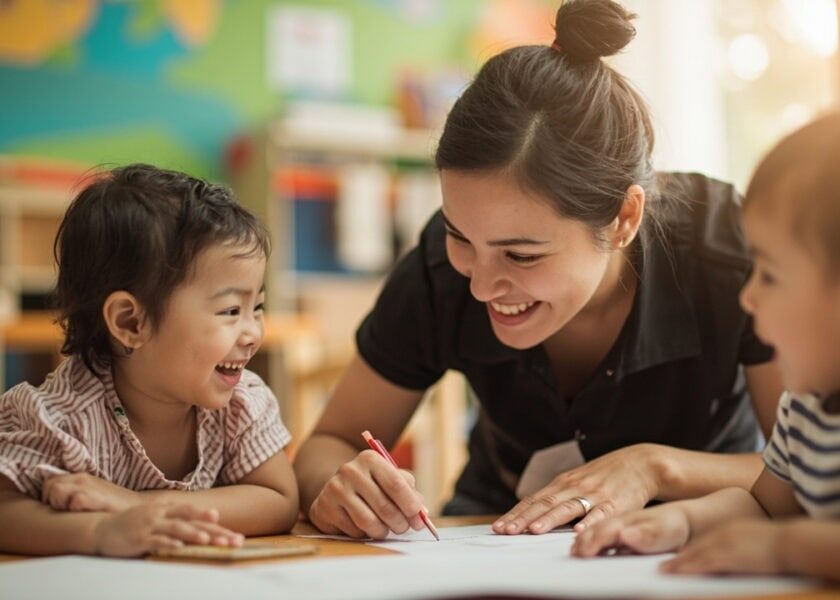
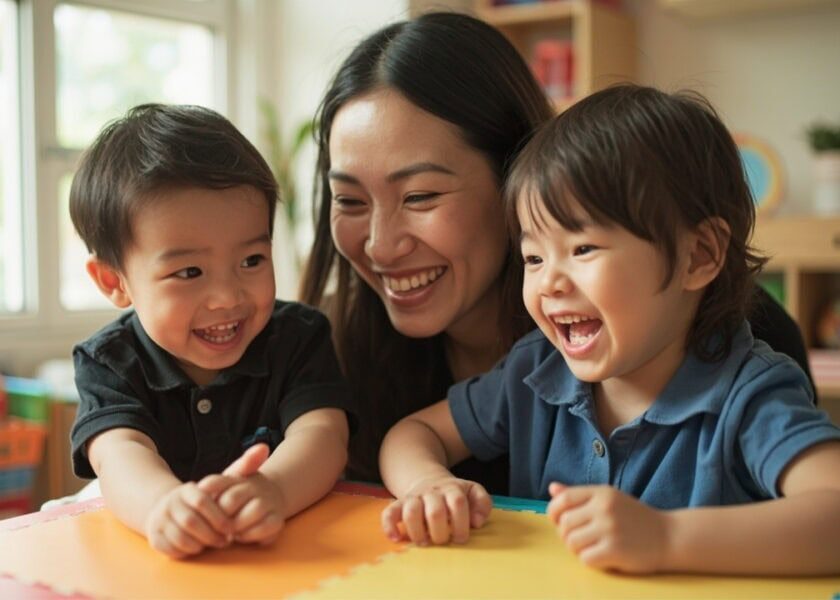
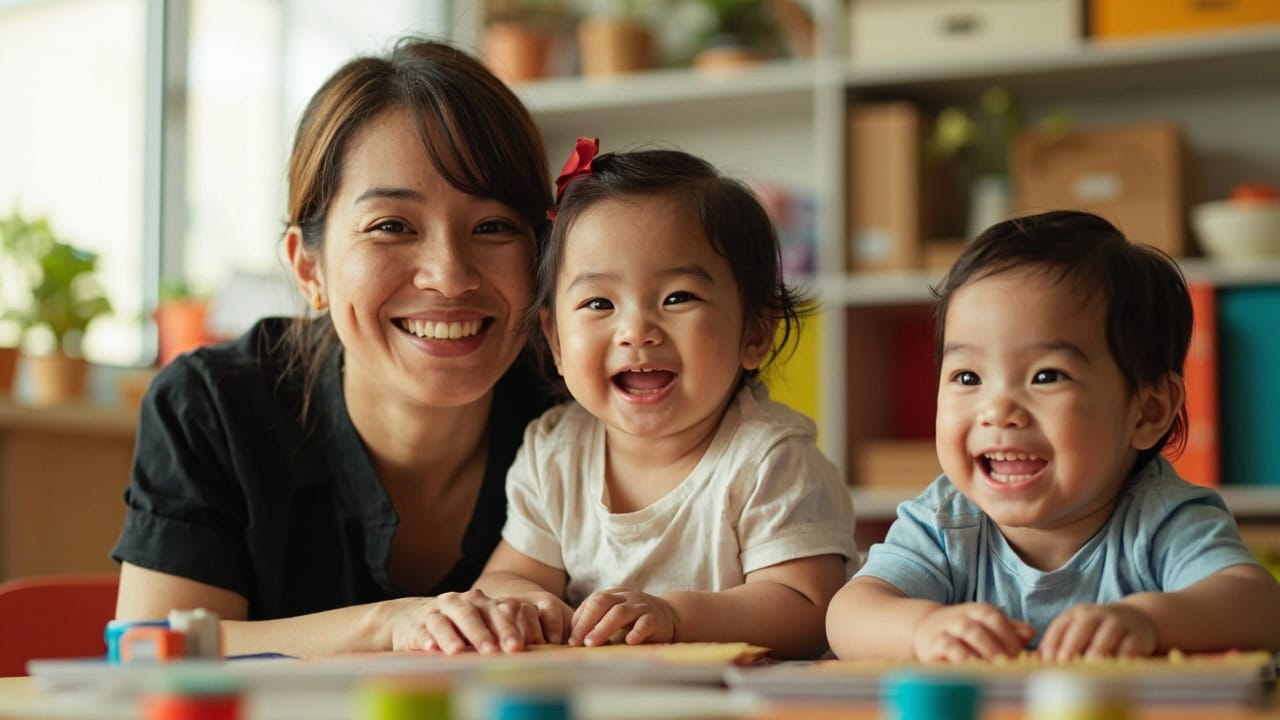
You cannot see this scaffolding. That is what makes it so easy to underestimate. It does not look like school. It looks like play. It looks like a caregiver getting down on the floor and following your child’s lead. It looks like time allowed for a child to work through a frustration rather than being talked out of it or redirected away from it.
It looks like a nap being treated as something that matters, because the regulation that comes from adequate sleep is the foundation of every other kind of learning. It looks like food offered with attention, not just fuel dispensed efficiently. It looks like your child’s individual temperament being respected, their pace of development being honoured, their particular ways of relating to the world being received as information rather than as problems to correct.
How to Choose the Right Infant Care in Singapore
Whether or not EduNanny is the right fit for your family, here are the questions worth asking when you evaluate any infant or toddler care environment.
- Observe the caregivers, not just the programme. Watch how the adults respond when a child is upset, frustrated, or seeking attention. Do they respond with warmth and presence, or do they redirect quickly to manage the situation? The quality of adult responsiveness is the single most important predictor of care quality.
- Notice whether your child is seen as an individual. Does the caregiver know your child’s particular ways of expressing hunger, fatigue, or overwhelm? Can they tell you something specific about your child’s temperament and preferences, or is your child treated as part of a routine?
- Ask about ratios. The number of children per caregiver matters enormously for infants and toddlers. Smaller ratios mean more individual attention, more responsiveness, and more safety.
- Look for evidence of emotional support, not just cognitive stimulation. A good infant care environment will have caregivers who get down on the floor, who allow children to express frustration without immediately redirecting, who treat nap time and meals as moments of connection, not just logistics.
- Trust your own observation over the brochure. Visit more than once. Observe at different times of day. Watch how your child responds to the environment when you are there and, if possible, when you step away briefly. Your child’s reaction is information. Use it.
- Ask about communication. How will you know what happened in your child’s day? Are there structures for daily updates? For younger infants, how frequently will you be contacted if there are any concerns? Transparency is not a luxury. It is a condition of trust.
Addressing Common Concerns
Is home-based childcare rigorous enough for Singapore’s educational demands?
Parents worry that warm, play-based care is not rigorous enough. That while it feels right, it might be letting their child fall behind peers who are in more structured programmes.
Here is what the evidence consistently shows: the most rigorous thing you can do for your child in the years before Primary One is to build their emotional security. Every minute of anxious, rushed, academically-pressured early learning is a minute spent building the wrong foundation. Children who feel safe, seen, and secure are the children who have the cognitive and emotional bandwidth to actually learn.
Can I afford quality childcare without compromising my family’s financial stability?
EduNanny is designed to work within the support structures that already exist for Singapore families, including the use of Child Development Accounts and Baby Bonus provisions where applicable. When parents do not have to choose between quality care and financial stability, they can actually focus on what matters—watching their child and trusting what they see.
How do I know my child is safe and truly seen in a childcare environment?
When you leave your infant with someone, you are extending a trust that is profound and frightening and entirely necessary. EduNanny’s approach includes communication structures that help parents stay connected to their child’s day, and in some settings, practical measures like CCTV that acknowledge the reality of what parents need in order to feel genuinely secure. These are not glamorous features. They are the conditions that allow trust to actually exist rather than just being demanded.
Why EduNanny
EduNanny operates within the ECDA Childminding Pilot, which means it is part of a carefully structured initiative that gives home-based and community-based childcare pathways the support and oversight they need to be genuinely excellent.
For infants and toddlers, the ratio of caregivers to children is not a technical detail. It is the difference between your child being known as an individual and being managed as part of a group. At EduNanny, the infant ratios are structured to make genuine responsiveness possible. Your child is not one of many. Your child is one, and that one matters.
Trust Yourself: The Real Answer to Readiness
What I want to leave you with is not a sales pitch. It is an invitation to trust yourself.
If you have been watching your child, really watching them, then you already know more than you think. You know when they are genuinely curious versus performing curiosity. You know when their quietness is peace versus protection. You know when their compliance is confidence or fear. You know because you love them, and love, when it pays attention, is extraordinarily perceptive.
The question is not whether your child is keeping pace with a standard that was designed for all children and therefore for no particular child. The question is whether your child is growing in the ways that matter for them, at the pace that makes sense for their particular wiring, toward a version of readiness that is real rather than performed.
The question is whether the care environment your child is in is building the foundations that cannot be rushed, or whether it is asking your child to look ready before they have had the chance to become ready.
EduNanny was built for this. Not for the visible markers. Not for the reportable outcomes. But for the quiet, essential work of making sure that when your child walks through a school gate, they do so not because they have been taught to perform readiness, but because they genuinely, deeply, from the inside out, are ready to learn.
That readiness—that emotional foundation, that sense of security and belonging and capability—is the single greatest gift you can give your child. Not just for Primary One. For everything that comes after.
You are asking the right questions. Trust that. Trust what you see when you look at your child without the noise of comparison. Trust that the care environment you choose for the years before school will matter more than any curriculum or assessment or preparation programme.
If you are looking for a place that understands this, that has built its practice around what children actually need rather than what parents can be sold, then EduNanny is worth knowing more about. Not because it is perfect. Because it is honest. Because it knows that the work of early childhood care is quiet and invisible and profoundly important, and it is doing that work with your child at the centre of every decision.
That is what readiness actually looks like. Not a child who is ready for school. A child who is ready to learn.
And that begins long before Primary One, in the everyday moments of being seen, being heard, being held in a consistent and loving way by people who understand what they are building. You are building that too. In everything you pay attention to. In every question you ask. In every moment you choose trust over fear.
Your child is lucky to have you paying such careful attention. And they will show you, in their own time and in their own way, that all of it mattered.
Learn more about EduNanny Singapore and how our Childminding Pilot programme supports infants and toddlers in a home-based environment designed around what children actually need to thrive. You are also welcome to reach out to us directly with any questions.