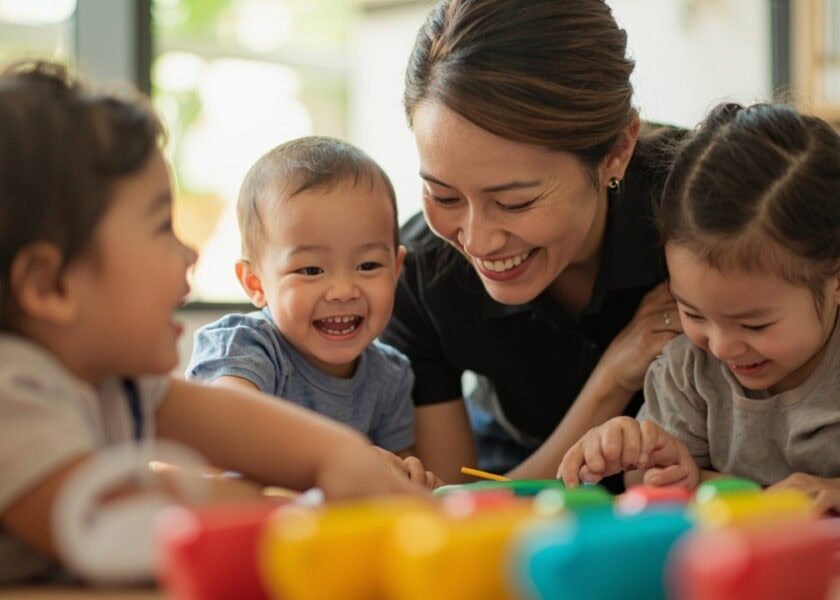
The EduNanny Day Your Child Deserves in Singapore
The Morning Greeting: Where Trust Begins
Before the children arrive, there is work no parent sees. The educator who will welcome your child that morning has already reviewed the notes from the previous day. She knows that your daughter slept poorly and might need an especially gentle hand during the transition. She knows that your son has been working hard on a new physical skill and will want to show her.
She has prepared the environment with intention—not just tidied it, but considered it. She has thought about where the morning light falls, where a shy child might retreat to feel safe, which materials will invite curiosity without overwhelming. This is not bureaucracy. This is care. And it is the foundation upon which the entire day is built.
Then the door opens, and the morning greeting ritual begins.
There is something profound that happens in these first moments. When a child walks through the door and is met by name, by eye contact, by a genuine expression of pleasure at their arrival, something settles inside them. The body language shifts. The shoulders drop. The grip on a parent’s hand loosens because the message has been received: I am expected here. I belong here. Someone was thinking about me.
EduNanny educators understand this. They have been trained to make each greeting a small ceremony of recognition. It is not perfunctory. It is not rushed. It is the first of many intentional moments that will populate the hours ahead.
For parents in Singapore, where the transition to childcare often marks a child’s first extended separation from family, this moment matters enormously. A child who arrives feeling welcomed arrives ready to learn. A child who arrives feeling anxious carries that anxiety through the morning. The quality of the greeting is not a soft, sentimental nice-to-have. It is a developmental essential.
Language-Rich Play: Where Learning Actually Happens
After the morning transition has settled, the children move into what might look, to an untrained observer, like free play. But it is not free in the sense of aimless. It is free in the way that a well-tended garden is free—the plants grow according to their nature, but within a thoughtfully prepared environment.
A child picks up a wooden block. What happens next is where the quality lives. Does an educator notice? Does she kneel down, not to direct but to wonder? “You’re building a tower. I wonder how tall it will go.”
These are not idle words. They are language-rich interactions that expand a child’s thinking, that model curiosity, that show a child that their actions matter and that an adult finds them worthy of attention.
Another child is arranging small objects—shells, perhaps, or coloured stones. She is working on fine motor control, on spatial reasoning, on the early foundations of mathematics. An educator might join her, silently at first, then perhaps with a quiet comment that scaffolds rather than instructs. “You put the big ones at the back.” The child nods, confirms, continues.
The distinction that matters: Supervision means a child is safe. Intentional engagement means a child is seen.
EduNanny maintains ratios that allow for this kind of attention. In the infant rooms, where the stakes of observation and responsiveness are highest, the ratio of educators to children is such that each little one can be truly known. Not just managed. Not just kept safe. Known.
Mealtimes and Rest: Where Values Reveal Themselves
Mid-morning arrives, and with it, the rhythm of mealtime. There is a philosophy at EduNanny that frames mealtimes as far more than nutrition. Yes, children eat. They are fed well, with meals planned to meet their developmental and dietary needs. But the mealtime experience is also social, emotional, and developmental.
Children sit together. Educators sit with them. The meal is a conversation, not a chore. A child learning to use a spoon is given space to try, to fail, to try again—patiently, encouragingly. A child who is a picky eater is not pressured but is offered the food again, and again, in a low-stakes environment that normalises variety without force.
Mealtimes are where language grows most naturally. Where children learn table manners not through instruction but through imitation. Where they discover the pleasure of sharing food with companions. Where independence is gently encouraged, and where the small triumph of feeding oneself for the first time is celebrated by people who understand exactly how significant that moment is.
For infants, mealtimes are intimate. They are held. They are spoken to softly. They are watched with the kind of attention that notices the difference between hunger and fatigue, between the need for food and the need for comfort. This is care in its most fundamental form.
After the morning’s activities have run their course, the day moves into a different register. It is time for rest. Rest is not a pause in the programme. It is not a waiting period until the next activity begins. It is a care moment in itself—perhaps the care moment that reveals the most about an organisation’s values.
For infants, rest is prepared for with the same intention as everything else. The room dims. The temperature adjusts. Soft music may play, or silence may be preferred—the approach is individualised, responsive. Some children fall asleep easily; others need to be rocked, or held, or simply accompanied. Some need a familiar object from home; this is understood and welcomed.
For older toddlers and young children, rest might mean a nap, or it might mean a period of quiet. An educator may read a story softly. She may sit close to a child who is restless, offering a gentle hand on a back. The transition from activity to stillness is as carefully managed as the transition from stillness to activity.
What parents should know: Their child’s rest is not supervised from a distance. It is tended. It is attended. The educator who sits with a drowsy child and hums a quiet tune is not doing so because she must. She is doing so because she understands that this moment—this small, seemingly unremarkable moment of a child drifting into peaceful sleep—is where the quality of care is most visible.
The Afternoon: Rhythm and the Handover
After rest, the afternoon unfolds with its own rhythm. There may be outdoor time, if Singapore’s climate permits—because sensory-rich experiences in nature, in fresh air, under open sky, are not luxuries. They are necessities for developing bodies and minds.
The garden, the playground, the simple experience of feeling grass beneath bare feet—these are the experiences that build the neural pathways for wonder, for curiosity, for a lifelong relationship with the natural world.
Or the afternoon may bring a structured activity—a music session, a craft exploration, a story circle, a movement exercise. Each is chosen for its developmental value. Each is facilitated by an educator who understands why this activity, for this group of children, on this particular day, matters.
This is where the EduNanny philosophy becomes visible. Not in a brochure, but in the reason behind the rhyme. In the careful sequencing of a day that moves from active to quiet, from structured to free, from group to individual, from indoor to outdoor. The rhythm is not arbitrary. It is designed around what developing brains and bodies need to feel secure, to stay engaged, to grow.
Children who know what comes next do not need to waste energy on anxiety. They can relax into the moment. They can learn. They can play. They can be children.
This is what routine consistency offers—not rigidity, but freedom. The freedom that comes from knowing that after snack comes play, after play comes outdoor time, after outdoor time comes home. The structure is a gift. It is a container that holds.
As the afternoon advances, parents begin to think about the reunion. At EduNanny, the answer to that question—how was the day?—begins to be prepared before the parents arrive.
The educator who has spent the day with a child has been noting moments. She has watched the child solve a problem that had frustrated her yesterday. She has heard the child use a word correctly for the first time. She has seen the child offer a toy to a friend, or accept comfort after a small tumble, or settle into rest more easily than the week before.
These moments are documented. They are shared. The end-of-day conversation between educator and parent is not a transaction. It is a handover of understanding. “Today was a good day. Here’s what happened. Here’s what I noticed. Here’s what your child might tell you about if they could.”
Where deployed, communication tools including secure parent access allow families who want an extra layer of reassurance to stay connected throughout the day. This is not about surveillance. It is about trust—EduNanny’s trust in its own work, and its willingness to let parents see it clearly.
What Sets This Standard Apart
Because EduNanny operates under the ECDA Childminding Pilot, this standard of attention is maintained not as an aspiration but as an expectation. The pilot framework sets requirements that align with what every parent would hope for: small groups, trained educators, individualised care, transparent communication.
The pilot fee structures have been designed to make this level of care accessible. CDA and Baby Bonus funding can be applied, so that financial considerations do not force families into care that does not meet their standards. Monday to Friday care blocks provide the rhythm that working parents need.
EduNanny is part of the BUTLER ecosystem—a name that carries its own expectations. The name BUTLER has long stood for something: attentive service, personalised care, the understanding that how something is done matters as much as what is done. This heritage informs every EduNanny programme.
It is the difference between childcare that functions and childcare that cares. Between a service that meets requirements and a relationship that meets children.
Your Questions, Answered Honestly
If you are researching infant care or childminding in Singapore, you likely have specific questions. Let us address a few directly.
How do I know my child is actually safe and well-cared for when I cannot see them?
Ask about ratios. Ask about training. Ask about documentation. Ask if you can see the communication tools they use. Quality providers welcome these questions because they have nothing to hide.
What should I look for during a centre tour?
Notice the educators—not just whether they smile, but whether they kneel to children’s level, whether they respond to children who speak, whether transitions feel calm or chaotic. Notice the environment—is it rich with materials, or bare? Is there a natural rhythm you can sense? Trust your instincts. If something feels off, ask about it.
How important is ECDA licensing or pilot status?
It matters, but it is a floor, not a ceiling. Licensing ensures minimum standards. What matters beyond licensing is the culture of care, the training of educators, and the attention given to each child’s individual needs.
The Invitation
We have walked through a day now. We have seen the greeting and the language-rich play, the intentional mealtime, the tended rest, the sensory-rich afternoon, the careful handover. We have seen an educator kneel to a child’s level and speak with genuine interest. We have seen a routine that holds rather than constrains.
What we have seen is not extraordinary. That is the point. What we have seen is competent, intentional, loving childcare. The kind that a child receives when the adults in the room are not just doing a job, but are practicing a craft.
The EduNanny difference is not a feature list. It is not a price point. It is not a marketing claim. It is the accumulation of these moments—the greeting ritual, the responsive interaction, the careful transition, the honest communication—woven into a day that holds children in mind from the time they arrive until the time they leave.
This is what the first thousand days deserve. This is what Singapore parents deserve. Not blind trust, but informed confidence. Not abstract promises, but concrete days.
We invite you to imagine your child in this day. Not as a theoretical child, not as a stock image from a brochure, but as your child. The specific, irreplaceable, extraordinary person who calls you Mummy or Papa or some name that only they use. Imagine them being greeted by name. Imagine them being noticed. Imagine them learning, playing, resting, growing, in an environment that has been prepared with their needs in mind.
Imagine yourself, at the end of the day, receiving not just your child but a small piece of their day. A moment described. A progress noted. A door opened between the world of the centre and the world of your home.
EduNanny also offers an additional layer of support. The Thomas AI Chatbot, available within the EduNanny experience, becomes a quiet partner for parents navigating childminding. It answers questions. It offers guidance. It is present in the spaces between conversations with educators—those moments when a parent lies awake and wonders about something small, something specific, something that does not warrant a phone call but that matters nonetheless.
Thomas is there. Not as a replacement for human care, but as an extension of it. One more way that EduNanny says: we are thinking about this alongside you.
This is what EduNanny offers. Not certainty—nothing can offer that—but confidence. The confidence that comes from seeing. The confidence that comes from transparency. The confidence that comes from an organisation that has nothing to hide and everything to share.
The question you carry—what does my child actually do all day?—is a question born of love. EduNanny does not want you to set it aside. We want to answer it. Day after day. Moment after moment. In full view.
That is our invitation. That is our promise. That is the work we are proud to do.
Ready to see what a day at EduNanny looks like for your child? Schedule a visit to experience the difference transparency makes.