The First Thousand Days: Why Your Child’s Words Matter Most
The Quiet Moment Every Singapore Parent Knows
Every parent in Singapore has felt it. That quiet moment, usually sometime in your child’s fourth year, when someone asks a question and you realise you are already calculating: how many months until Primary One?
You watch your child stack blocks at a playground or chase pigeons at the Botanic Gardens, and beneath the joy of watching them play, there is another thought pressing in. You think about assessments. About whether they can sit still long enough. About whether they will be ready for the noise and structure of a classroom.
And somewhere beneath that thought, there is another one you might not say aloud: Will I have done enough?
Here is what I want you to hear: that question is not weakness. It is the most honest form of love. And today, I want to talk about what we do with that question, because the answer is not found in flashcards or enrichment schedules or the perfectly chosen primary school. It is found in something far more ordinary and far more powerful.
It is found in words.
Research consistently shows that the first thousand days of life — from birth to roughly age three — are the most intensive period of language acquisition any human being will ever experience. A child who arrives at Primary One with a rich vocabulary and the confidence to use it is not just better prepared academically. They believe they belong in that classroom. They believe their voice matters. That belief is built in the years before school ever begins.
Language Is Not a Subject — It Is the Architecture of Everything
Think about what your child will actually need on their first day of Primary One. They will need to listen to a teacher, follow instructions, sit through a story, raise their hand, express when something is confusing, and navigate friendships with words rather than actions.
These are not skills that appear overnight. They are built slowly through thousands of hours of being spoken to, read to, and included in conversation. Language is not a subject your child will study. Language is the architecture of everything they will ever learn.
By age three, a child’s brain has formed a million new neural connections every second. By age four, a child who has been immersed in rich, responsive, back-and-forth conversation will have a vocabulary measurably different from a child who has not. These are not minor differences. They are the difference between a child who finds Primary One comfortable and a child who finds it hard — not because one is smarter, but because one arrived with more words.
What Quality Language Development Looks Like
Here are the signs that a language-rich environment is working as it should:
- Your child uses longer sentences as they grow — not just two-word combinations, but full thoughts expressed in sequence.
- Your child connects ideas across experiences — “The sky is angry, like in the book” is not just a sentence, it is reasoning.
- Your child asks questions with full sentences, not just single words.
- Your child begins to self-correct grammar — not because anyone corrected them, but because they have heard enough correct language to know what sounds right.
- Your child follows multi-step instructions (“Pick up the ball, put it in the box, and close the lid”).
- Your child can retell simple stories in order — beginning, middle, end.
These are not signs of genius. They are signs of a language-rich environment working exactly as it should.
The Singapore Reality: Bilingual Pressure and Working Parents
In Singapore, the pressure on parents is unlike anywhere else. You are raising children in a bilingual city, navigating a system that is meritocratic, demanding, and deeply competitive. You are doing it while both parents often work full-time, while grandparents may not live nearby, while the cost of living presses in from every direction.
You want your child to speak English fluently enough to learn in school. You want them to have Mandarin skills that connect them to culture, family, and opportunity. You want both, simultaneously, without confusion, without delay, without one language crowding out the other.
That is a sophisticated ask. And most parents know, in their gut, that it does not happen by accident. It happens through consistent, intentional exposure. Through conversation. Through being spoken to, read to, sung to, and responded to.
There is also a quiet worry that sits beneath the surface for many families: that choosing childcare means choosing between your career and your child’s future. That asking for help is an admission of something. That if you are not the one building their vocabulary every single day, no one else will.
I want to say this clearly: that worry is not irrational. It is a parent’s conscience at work, and it deserves an honest answer, not a dismissive reassurance.
Here is the honest answer. The right childcare does not pause your child’s development. In a quality environment, it accelerates it — because your child gains not just supervision, but intentional, expert interaction that builds language every single day.
The Difference Between Supervision and Education
This is where the distinction becomes important. Supervision means your child is safe, fed, and looked after. That is necessary. But it is not sufficient for school readiness.
Education — real, early childhood education — means your child is in an environment where every interaction is an opportunity to build language. Where a caregiver understands that a two-year-old handing you a block and saying “look” is producing a sentence. Where that utterance is expanded — “Yes, look, a red block” — not corrected, but taught.
Where picture books are used to ask open questions, not just read words. Where nursery rhymes include pauses for your child to fill in the last word, building phonological awareness that will later become literacy.
A trained caregiver knows the difference between a child who is watching a screen and a child who is having a conversation. They know which one builds language. They know what to listen for, what to respond to, and how to extend every interaction into a learning moment.
This is not magic. It is simply attention, applied consistently, by someone who understands what they are looking at.
EduNanny Singapore: Built on This Understanding
EduNanny Singapore was built on this understanding. We are not in the business of watching your children. We are in the business of being present with your children, in a way that makes a measurable difference to how they grow.
We are part of the ECDA Childminding Pilot, which means our programme is embedded in Singapore’s own recognition that home-based and community-based childcare is not a lesser option. It is a necessary, high-quality option for families who want their child cared for in an environment that feels like home, with the structure and intentionality that produces real development.
What EduNanny Offers
EduNanny offers home-based care with ratios of up to one to three infants. This is not a regulatory checkbox. It is the condition that makes language development possible, because language is built in moments of reciprocal attention — in the back-and-forth that cannot happen when one adult is managing six children at once.
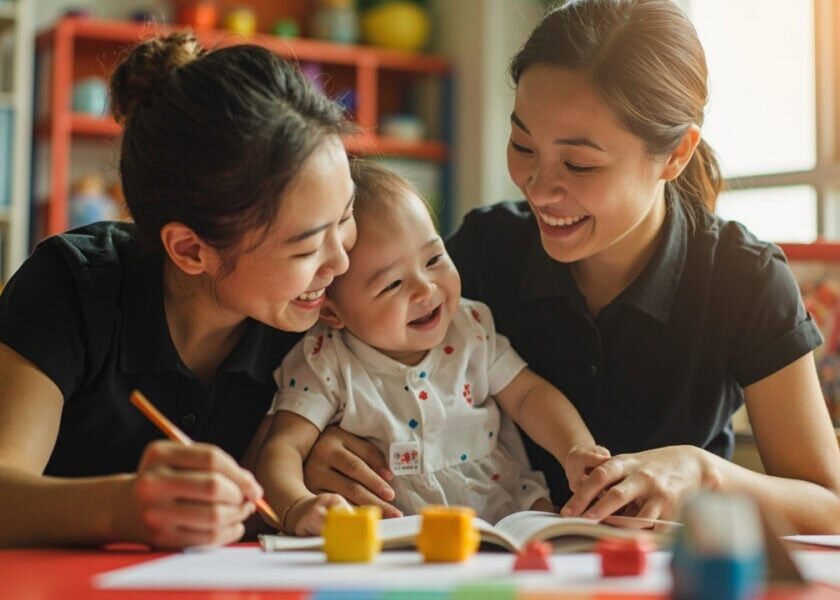
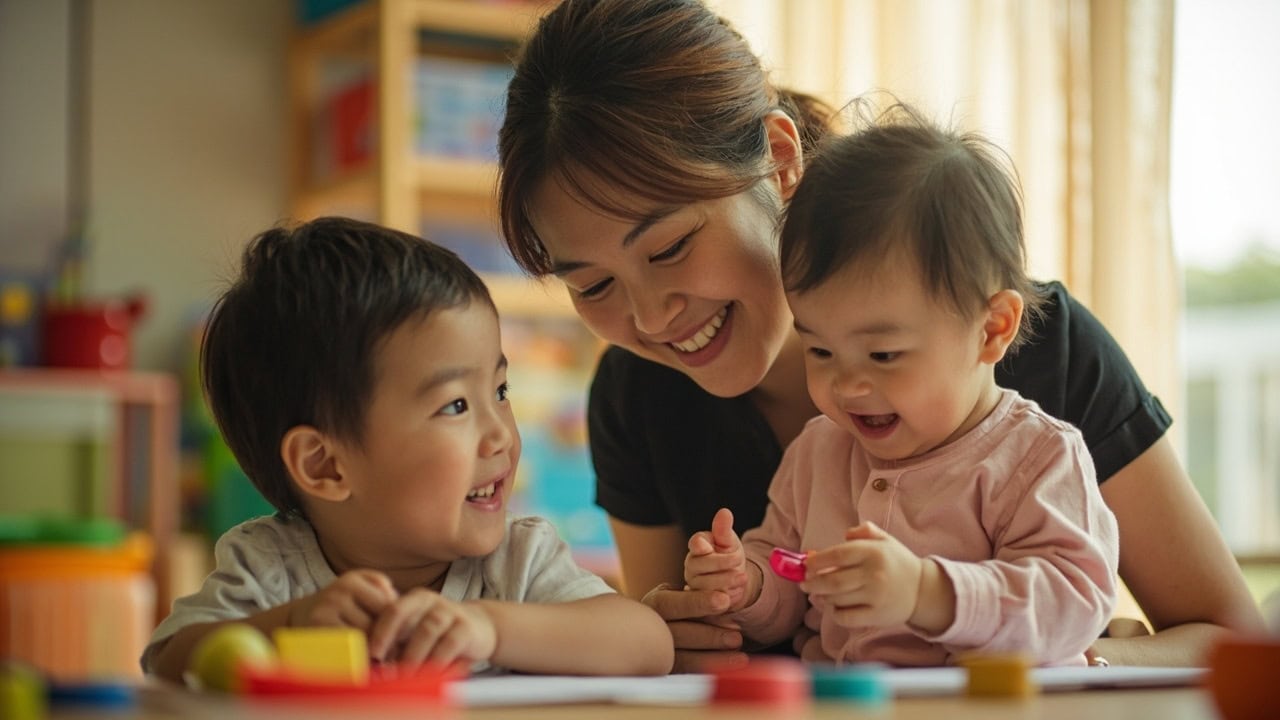
When they babble, someone answers. When they reach for a book, someone sits with them. Your child is seen. Your child is responded to. That ratio is the foundation.
We also offer centre-based pathways where applicable, because families are different and needs evolve. The best childcare system is one that flexes with your life, not against it.
Trust and Professional Care
You are inviting someone into the most important part of your life. You are leaving your child with another person and trusting that person with their safety, their wellbeing, and their development. That is not a small thing, and we know it.
Your childminder is a professional. I want to say that plainly, because the word “babysitter” does a disservice to what this role actually is.
A great childminder is an early childhood professional who understands developmental milestones, knows how to scaffold language for a toddler, and recognises when a child is on track and when they might need additional support. In the EduNanny model, your childminder is trained, supported, and treated as a skilled practitioner, not a domestic helper.
We invest in these caregivers because they are, in the most literal sense, building your child’s future. And we have transparency measures in place — communication protocols and regular updates — so that you know not just what your child ate, but what words they used, what story they loved, what sound they were practising. That is the kind of transparency that tells you your child is in the right hands.
Accessibility and Affordability
Language development should not be a privilege reserved for children whose parents can afford premium enrichment. It should be available to every child in Singapore, and it is one of the reasons we built this the way we did.
You can use your Child Development Account for EduNanny services. Baby Bonus funds are applicable. Within the pilot fee structures, we have worked to keep quality care within reach for families who are not looking for luxury but are looking for results.
The Long-Term Picture: Language Confidence and School Readiness
Early language confidence is not just about Primary One. It is about every year that follows.
A child who arrives at school believing they can communicate, believing their words matter, believing they have the vocabulary to express what they know and what they feel — that is a child who will take risks in learning. They will raise their hand. They will write the story. They will ask the teacher for help when something is unclear.
Language is the tool through which confidence becomes visible, and the years before school are when that tool is forged. The investment you make in your child’s early language environment compounds over time, not just in academic outcomes, but in how your child sees themselves as a learner and a person.
Bilingual Development in Singapore
For Singapore families, bilingual development adds both richness and complexity. The goal is not two separate languages learned in isolation, but a child who can move between English and Mandarin with growing ease and confidence.
This happens through exactly the same mechanisms as monolingual language development: consistent exposure, responsive interaction, and meaningful use. Your child does not need you to be perfectly bilingual to achieve this. They need a language-rich environment where both languages are valued, used naturally, and responded to warmly.
Quality childcare can provide that environment, extending and complementing what happens at home, so that your child builds confidence in both languages before Primary One begins.
Choosing Quality Childcare in Singapore: What to Look For
If you are currently comparing childcare options, here are the questions that actually matter:
- What is the caregiver-to-child ratio? Smaller ratios mean more individual attention and more language-building interaction per child.
- Is the caregiver trained in early childhood development? Understanding language milestones is what transforms supervision into education.
- How is a typical day structured? Look for a balance of free play, guided interaction, storytime, songs, and conversation — not just scheduled activities, but responsive engagement.
- How will I know what my child is learning? You should receive regular, specific updates: new words learned, books shared, conversations had. Vague reassurances are not enough.
- What happens if I have concerns? A quality provider will have clear pathways for discussing your child’s development and making adjustments.
- Is the environment flexible to my family’s needs? Your childcare should work with your life, not create additional stress.
You Are Doing Enough — And You Do Not Have to Do It Alone
So if you are standing in that quiet moment, calculating the months, wondering if you are doing enough — here is what I want to leave you with.
You are. And you do not have to do it alone.
The first thousand days are waiting. And we would be honoured to walk part of that road with you.
EduNanny Singapore is part of Singapore’s own commitment to building a childcare system that works for families — through the ECDA Childminding Pilot, through home-based care and centre-based pathways, through trained professionals and ratios that make real attention possible.
We believe every child in Singapore deserves to start school with words in their pockets and the confidence to use them. We believe parents deserve to go to work knowing that their child’s development is not paused but accelerating. And we believe that childminding is not a compromise. It is a choice, made with intention and love, and it deserves to be treated with the seriousness it commands.
If you are ready to explore what quality childcare looks like for your family, we invite you to learn more about EduNanny Singapore — and find a partner who will be present with your child, every single day.
At EduNanny Singapore, we are committed to thoughtful, development-oriented childcare for families across the island. Learn about our approach or get in touch to explore how we can support your child’s early years.