What Singapore Parents Need to Know About the Hidden Curriculum
The Hidden Curriculum: What Happens in the Hours You Don’t See
I want to talk to you about what happens in those hours—not the hours you see, but the hours you don’t. I want to introduce you to what researchers and early childhood educators call the hidden curriculum: the rich, invisible layer of learning that unfolds when children are in environments designed to help them grow.
In quality childcare, your child’s brain is extraordinarily active. Not just busy, but actively building the architecture for everything that comes next: language, logic, empathy, resilience, creativity. Every interaction with a responsive caregiver, every moment they navigate a conflict with another child, every time they try something new and fail and try again—these are not idle moments. They are the building blocks of who your child will become.
This is the hidden curriculum. It is hidden not because it is secret, but because it is invisible to parents who have not yet learned to see it.
- The social skill your eighteen-month-old is building when they watch another child cry and then offer their own stuffed rabbit—a gesture of empathy you will never hear about because your child is too young to narrate it
- The language explosion your two-year-old is experiencing because a skilled caregiver narrates everything, asks open questions, and expands every short phrase into a richer thought
- The emotional regulation your three-year-old is learning when a trained adult helps them name their frustration, calm their body, and try again—skills that will serve them in primary school, in friendships, in life
Here is what I have learned, watching how children grow in Singapore’s best childcare environments: the difference between adequate care and quality care is not visible to the naked eye in any single moment. It is visible over time, in the trajectory of your child’s development. It is visible in the way they play, the way they speak, the way they navigate the world. And once you know what to look for, you cannot unsee it.
Inside a Quality Childcare Environment
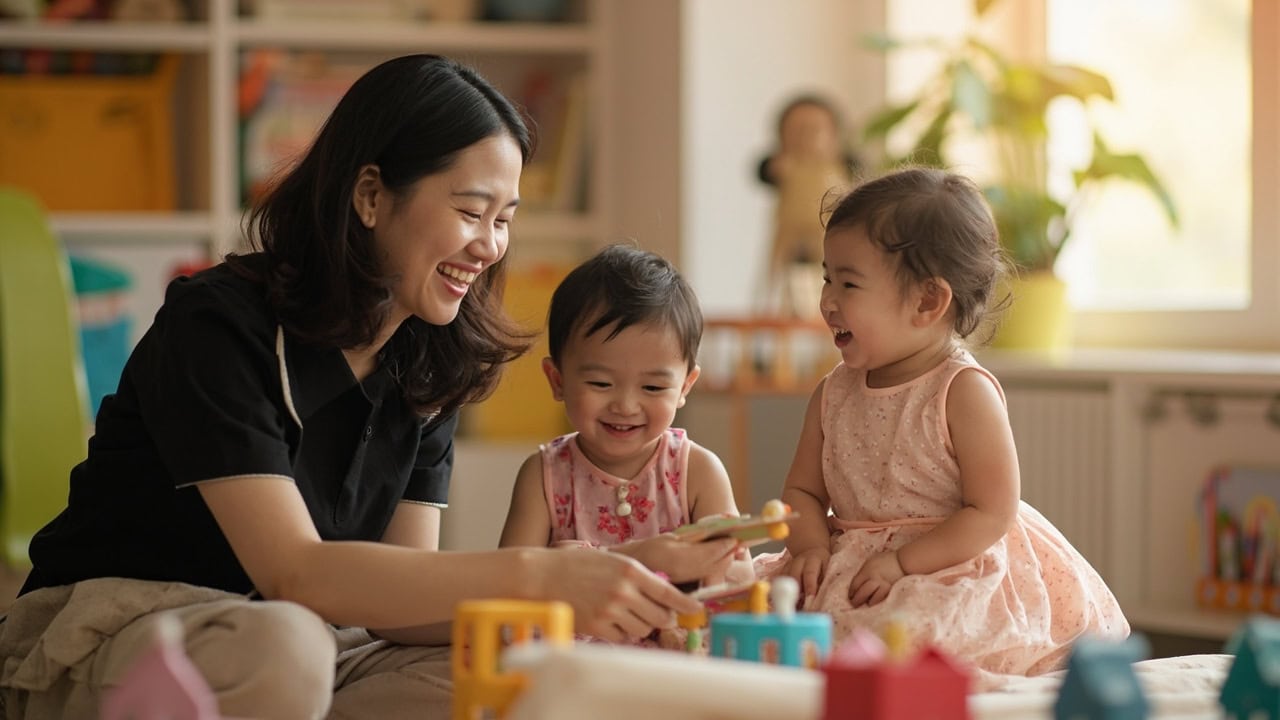
In a quality infant and toddler environment, there is something that looks deceptively simple: free play. Your child wanders around a carefully prepared space, choosing what interests them. They pick up a wooden block, turn it over, feel its weight. They stack it on another block. It falls. They try again.
This does not look like learning. It looks like play.
But what is actually happening is extraordinary. Your child is developing fine motor skills, persistence, problem-solving, and spatial reasoning. They are learning about cause and effect. They are building the neural pathways that will later support mathematics, engineering, and the ability to think through complex problems.
Now watch what a skilled caregiver does. They do not take over. They do not build the tower for the child or correct their technique. Instead, they observe. And then, at the right moment, they offer a simple challenge—not too easy, not too hard. Educators call this the zone of proximal development.
“What do you think will happen if you put the bigger block at the bottom?”
The child considers this. They try it. The tower stands. The child’s face lights up with the particular satisfaction of having solved a problem.
This is intentional engagement. This is the hidden curriculum at work.
Multiply this by dozens of moments across a day, across months, across years. Every interaction is an opportunity for growth, if the environment and the caregiver are attentive enough to see it.
What Quality Looks Like Across Ages
For infants: The hidden curriculum is about trust, attachment, and the physical foundations of learning. When a caregiver responds promptly and warmly to a baby’s cry, they are teaching that baby something profound: that needs are met, that people are reliable, that the universe is fundamentally safe. A child who feels secure is a child who can explore. In quality infant environments, you will see caregivers on the floor, at eye level with babies, talking and singing to them, describing what they see. You will see babies being encouraged to reach, to roll, to push up, to crawl toward something they want.
For toddlers: The hidden curriculum shifts to include social navigation. Your child is learning to be with others—to understand that other children exist and have desires that may conflict with their own. Toddlers do not naturally share or take turns. These are skills that must be taught, modeled, and practiced. In quality toddler environments, skilled caregivers guide conflicts rather than solve them. They help children use words, narrate emotions (“I see that you both want the truck. That is frustrating.”), and offer solutions (“We can take turns, or we can find another truck.”).
For preschoolers: The hidden curriculum expands to include the foundations of school readiness—concentration, persistence, cooperation, early literacy and numeracy, creative thinking. A quality preschool looks different from a toddler environment. There is more structure, more intentional activities, more scaffolding toward specific skills. But the principle is the same: learning is not something that happens to a child. It is something a child does, with the support of skilled adults.
What You Can Actually Observe
All of this learning is happening, in some form, in every quality childcare environment. But it is not always visible to parents. It does not always make it into the daily activity log. It is hidden not because anyone is hiding it, but because it is subtle, unfolds over time, and requires an understanding of development to recognize.
So what can you, as a parent, actually observe at pickup time? Here are five signs that meaningful learning occurred:
1. Your Child’s State
When you arrive, how does your child respond to you? A child who runs to greet you, eager to show you something, curious about your day, is a child who is generally feeling secure and engaged. A smooth transition, where your child can say goodbye without excessive distress and hello with genuine enthusiasm, is a sign of healthy attachment in both directions.
2. Language Growth
Has their vocabulary grown? Are they using new phrases, new sentence structures, new words? Are they narrating their day, telling you stories, asking questions? When caregivers talk to children—really talk, narrate, describe, ask, listen, expand—children’s language flourishes. If your child is suddenly using words or phrases you did not teach them, this is a sign of meaningful interaction happening during the day.
3. Growing Independence
Can your child do more for themselves than they could a month ago? Can they put on their shoes, wash their hands, use a spoon with more skill, try new things without immediate fear? In quality childcare environments, caregivers deliberately foster independence. They resist the urge to do things for children that children can do for themselves. This is not neglect—it is intentional development.
4. Curiosity and Engagement
Does your child ask questions? Do they want to explore, to try, to experiment? A child who is curious is a child whose desire to learn has been nurtured rather than squelched. Quality caregivers protect play, protect exploration, protect the natural curiosity that all children are born with. They leave space for children to discover.
5. Social-Emotional Development
Can they name their emotions? Can they begin to regulate them? Do they show empathy, concern for others, the beginning of a moral sense? These skills are built in relationship, in the daily back-and-forth of social interaction. Quality caregivers help children develop the social-emotional toolkit they will need for life.
These observations are not about perfection. No child develops smoothly in every area all the time. What you are looking for is trajectory—evidence that your child is moving forward, not just being kept occupied.
The Partnership That Makes Learning Visible
The hidden curriculum is not something that happens to your child in isolation. It is co-created, with parents and caregivers working together, sharing observations, aligning on goals, celebrating milestones, and addressing challenges.
When this partnership is strong, the hidden curriculum becomes visible—not because it is no longer hidden, but because you have built the knowledge and the relationship to see it.
This is why communication matters so much. Not just the daily activity log that tells you what your child ate and when they slept—though that information is practical and useful—but the deeper communication: the conversation about what your child is working on developmentally, the sharing of observations, the collaborative problem-solving when challenges arise.
At EduNanny Singapore, this partnership is foundational to everything we do. We are part of the ECDA Childminding Pilot, committed to standards that go beyond regulatory compliance to genuine developmental excellence. Our infant ratios are designed to ensure responsive, attentive caregiving—no more than three infants per caregiver in our infant environments, because quality cannot be achieved when caregivers are stretched too thin.
Our caregivers are not just watchers. They are trained professionals who understand child development, recognize developmental windows, and know how to support growth at every stage. They observe, document, share, and communicate with parents as ongoing partners in your child’s development.
We have built transparency into everything we do. Where deployed, CCTV measures allow parents to see into their child’s day. Communication channels are open, responsive, and regular. We want you to know what is happening, not because we are required to show you, but because we believe informed trust is the only trust worth having.
Our fee structures are designed to be accessible within the pilot framework. We accept CDA and Baby Bonus, understanding that Singapore families need practical support alongside thoughtful, development-oriented care.
A Simple Framework for Choosing Childcare in Singapore
If you are currently researching childcare options, here is a framework to guide your evaluation:
- Ask about ratios: How many children per caregiver? For infants, lower ratios mean more responsive care.
- Observe the environment: Is it safe, stimulating, and designed for children’s development—or just for convenience?
- Ask about communication: Beyond daily logs, how do caregivers share developmental observations?
- Watch the caregivers: Are they on the floor with the children? Are they talking, not just supervising?
- Trust your child: After a few weeks, does your child seem happy to go? Do they show signs of growth?
Your Child’s Growth Story Starts Here
The hidden curriculum is real. In every quality childcare environment, learning is happening—not the superficial learning of facts and skills, but the deep learning of who your child is becoming. Their social skills, their emotional resilience, their language, their curiosity, their independence, their capacity for wonder. These things are being built, hour by hour, in the unseen hours that matter most.
You cannot see all of this directly. You will not always receive evidence in the form of photos or activity logs. But you can learn to see it. You can learn to read your child’s development, to recognize the signs of quality, to understand what is happening even when you are not there.
And when you find a childcare arrangement that aligns with these principles—when you find caregivers who are trained, attentive, intentional; when you find an environment designed for development, not just occupation; when you find a partnership where communication flows freely and transparently—you can rest in something deeper than blind trust. You can rest in informed understanding.
Your child’s hidden curriculum is being written every day, in the hours you are not there. Your job is not to be present for every moment. Your job is to find the right environment, to build the right partnership, and to learn to see what is happening.
And then, when you pick up your child at the end of the day, you will not just see a child who has been fed and changed and kept safe. You will see a child who is growing. You will see the hidden curriculum made visible, right before your eyes.
We are not just watching your children. We are helping them become who they are meant to be.
If you are researching infant care or childminding in Singapore and want to learn more about how EduNanny Singapore supports the hidden curriculum for your child, we welcome the conversation. Visit our website or reach out to speak with our team.