For Singapore’s Growing Families: A Better Approach to Childcare for Multiple Children
The Moment Every Second-Time Singapore Parent Recognises
There is a moment that every second-time parent in Singapore recognises, even if no one has ever said it out loud. It arrives quietly, usually in the weeks after the second child is born.
The older child, who has known a certain rhythm of mornings and afternoons — a bond with the person who cares for them — suddenly finds that everything has shifted. The person who used to give them full attention is now holding a newborn. The routines that felt permanent are suddenly under revision.
And somewhere in that quiet rearrangement, a question surfaces that most childcare brands never bother to answer: What happens to my first child when the second one arrives?
That question is the one EduNanny Singapore was built to answer. Not as a secondary concern. Not as an afterthought to individual childcare. But as the central question that quality family childcare must begin with.
Why Your Family Feels Invisible to Most Childcare Services
Here is what Singapore parents with multiple children know, and what most childcare communication refuses to acknowledge: your family is not a collection of individuals who happen to share an address.
Your children are bound to each other in ways that will shape them for life. The way they learn to share, to compete, to protect, to love, to negotiate, to play together, and to manage jealousy — these are not skills that develop in isolation. They are forged in the daily texture of growing up alongside someone else.
When you bring a childcare partner into your home, that partner is stepping into the middle of all of that.
Yet nearly every piece of childcare communication in this country speaks as if you have one child. The language is singular. The scenarios are singular. The concerns addressed are singular. If you are a parent of two, or three, or more, you sit there reading advice that applies to someone else’s family and wonder when someone will finally talk about yours.
This is not a small thing. This is the reason many families feel, despite engaging with childcare services, that something is missing. They feel managed, not known. They feel like clients in a transaction, not members of a family being accompanied through a complex and beautiful season of life.
The Mental Load Nobody Talks About
Let us name something that parents of multiples often feel but rarely say: the exhaustion of coordination.
You are not just a parent. You are a logistics manager, a translator, an emotional regulator, and a calendar keeper — all running simultaneously. Two different sets of developmental milestones. Two different nap schedules. Two different food preferences. Two different temperaments.
You need to know what good looked like for your two-year-old and what it looked like for your four-year-old, because those are different experiences entirely. A generic daily log that says “had a good day” does not help you. It makes you feel more alone.
What Your Children Actually Need, Stage by Stage
The first thing that shifts when you begin thinking about childcare at the family level is the understanding of what your children actually need from their days.
- An infant in the first year requires feeding, sleep cycles, sensory stimulation, and the constant sense of security that comes from being held and responded to.
- A toddler approaching two is in an entirely different mode — driven by a need for autonomy, language acquisition, physical exploration, and social play.
- A preschooler of four or five is ready for complex storytelling, early numeracy, peer negotiation, and imaginative play that requires real cognitive scaffolding.
These are not minor differences. They are distinct developmental windows that demand distinct approaches.
The Sibling Relationship: What Children Learn Together That They Cannot Learn Apart
Consider the sibling relationship itself. When your children are in the same childcare setting, they are learning something that no amount of separate enrichment classes can teach them.
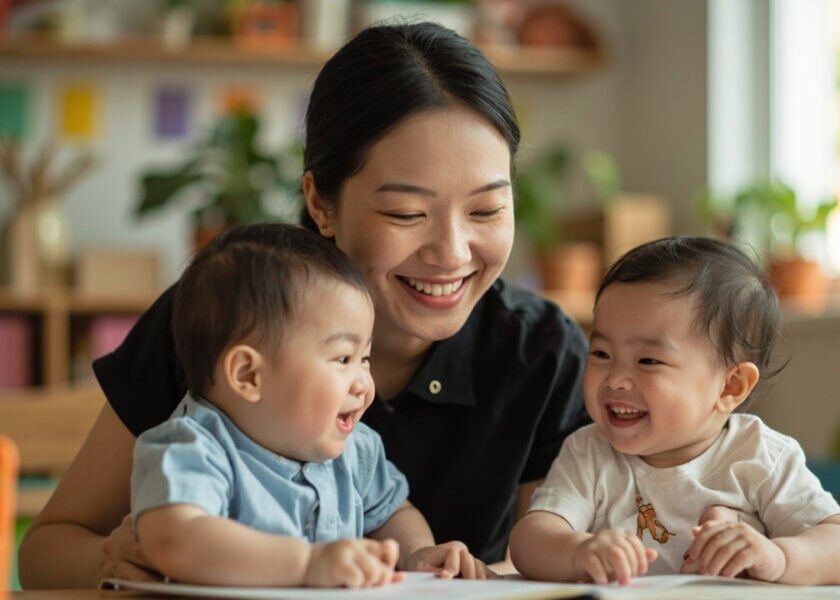
They are learning how to be siblings — in the presence of a trusted adult who can model fairness, who can name what she sees, who can intervene in squabbles without favouritism, who can celebrate one child without diminishing another, and who can help each child feel that they are known as themselves, not just as someone’s brother or sister.
This requires a caregiver who can:
- Read the emotional temperature of two or three children at once
- Manage the jealousy that flares when one child receives praise
- Navigate competing demands of nap schedules and play preferences
- Do all of this with the kind of steady, warm authority that children actually respond to — not permissive, not harsh, but genuinely present and fair
There is a particular moment when a caregiver understands that the older child needs to feel that his new role as helper and model has value. When he helps his younger sibling with a puzzle, someone notices and names that kindness. And when the younger child needs to feel that she is not always in the shadow of her brother’s accomplishments, someone creates space for her own victories — small ones, age-appropriate ones, but real ones.
When that happens, the childcare environment stops feeling like a holding pen and starts feeling like a small, safe world where sibling bonds can deepen.
When Your Family Is in Transition
Not every arrival is planned in a neat sequence. Sometimes a second child comes sooner than expected. Sometimes a grandparent who was helping has to return to work. Sometimes a family move, a job change, or a family illness means that your carefully arranged childcare suddenly has a gap.
In those moments, the last thing you need is a childcare partner who says, “Let me check my availability calendar.” What you need is someone who already knows your family. Who has watched your eldest transition from parallel play to cooperative play. Who has noticed that your middle child is more sensitive to loud noises than her siblings. Who knows that your youngest only settles when someone sings — and that the song must be a specific one.
When a family has continuity of caregiver, that knowledge accumulates. It becomes institutional memory that serves your children in ways that a rotation of unfamiliar faces simply cannot.
Honouring What Grandparents Have Built
Singapore families do not exist in isolation. Grandparents are often deeply involved. In many households, grandmother care is the backbone of the early years.
Then, often around the time a second child arrives — or when a grandparent’s health makes full-time care difficult — families find themselves needing to make a transition. They are not replacing their parents’ love. They are acknowledging that the season has changed, and that their children would benefit from professional, structured, resourced childcare.
This transition is emotional. It carries weight. It is not something that should be approached with a transactional mindset.
EduNanny Singapore understands this. The caregivers in the network are trained not just to care for children, but to honour the relationships that already exist. When a grandmother has been the primary caregiver and is transitioning to a new arrangement, a skilled caregiver will find ways to include her, to reference her, to maintain continuity in the child’s emotional world.
The child does not need to feel that grandmother has been replaced. They need to feel that grandmother is still part of their village, and that the new caregiver is a trusted addition — not a substitute.
What Quality Childcare for Multiple Children Actually Looks Like
Here is how to recognise whether a service is designed for your whole family or just for individual children:
| Single-Child Approach | Whole-Family Approach |
|---|---|
| Caregiver ratio focuses on one child at a time | Caregiver has capacity to engage multiple children meaningfully |
| Updates are generic: “Had a good day” | Updates are child-specific and developmentally grounded |
| Sibling dynamics treated as distraction | Sibling bonds actively nurtured by caregiver |
| Transitions handled transactionally | Transitions handled with awareness of emotional impact on all children |
| Family history unknown to new caregiver | Continuity of knowledge builds over time |
What You Actually Need From a Childcare Partner
Not the abstract ideal of perfect childcare. The practical, real-world things that would make your mornings less frantic and your evenings less anxious.
You need your caregiver to know your children. Not just their names and ages, but their textures. The way your eldest needs a warning before transitions. The way your middle child melts down when overtired. The way your youngest is finally sleeping through the night and you are both so relieved you could cry.
You need logistics that actually work. Monday to Friday care blocks that align with your working life. A fee structure that is transparent and, within the pilot framework, affordable. The ability to use your Child Development Account and Baby Bonus funds in ways that reduce the financial weight of quality care.
You need to trust the person in your home. Not because you have been told to trust her, but because you have seen her in action, because you know how she is supported, because you understand the standards she is held to.
EduNanny Singapore operates within the ECDA Childminding Pilot framework, which means caregivers have been assessed, supported, and connected to a structure that values continuity and quality. Because EduNanny is part of the broader BUTLER ecosystem, there is a depth of oversight and support that goes beyond what a standalone arrangement could offer. You are not alone in this. There is a system behind your caregiver, helping her grow, helping her troubleshoot, and making sure that your family has the kind of consistent, reliable care that allows everyone to breathe.
Communication That Sees Each Child as an Individual
Here is what family-level communication actually means in practice.
Not a generic daily log that says “had a good day.” But real information about what happened with each child:
- Who had a breakthrough with using the potty
- Who resisted the afternoon nap but eventually settled
- Who was clingy after the grandparent visit
- Who shared a toy unprompted for the first time
These are the details that help you feel connected to your children’s days, even when you are not there. For parents with multiple children, the complexity of that communication doubles or triples.
EduNanny’s approach is designed to honour that complexity. Where the service is deployed, structured updates allow parents to receive meaningful, child-specific information rather than a one-size-fits-all summary.
This is not about surveillance. It is about partnership. When you receive a message that tells you something real about your child’s day, you feel seen. You feel that the person caring for your children actually knows them.
For families navigating the intensity of multiple children, that feeling is not a luxury. It is the difference between feeling supported and feeling alone.
Your Family Deserves to Be Known. All of You.
You are not a single-child family in a system designed for one. You are a family with history, with dynamics, with children who love each other and frustrate each other and learn from each other in equal measure.
You are a family that is growing, shifting, and constantly adapting. And you deserve a childcare partner who sees that whole picture — not just your infant, not just your toddler, your whole family.
EduNanny Singapore was built for this moment. For families who have felt the gap. For parents who have sat through childcare consultations where no one mentioned their second child. For families who have wondered whether professional care could really honour the complexity of what they are living.
Yes, it can. Not perfectly, because no human arrangement is perfect. But thoughtfully, consistently, and with genuine care for the sibling bond and the individual soul of each child in your home.
The first thousand days matter. We know that. But what matters equally is the season that follows — when your children are no longer infants but are learning, in the daily company of each other and their caregiver, how to be siblings, how to be friends, how to navigate the world together.
That is the work that EduNanny Singapore is here to walk alongside you in.
If you are a Singapore family with multiple children and you are looking for childcare that sees your whole family, we invite you to start a conversation. Ask the questions that matter to you. See how the approach works in practice. And find out whether this feels like the kind of care your family has been looking for.
Because you deserve to be known. All of you.
EduNanny Singapore is a development-oriented childcare and childminding service for families across Singapore. Learn more about who we are or explore our approach.