What Singapore Parents Need to Know About Childcare and Learning
The Moment Every Working Parent Knows
There is a moment, known to many working parents, when you hand your child over at the door and watch them disappear into someone else’s morning.
You tell yourself it will be fine. You tell yourself they are in good hands. And somewhere beneath all of that, a small question lingers—one you may not even say out loud: What are they actually doing in there? Are they just being looked after? Or are they growing?
That question is not a lack of trust in your childcare arrangement. It is not guilt, though so many of us have been made to feel that our working lives are something to apologize for.
That question is something far more fundamental. It is the question of every parent who loves their child and wants the best for them. It is the question of whether the hours you are away are hours well spent in the development of the person your child is becoming.
This question deserves a real answer. And in Singapore, that answer is beginning to change how we think about childcare entirely.
The False Choice We Have Been Given
We have been presented with a false choice for a very long time. It lives in the language we use, in the advertisements we scroll past, in the conversations we have at playdates and in the quiet corners of our own minds.
The choice sounds like this: you can have childcare that is warm and loving, where your child feels safe and happy and nurtured. Or you can have childcare that is educational, where your child is learning, preparing, building the foundations they will need for school and for life.
Pick one. Find the balance. Good luck.
But here is what decades of research in child development have shown us, and what working with families in Singapore consistently demonstrates: this is not a choice at all. It is a false dichotomy built on a misunderstanding of how children actually learn in their first five years.
How Children Actually Learn Before Age Five
Children do not learn the way older children learn. They do not sit at desks and absorb information delivered in lessons. They do not benefit from worksheets or homework or academic pressure.
What young children need—what their rapidly developing brains are wired for—is learning that happens through human connection, through responsive interaction, through the ordinary moments of a day filled with purpose.
Consider these examples:
- When a caregiver narrates what is happening as a toddler explores a new texture, that is language development.
- When a small group of children figures out who goes down the slide first and negotiates their way to a resolution, that is social-emotional learning.
- When an infant reaches for a toy just beyond their grasp and a patient adult places it within reach, celebrating their effort, that is the building of motor confidence and the scaffolding of cognitive growth.
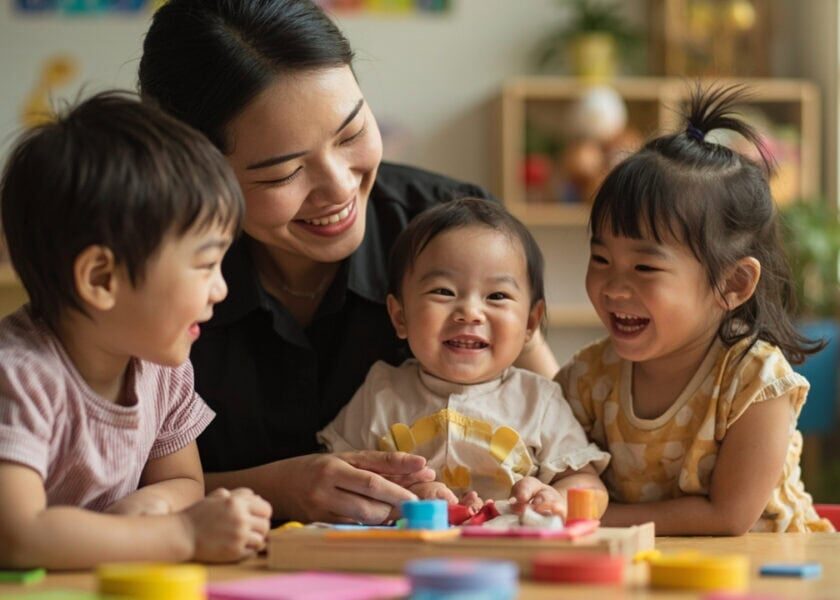
These are not activities on a curriculum. They are the curriculum of early childhood, and they happen most powerfully in an environment that is warm, consistent, and full of attentive human beings.
This is the insight that changes everything: learning and care are not separate tracks running parallel in a child’s early years. They are the same track. The quality of the care is the quality of the learning environment.
Learning Hidden in Plain Sight
Let me paint a picture of what this looks like in practice, because it is easy for this to remain abstract.
Mealtimes Are Language-Rich Environments
Consider mealtime in a quality childcare setting. It is not simply about feeding children. It is a language-rich environment where the caregiver sits with the children, models conversation, and introduces new vocabulary naturally.
A mango is not just a mango. It is sweet. It is soft. It is slippery when it is ripe. The children are not being lectured. They are immersed in language, in the social ritual of eating together, in the modeling of manners and patience and curiosity about food.
Motor skills are developing too, as small hands learn to hold spoons, to pick up pieces of food, to manage the physical reality of a meal. And alongside all of that, children are learning about trust. They are learning that someone is there to meet their needs, to nourish them, to care about whether they are hungry or full.
Transitions Are Opportunities, Not Filler
Consider transition times. These are the moments we often rush through as adults because we are busy, because we have places to be.
But in quality childcare, transitions are not filler. They are opportunities:
- The walk from the playroom to the garden is an opportunity for conversation, for observation, for pointing out the world.
- The change from active play to rest is an opportunity to teach children about their own bodies, about wind-down rituals, about the dignity of rest.
These moments, so easily dismissed as logistical, are when a skilled caregiver is constantly reading the room, responding to cues, supporting regulation, and creating the kind of predictable, secure environment that allows a child’s brain to actually develop.
Guided Play Is Not the Same as Supervision
There is a difference—and it is a significant one—between a child being supervised in a room full of toys and a child engaging in play that has been thoughtfully prepared by someone who understands development.
The difference is intentionality. It is the difference between a playground and a learning laboratory. In the first, children may be safe and occupied. In the second, every material has been chosen for its developmental purpose:
- Open-ended resources that encourage problem-solving
- Sensory experiences that build neural pathways
- Peer groupings carefully considered to support social learning at just the right level of challenge
This is what separates supervision from developmental care. Once you see it, you cannot unsee it.
The Domains of Learning in Quality Childcare
Parents deserve to understand the depth of what is possible in quality childcare. Here is what research shows is developing during those hours you are apart:
Language Development: Building the Architecture of Thought
A child’s brain is building language networks at a pace that will never be matched again in their lifetime. What this means in practice:
- The conversations your child has throughout the day
- The songs they hear and eventually join in with
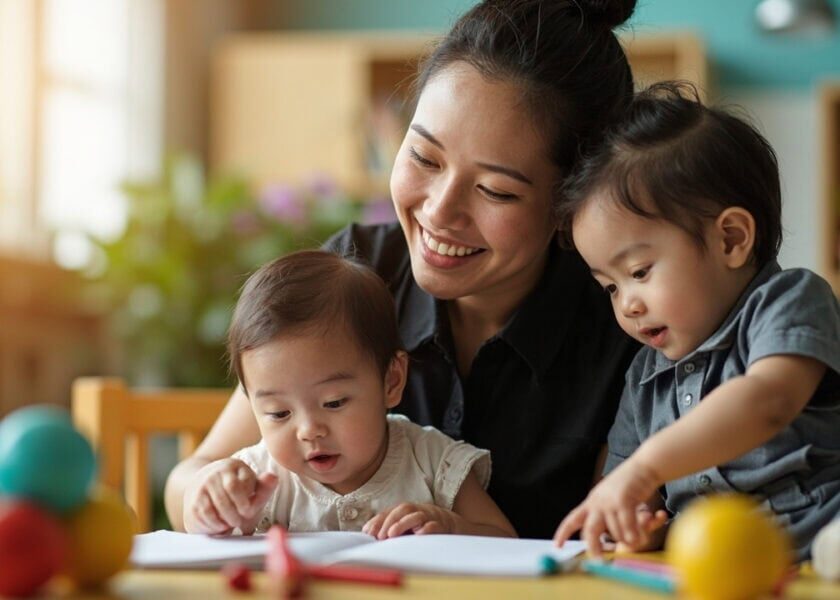
- The stories read to them with expression and engagement
- The narration of their world by a responsive caregiver
These are not just nice extras. They are building the architecture of their capacity to think, to communicate, to understand, to learn.
In a setting with a low infant ratio, where caregivers have the time and attention to truly engage with each child, this language exposure is rich and consistent and responsive. The child is not just hearing language. They are having their communicative attempts acknowledged, extended, and built upon.
This is the soil in which vocabulary grows.
Motor Development: Physical Competence Builds Confidence
Motor development is equally profound and equally often underestimated in Singapore’s academic-focused culture.
Gross motor skills—running, climbing, balancing—build not just physical capability but confidence and spatial awareness. Fine motor skills—picking up small objects, using utensils, manipulating materials—build the precision that will later support writing, drawing, and countless daily tasks.
In a quality childcare environment, children are not confined to a mat. They are moving, exploring, testing their bodies in safe but challenging ways. They are building the physical competence that is the foundation for so much else.
Social-Emotional Development: The Most Invisible and Most Important
Children learn to manage their emotions, to understand the emotions of others, to negotiate, to share, to care, to resolve conflict. They learn this by:
- Being in relationship with attentive adults who model regulation
- Hearing feelings named and validated
- Experiencing boundaries set with warmth
- Being in community with other children, with just enough support to succeed and just enough challenge to grow
This is not something that can be rushed or forced. It unfolds in the context of relationships, over time, in a secure and consistent environment.
Curiosity: The Drive That Makes Everything Else Possible
Every child is born curious. The question is not whether your child is curious. The question is whether the environment around them nurtures that curiosity or stifles it.
Look for environments where:
- Adults notice a child’s wonder and respond with enthusiasm and more questions
- The space invites exploration, allows for mess and failure and trial
- The process of learning is celebrated, not just the outcome
A warm, responsive, intentionally designed environment does not kill curiosity. It feeds it.
Why Academic-Heavy Models Fall Short
You may have encountered childcare models that emphasize early academics. They show you curriculum. They talk about readiness for primary school. They use words like accelerate and advance.
The appeal is understandable, especially in a context like Singapore, where parents feel the weight of educational expectations from very early on. But here is what the evidence actually shows:
Children who are pushed into academic learning before they are developmentally ready do not get a head start. They get anxiety. They lose the love of learning that is far more predictive of long-term success than any particular skill mastered at age four.
What builds the foundation for academic achievement later is not early academics. It is:
- Secure attachment
- Language development
- Cognitive scaffolding
- Emotional regulation
- Physical competence
- Curiosity that was nurtured
These are the preconditions for everything else. Quality childcare is not in competition with academic preparation. It is the thing that makes academic preparation possible—eventually, in the right timeframe, naturally, without pressure.
When children have been well-cared for in these early years, when they have had rich language exposure and responsive relationships and opportunities to explore and grow, they arrive at school ready to learn. Not because they were taught to read at three, but because they were loved and supported and given the space to become who they are.
What Quality Childcare Looks Like: A Parent’s Guide
What should you, as a parent, be looking for when you visit a childcare setting? What does learning actually look like when it is happening?
You know your child. You know what they are interested in, what they struggle with, what makes them light up. And you can learn to see the signs of a developmentally rich environment.
Look for Conversation
Is your child being talked to throughout the day? Not just managed, not just instructed, but engaged? Are caregivers narrating the world to them? Asking them questions? Responding to their sounds and gestures with words?
Look for Initiative
Is your child being allowed to try things? To struggle a little? To figure things out? Or are they being kept passive, entertained, restrained?
The child who is bored and passive is not learning. The child who is engaged and curious—even frustrated at times—is exactly where they need to be.
Look for Connection
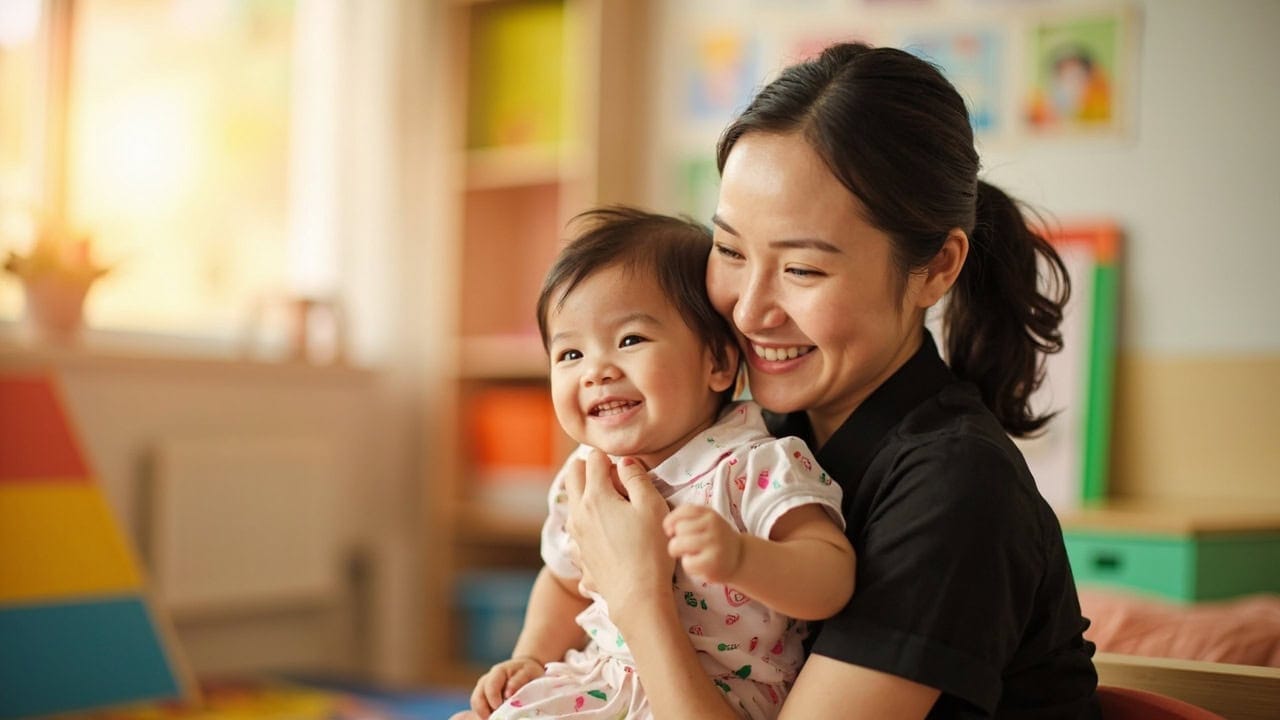
Do caregivers seem genuinely attuned to the children in their care? Do they notice when a child is tired or hungry or overwhelmed? Do they respond with warmth to distress? Do children seem to seek them out for comfort and security?
Look at Your Child’s Reports
Even very young children communicate. Their mood when they come home. Their language. Their play. If your child is coming home energized rather than depleted, curious rather than dulled, that is information. Trust it.
Look for Transparency
A quality childcare provider will not make you guess what is happening during the day. They will show you. They will share photographs, updates, observations. They will welcome your questions. They will have nothing to hide.
Your Options in Singapore
Singapore families have several pathways for quality childcare. Understanding these options helps you make an informed decision:
| Care Type | Key Features | Best For |
|---|---|---|
| Home-Based Childminding | Care in child’s own home; low infant ratios; personalized environment | Infants and toddlers; families seeking continuity of care |
| Community-Based Care | Small group settings; regulated quality; peer interaction | Families wanting social development in structured settings |
| Centre-Based Care | Larger groups; structured programs; more peer exposure | Families seeking structured schedules; older toddlers |
The right fit depends on your family’s needs, your child’s temperament, and your schedule. What matters most is not the model itself, but the quality within that model.
EduNanny Singapore: Built on Developmental Conviction
EduNanny by BUTLER is built on a conviction shared by families who understand that the early years matter profoundly. The care of young children is not merely a service arrangement—it is a developmental opportunity to be honored with intention, expertise, and genuine commitment.
As part of the ECDA Childminding Pilot, EduNanny operates within a framework that recognizes the importance of quality, regulated, supported childcare. The approach is not one-size-fits-all:
- For some families, home-based care—with a trained childminder in the child’s own environment—offers the personalized attention that best serves their child.
- For others, community-based or centre-based settings provide the peer interaction and structured environment that serves their child best.
EduNanny believes in understanding your family and matching you with the right fit.
What Makes EduNanny Different
Infant ratios designed for quality. With up to one-to-three infants in care, every child receives the attention they need and deserve. This is not a luxury feature. It is a precondition for the kind of responsive, language-rich, developmentally supportive care described throughout this article. You cannot build language if you are managing six infants at once. You cannot attune to emotional needs if you are overwhelmed yourself.
Caregivers who are trained, supported, and valued. The quality of your child’s early care is not ultimately about the curriculum or the toys or the facilities. It is about the human beings who are with your child each day—their warmth, their responsiveness, their understanding of child development, their ability to create a secure and stimulating environment. EduNanny invests in caregivers because investing in them is investing in your child.
Affordability as a core principle. Quality care should not be available only to those with significant means. EduNanny’s pilot fee structures are designed to be accessible, and CDA and Baby Bonus can be used with them. Every child deserves a strong start.
Transparency by design. Communication with parents is not an add-on. It is part of the model. Where deployed, communication tools and oversight measures are in place because parents deserve to see what is happening in the care of their children. This is not about surveillance. It is about trust, and trust must be built through openness.
Questions to Ask When Evaluating Options
When you are evaluating childcare options in Singapore, consider asking:
- What is the infant-to-caregiver ratio, and why does that matter for my child’s development?
- How do caregivers support language development during ordinary daily moments?
- What does a typical day look like, and how are transitions handled?
- How will I know what my child is doing and learning each day?
- How are caregivers trained and supported in their own development?
- Can CDA and Baby Bonus be used, and what are the total costs involved?
- What happens if my child is unwell or has special needs?
The answers to these questions will tell you far more than a tour of brightly painted walls or a brochure about curriculum.
The Morning Drop-Off, Reimagined
Let us return to that moment described at the beginning. The moment of the morning drop-off. The hand-off. The lingering question.
What if that question did not need to feel like a source of guilt or anxiety? What if it could be answered, clearly and confidently, each and every day?
What if you could drop your child off knowing not just that they are safe, but that they are in a place designed for their development? That the people caring for them understand how children learn? That the environment around them has been prepared with intention? That the small moments of their day—the meals and transitions and playtimes and rest—are all part of a thoughtful approach to building the person they are becoming?
This is what quality childminding offers. Not just childcare. Not just supervision. A developmental environment. A place where your child is growing, learning, and becoming, in the way that children are meant to: through relationship, through play, through the richness of an ordinary day lived with attentive, caring, expert adults.
The early years are not waiting time. They are not a gap to be filled until school begins. They are the most important years, and they are happening now. Every day. In the moments you are apart and the moments you are together. In the learning that looks like nothing and everything at once.
You have chosen—or you are considering choosing—to entrust your child to someone else during these precious hours. That is not a compromise. That is not a defeat. That is a choice to seek quality care for your child, and that is something to be honored.
The door closes after you leave your child each morning. But behind that door, the learning is happening. The development is unfolding. The foundation is being built.
EduNanny Singapore. Every moment, designed for development.
Ready to learn what quality childminding looks like for your family? Connect with EduNanny by BUTLER to explore your options and discover a childcare approach where care and learning are never apart.
Learn more about who we are or return to EduNanny Singapore.