Why the First Five Years Shape Your Child’s Entire Future
What Your Child Is Actually Learning: A Quick Summary
If you’re reading this during a commute or a late-night feed, here is what matters most:
- The first five years are the most significant developmental window of your child’s entire life. The neural architecture that determines how they think, learn, feel, and relate to others is built during this time — not later.
- Every sensory experience, every word spoken to your child, every moment of frustration followed by comfort is raw material for their developing brain. Childcare is not a waiting room. It is a building site.
- Language-rich, responsive interaction in the early years has a measurable effect on later literacy. Children who hear more words — real, varied, narrating words — arrive at school with significantly larger vocabularies.
- The quality of the educator in the room matters more than the quality of the toys. A trained early childhood educator is not the same as a babysitter, and this difference shapes your child’s daily experience in profound ways.
- You can learn to recognise quality when you see it. There are specific, observable things you can look for during a visit that will tell you whether the environment is truly learning-rich.
Now let us go deeper — because you deserve to understand what you are entrusting your child with each morning.
The Brain in the First Five Years: Why These Hours Matter
In the first five years of life — some researchers narrow it further to the first thousand days — the human brain undergoes a construction project of almost incomprehensible scale. At birth, your child has nearly all the neurons they will ever have, but they are largely unconnected. The architecture of their mind — the web of neural pathways that will determine how they think, learn, feel, and relate to others for the rest of their life — is built during this window. And it is built not in stillness, but in response.
Every sensory experience. Every verbal exchange. Every moment of reaching for an object and missing. Every instance of frustration followed by comfort. These are not passive events. They are the raw material of your child’s neural architecture.
This is not metaphor. When neuroscientists study the developing brain, they find that the prefrontal cortex — the region responsible for self-regulation, executive function, impulse control, and what we sometimes call character — is still under construction well into the mid-twenties. But its foundation is laid in early childhood.
The quality of interaction, the richness of language, the presence of responsive adults who narrate the world and mirror emotions — these are the experiences that thicken the synaptic connections, that build the capacity for focus, empathy, and flexible thinking.
What does this mean for a childcare environment? It means that the room your child enters each morning is not a waiting room. It is a building site. And the people in that building site are architects.
What This Looks Like in Practice
When your child crawls across a textured mat, they are not just playing. They are receiving tactile information that helps their brain map the body in space. When they splash in a shallow tray of water with different objects floating and sinking, they are not just having fun. They are constructing concepts of causation, permanence, and prediction — the foundations of scientific thinking. When they climb a low structure and hesitate at the top, feeling the slight fear that precedes mastery, their brain is lighting up in regions that will one day govern courage and decision-making.
This is why quality childcare is not a luxury. It is a developmental environment, and its quality determines — in measurable ways — the trajectory of your child’s cognitive and emotional capacity. This is supported by decades of longitudinal research, and it is why governments around the world — including Singapore’s — invest in and regulate early childhood education as a matter of national importance.
Inside a Quality Infant and Toddler Environment
In a truly purposeful infant care setting, here is what you would see, hear, and feel.
Sensory-Rich, Purposeful Play
You will see textured surfaces at different heights for babies who are learning to push up, to roll, to crawl. You will see mirrors at floor level so that a nine-month-old can discover their own face — a moment of astonishment that is also a lesson in self-recognition. You will see containers and objects of different sizes, shapes, and weights for children who are figuring out that the world has properties, that some things fit inside other things, that manipulation of objects is both possible and satisfying.
The Language That Actually Builds Literacy
You will hear language. But not baby talk — not the singsong, repetitive, developmentally impoverished “goo-goo ga-ga” that many of us were raised on. You will hear real, responsive, narrating language.
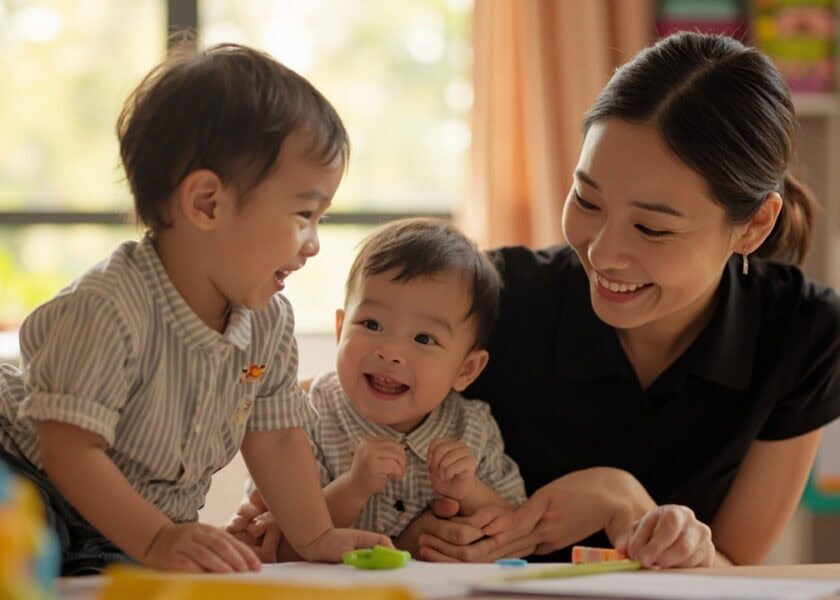
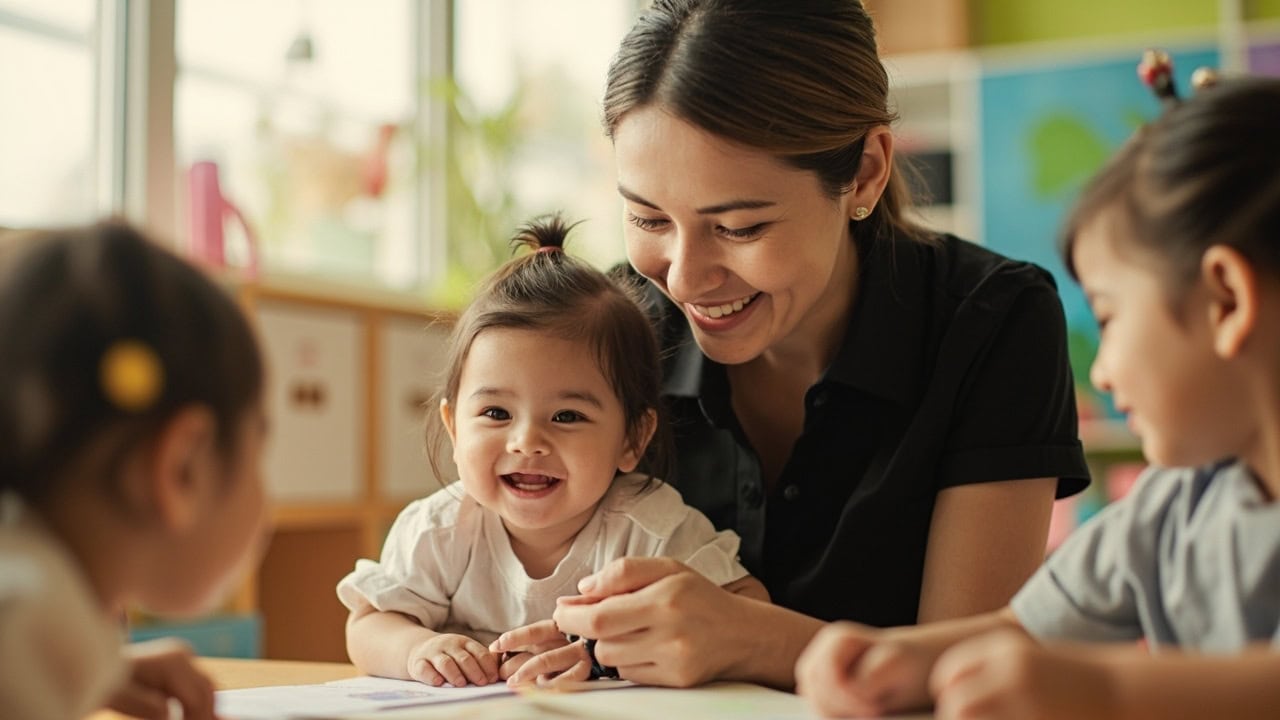
An educator crouches beside a twelve-month-old who is stacking blocks. She does not say, “Good job!” That phrase, so ubiquitous in early childhood settings, actually teaches very little. Instead, she says, “You’re stacking the red block on top of the blue block. That one fell. You’re trying again. Now the tower is taller.”
She is not simply praising. She is naming, describing, thinking aloud. She is modelling the inner voice that your child will eventually internalise — the voice that narrates their own experience and makes sense of the world.
Children who hear more words — not just more baby words, but more of the rich, varied, complex vocabulary of adult speech — arrive at preschool and primary school with significantly larger vocabularies. They find reading easier. They find meaning more accessible. They have, quite literally, been building the neural pathways for language comprehension since before they could string a sentence together.
Motor Development Through Purposeful Movement
Quality infant care is not about keeping children still. It is about providing safe, structured opportunities for physical exploration — crawling tunnels, climbing structures, sand and water play, art experiences that engage the senses. Each of these is not entertainment. Each is a carefully designed experience that develops the vestibular system, refines gross and fine motor skills, and builds the body awareness that underlies all later learning.
The Trained Educator: Why the Person in the Room Matters Most
This is perhaps the most important variable in your child’s early childhood environment, and also the most overlooked.
What Training Actually Means
A trained early childhood educator is not a babysitter. This distinction matters more than the word choice might suggest. A babysitter — whether a teenager next door or a well-meaning relative — may be warm, may be safe, may genuinely love your child. But warmth and love, without training, are not enough to structure the developmental experiences your child’s brain requires.
A trained educator has studied child development. She understands the sequence of motor milestones and knows how to support, not rush, your child’s physical development. She understands language acquisition and knows how to scaffold communication for a child who has not yet found words. She understands social-emotional development and knows that a toddler’s tantrum is not bad behaviour but an overwhelmed nervous system expressing needs it cannot yet articulate.
The Moment of Response
When your child falls and cries, a trained educator does not simply comfort the tears. She names the emotion — “You fell and it scared you” — because she knows that children cannot regulate emotions they cannot name, and that the words we offer them become the tools they use to understand themselves.
When two children reach for the same toy, she does not simply intervene with a solution. She guides them through the negotiation, giving them language and modelling the skills they will need for the rest of their lives to navigate a world of competing needs.
This is what professional knowledge looks like in a room. It is not visible in photographs of tidy shelves or brightly coloured walls. It is visible in the quality of interaction — the thousands of small exchanges that happen between a trained educator and a child throughout every single day.
What Singapore Parents Can Look For: A Practical Guide
How do you recognise whether the environment your child spends their mornings in is truly one of these learning-rich spaces? Here is what to notice when you visit — and we encourage you to visit more than one, to return at different times of day, to observe not just the physical space but the human interactions within it.
1. Listen
What do you hear? In a language-rich environment, you will hear adults talking — not just to manage behaviour (“Sit down,” “Don’t run,” “Share”) but to narrate, to describe, to ask open questions. You will hear children responding, babbling, experimenting with sounds. You will not hear the television or the radio filling the background of conversation.
2. Watch the Educators’ Faces
Are they present? Are they at the children’s level — crouching, sitting, kneeling — rather than standing over the room like supervisors? Are they watching, or are they also on their phones, distracted, disengaged? A child’s emotional safety is built on the foundation of an adult’s sustained, warm attention. Attention is the resource. Its quality and quantity tell you almost everything.
3. Look at the Children
Are they engaged? Not necessarily in quiet, structured activity — young children are meant to move, to explore, to make noise and mess. But are they interested? Do they have access to materials that invite manipulation, curiosity, discovery? Are there moments of choice — the opportunity to decide what to touch, where to go, what to attempt? Freedom within structure is not chaos. It is the environment in which agency is born.
4. Ask Questions
Ask about the daily rhythm. Ask how they handle transitions — the notoriously difficult moments between activities when young children lose coherence and become dysregulated. Ask what happens when a child is struggling. Ask how they communicate with parents. Ask what training their educators have. Ask what a typical morning looks like.
A quality programme will welcome these questions because they have nothing to hide. They will not give you polished answers. They will give you honest ones. And an honest answer — one that acknowledges difficulty and describes a thoughtful approach — is worth more than a perfect one.
5. Observe How They Handle Difficulty
Real childcare rooms are not perfectly orchestrated symphonies. There are moments of chaos, of crying, of children who are tired or hungry or simply having a hard day. But the difference between a trained environment and an untrained one is not the absence of difficulty — it is the presence of response. A trained educator does not manage difficulty. She works with it. She uses it as information. And she trusts that every challenge a child faces, with the right kind of support, is an opportunity for growth.
Understanding What Quality Care Actually Costs
In Singapore’s early childhood landscape, regulatory ratios specify minimum staffing levels for different age groups. But minimum is not the same as optimal, particularly for infants in their most formative months.
| Caregiver-to-Child Ratio | What This Means in Practice |
|---|---|
| 1:3 (Infant Care) | One trained caregiver for every three infants. Allows for individual attention, prompt responsiveness to distress, and extended naming and interaction during moments of discovery. |
| 1:5 to 1:8 (Toddler Care) | One trained caregiver for every five to eight toddlers. Common in larger centre settings. Still effective when educator quality is high, though individual attention is necessarily more distributed. |
| 1:12+ (Larger Group Care) | Exceeds optimal ratios for this age group. Infants and toddlers in these settings tend to experience more unstructured waiting time and less individual responsive interaction. |
The ratio of educators to infants matters enormously. It means that when your infant is grizzling in the early afternoon, someone is able to pick them up, to hold them, to meet their need for comfort and co-regulation before it escalates into distress. It means that when your toddler is in the midst of a discovery — a ladybug on the window, a new sound, a sensation of sand between their fingers — there is an attentive adult present to name it, to extend it, to turn a moment of interest into a moment of learning.
For families exploring options in Singapore, home-based care through programmes like EduNanny’s ECDA-registered childminding service offers another pathway. These services provide the intimacy of a smaller, home-like setting while remaining part of the formal early childhood ecosystem — recognised, supported, and quality-assured. At EduNanny, trained educators understand that their hours with your child are not filler but formative, building the neural foundations your child will carry into school, into relationships, and into the challenges of adult life.
Your Child Deserves to Be Understood
You may still have questions. That is not just okay — it is appropriate. A decision this important deserves careful thinking.
Will my child be safe?
Safety is the foundation, not the ceiling. Quality care goes beyond preventing harm to actively building capacity — physical, cognitive, and emotional. In a trained environment, safety protocols exist alongside developmental richness. Your child should be both protected and engaged.
Will my child actually learn, or just be babysat?
The difference between babysitting and quality care is not always visible to the untrained eye — but it is there. It is in the language your child hears. It is in the way an educator narrates a moment of discovery instead of simply watching. It is in the way a fall is handled, the way a conflict is resolved, the way a child’s emotions are named and therefore made manageable. These are not soft, intangible qualities. They are specific, observable practices that shape neural development in measurable ways.
What if my child has a hard day?
Real childcare rooms have real difficulty. There are days when children are tired, hungry, overwhelmed, or simply having a hard time. The question is not whether difficulty occurs — it is how it is responded to. A trained educator uses difficulty as information. She stays calm. She names the emotion. She supports without rescuing. She trusts that, with the right kind of support, every challenge is an opportunity for growth.
How do I know if the programme is right for my family?
Visit. Ask questions. Observe. Trust your instincts, but also trust the evidence. If you see language-rich interaction, present and engaged educators, children who are interested and active, and a team that welcomes your questions with honest answers — you are likely in the right place. The best programmes are not the ones with the flashiest facilities. They are the ones where the people inside them take their work seriously, and where they are proud enough of what they do to let you see it.
Every parent deserves to understand what is happening in the hours their child is away from them. Not in vague terms. Not in reassuring platitudes. But in the specific, developmental, scientifically-grounded language of what children actually need in the first five years of life, and what quality environments actually provide.
Quality childcare is done every single day — not because it is easy, but because it is important. Because these are the first five years. Because these hours matter. Because your child is worth it, and so are you.
If you are exploring infant care or childminding options in Singapore and want to see what quality care looks like in practice, we invite you to visit and ask questions. We believe in transparency — not as a marketing strategy, but as a reflection of the professional conviction behind the work we do.
Because you deserve to know what is happening behind the door. And because your child’s first five years are too important to leave to chance.