Beyond the Surface: How Singapore Parents Can Recognise True Quality in Childcare
The Moment Every Singapore Parent Knows—and What It Really Means
Picture yourself walking out of a childcare centre after a tour. You spent an hour being shown around. You saw the play areas, the sleeping rooms, the kitchen where the meals are prepared. You watched the children. You watched the teachers. You nodded along as the staff member explained the daily schedule, the learning approach, the safety protocols. You took notes. You smiled.
And then you got to your car, or onto the train, or back to your desk at work, and you sat for a moment with a feeling you could not quite name. You had seen something. You had formed an impression. But when you tried to articulate what that impression was actually based on, you found yourself reaching for words that felt inadequate. It was clean. The teachers seemed friendly. The children looked happy. There were a lot of toys.
If this sounds familiar, you are not alone. And more importantly, you are not failing at this. What you experienced is one of the most quietly challenging moments in modern parenting—the moment when you realise that you have been handed a decision of enormous importance, and yet you have not been given the tools to make it with any real confidence.
This is the gap we want to talk about. Not to make you feel uncertain, but because acknowledging this gap honestly is the first step to bridging it. And bridging it is exactly what this article is designed to do—not by telling you what to feel, but by giving you the framework to see clearly.
Supervised or Truly Engaged? The Question That Changes Everything
The truth is that most parents, when they walk into a centre, are seeing a version of the environment through a lens built from marketing messages and cultural shorthand. We have been taught—subtly, persistently—what good childcare looks like. Clean floors. Bright colours. Happy faces in photographs. A teacher kneeling down to a child’s level. These are the symbols we have absorbed, and they are not wrong, exactly. But they are incomplete.
Here is what this means in practice. When you observe a classroom, you might notice that the children are engaged in an activity. They are cutting paper, or playing with blocks, or gathered on a mat with a storybook. What you cannot see—unless you know what to look for—is whether that activity was chosen with intention, whether it connects to something the children explored yesterday and will build on tomorrow, whether the teacher guiding them is following a developmental thread or simply filling time until the next transition.
Both scenarios can look identical to the untrained eye. Both can have clean surfaces, attentive staff, and smiling children. And yet one is genuinely preparing a child for how to think, while the other is genuinely just keeping them occupied.
Supervised care is not the same as engaged care. A child can be safe, warm, fed, and content in a setting that offers very little developmental stimulation. They can be kept clean, calm, and happy, and still not be growing in the ways that early childhood fundamentally demands.
We know this because decades of research on early brain development have shown us that the first years of life are a period of extraordinary neural plasticity—when the brain is forming connections at a speed it will never again achieve, and when the quality of a child’s interactions and experiences shapes the architecture of everything that follows.
This is not about making children smarter in some narrow, testable sense. It is about giving them the foundations for emotional regulation, for curiosity, for the ability to focus, for empathy, for the capacity to learn. These are not soft outcomes. They are the hardest and most important things a young child develops.
What Genuine Quality Looks Like: Reading Staff-Child Interactions
Staff-child interactions are where most parents focus their attention during a visit, and yet it is also where surface impressions can be most misleading.
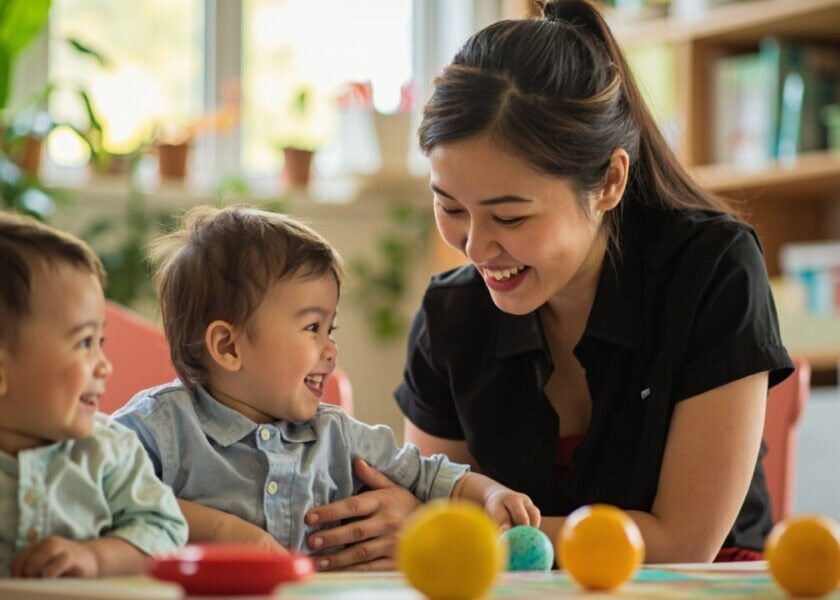
When you see a caregiver with an infant, you might notice warmth. You might notice that the adult speaks gently, that they respond when the baby makes a sound, that there is physical affection—rocking, holding, smiling. These are good signs. But they are baseline signs. They tell you that the environment is not hostile. They do not tell you very much about whether this is genuinely excellent care.
What you want to look for is something more specific: the quality of responsiveness, and the nature of the adult’s role in the interaction.
The Quality of Responsiveness
Responsiveness is not simply reacting to a baby’s cries or requests. It is the degree to which the caregiver is reading the child’s unspoken cues, anticipating needs, and facilitating rather than controlling the interaction.
Consider these examples:
- When a baby reaches for a toy and the caregiver places it slightly within reach rather than handing it directly, that is responsiveness.
- When a toddler begins to show frustration with a puzzle and the adult notices the micro-expressions of that frustration before it escalates into a meltdown, that is responsiveness.
- When a caregiver narrates what a baby is doing—”You are reaching for the red ball, you noticed it was different”—that is responsiveness.
It is a form of professional attunement that communicates to the child that their experience matters and that they are being understood. This is the kind of quality that does not always photograph well, that does not always feature in centre brochures, but that you will feel the moment you witness it in action.
The Adult’s Role: Following or Directing?
Look at the role the adult is taking. Are they directing the activity? Are they narrating every moment, telling children what to do next, controlling the pace? Or are they following the child’s lead while holding a framework of intentionality underneath?
The difference sounds subtle, but a child can feel it. A child in an environment where their curiosity is permitted to lead learns something fundamentally different about learning itself than a child in an environment where their curiosity is guided, however gently, along a predetermined path.
The Space Tells a Story: Evaluating the Physical Environment
Parents often tell us that the physical space is one of the first things they notice and one of the hardest things to evaluate properly. When you walk into a childcare setting, you are going to see an environment that has been arranged for you. The toys are accessible but not chaotic. The children’s work is displayed at eye level. The lighting is pleasant, the temperature is comfortable. This is not dishonest—centres genuinely do want to show you their best selves. But it can make it difficult to assess what the environment is actually like for the children who inhabit it every day.
Here is what you want to look beneath the presentation for.
Is This Space Designed for Children, or for Adults Who Visit?
You can often tell by the scale of things. Are the shelves at a height where a two-year-old can make an independent choice about what to play with? Are the materials arranged in a way that invites exploration, or in a way that makes the room look orderly and impressive to a parent walking through? These are not the same thing, and they are not always compatible.
Look for Evidence of Intentional Use
In a high-quality environment, you will often see that the same activity area has been in use for a period of time—a project that children have been building on, a collection of materials related to a theme that connects to something the children encountered earlier. This kind of continuity signals that the programme has a pedagogical logic underneath it, that days are not simply divided into segments of supervised play but are part of a longer developmental arc.
The Balance Between Structure and Openness
Every good childcare environment needs routines. Children need predictability; it is how they develop trust and security. But within that structure, there should be room for child-directed activity, for the kind of open-ended play that teaches problem-solving, creativity, and social negotiation. If every moment of the day is tightly scheduled, or conversely, if there is no discernible structure at all, neither extreme is serving the children well.
Questions That Reveal Substance: A Framework for Your Visit
Observation is important, but it is not complete without conversation. Here is a short framework for asking better questions during a childcare visit. Not a checklist—those tend to produce anxiety rather than insight—but a handful of questions that tend to reveal the substance of a programme, rather than its surface presentation.
Ask About the Daily Rhythm
Not just what time lunch is or when nap time falls, but how transitions are handled, and whether the schedule is considered flexible or fixed. A programme that can articulate why certain rhythms matter is a programme that has thought about the children in its care.
Ask How Individual Children Are Supported
Ask how individual children are supported when they struggle. Every child will have difficult moments. The question is not whether those moments happen but how the adults respond when they do. You want to hear language that suggests observation, patience, and respect for the child’s emotional experience—not just management strategies.
Ask About Parent Communication
Ask how the programme communicates with parents. Transparency is not optional in quality care. How are families genuinely informed about what their child is experiencing and learning—not just what they ate for lunch or whether they napped?
Ask to Observe a Little Longer
Ask, if you feel comfortable, whether you might observe for a few minutes longer. The difference between a tour and an observation is significant. A tour is a performance. An observation is a glimpse of reality. The best childcare settings are usually comfortable with this distinction, because they have nothing to hide.
As you observe, ask yourself:
- Are children being given opportunities to persist at challenging tasks, or are they being rescued from frustration before they can learn to manage it?
- Are they being spoken to with respect, as capable of understanding, even when they are very young?
- Are their communications being received as meaningful, even before they have language?
- Are they being helped to notice and name their own emotions, to resolve conflicts with peers, to understand the social world they are part of?
These are the signatures of care that goes beyond supervision. And they are visible, if you know how to look for them.
Why This Matters in Singapore—and What We Do About It
Parenting in Singapore carries demands that are specific to this place and this time. The cost of living, the expectations of dual-income households, the pressures of academic culture, the distance from extended family that many families navigate—the reality is that for most Singaporean parents, quality childcare is not a luxury. It is a necessity. And yet the infrastructure to support that necessity has not always kept pace with the need.
This is why options like EduNanny Singapore exist—to offer families genuine flexibility in how and where their children are cared for, with fee structures designed to be accessible and funding options that families can actually use.
We believe that childminding is not merely a service. It is a practice with dignity, with purpose, and with profound implications for the children and families it touches. The caregivers who work within this model are trained professionals who understand child development, who take their responsibility seriously, and who bring intentionality to every interaction.
Consider what this looks like in practice:
- Staffing ratios: Up to one-to-three infant ratios in the programme. This is not simply a staffing convenience. It is a deliberate structural choice that makes deep responsiveness possible. When a caregiver is responsible for fewer children, they can notice more. They can linger with a moment of discovery rather than move on because three other children need attention.
- Professional attunement: Caregivers are trained not just to be warm but to be professionally attuned—reading unspoken cues, facilitating rather than controlling interactions, following the child’s lead while holding intentionality underneath.
- Environment design: Whether working within home-based or centre-based pathways under the ECDA Childminding Pilot, settings are designed with intentionality in mind. Children should feel that this is a place where they can belong, explore, and grow.
- Parent partnership: Parents deserve more than good intentions. They deserve transparency. Communication with families is designed not to reassure but to genuinely inform.
These are not marketing claims. These are choices made deliberately, and that you can examine, question, and verify.
The Invitation
We invite you, not as a sales tactic, but as a genuine act of respect, to look carefully, ask hard questions, and choose with clarity. Do not take any programme’s word for quality. Learn to see it for yourself. And when you do, we are confident that you will recognise the kind of care that goes beyond supervision.
Every day, in childcare settings across Singapore, children are being held, spoken to, played with, comforted, and challenged. They are learning what it feels like to be seen. They are learning what it feels like when an adult takes their curiosity seriously. They are learning, in the most fundamental way possible, whether the world is a place that understands them and is worth understanding in return.
These are not small things. These are the things that matter most. And they happen in the spaces between the grand narratives, in the ordinary moments of a Tuesday morning, in the way a caregiver pauses to notice what a baby is pointing at, in the patience shown to a toddler working out how to share, in the way a child is greeted when they arrive, and the way they are settled when they are tired.
This is the work we are part of. This is why EduNanny Singapore exists. And this is why we are willing to stand in front of you and say: come and look. Ask your questions. Observe. Because your child deserves nothing less. And you deserve nothing less either.
If you are ready to explore what quality childminding looks like—with eyes open, questions welcome, and no pressure—we would be glad to hear from you.
Arrange a visit or conversation with our team today.