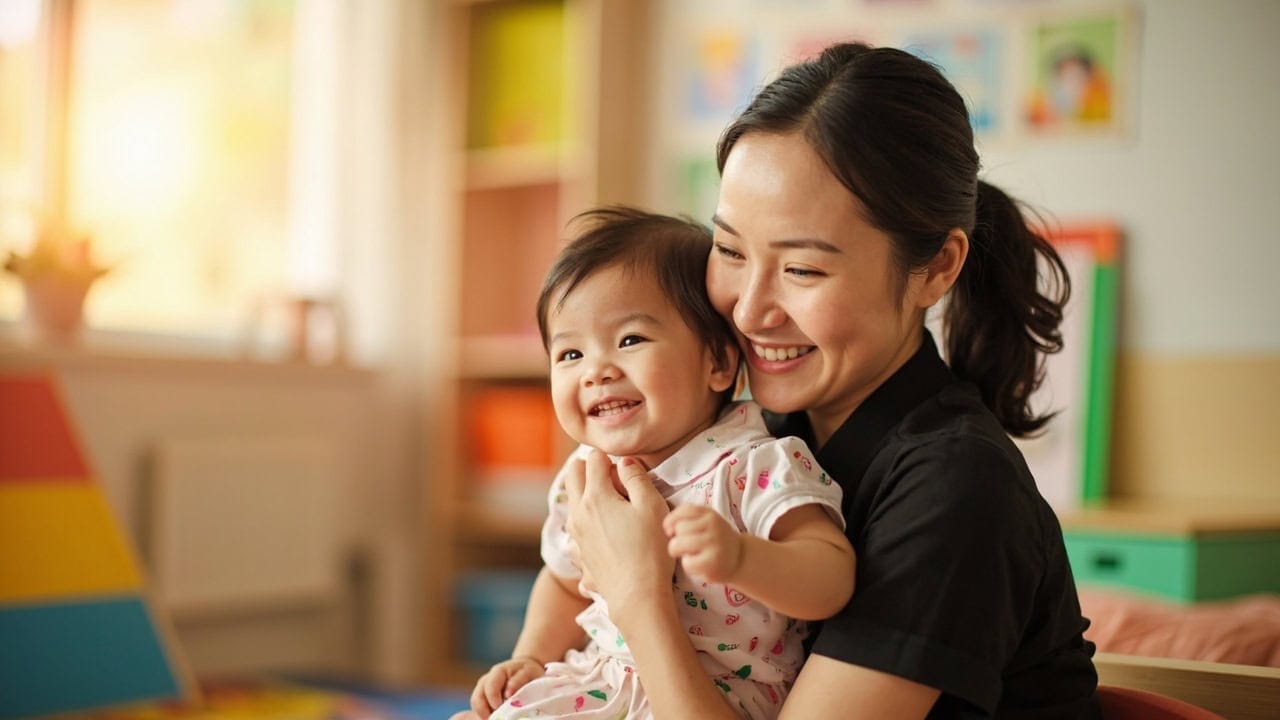
The Feeling Child: Understanding Your Child’s Inner World in Singapore Childcare
The Question Every Parent Carries
There is a moment, every morning, that millions of parents in Singapore know by heart. You hand your child over. You crouch down to their level. You say the words — Mummy will be back, I love you, have a wonderful day — and you mean every single one of them. And then you walk away.
And in that walking away, something tugs at you. Not doubt. Not guilt, not anymore. Something quieter than that. A genuine curiosity about what happens next. A wondering about the world your child steps into the moment you are no longer in the room.
What does it actually feel like, from the inside, to be three years old in childcare?
That is the question we want to sit with today. Not because the logistics are not important — they are, and we will get to the practical shape of things. But because for too long, conversations about childcare in Singapore have been conversations about parents. About the decisions parents make. About the guilt parents carry.
And all of that matters. But there is another conversation that has been almost entirely missing. The one about the child. The one about what your child is actually experiencing, feeling, remembering, and becoming.
We believe that conversation is the most important one of all.
The Inner World of the Child in Childcare
When a young child walks into a childcare environment — whether it is a home setting, a community space, or a centre — they do not walk in as a checklist of developmental milestones. They walk in as a whole, complex, deeply feeling human being.
They walk in with preferences they cannot yet articulate. With curiosities that arrive and disappear in the span of a breath. With moods that shift like Singapore’s afternoon sky — suddenly radiant, suddenly overcast, suddenly bright again, and all of it entirely real.
They arrive carrying the residue of the morning — the cereal they did not finish, the cuddle that was a little too quick, the strange excitement of shoes on the wrong feet. And then the door closes behind them, and a new world begins.
What That World Feels Like
It feels like the quality of light in a room. It feels like whether the person who welcomes them remembers that they like the blue cup, or that they are going through a phase where they need to carry a small stone in their pocket all day.
It feels like whether laughter is allowed to get truly loud, or whether there is a quiet corner where a child can sit with a book and not be interrupted.
It feels like the texture of a morning — whether it rushes past in a blur of activities, or whether there is space for the kind of slow, aimless, deeply purposeful play that a child’s mind actually needs.
We talk a great deal in Singapore about child development. We talk about milestones, about curricula, about preparing our children for a future we can barely imagine. And all of that has its place.
But we rarely talk about something simpler and more foundational: how does this particular child, in this particular setting, feel about being here?
Not safety — we have covered that. Not supervision — parents expect that.
But genuine, textured, moment-to-moment feeling. The feeling of being genuinely glad to be somewhere. The feeling of belonging to a place. The feeling of being known.
That feeling is not a luxury. It is the foundation on which everything else is built.
Emotional Security Is the Foundation
Developmental psychologists have known for a very long time that a child’s emotional environment is not separate from their cognitive development. A child who feels emotionally secure does not just play more freely. They think more freely. They explore more boldly. They take the kinds of intellectual risks that lead to genuine learning because they are not spending their mental energy on managing fear.
Emotional security is not a soft and fuzzy addition to the serious business of growing up. It is the operating system on which all other development runs.
Here is something that is beautifully counterintuitive: the child who feels most secure at childcare is not the child who never misses their parent. It is the child who misses their parent and then, because the environment is warm and attuned, gradually discovers that the world can hold them too. That there are other hands that are gentle. Other voices that are kind. Other people who notice when they are tired and who do not rush them.
This is not a failure of attachment. This is the beginning of its expansion. The secure child learns that love is not a single narrow channel — it is a whole network of genuine connection, and they are at the centre of it, held by more than one pair of arms.
Separation Anxiety: What It Really Signals
We sometimes think of separation anxiety as a problem to solve. But separation anxiety, in its truest form, is a signal that your child has formed a deep and meaningful bond — with you, at home — and that bond is not broken by the experience of childcare. It is the evidence of it.
What matters is how the childcare environment receives that anxiety, honours it, and slowly and patiently helps the child discover that the world has more to offer than just the people they already know.
A quality childcare environment does not pretend that separation is easy or dismiss the child’s feelings. It acknowledges the reality: this is hard, and it is okay to feel what you feel. And then it offers something powerful in return — the experience of being welcomed, being seen, and gradually finding joy in a new place.
The child who cries at drop-off and is met with warmth and patience — not impatience, not dismissal — learns something profound. They learn that big feelings can be held. That the world contains people who will not abandon them even when they are struggling. That they are strong enough to feel afraid and still move forward.
This is emotional resilience. Not the resilience of the child who has been hardened to separation, but the resilience of the child who has been genuinely supported through it.
What Your Child Will Actually Remember
Young children do not remember events the way adults do. They do not create narrative archives of their days. What they remember is feeling. The emotional residue of an experience lingers in them long after the specific details have dissolved.
A child who spent a year in a childcare environment where they felt hurried, unseen, or anxious may not be able to tell you a single story about it. But something in their body remembers. Something in their nervous system carries the trace of those days. And it shapes how they approach new environments, new people, new challenges — often in ways we do not consciously recognise.
Conversely, a child who remembers childcare as a place where they felt noticed — where a caregiver paused long enough to see that they were frustrated, where a small conflict with another child was handled with patience instead of impatience, where the rhythm of the day felt gentle enough to match their own pace — that child carries something with them.
Not a memory in the way we think of memories. But a felt sense of what the world can be. A kind of inner compass that says, I belong here. I am capable. Other people can be trusted to be kind to me.
That is not a small thing to give a child. It is one of the most significant gifts we can offer. And it happens not through any curriculum or program, but through the accumulated quality of hundreds and hundreds of small, ordinary, irreplaceable moments.
What Quality Childcare Looks and Feels Like
So what does a childcare environment need to look and feel like in order to produce that quality? It starts with ratio.
When an infant caregiver is responsible for three children instead of eight, something fundamental changes. There is time — not just to feed and change and soothe, but to notice.
- To see that one child is about to have a meltdown not because they are being difficult, but because they are genuinely overtired and needed a nap twenty minutes ago.
- To notice that another child has been watching the group activity from the edges for several days in a row and might need a quiet invitation to join, not a loud announcement.
- To notice the child who has started humming while they draw, and to ask them what song they are singing.
Noticing is not a technique. It is a consequence of having enough time and enough space to be truly present.
The Difference That Ratio Makes
| High Ratio (Fewer Caregivers) | Low Ratio (More Caregivers) |
|---|---|
| Tasks completed efficiently | Children noticed individually |
| Children managed | Children known |
| Schedules followed | Rhythms observed and respected |
| Incidents responded to | Meltdowns anticipated and prevented |
| Groups engaged | Individuals invited |
The difference is not just quantitative. It is qualitative. A 1-to-3 infant ratio means that each child can be seen as an individual — with their own pace, their own preferences, their own inner world that deserves to be understood.
The Agency of the Child
One of the most powerful elements of a child’s inner experience is the experience of being able to choose. Of having preferences that are respected. Of being asked what they want to play with, rather than being told. Of being allowed to refuse something. Of being treated not as a passive recipient of care, but as a person whose opinions, however small they may seem, actually matter.
In a premium childcare environment, the child’s voice is not just tolerated — it is actively sought. Not in a way that is chaotic or unstructured, but in a way that recognises that children are not just becoming people. They are already people, right now, with full emotional lives and preferences and ideas about how their world should be arranged.
When a child feels that their agency is respected, something extraordinary happens. They become more confident. More curious. More willing to try new things, because they have learned that their own judgment is trusted.
This is not something that can be engineered or programmed. It emerges from the culture of the environment — from the daily, moment-by-moment interactions between caregivers and children, built on a foundation of genuine respect for the child as a full human being.
Reading Your Child’s Signals
You know your child better than anyone. You know the way their face changes when they are about to cry, three minutes before the tears come. You know the song they hum when they are thinking hard about something. You know that they are braver in some contexts than in others, and that the company they keep matters enormously to them.
That knowledge — that deep, intimate, parental knowledge — is not separate from what happens at childcare. It is exactly what childcare should build on.
And so our invitation is this: pay attention not just to what your child does when you pick them up, but to what they seem to be feeling.
- Notice the texture of their mood.
- Notice whether they seem lighter or heavier.
- Notice whether they mention the caregiver’s name with warmth.
- Notice whether they talk about specific moments — a song, a game, a discovery — or whether the day seems to have been an undifferentiated blur.
These are the windows into your child’s inner experience, and they are more revealing than any daily report can be.
Signs That Your Child’s Experience Is Thriving
- They come home tired in the good way — the kind of tiredness that comes from genuine engagement, not overstimulation or stress.
- They mention specific moments, caregivers, or activities from their day.
- They show signs of looking forward to returning — not dread, but curiosity.
- They talk about other children with warmth and recognition.
- They have developed a relationship with at least one caregiver that includes genuine connection.
Signs That Something May Need Attention
- They consistently resist going or show increasing distress that does not gradually resolve.
- They come home depleted rather than tired — withdrawn, irritable, or unusually clingy.
- They never mention anything specific about their day.
- Their sleep or eating patterns change noticeably.
- They show regression in skills they had previously mastered.
If your child comes home from childcare tired in the good way — the way that comes from having been genuinely engaged and challenged and delighted — that is not an accident. That is the signature of a quality experience.
Questions to Ask When Choosing Infant Care
When you visit a potential childcare setting, here are the questions that go beyond the brochure:
- What is the caregiver-to-infant ratio, and why was that number chosen?
- How do caregivers respond when a child is distressed at drop-off?
- Can you describe a typical morning — what does the rhythm feel like?
- How do caregivers get to know each child’s individual preferences and rhythms?
- What does a child’s typical day look like in terms of free play versus structured activities?
- How do you handle conflicts between children?
- How do you communicate with parents about their child’s emotional experience — not just their meals and naps?
- How is the child’s voice and agency incorporated into daily routines?
- What training do caregivers receive in understanding child development and emotional attunement?
- Can I speak with other parents whose children have been in your care?
Trust your instincts too. Visit more than once, if possible. Come at different times of day. Watch how the children move through the space. Watch how caregivers interact with them — not just when they are performing for a visitor, but in the ordinary moments.
EduNanny by BUTLER: Where Your Child Is Seen
This is the philosophy that shapes EduNanny by BUTLER. We are part of the ECDA Childminding Pilot, and that participation reflects our commitment to making quality care accessible and affordable within Singapore’s ecosystem of support — including pathways that allow for the use of CDAs and Baby Bonus provisions.
Our home-based and centre-based options mean that families across Singapore can find an arrangement that genuinely fits their circumstances.
The 1-to-3 infant ratio is not a number we arrived at lightly. It is the ratio that we believe allows a caregiver to truly see each child, to know each child’s rhythms and preferences, and to create the kind of emotionally attuned environment that makes childcare something a child thrives in rather than merely endures.
We know that trust is not something you extend blindly. Parents need to be able to see, to feel connected to, and to have genuine transparency around their child’s day. That is why communication is built into the way we work — so that parents are not left to wonder, but are invited into a shared understanding of what their child’s day is actually like.
This is not about generating reports or updating apps. It is about the kind of relationship where a caregiver can genuinely tell you: your child was humming that song again today, the one they have been obsessed with since last week. Or: I noticed they were a bit wobbly this morning but by lunch they had found their footing again.
These are the details that tell you your child is known, not just supervised.
Going Back to That Morning Moment
So let us go back to that moment, every morning, when you hand your child over. When you crouch down to their level. When you say the words and mean them and walk away.
What you can carry with you, after today, is not certainty that the worry will never come — it will, because you love them.
But something more grounded than that. The knowledge that the question you are asking — what does my child feel? — is the right question. The most important question.
And the fact that you are asking it means that you are exactly the kind of parent your child needs.
We started with a question: what does it actually feel like, from the inside, to be a young child in childcare?
We do not pretend to have a single answer, because every child is different, and every child’s experience is unrepeatable and unique.
But we believe something that sits at the very heart of everything we do. We believe that when a child is in a space where they are genuinely seen — where their feelings are noticed, their curiosity is welcomed, their small personhood is honoured — they do not just survive the day. They grow. They expand. They become a little more themselves.
That is what quality childcare offers. Not a replacement for your love, but an extension of it. Not a place where your child learns to be without you, but a place where your child discovers that the world is full of people who can love them well, and that they are worthy of that love, and that they can give it too.
We believe that every child deserves to have that experience. We believe that the first thousand days — and the thousands of moments within them — are not just a phase to be gotten through. They are the foundation of everything that comes after.
And we believe that how a child feels during those days matters as much as anything we could ever measure or report.
If you are exploring childcare options in Singapore and would like to learn more about how we work with families, we invite you to connect with us to discuss your child’s needs and what a thoughtful, development-oriented approach to care can look like for your family.