Why Singapore Parents Are Building Bigger Villages for Their Children
Quick Summary: Navigating the Generational Care Divide
- The tension is real: Singapore parents often face quiet resistance from grandparents when considering professional childcare, feeling caught between respecting generational wisdom and choosing evidence-based care.
- Grandparent love is irreplaceable: The patience, memory, and continuity grandparents offer cannot be replicated—and should not be dismissed.
- Knowledge has evolved: The science of early childhood development has advanced significantly, revealing that the first thousand days are foundational architecture, not just waiting time.
- You are expanding your village: Professional care complements grandparent involvement in a family ecosystem that serves children better than either could alone.
Understanding Singapore’s Multigenerational Reality
Singapore has one of the highest rates of multigenerational living in the world. By choice and by necessity, by cultural expectation and economic reality, many Singapore families share space, share meals, share the daily rhythms of raising children. This is not merely a logistical arrangement. It is a statement of values.
It says: we believe family matters. We believe our elders have something irreplaceable to offer. We believe that children thrive when they are held by more than one pair of hands.
And all of that is true.
But here is what we must also acknowledge, if we are being honest: the world our children are growing into is not the same world we grew up in, and it is not the same world our parents navigated. The science of early childhood development has advanced enormously in the past thirty years. We understand now, with clarity that was not available to previous generations, that the early years are foundational in ways that were simply not understood before.
Grandparents offer a kind of love that is genuinely irreplaceable. It is patient in a way that is different from parental patience. It is steeped in memory and meaning. It carries the weight of having loved before, and of knowing, now, how fast it goes.
When a grandmother sings a song her own mother sang. When a grandfather tells a story he has told a hundred times. When a child is lifted up by someone who has lifted children before and knows, instinctively, how to make them feel safe—there is a kind of magic that cannot be replicated in any training programme or curriculum.
This does not mean our parents did anything wrong. It means we know more now than they knew then, just as our grandchildren will likely know more than we do. That is not a rejection of generational wisdom. That is the natural course of knowledge and understanding across time.
What Science Now Tells Us About Early Childhood
The neural pathways that form in early childhood, the attachment patterns that become templates for future relationships, the language exposure that influences cognitive development, the sensory experiences that shape motor skills, the emotional attunement that builds a child’s sense of security and self—all of this is happening in a window of time that is both precious and finite.
Developmentally intentional care in the early years matters in ways that were not understood a generation ago. It is happening largely in the contexts of care we choose for our children.
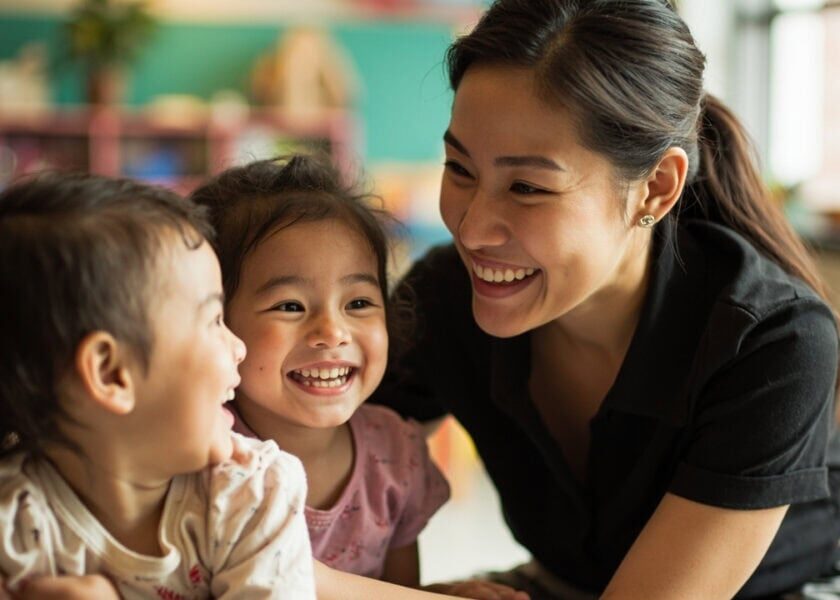
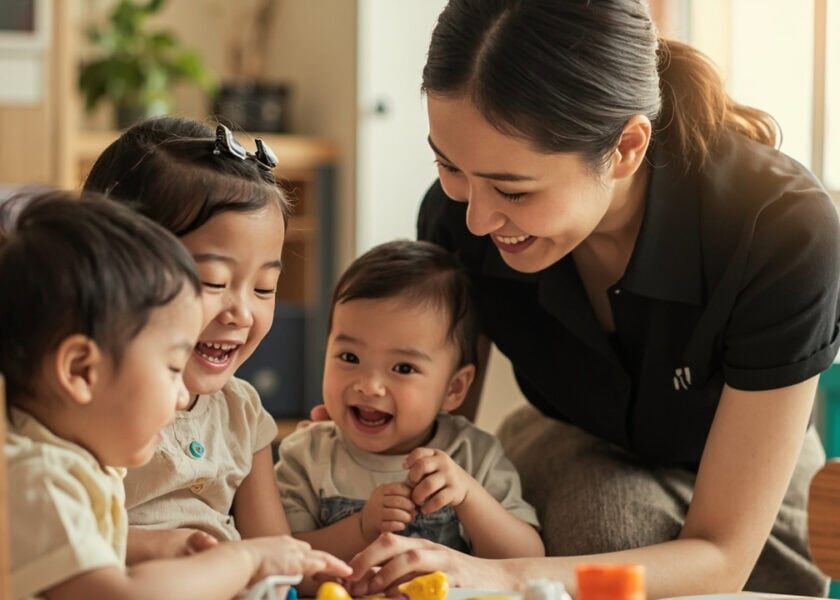
Consider what professional care actually adds when it is done well. A trained infant caregiver understands the stages of early neurological development. They know how to create environments that stimulate language acquisition, that encourage motor exploration, that support the gradual development of emotional regulation. They are trained to observe—to notice when a child’s behaviour signals something worth paying attention to, to document and communicate with parents about developmental milestones. They bring not just warmth but intentionality. Not just supervision but cultivation.
Now consider what grandparents add. They add history. They add a sense of continuity that grounds a child in the story of their family. They add a kind of unhurried presence that is different from the pressures of professional obligation. They add the particular love that comes from having raised children and knowing, now, how quickly it goes.
Neither of these is complete without the other. And no family has to choose between them.
The Reframe That Changes Everything
Here is the reframe that matters: you are not replacing your village. You are expanding it.
When you choose a childcare arrangement that includes trained, professional caregivers, you are not saying that your mother’s way was wrong. You are saying that there is more to offer your child than any one person, or any one generation, can provide alone.
You are building a village that includes:
- The wisdom of experience and the precision of professional training
- Unconditional family love and developmentally informed care
- The irreplaceable presence of grandparents and the intentionality of structured early learning environments
This is not a compromise. This is an expansion. And the difference matters enormously—for how you feel about your choices, and for how your family receives them.
Practical Guidance for Navigating Family Conversations
The fear is real. It is not imagined. You may have been told, explicitly, that you are abandoning your children by working. Your mother may have said, with genuine hurt, that she thought her years of childcare experience would be valued. You may have been made to feel that seeking professional support is an admission of failure, a betrayal of family.
If you have felt these things, you are not alone. Many Singapore parents carry this weight quietly, unsure whether they are making the right choices, wondering if they are somehow failing their families or their children.
These feelings do not mean you are wrong. They mean you care deeply about getting this right. They mean you are taking seriously the responsibility of raising the next generation. And they mean you are doing the difficult work of standing between two worlds and trying to honor both.
Navigating this reality requires something that does not always come naturally, especially in Singapore’s family culture, where respect for elders is not merely a courtesy but a core value. It requires parents to find their voice—while remaining genuinely connected to the people who love them.
Here is what we have observed about families who navigate this well:
Begin with gratitude
Acknowledge what grandparents have already given. Say, out loud, that you are not seeking to replace what they offer but to complement it. Grandparents need to hear that their role matters—and that it will continue to matter.
Share information, not defensively
Invite grandparents into the understanding that has shaped your decisions. Share what you have learned about early childhood development not as a correction but as an offering—here is something new we have come to understand, and here is why it matters to us.
Allow space for feelings
Allow grandparents to feel whatever they feel, including disappointment or concern, without rushing to fix those feelings or defend against them. Validation is not agreement. You can honor their feelings while still making the choices you believe are right.
Hold your choices with quiet confidence
This confidence is rooted not in arrogance but in deep care—in the knowledge that you are making decisions for your child’s future with the best information and the most love you have available. You do not need to defend your choices aggressively. You need to trust them steadily.
Expand rather than divide
Approach these conversations not as a confrontation but as a continuation of family dialogue. The question is not “who is right” but “how can we all be part of raising this child together?”
This is not easy. It requires emotional maturity and relational skill. It requires you to be clear about your own values while remaining genuinely curious about the values of the generation above you. It requires humility on all sides, and it requires time.
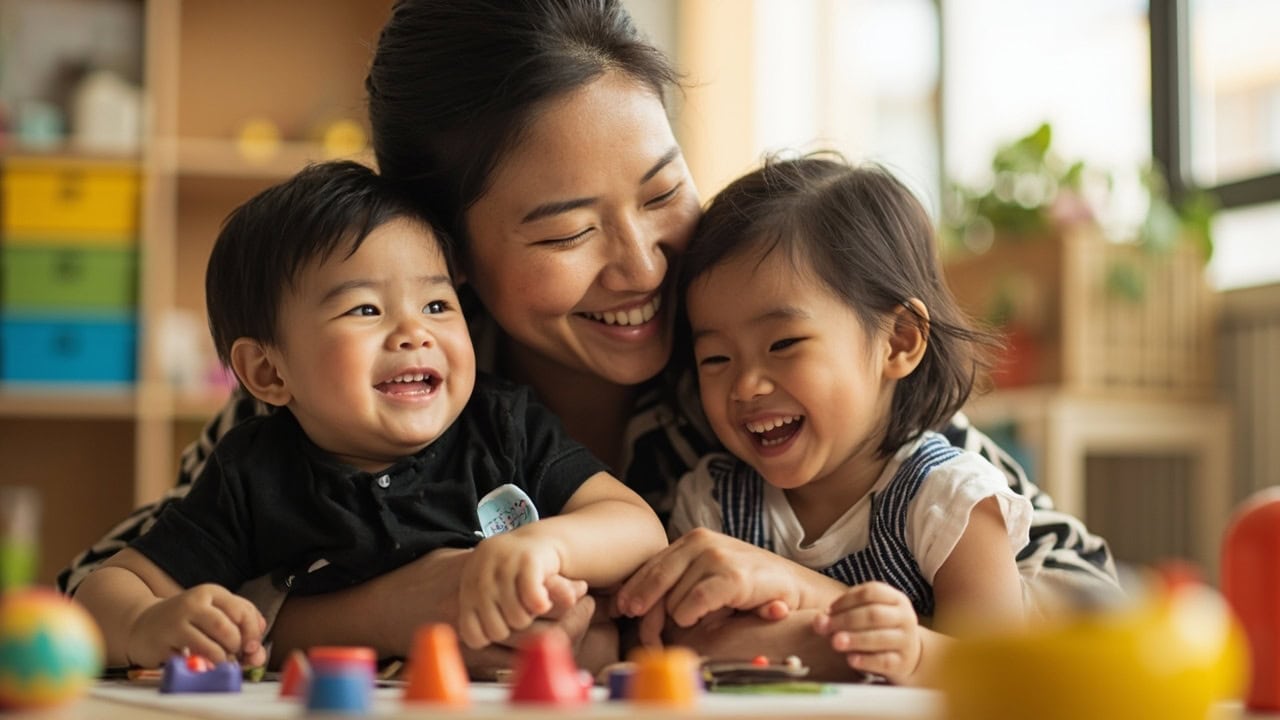
But here is what is possible when this is done well: a child who grows up knowing that their family is not divided but expanded. A child who hears grandmother’s stories and also plays with trained caregivers who understand their developmental needs. A child who knows that love comes in many forms, and that the village that raises them is bigger and richer than any one generation could build alone.
EduNanny: An Extension of Your Village
This is what EduNanny Singapore was built to offer. Not a replacement for family, but an extension of the family’s care. Not a cold institutional alternative, but a warm, professional complement to the love that already exists within the family system.
EduNanny is part of the ECDA Childminding Pilot, a government-supported initiative that reflects Singapore’s recognition that families need options, that the landscape of childcare is evolving, and that professional home-based care has an essential role to play in supporting parents who want both family involvement and evidence-based developmental support.
When you engage with EduNanny, you are not simply hiring someone to watch your child. You are inviting a trained, vetted professional into your family’s village. You are accessing caregivers who are trained in infant development, who understand the importance of the early years, who are equipped to communicate transparently with you about your child’s progress, your child’s cues, your child’s rhythms.
In home-based arrangements under this pilot, caregiver ratios are kept intentionally small—with up to one to three infants per caregiver, ensuring that every child receives the attention and attunement that early development requires. The fee structures are designed to be accessible, and for families using the Child Development Account or Baby Bonus, those resources are usable, making quality professional care a realistic option rather than an aspirational luxury.
Communication is a cornerstone of what EduNanny offers. Parents deserve to know what is happening with their children during the hours of care. Where systems are in place, transparency measures including CCTV access allow parents to stay connected to their child’s day—not out of distrust but out of genuine desire to be present in their child’s life, even when physical presence is not possible.
For questions that arise outside of care hours, EduNanny’s Thomas AI Chatbot offers a resource that is available, responsive, and grounded in evidence-based understanding. This is not artificial intelligence replacing human judgment. It is a tool that supports parents in making informed decisions, in accessing reliable information, in feeling less alone in the complexity of raising young children.
The care blocks are structured around Monday through Friday, designed to support working parents and families who need reliable, consistent professional support. And the reach is Singapore-wide, because the need for thoughtful, developmentally informed childcare is not limited to any particular neighbourhood or district.
Your Next Step
Every family in this country deserves access to care that respects both their cultural context and their children’s developmental needs. This is not just about individual families making individual choices. This is about the kind of village we are building together for the next generation.
This is not an argument that professional childcare is superior to family care. It is not an argument that grandparents should step aside, or that traditional ways are obsolete, or that the modern answer is always the better answer.
It is about a simple, profound truth: children are raised best by villages. And villages evolve. They do not stay static across generations. They incorporate new knowledge, new resources, new forms of support. They adapt to changing economic realities, changing family structures, changing scientific understanding of what children need.
That adaptation is not a betrayal of tradition. It is tradition continuing to serve its purpose, which has always been the well-being of the next generation.
The grandparents who raised us adapted too. They made choices that their own parents may not have fully understood. They embraced changes in education, in nutrition, in medical practice, in the rhythms of family life. They did what every generation does: they looked at what came before, they honored what was valuable, and they made choices that they believed would serve their children better than what they had known.
You are doing the same thing now. And it is not always easy to see yourself clearly in that light when you are in the middle of it—when you are the one being questioned, when you are the one who must defend a choice that feels both obvious to you and incomprehensible to those you love.
But that is exactly what you are doing. You are honoring the tradition of your family’s care by evolving it. You are accepting the responsibility of your generation’s knowledge and using it to shape something new, something that draws on the past and serves the future.
You are not failing if this feels hard. You are not failing if you do not have all the answers. You are not failing if you sometimes wonder if you are doing the right thing.
You are doing the most important work there is. You are building the future, one child at a time, one family at a time, one conversation at a time.
EduNanny exists to walk alongside you in that work. Not to tell you what to choose, not to judge the choices you have made, not to position itself as the authority voice in your family’s decisions. But to offer a resource that is thoughtful, that is grounded in evidence, that is delivered with warmth and professionalism, and that sees itself, genuinely, as part of your village—not the whole of it.
When you choose EduNanny, you are not choosing between your family and professional care. You are choosing to expand your family’s capacity to love and nurture your child. You are choosing to access knowledge that did not exist a generation ago. You are choosing to build a support system that acknowledges the complexity of modern parenthood and meets that complexity with practical, compassionate solutions.
And you are choosing to raise your child in a village that is bigger than any one person, any one perspective, any one generation’s understanding of what children need.
If you are considering your childcare options and want to explore how professional support can complement rather than replace the care your child already receives from family, we invite you to connect with us.
Every family deserves a village that grows with them. We would be honored to be part of yours.
You are part of that growth. Every conversation you have with your parents about why you made the choices you made. Every time you explain, with patience and clarity, what you have learned and why it matters. Every time you invite your family into the understanding that has shaped your parenting rather than shutting them out of it.
You are expanding the village. You are doing the hard, necessary work of carrying a tradition forward while honoring its origins.
And you are not alone. That is what this village is for.