What Quality Childcare Looks Like in Singapore
What Quality Childcare Looks Like: A Quick Reference
If you are pressed for time, here are the key indicators of quality care you can observe:
- Arrival and departure transitions that are unhurried, warm, and personalized
- Caregivers who kneel or sit at your child’s level when greeting them
- Intentional environments where materials are accessible, age-appropriate, and change based on children’s developmental readiness
- Responsive caregiver interaction—watching, listening, narrating the world back to children
- Social-emotional guidance through facilitated conflict resolution rather than imposed rules
- Wind-down routines at naptime with individual attention, especially for infants
- Specific updates at pickup that reveal your child’s unique experiences and moments of growth
- Communication that invites partnership rather than simply reporting
These are not aspirational ideals. They are observable moments, visible to any parent who knows how to look. This article will give you that language.
The Morning Threshold: Where Every Day Begins
Let us begin where every day begins: at the threshold.
When a child arrives at a quality childcare setting in the morning, something very specific is supposed to happen. It is not the greeting you might imagine—the quick “Hello, bye, have a good day” that describes so many drop-offs. It is something more deliberate.
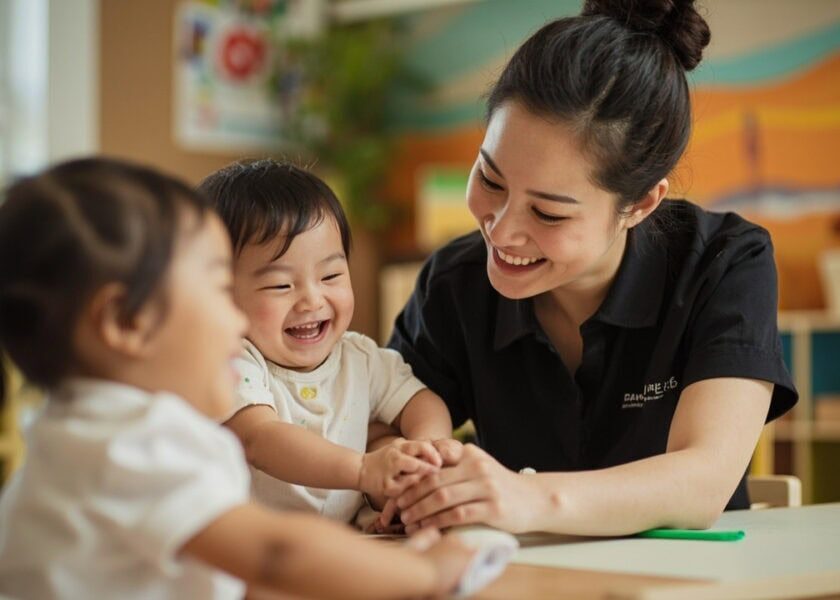
A caregiver kneels down, or sits at the child’s level, and makes eye contact. Not just with the child, but with the parent too. There is a brief exchange. The caregiver receives the child not as a task but as a person, and they receive the parent not as a customer to be processed but as the expert on this particular child.
What does this matter? It matters because children are extraordinarily sensitive to the quality of transitions. The moment of parting is not a logistical necessity to be hurried through. It is a psychological moment that, if handled well, gives the child permission to engage with the world ahead rather than spending the morning grieving what was left behind.
A child who is greeted warmly and genuinely is a child who is ready to play.
What You Can Observe at Drop-Off
Consider what you might observe in this moment if you were watching closely. You would see whether the caregiver seems rushed. You would notice whether they look at your child’s face or only at the attendance sheet. You would sense whether your child moves toward them willingly or hesitates.
And crucially, you would notice whether the caregiver notices your child’s hesitation and has a response for it—something small, perhaps a favorite toy already placed on the table, or a game they know this particular child enjoys, or simply a voice that has learned to say “I see you” in a way that this child can hear.
This is the first vocabulary of quality: attention at transitions. It is not dramatic. It does not make for impressive marketing photographs. But it is where the day begins, and if it is done poorly, the entire day is built on an unsteady foundation.
The Hours Between: What Quality Looks Like in Motion
By midmorning, something else begins. If you could look through the walls of a setting where intentional care is happening, you would see what might initially look like play. Children on the floor. Materials scattered. A caregiver moving between them.
It would not look like school. It would not look like the structured learning environments you might remember from your own childhood. This is precisely the point.
In the first years of life—the period from birth to approximately age three that researchers now understand as uniquely formative—children are building the foundations of everything they will become. Connections are forming at an extraordinary rate. But these connections are not random. They are shaped by experience, by what the child encounters, explores, and returns to. They are shaped by the quality of response the child receives when they reach out, when they ask a question with their eyes, when they drop something just to see what happens.
The Intentional Environment
In quality childcare, every moment is an opportunity for this shaping. The caregiver has not simply opened the door and let the children do as they please. They have prepared the environment with intention.
The toys on the shelf are at the right height. The materials available change according to what the children are ready for. The daily rhythm—the sequence of activity, rest, feeding, outdoor time—is designed not to constrain but to create a sense of safety through predictability.
When a child knows that after snack comes outdoor time and after outdoor time comes story, they are free to engage deeply with each thing rather than spending their energy wondering what comes next.
The Responsive Caregiver
And the caregiver is not just present but responsive. They watch. They listen. They notice when a child who has been working on stacking blocks finally succeeds and needs to see that someone noticed.
They notice when a child is becoming frustrated and intervene not by taking over but by offering just enough support to keep the learning alive. They notice when a child is hovering near a group of peers, wanting to join but not knowing how, and they offer a bridge—a suggestion, a role, a gentle entry point that preserves the child’s dignity.
This is what developmental care looks like in practice. It is not a curriculum that sits on a shelf. It is a living, moment-to-moment responsiveness that says, in a thousand small ways, I see who you are becoming and I am helping you become it.
The Language of Growth: How Words Build Thought
Let us talk about language, because language is where so much of this invisible work becomes visible to a watching parent.
In the first years of life, children are absorbing language at a rate that will never be matched. Not just the words themselves, but the rhythms, the tones, the way sounds connect to meaning. In a quality childcare setting, this absorption is happening all the time, but it is also being supported intentionally.
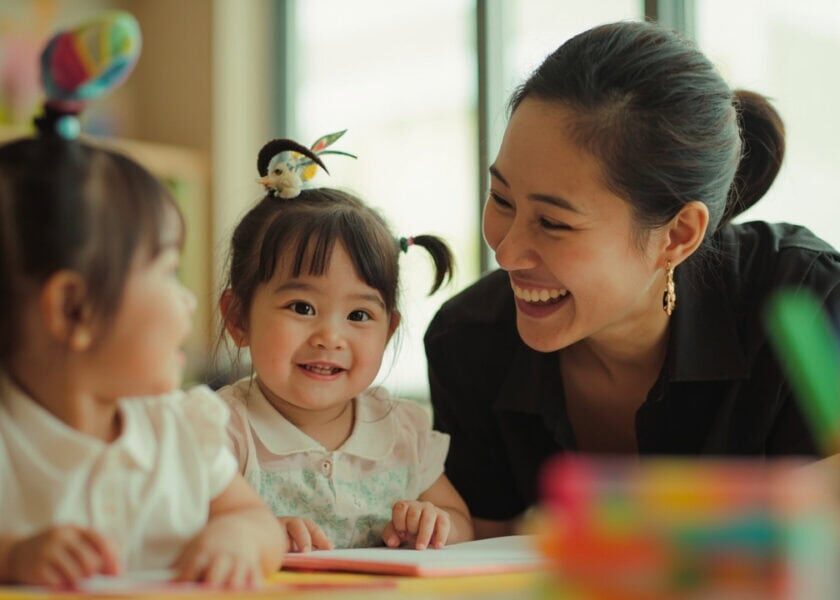
A trained caregiver narrates the world to the children around them. Not in a lecturing way, not in a way that interrupts play, but in a natural, conversational style that might sound something like this: “You’re holding the red ball. You’re putting it in the blue bucket. Now the bucket is heavy. Shall we try the green ball?”
This is not idle chatter. This is the scaffolding of thought. When a caregiver speaks to a child in complete sentences, at the child’s level, about what the child is experiencing, they are giving the child the raw material of thought, connecting words to objects and actions and feelings in real time.
Signs of Language Development to Watch For
You might notice this language development in your child over weeks and months. New words appearing in unexpected places. Your child pointing to a bird and naming it—not because they were taught the word in a lesson, but because someone named birds with them while they were watching birds.
Your child beginning to string sentences together in ways that surprise you. Your child asking questions that have genuine curiosity behind them, not just the repetition of what they have heard.
These are not miracles. They are the predictable result of hundreds of hours in an environment where language is present, responsive, and connected to experience.
Social-Emotional Foundations: Learning to Be With Others
We should also speak about something that is harder to observe but perhaps more important than any single skill: social-emotional growth.
In the first years of life, children are learning how to be people in relation to other people. They are learning that other children have feelings. They are learning that their actions have effects on others. They are learning what it feels like to share, to wait, to be disappointed, to recover from disappointment, to reach for a toy and have it given to them, to reach for a toy and have to wait, to reach for a toy and have someone else reach for it at the same moment.
These are not small things. These are the foundations of everything that comes later: empathy, resilience, the ability to negotiate, the ability to belong.
How Quality Caregivers Guide Social Development
In a quality childcare setting, the caregiver is not just managing a group of children but shaping a small community. They are teaching social skills not through lectures but through facilitation.
When a conflict arises—and conflicts will arise—the caregiver does not simply resolve it. They guide the children through the resolution, asking questions, reflecting feelings, offering language for what is happening. “I see that you both wanted the truck. How can we solve this?”
This is emotional education in its earliest and most potent form.
Evidence of Social-Emotional Growth at Home
And you can see evidence of it, if you know what to look for. A child who has been in quality care for several months begins to show a different quality of social awareness. They notice when another child is upset. They offer comfort. They negotiate with language rather than impulse.
These are not behaviors that can be taught directly. They are absorbed through experience, and a good childcare setting provides the experiences and the guidance to make those absorptions count.
The Rest and the Return: Naptime and Pickup
There are two moments in every childcare day that tell you more about quality than almost anything else: the transition to rest, and the transition back home.
Why Naptime Matters
For infants and toddlers, sleep is not separate from development—it is development. The brain consolidates learning during sleep. The body restores itself. But for naptime to serve these functions, it must be handled with care.
In a quality setting, naptime is approached with the same intentionality as every other part of the day. The room is prepared: lights dimmed, white noise or soft music available, the temperature comfortable. The children are not simply told to lie down and sleep. They are given a wind-down routine—perhaps a story, perhaps a song, perhaps a gentle massage—that signals to their bodies that it is time to rest.
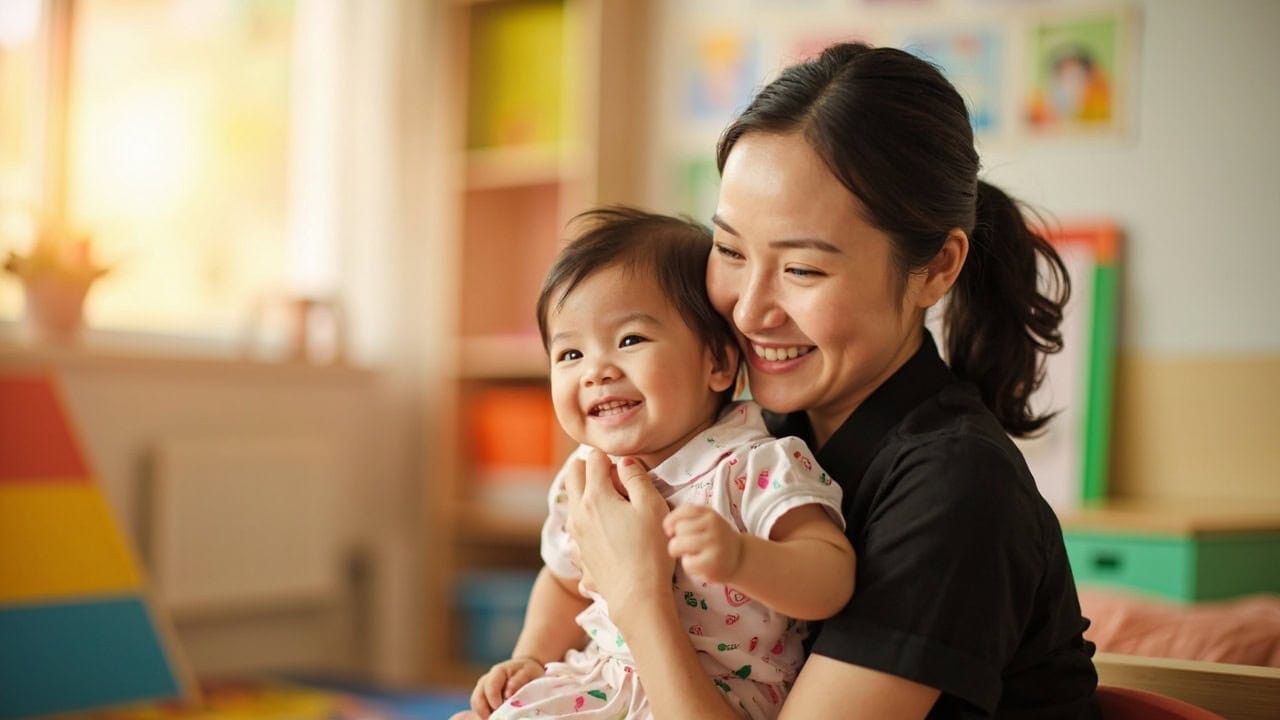
For infants, there is holding, rocking, the kind of individual attention that would be impossible in a setting with too many children and too few caregivers. This is where ratios matter. When it comes to infants, the numbers are not just logistics but ethics. Quality infant care maintains ratios that allow for genuine individual attention.
A child who has slept well, in a calm environment with individual attention, wakes differently than a child who has been managed through a nap. You might notice a clarity in their eyes, a readiness to re-engage, a contentment that speaks of a body and mind that have been restored.
Reading the Evidence at Pickup
And then there is pickup. Here is where the invisible hours become visible again.
The caregiver speaks with you—not just a perfunctory “she ate well” but a genuine exchange. They tell you something specific. Perhaps a breakthrough that happened during the day, a moment when your child did something new. Perhaps a challenge that arose and how they responded to it. Perhaps nothing dramatic, but something observational: “She really loved the sand today” or “He kept asking for the book about the moon” or “She didn’t want to leave the window where we were watching the rain.”
These details are not small talk. They are evidence. They are proof that someone was watching your child closely enough to notice these things. And they give you something precious: a window into your child’s inner life during the hours you were apart.
There is also what you can observe directly in your child. A child who has had a high-quality day in care comes home with something. Not exhaustion—though they may be tired—but a kind of aliveness. They want to tell you things. They want to show you things. They have absorbed the day and they want to process it with you.
They may be clingy for a few minutes as they transition back into the family rhythm, and this is normal. But they are also full of something. They have things to show you. They have language that surprises you. They have behaviors that suggest they have been practicing something.
This is the evidence you are looking for. It is not a daily report card. It is your child, coming home, showing you who they have become in your absence.
Trust as Architecture: Building the Partnership
We have spoken about what happens inside quality care, and we have spoken about how to read the evidence. But we have not yet spoken about what makes it possible, and that is trust.
Trust is not a warm feeling. Trust is a structure. It is the architecture that allows quality to exist. Without trust, parents are too anxious to let go, and children sense that anxiety, and the entire system becomes tense and performative.
With trust, everyone can breathe. Parents can go to work knowing that their child is in good hands. Caregivers can focus on the children rather than managing parental anxiety. And children can feel secure enough to explore, to grow, to flourish.
Transparency as Practice
This is why transparency matters in childcare. In quality settings, communication is not a courtesy—it is a practice. Parents deserve to know what is happening with their children, and open communication builds the trust that makes quality care possible.
Some settings offer measures that allow parents who wish to have that extra layer of reassurance to access it. These are not surveillance tools—they are trust tools. They exist because what the setting is doing is worth seeing.
The Parent-Caregiver Partnership
The caregiver-child relationship is sacred, and the relationship between parent and caregiver must be a true partnership. You are not handing your child to a stranger. You are entering into a collaboration with trained professionals who have devoted their working lives to understanding how children grow.
They have knowledge you may not have, and you have knowledge they cannot have—the deep, intimate knowledge of your particular child that no amount of training replaces. When these two kinds of knowledge come together, the child benefits.
The best care is never one-directional. It is a conversation that includes everyone who loves this child.
Choosing Quality: What to Look For in Singapore
If you are evaluating childcare options, here are the questions that matter most:
- How does my child feel when they arrive? Watch the first few moments. Does your child move toward the caregiver willingly? Hesitation is normal at first, but persistent distress is not.
- What do I hear during my visit? In quality settings, you should hear caregiver voices—narrating, responding, engaging. Silence from adults is often a sign of understaffing or disengagement.
- What do the caregiver updates sound like? Generic reports (“she had a good day”) suggest minimal observation. Specific, individualized observations suggest real attention.
- How does my child behave when they come home? A child who is clingy for a moment is normal. A child who is withdrawn, consistently exhausted, or displaying regression may not be in a quality environment.
- What do I sense about the ratios? Can caregivers realistically give individual attention? Are there enough hands for the number of children, especially during transitions like meals and naptime?
- Is there an environment designed for infants? Infants need different care than toddlers. The space, the ratios, and the activities should be designed for their specific developmental stage.
Quality childcare should also be accessible. Look for settings that participate in government support schemes where families can access available subsidies and grants. Every child deserves environments that support their development.
The Question That Opened This Article
Let us return, one final time, to the question that opened this article.
What is happening to my child in the hours that I am not there?
You now have a different answer to that question. You have language for what quality looks like when you are not watching.
You know that it begins at the threshold, in the quality of the greeting and the goodbye. You know that it lives in the environment, in the intentional arrangement of materials that invite exploration. You know that it happens in language, in the steady, responsive narration of the world that builds thought. You know that it grows in social interaction, in the guided navigation of conflict and connection that builds emotional intelligence. You know that it rests in sleep, in the calm preparation of a child’s body and mind for restoration. And you know that it emerges at pickup, in the details that caregivers share and in the aliveness your child brings home.
You have always been able to read your child. You have always been tuned to the frequencies of their growth. What this article offers is not a new skill but permission—an invitation to trust what you are already noticing, to name what you have always sensed, and to recognize that the evidence of quality is not hidden.
It is all around you, in the small moments, if you know how to look.
Your child is not just being kept safe in your absence. Your child is being seen, supported, and shaped by people who believe that every hour matters, because every hour is building the person they will become.
That is not a small thing. That is everything.
And you, in your readiness to ask the question, in your willingness to look closely and read carefully, are part of it. The partnership between parent and childcare provider is not a compromise. It is a collaboration. And in that collaboration, your child is not just flourishing despite your absence—they are flourishing in part because of it, because you chose a place where absence is not emptiness but a different kind of presence, one that works alongside the presence you offer at home.
This is what quality childcare looks like when no one is watching. And now, when you watch, you know what you are seeing.
If you are exploring childcare options in Singapore and would like to learn more about our approach to developmental, relationship-based care, we invite you to discover more about our childminding programme or connect with us to discuss your family’s needs.