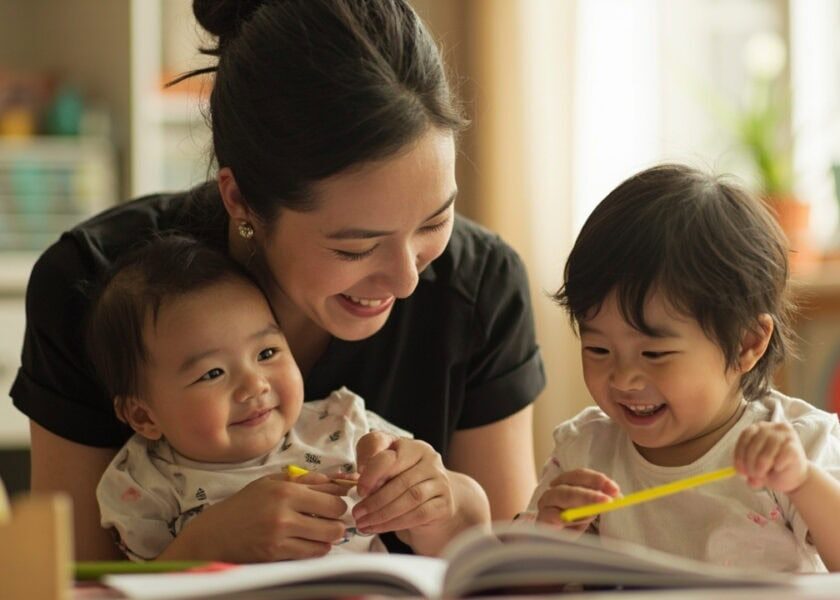
Beyond Babysitting: Building Your Child’s Development Team
The Moment Everything Changes
There is a moment — quiet, unexpected — that changes how a parent understands their child’s care. It does not arrive with fanfare. It arrives in the middle of an ordinary morning, when your caregiver tells you something about your child that you had seen but had not yet named.
Perhaps it is the way your daughter reaches for a particular book before she is ready to ask for it. Perhaps it is the observation that your son is most settled when the room has a specific rhythm of sound and movement. Something you knew in your bones, something you had felt without being able to articulate, suddenly reflected back to you with clarity by the person who spends her days with your child while you are not there.
And in that moment, something shifts.
You realize that the person caring for your child has not simply been keeping her safe. She has been paying attention. She has been learning her. And in learning her, she has become — without either of you planning it — a mirror for your own understanding of who this small person is becoming.
That moment is not a perk. It is not a feature of a good childcare arrangement. It is the first signal of something far more significant: an alliance. A quiet, consistent, deeply functional partnership between parent and caregiver that, when it works as it should, becomes one of the most powerful developmental multipliers a child can have.
This is what we want to explore with you today — not as a service transaction, not as a checklist of features, but as one of the most meaningful relationships you will build in your child’s early years.
The Question Every Parent Carries
There is no shortage of advice available to Singapore parents. The parenting landscape here is extraordinary in its richness — forums, groups, articles, expert commentary, government resources, well-meaning relatives with strong opinions. But somewhere beneath all of that information, there is a question that does not get answered easily.
Not because parents are uninformed, but because the question is not really about information. It is about trust.
The Question at 3 a.m.
The question is this: Will my child be alright when I am not there?
Not alright in the basic sense. Every parent knows their child will be fed, changed, supervised, kept safe. That is the baseline expectation. The question that lives deeper — the one that surfaces at 3 a.m. when the house is quiet and the day’s goodbyes replay in your mind — is something else entirely.
It is: Will she feel seen? Will he feel loved? Will the person caring for her understand her the way I do, or at least in a way that honors who she is?
And deeper still, a question many parents feel guilty even thinking: Am I still the most important person in her story?
These are not irrational fears. They are the fears of deeply engaged parents. They are the fears of people who understand — perhaps instinctively, even before the research confirms it — that the early years matter enormously. That a child’s brain is building at a rate it will never match again. That emotional security, language exposure, the quality of responsive interaction: these are not luxuries of early childhood. They are its architecture.
The Weight of the Decision
So the parent stands at the threshold of a childcare decision, and the weight they carry is not really about logistics. It is about whether they are about to step into a compromise — trading quality time with their child for financial necessity, professional ambition, or simply the reality of modern Singapore family life.
The deepest fear is not that childcare will be inadequate. The deepest fear is that it will be adequate, and that will have to be enough.
We believe there is a better way to think about this. Not as a compromise. Not as a reluctant handing-off of responsibility. But as the deliberate formation of a team.
Two Models of Childcare
The distinction matters more than it might first appear.
The Transactional Arrangement
A transactional childcare arrangement is one in which two parties exchange services for payment. The parent expects competence, punctuality, safety records, a clean environment, a warm caregiver. The caregiver expects clarity of instructions, timely fee payments, respectful communication.
Both are reasonable expectations. Neither is wrong.
But when childcare remains at this level — however well-executed — something essential is left on the table. Something the child, the parent, and the caregiver all deserve.
The Developmental Alliance
A developmental alliance is different. In an alliance, both parties recognize that they are engaged in the same work: the holistic nurturing of a specific, irreplaceable child.
The parent brings irreplaceable knowledge — the child’s history, temperament, preferences, the texture of their family life, the language spoken at home, the rituals that comfort them.
The caregiver brings her own knowledge — professional training, observational skill, the ability to notice patterns across many children, the daily documentation of progress and behavior in a context removed from the home environment.
Neither of these knowledge sets is complete without the other. Together, they form something far richer than either could produce alone.
This is not idealism. This is how child development actually works.
What This Means for Your Child
When a child moves between two environments — home and care — that are characterized by different adults who nonetheless share a coherent understanding of the child’s needs, the child does not experience fragmentation. They experience expansion.
They learn that their world is reliable in its consistency. They learn that the people who love them talk to each other, pay attention together, and adjust their care in response to what they observe. They are, in the most literal sense, building their sense of security on a foundation that is broader than any single relationship.
Security is the word we keep returning to, because it is the word that matters most. A child who is secure does not merely tolerate separation. A secure child explores. A secure child takes intellectual and social risks. A secure child builds the confidence to engage with the world precisely because they trust — at a level deeper than language — that the adults in their life are aligned in their care for them.
What a True Alliance Looks Like
So what does this look like in practice? How does a family move from a functional arrangement to a genuine alliance?
The Conversations That Matter
It begins with communication, but not the kind that lives in formal reports or daily sheets alone — though those have their place. It begins with the quality of conversation that happens between parent and caregiver when they both show up with the same question:
What did you observe today? What is she working on right now? What does she need more of, and what does she need less of?
In a quality childminding arrangement, these conversations are supported by structure. Caregivers are trained not only in the practical dimensions of infant and child care — the feeding, the soothing, the developmental milestones — but in the discipline of observation. They notice. They document. They bring that documentation into their communication with families.
The Exchange That Transforms
Parents, in turn, are invited — and we use that word deliberately — to share what they observe at home.
Consider this scenario: A caregiver learns that a particular stuffed rabbit is not merely a toy but a transitional object that helps your child manage separations. With that knowledge, she can ease goodbyes with intentionality rather than routine.
Or this: A parent learns from the caregiver that their child has been reaching for small objects with new precision. During evenings and weekends, they reinforce that developmental milestone with informed, purposeful engagement.
This is the exchange that transforms childcare from a service into a partnership. It requires time. It requires mutual respect. It requires a caregiver who sees her role as more than a job, and a parent who is willing to extend trust before it has been fully earned, while remaining appropriately discerning.
The alliance is not automatic. But it is achievable, and it is worth the investment.
The Trust Signals
There are practical rhythms that signal a genuine alliance is forming. You will recognize them when they appear:
- The caregiver who greets you not just with a report of meals and naps but with an observation about your child’s curiosity: She was fascinated by the way the leaves moved in the garden today; we talked about wind — this is the language of a partner.
- The caregiver who asks about a new routine you are trying at home and adjusts her approach accordingly — this is a collaborator.
- The caregiver who tells you something about your child you had not fully seen — and does so with the same tenderness you would bring to that observation — has crossed the threshold from service provider to ally.
Parents, too, signal the presence of an alliance. The parent who arrives early to observe a moment, who asks specific questions, who shares not just what happened at home but what is happening in their own emotional landscape — this parent is building the relationship that will sustain and strengthen the care their child receives.
These are the trust signals. Not a single grand gesture, but an accumulation of small, consistent acts of mutual attention. The alliance is built not in a single conversation, but across dozens of them, over weeks and months, in the everyday texture of a shared commitment to one child’s wellbeing.
Why This Matters in Singapore
Let us speak honestly for a moment about the realities that Singapore parents face, because any discussion of childcare would be incomplete if it pretended those realities were simple.
Singapore parents are navigating a particular combination of pressures that is, in many ways, unique:
- The cost of living is real, and childcare represents a significant household investment.
- The expectations of professional life are demanding, with long commutes and competitive work environments.
- The family structures that once provided informal village support — extended family nearby, community childcare networks, generations of shared childrearing knowledge within easy reach — have, for many families, thinned considerably.
A parent here might be managing a career, a commute, the demands of an extended family, and the quiet, persistent awareness that they are raising their child in a society that is fast, ambitious, and not always patient with the slower rhythms that young children require.
Childcare as a Source of Strength
Into this landscape, childcare is not a luxury. It is a structural necessity for many families. And yet — this is the crux of what quality childminding should address — it does not have to be experienced as a loss.
The childcare arrangement itself can be a source of strength. The caregiver can become a resource not just for the child, but for the parent. A reliable voice. A knowledgeable guide. A partner who notices things the parent is too close to see, and who can offer perspective without judgment.
Transparency and Presence
Transparency is a cornerstone of trust. Families should not have to guess what is happening during care hours. Where transparency measures are in place, they offer parents a window — not into surveillance, but into presence. The knowledge that you can look in, that there is nothing to hide, that the care your child receives is visible and accountable — this is not a gimmick. It is a reflection of a deeper conviction that the parent-caregiver alliance works best when it is built on honest, open communication.
And yet the alliance transcends technology. It lives in the handwritten note on the daily sheet. In the photograph of your child reaching for a mango slice, eyes wide with discovery. In the conversation at pick-up when your caregiver says, She said her first word today. It sounded like “more.” She was reaching for the blocks.
And you realize, with a shock of joy, that you were both there for it. That you shared that moment, even if you were not in the same room.
This is what the alliance gives you. Not just peace of mind. Participation. Continued presence in your child’s daily story, even when you are physically apart.
The Structural Foundation
Childminding arrangements operating under the ECDA Childminding Pilot are designed with this philosophy at their core. The pilot framework — whether through home-based or community and centre-based pathways — creates structures that support the kind of care ratios that allow real attention.
When care operates at ratios that enable genuine one-to-one interaction, caregivers have the capacity to observe, to respond, to know each child as an individual rather than managing a group. This is not a minor detail. This is the structural foundation that makes the alliance possible.
The affordability of pilot fee structures, combined with the usability of CDA and Baby Bonus schemes, means that families across Singapore can access this quality of care without it becoming a source of financial strain. This matters enormously. An alliance cannot flourish if the family is consumed by anxiety about its cost.
Building the Alliance: A Practical Guide
If you are researching infant care in Singapore and want to move toward a genuine alliance rather than a mere transaction, here is practical guidance:
Before You Choose
- Ask about communication rhythms. How will you receive updates about your child’s day? What is the expected cadence of information exchange?
- Observe the caregiver’s language. Does she speak about children as individuals with specific temperaments and needs, or in generalities?
- Notice whether you are invited to share. Does the arrangement invite you to contribute what you know about your child, or is it structured as one-way reporting?
- Ask about the caregiver-to-child ratio. This is not just a regulatory detail — it is a predictor of whether your child will receive genuine individual attention.
After You Begin
- Share proactively. Tell the caregiver about changes at home, new routines, your child’s current fascinations or fears. This information is the raw material of the alliance.
- Ask specific questions. Instead of “How was her day?” try “What was she most interested in today?” or “Did you notice anything new in how she played?”
- Receive observations with openness. When the caregiver shares something about your child, resist the urge to immediately explain or qualify. Let it land. You may learn something.
- Extend trust gradually. The alliance develops over time. Initial reserve is natural. Allow the relationship to deepen as trust is built on both sides.
Signs the Alliance Is Forming
Here are concrete indicators that your childcare arrangement is developing into the kind of partnership that benefits your child:
- Observational exchange: The caregiver shares specific observations about your child’s interests, progress, and behavior — not just routines.
- Reciprocal communication: You feel comfortable sharing what happens at home, and the caregiver uses that information thoughtfully.
- Collaborative adjustments: The caregiver adapts her approach based on what she learns from you, and vice versa.
- Emotional attunement: The caregiver speaks about your child with warmth and genuine investment, not clinical detachment.
- Continuity of care: Your child shows signs of security in both environments, without visible fragmentation between home and care.
You Are Building a Village
Now, we want to say something directly to the parent who is reading this and carrying the weight of this decision right now.
You have not left your child. You have not abandoned your role. You have not chosen convenience over love.
What you have done — what you are doing — is assembling a team around your child. You are identifying the person or the team who will bring their own strengths to your child’s life. You are building the network of care that your child deserves and that you, as a parent, cannot and should not be expected to provide entirely alone.
The village is not a metaphor. It is a developmental necessity. And the caregiver in that village is not a stranger performing a task. She is a professional who has trained for this work, who brings skill and compassion to it, and who, when the alliance is properly formed, will care for your child not just competently but devotedly.
Caregivers aligned with this philosophy are selected and nurtured not only for their technical competence but for their understanding that they are not substitutes for parents. They know that the parent remains the most important person in the child’s life — and that their role is to support, extend, and complement that primary relationship.
When a caregiver sends you a message about your child’s day, she is not fulfilling an administrative requirement. She is including you. She is keeping the door open between your world and hers, so that your child feels the connection between home and care as a single, continuous, loving space.
We spoke earlier about the moment when a caregiver tells a parent something about their child they had not fully seen themselves. That moment is the signature of the alliance. It is the evidence — quiet, personal, irrefutable — that two people are working on the same purpose.
Your child has two adults, or perhaps more, who know her fully. Who track her growth not as a series of milestones but as a continuous unfolding. Who talk to each other about her needs, her joys, her struggles, her small daily triumphs. Who adjust, who learn, who grow in their understanding of who she is.
That is not a compromise. That is a multiplier. That is the thing that gives a child the widest possible foundation of love, attention, and developmental support.
The Work Begins with a Conversation
You did not leave your child. You invited someone into your village. And together, you are raising a child who will know — in the marrow of herself — that she is held, at home and in care, by day and by night, by people who are paying attention.
People who are paying attention because they love her, and because they are paying attention together.
That is the alliance.
That is what we stand for. That is what we want for every family who entrusts their child to our care.
The work begins with a conversation. It deepens with trust. It endures because both parties — parent and caregiver, home and care — recognize that they are engaged in something worth every ounce of effort, every honest exchange, every quiet act of attention.
Your child is already known. Now, let us build the alliance that lets that knowledge grow.
If you are ready to explore childcare that is structured around the parent-caregiver alliance — where your child is known, where you are included, and where care becomes partnership — we invite you to begin a conversation with us.
Your child is ready to be known more fully. Are you ready to build the alliance?
At EduNanny Singapore, we believe that every child deserves to be known — and that families deserve the peace of mind that comes from a trusted, development-oriented childcare partnership. Speak with us about how we can walk this journey alongside you.