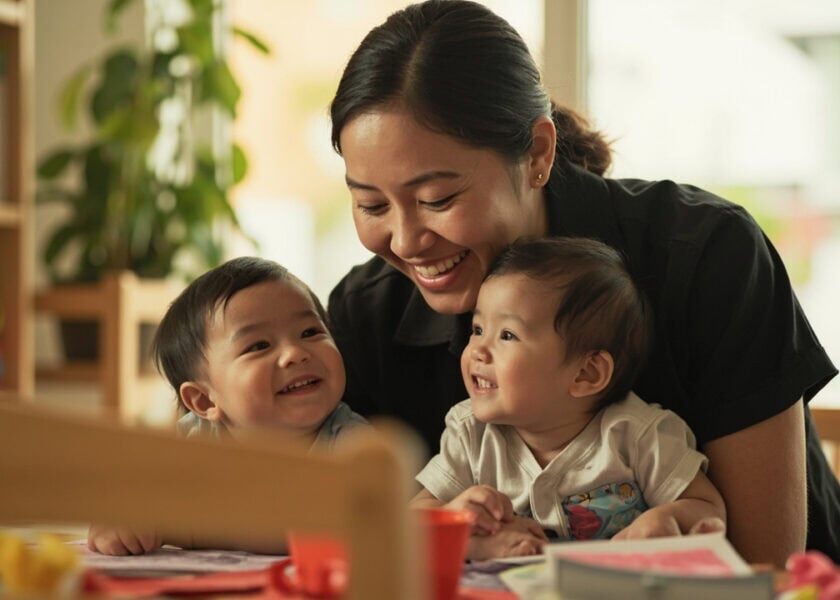
The Hours That Matter: What Quality Childcare Builds in Your Child
Why Quality Childcare Matters: The First Thousand Days and What Research Tells Us
When you walk away from that handover, something important begins. Not the filling of time. Not mere supervision. In quality infant care, a deliberate architecture of development activates. Every surface, every interaction, every response is part of a carefully considered environment designed to support your child’s rapidly forming brain, their emerging sense of self, and their growing capacity for trust and exploration.
The first thousand days of life carry extraordinary weight. Research across neuroscience, developmental psychology, and early childhood education converges on the same truth: the brain builds its architecture at unprecedented speed during these early years. Neural connections form faster than they ever will again. The circuits that will later enable thinking, feeling, learning, and relating are being laid down now, in these hours you cannot see.
In quality childcare, your child encounters something profound: consistent, warm, responsive care from adults trained to attune to infant and toddler signals. This is what quality childcare builds—not just care, but the very foundations of who your child will become.
What Your Child Builds: Security, Language, Senses, Social Skills, and Confidence
Secure Attachment Expands
When a baby fusses and a caregiver responds with gentle voice and tender movement, the infant’s nervous system registers safety. When a toddler reaches for a toy and a caregiver names it—describing its colour and texture—language circuits activate. When a child explores a new space and a familiar face stays nearby, present but not intrusive, the child learns that the world is interesting and that help is available when needed.
Here is what is essential to understand: secure attachment does not diminish because a child is in quality care. It expands. Your child’s capacity to trust deepens because they experience consistent, responsive care in your presence and beyond. They learn that separation does not mean abandonment. They learn that leaving does not mean forgetting. They learn, in these early hours, that the adults in their life can be relied upon to return.
This is the foundation for every relationship your child will ever have.
Language Development Accelerates
Quality childcare environments are language-rich in ways that matter enormously for early development. Every interaction—feeding, diaper changing, play on the mat, the simple act of being held—becomes an opportunity for language input.
Caregivers narrate what they are doing. They name emotions. They respond to babbling as if it were the most interesting conversation in the world. When a child points at a bird outside the window, a caregiver does not simply say “bird.” She says, “You see that bird? It is a sparrow. Look at its grey feathers and its small beak. It is singing.”
Research consistently shows that children in language-rich environments hear millions more words by age three than children in language-sparse environments. This difference does not fade—it compounds. It shapes vocabulary, grammar, and eventually, the ability to read and write. Early language exposure is not about academic preparation. It is about giving your child the tools to think, to communicate, to understand the world and make themselves understood in it.
Sensory and Motor Development Deepens
Quality childcare shapes your child’s developing brain through sensory experience. In a well-designed infant environment, the sensory opportunities available to your child are not random. They are chosen.
- A child who crawls across a smooth floor and then a textured mat is building sensory integration
- A child who reaches for a hanging toy is developing visual tracking and hand-eye coordination
- A child who hears music, rhymes, and conversation throughout the morning is building auditory processing that underlies later listening skills
These are not activities. They are the construction of neural pathways that will enable thinking, coordination, and eventually, the ability to regulate one’s own emotions and behaviour.
Social Intelligence Begins
Even before children can speak fluently, they are social beings. They watch each other. They reach for the same toy. They notice when another child cries.
In quality childcare, these early peer experiences are carefully facilitated. A child learns, in a small and supported way, what it means to share attention, to navigate conflict, to notice another person’s feelings. The role of the caregiver in these moments is essential—they do not hover constantly, but they are present, watching, ready to support but also ready to allow small struggles that lead to growth.
- A child who has learned, with caregiver support, to navigate the disappointment of a toy being taken is building the foundation for later social competence
- A child who has been helped to notice and respond to another child’s distress is developing empathy
- A child who has practiced waiting, with kind support, is building patience that will serve them in school, in friendships, and in every social context of their life
Autonomy and Confidence Grow
From the earliest months, children are not passive recipients of care. They are active learners who reach, crawl, explore, and choose. In quality infant care, this drive toward independence is supported.
- A child learning to feed themselves with increasing competence is not just eating. They are building mastery
- A toddler learning to put on their own shoes, with patient assistance from a caregiver, is not just getting dressed. They are discovering that they are capable, that they can do things, that they have agency in the world
These small victories, repeated across hundreds of moments, accumulate into something significant: a child who believes in their own competence, who approaches challenges with confidence rather than learned helplessness.
The best caregivers know how to support without doing for. They offer the right amount of help—enough to prevent frustration, not so much that the child learns nothing.
The Caregiver Relationship: Being Known, Not Just Watched
What caregivers provide is not mere supervision. In quality childcare, your child’s primary caregivers are trained professionals who understand infant and toddler development deeply.
They know the milestones. They understand the significance of the games children play, the way children use play to make sense of their experiences. They know how to read a child’s cues and respond in ways that build trust and security.
A caregiver in a quality setting does not simply keep children safe. They build relationships. They learn each child’s preferences, rhythms, and temperament. They remember that this little one loves songs about animals and that one is working through a phase of intense separation anxiety. They hold the child with genuine warmth during the morning drop-off when a parent has already left and the tears are real.
They are not strangers. They are partners in your child’s early development.
In being known by competent, warm adults, your child is learning something profound: that they matter, that their needs are noticed and met, that the world contains people who will treat them with patience and care. This template is being formed now, in these hours. It shapes how your child will relate to teachers, to friends, eventually to colleagues and romantic partners and their own children.
What Your Child Is Actually Experiencing: Addressing the Question You Carry
You cannot see. You cannot hear. You drop them at the door and you go to work, and there is an entire world happening that you are not part of. What happens in those hours, in quality care, is meaningful.
It is developmental. It is building your child’s brain, their sense of security, their social skills, their language, their confidence, their capacity for wonder and exploration.
The goodbye is not a withdrawal of love. It is an expansion of it. It is you trusting that the foundations you are laying can be reinforced by others who share your commitment to your child’s wellbeing.
What Quality Childcare Is Not
Before discussing what quality care looks like, it helps to be clear about what it is not:
- It is not babysitting. Quality childcare is intentional, developmentally informed, and designed to support your child’s growth—not just to keep them occupied.
- It is not a substitute for family. The best childcare works with your family, extending your values and your care rather than replacing them.
- It is not one-size-fits-all. Quality care adapts to your child’s individual temperament, needs, and developmental stage.
- It is not passive. Every interaction, every environment, every routine is designed with your child’s development in mind.
What to Look For: Practical Guidance for Choosing Infant Care in Singapore
If you are researching childcare options in Singapore, here are the questions that matter most:
Environment and Safety
- Are infant-to-caregiver ratios appropriate for your child’s age? For infants, a ratio of 1:3 or better is ideal.
- Is the environment clean, safe, and designed with your child’s developmental needs in mind?
- Are materials age-appropriate and intentionally chosen for learning, not just occupation?
- What is the daily routine, and does it balance structure with flexibility?
Caregiver Quality
- What training do caregivers have in infant and toddler development?
- How do caregivers respond to distress, separation anxiety, and conflict?
- Do caregivers build individual relationships with each child, or does care feel impersonal?
- Is the turnover rate low? Consistent, familiar caregivers matter for attachment.
Communication and Partnership
- How will you be updated on your child’s day? Photos, notes, verbal handoffs?
- Is there transparency about what happens during the hours you are away?
- How does the service handle concerns or questions from parents?
- Do they see themselves as working with you, not just for you?
Logistics for Singapore Families
- What are the hours, and do they align with your work schedule?
- Is the location convenient for your commute or home?
- What funding options are available? CDA, Baby Bonus, subsidies?
- What is the enrolment process, and is there a trial period?
EduNanny Singapore: Partnership in the Hours That Matter Most
EduNanny Singapore understands that parents and childcare are not in competition. They are partners.
EduNanny operates as part of the ECDA Childminding Pilot, offering pathways that recognise the diverse needs of Singapore families. Whether through home-based care that brings attentive, trained caregivers into your space, or centre-based environments designed for rich peer interaction and structured learning, options are available to serve your family’s circumstances.
Infant ratios—up to one to three in youngest rooms—ensure that every child receives the individual attention their development requires. Care blocks run Monday through Friday, supporting the rhythms of working families. Fee structures are designed to be accessible, with CDA and Baby Bonus usability available so that quality care is not a privilege reserved for those with substantial means.
Beyond the structure, beyond the compliance and the ratios and the facilities, EduNanny is built on a philosophy of partnership. The team does not replace the family. It extends it.
- Communication with parents happens not just at drop-off and pickup, but throughout the day
- Where environments include CCTV access, it is offered because there is nothing to hide and everything to share
- The goal is for parents to know what their child is experiencing, to feel connected even when apart
Caregivers are trained, supported, and valued. Because what they provide is not mere supervision. It is the continued building of the person your child will become.
You love your child enough to ask the hard questions. You care enough to wonder what happens in the hours you are apart. That questioning is not weakness. It is evidence of the kind of parent you are.
The honest answer is this: in quality childcare, your child is not missing you. They are building on everything you have already given them, in a warm, intentional environment designed for exactly this purpose.
The template you are laying—in those morning handoffs, in the trust you extend to quality caregivers, in the partnership you are building—is not a compromise. It is an investment. It is trust: in yourself, in your child, and in the partnership you are creating with those who will care for them when you cannot.
EduNanny Singapore. The hours that matter most, for the child you love most.
To learn more about the team and approach, visit the about EduNanny page. For questions or to begin a conversation about your family’s needs, the EduNanny team is ready to hear from you.