What Singapore Parents Notice During a Childcare Visit
The Moment Every Singapore Parent Dreads—and How to Move Through It With Confidence
You walk in, and the door closes behind you. The air changes. You are standing in a room full of children, and suddenly every instinct you have tells you to pay attention—but to what, exactly?
This is the moment so many parents in Singapore describe. They have done their research. They have read reviews, compared curricula, examined ratios, checked certifications. They arrive at a childcare visit armed with questions, ready to evaluate.
And then they step inside, and something unexpected happens.
The information they gathered feels distant, almost irrelevant. What remains is raw, sensory, immediate—and yet impossible to interpret with confidence.
They watch a caregiver kneel to speak with a toddler. They hear the hum of the room, the quality of the laughter. They notice whether the light feels open or institutional. And they ask themselves: What am I actually seeing right now? How do I know if this is good?
This is not a failure of preparation. It is the nature of the problem itself. We have built an abundance of content to help parents choose, to help them decide, to help them feel less guilty about the impossible calculus of modern parenting. But we have given far less attention to the moment that matters most: the visit itself, the hour you spend inside a childcare environment, the quiet details that tell the truth that brochures cannot.
Today, I want to walk you through what to notice when you walk through that door. Not as a checklist. Not as a performance of vigilance. But as a form of care—the care that comes from learning to see clearly, because what you are looking at is someone’s daily world, and you are trusting it with the most important thing in your life.
Quick Summary: What to Look For During a Childcare Visit
- The environment: Natural light, acoustic quality, whether the space supports child autonomy, thoughtful safety design
- The caregivers: Responsiveness over warmth, rich language use, consistency of presence, how adults speak to each other
- The children: Genuine curiosity, baseline comfort, peer interaction, emotional freedom to express the full range of feelings
- The communication: Specific daily updates, transparent protocols, clear processes for raising concerns
- Your instincts: Pattern recognition sharpened by love—not paranoia, but attention
The Room Itself: What the Environment Tells You
The physical environment of a childcare setting is not decoration. It is a message. It is a statement about what this place believes children need and how it understands their experience of the world.
When you enter, let your eyes move slowly. Do not look for perfection. Look for intention.
Notice the Light
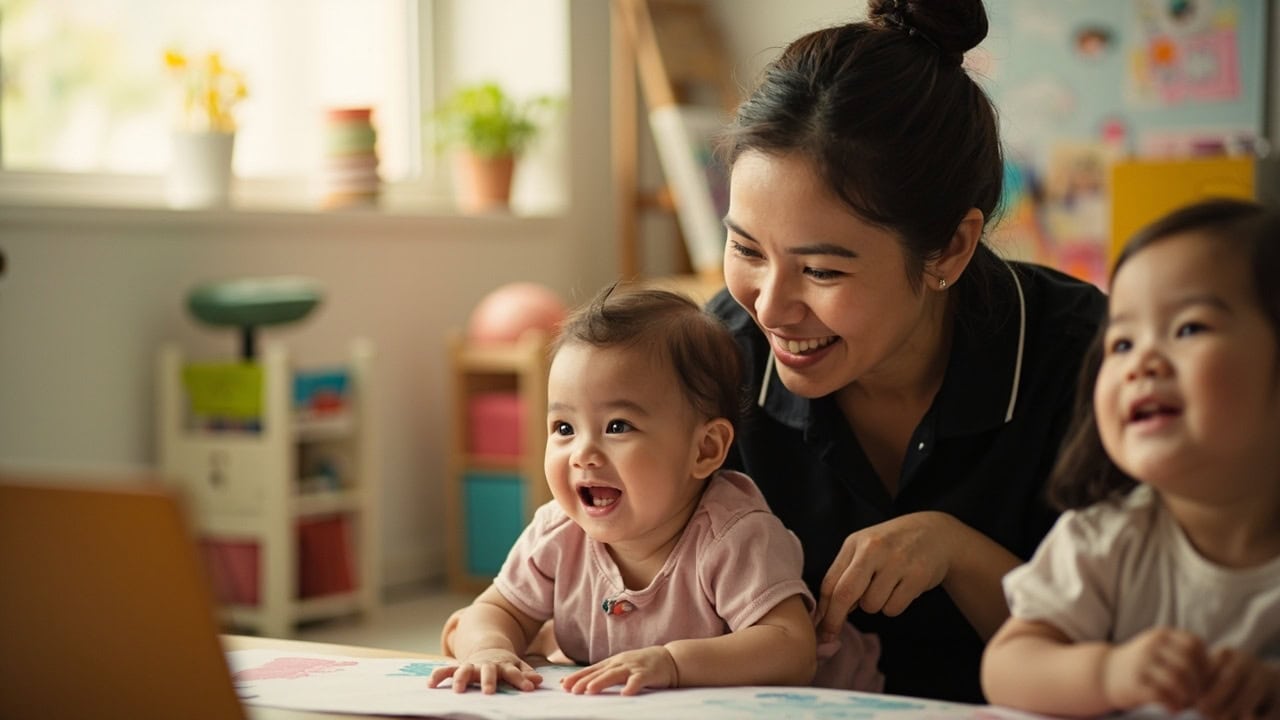
Natural light matters—not as an aesthetic preference but as a developmental consideration. Children in well-lit environments tend to be calmer, more settled, more able to engage. Does the room feel open, or does it feel like fluorescent institutional brightness that creates fatigue before the morning is half over?
Neither answer is a dealbreaker on its own, but it tells you something about whether the environment was designed with the child’s experience in mind.
Notice the Noise
Not the absence of sound—young children are meant to be noisy, to experiment with their voices, to discover the world through sound and movement.
But notice the quality of the noise. Is it chaotic, overlapping, overwhelming? Or is there a rhythm to it, spaces where a caregiver’s voice can reach a child without shouting?
You can learn a great deal about a programme’s design philosophy by listening to how it manages acoustic space.
Notice the Organization
This is not about tidiness for its own sake. It is about whether the environment supports children’s autonomy.
- Can a three-year-old reach the materials they need?
- Are there spaces that invite quiet, and spaces that accommodate movement?
- Is there evidence that children use this space, or does it feel like a display that children are merely allowed to inhabit?
The room should feel alive with purpose, not like a stage set waiting for an audience.
Notice the Safety Details
They should be present but not aggressive. Childproofed sockets, secured furniture, age-appropriate equipment—these are table stakes, not luxuries.
But look deeper. Do the outdoor spaces feel safe not because they are locked down, but because they are thoughtfully designed? Can children move freely within appropriate boundaries?
The best safety is invisible; it does not need to shout its presence because it has been integrated into the environment with care.
Notice What Is Absent
Sometimes the most telling detail is what you do not see.
- No sticky floors
- No unexplained odours
- No hidden corners where a child might be out of sight for too long
The absence of alarm signals is its own form of presence—the presence of consistent, attentive practice.
Watch the People: What Caregiver Interactions Reveal
The caregivers are not staff members. They are the environment. Everything else—the materials, the curriculum, the schedule—takes its meaning from the human beings who inhabit it with your child.
So watch them. Not just when they are performing for you during a tour, but in the ordinary moments. If you can, arrive early or stay late. Watch what happens when no one is being evaluated.
Observe Warmth—But Look Beyond It
Warmth is necessary but not sufficient. A caregiver can smile and still be emotionally distant.
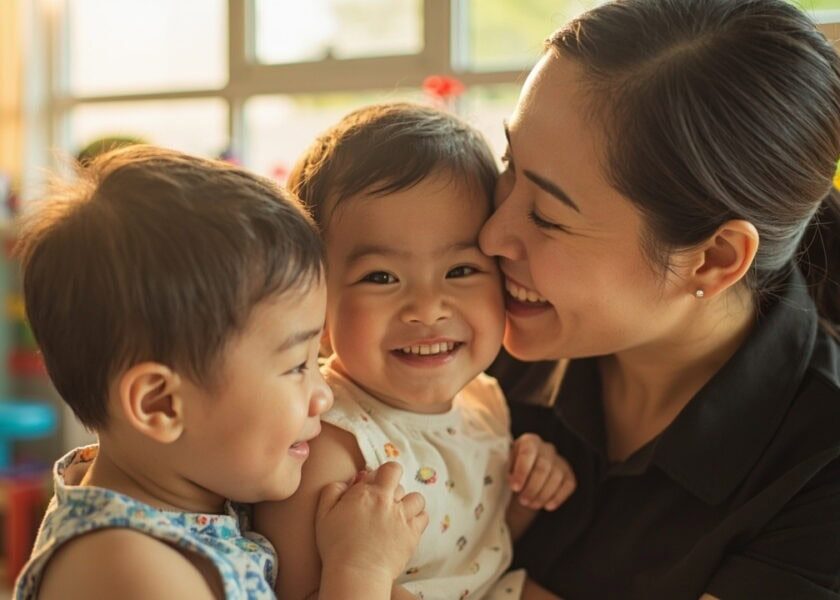
What you want to notice is responsiveness. Watch how a caregiver responds when a child approaches:
- Does she put down what she is doing?
- Does she kneel to the child’s level, not just physically but attentively?
- When a child speaks, does she receive that communication as meaningful, or does she treat it as background noise to be acknowledged and then ignored?
Notice the Language
This is one of the most powerful indicators of quality you will encounter.
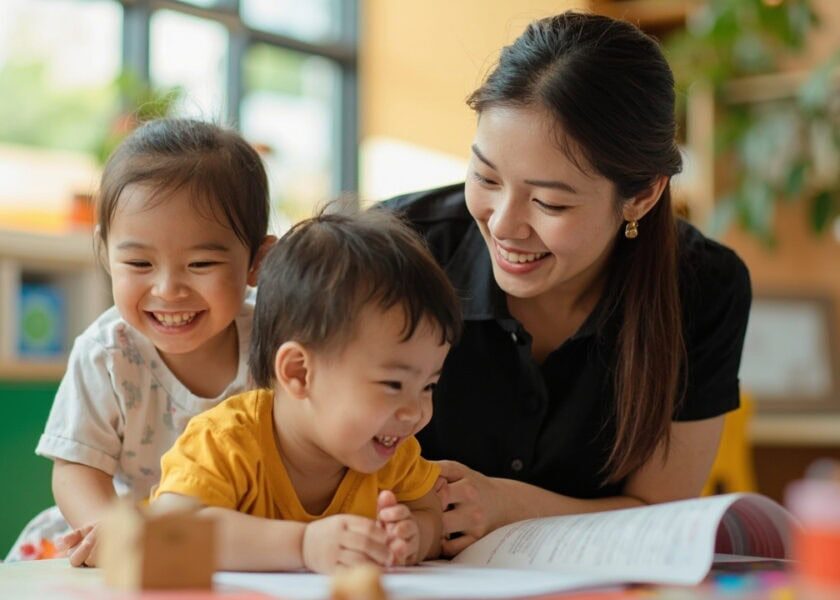
Listen to the words caregivers use with children—not baby talk, but real language, extended sentences, rich vocabulary offered naturally in the context of play and care.
A caregiver who says, “Look, you’re stacking the blue block on top of the red one—it’s getting taller, isn’t it?” is doing something profoundly important for language development. She is narrating the child’s experience, adding words to sensation, building the architecture of thought through conversation.
A caregiver who simply says, “Good job,” is offering approval, not language.
Notice Consistency
Is the same caregiver present each time you visit, or do you see different faces each time?
Young children form attachments to specific caregivers, and those attachments are not a luxury—they are the foundation of emotional security. A programme that consistently assigns primary caregivers, that invests in relationship-building over time, is a programme that understands how children develop.
Notice How Caregivers Speak to Each Other
The culture between adults in a programme is transmitted to children.
Listen for respect, for collaboration, for the quiet professional language of people who value their work and each other. A programme where adults are at ease with children, where you hear genuine conversation rather than stressed commands or whispered complaints, is a programme where children are likely to feel safe.
Watch the Children: Your Most Honest Source of Information
They cannot be fooled by a polished tour or a charming guide. What they show you is the truth of the daily experience.
Look for Curiosity
Are children engaged with their environment, or are they simply occupying space?
Curiosity shows in body language—the way a child leans toward something that interests her, the way she returns to a material or activity with purpose. Curiosity is not constant; it comes and goes. But its presence, even in glimpses, is a powerful indicator that the environment is stimulating enough to capture young attention.
Look for Comfort
Not happiness—that is too simplistic, and children experience frustration, boredom, and sadness as part of healthy development.
But look for a baseline of comfort:
- Can children move through the space without anxiety?
- Do they seem to know the routines?
- Are there moments of genuine play, of laughter, of absorption?
A programme where children look tense, watchful, or withdrawn—even if the adults around them are smiling—may be a programme that prioritizes compliance over wellbeing.
Look for Peer Dynamics
How do children relate to each other? Are there opportunities for cooperative play, or is the environment organized in ways that prevent interaction?
Watch how conflicts are handled—because conflicts will happen. When they do:
- Do caregivers intervene with calm, with patience, with respect for the children involved?
- Or do they suppress, redirect, or ignore?
The way a programme handles small frictions reveals its philosophy of child development more clearly than any brochure.
Look for Emotional Freedom
Can children express a range of emotions? Are they permitted to be frustrated, to be sad, to need comfort?
A programme that only allows contentment is a programme that is managing appearances, not supporting development.
The children who thrive are not the ones who never cry—they are the ones who cry and are met with patience, who are helped to name and regulate their feelings, who learn that all of themselves is welcome in this space.
Ask About What You Cannot See
A good programme will not only welcome your questions—they will have answers ready.
Communication Systems
How will you know what your child did today? Singapore parents are often managing demanding work schedules, and the need for clear, consistent updates is not a luxury—it is a practical necessity for trust.
Ask whether the programme uses daily reports, photographs, or verbal check-ins. Ask whether documentation is regular and specific, not generic.
“Your child had a good day” is not a report.
“Your child spent twenty minutes at the water table today, explored mixing colours, and shared a toy with another child during free play” is a report.
Transparency Protocols
Where CCTV is deployed—and this is increasingly common and appropriate—ask about viewing protocols. Where it is not, ask what other forms of transparency the programme offers.
Ask how you can reach your child’s caregiver during the day, and what the response time typically looks like. These are not intrusive questions. They are reasonable expectations for any family entrusting their child’s daily care to another setting.
How Concerns Are Handled
Every relationship has moments of friction, misunderstanding, or worry. What matters is not the absence of those moments but the existence of a process to address them.
- Ask what happens if you have a concern about your child’s experience
- Ask who you speak to
- Ask how quickly you can expect a response
- Ask what the escalation process looks like
A programme that has thought carefully about this is a programme that takes partnership with families seriously.
Questions That Reveal Philosophy
Not “Do you follow the NEL framework?”—any programme in Singapore should.
Ask instead:
- “How do you handle a situation where my child is struggling to settle?”
- “What does a typical day look like for a two-year-old here, and how do you adapt when a child is having a difficult day?”
- “How do you support children who are at different developmental stages within the same group?”
These questions reveal philosophy. They reveal whether the programme has thought deeply about individual children or whether it operates on a one-size-fits-all model.
Listen to how answers are given, not just what they say. Answers that are specific, that reflect genuine experience, that acknowledge complexity, are answers from people who know what they are doing. Answers that are vague, rehearsed, or defensive may indicate a programme that is managing a narrative rather than operating with transparency.
Trust What You Feel—and Move Forward With Confidence
You have gathered information. You have observed. You have asked questions and received answers. Now, step back and notice your own response.
Your Instincts Are Not Superstition
You are not being paranoid when you trust your instincts. Parental intuition is not superstition—it is pattern recognition, drawn from a lifetime of experience with your own child, sharpened by love into something perceptive.
If something feels off, even if you cannot articulate it, that feeling deserves attention. It may be a warning signal worth investigating. Or it may be the discomfort of an unfamiliar environment, which is different. But do not dismiss it. Sit with it. Name it. Ask more questions.
The Questions Parents Actually Worry About
“I’m worried I’m asking the wrong questions.”
The questions that matter most are not the ones on generic childcare checklists. They are the questions that reveal how a programme thinks about individual children: How do you adapt when a child is having a difficult day? What does settling look like? How do you support children at different developmental stages together?
“What if I miss a warning sign?”
Warning signs are often subtle, but they are not invisible. The absence of natural light, chaotic acoustic environments, caregivers who are warm but not responsive, children who are compliant but not curious—these are details that register before you can articulate them. Trust that registration. Ask follow-up questions. A programme with nothing to hide will welcome your attention.
“What if the visit is misleading—what they show me isn’t what it’s really like?”
This is a legitimate concern. The best defence is observation over time: return for a second visit, arrive unannounced if possible, stay longer than the standard tour. But also observe the gaps: Do the caregivers behave differently when you’re watching? Or do they continue their routines as if you’re not there? A programme with authentic quality does not change its behaviour for visitors.
“I’m feeling guilty about this decision.”
Every parent who walks into a childcare setting carries some version of this feeling. It does not mean you are doing something wrong. It means you care deeply about getting this right. That care is not a burden—it is exactly the attention your child deserves. The guilt you feel is the shadow of love, and love is what this decision is really about.
When Something Feels Right
And if something feels right—if you watch a caregiver respond to your child and something in you relaxes, if you notice children who seem genuinely at ease, if the environment feels like a place where children are valued not as a category but as individuals—you are not being naive.
You are recognizing quality when you see it. That recognition is itself a form of wisdom.
The skill of observation is not innate. It is learned. And it is learnable, by any parent willing to invest the attention. The more you learn to see, the more confidently you can choose. Not because the right choice becomes obvious, but because you develop the capacity to recognize what is genuine when you encounter it.
A Programme That Welcomes Your Attention
Every parent who walks into a childcare programme is carrying something. They are carrying hopes for their child’s future, fears about whether they are making the right decision, guilt about circumstances that made this choice necessary, and love so fierce it can feel overwhelming.
You are not just evaluating a service. You are trying to find a home away from home for the person you love most. That is not weakness. That is not overparenting. That is what it means to care.
A programme that is excellent does not need you to be fooled. It welcomes your attention. It says, “Look closely. We have nothing to hide, because what we do is worth seeing.”
If what you have read here resonates with you—if you believe that informed observation matters, that transparency builds trust, that the quality of daily care is worth examining closely—consider beginning with a visit.
Come and watch. Ask questions. Look closely at the environment, at the caregivers, at the children. Notice what feels intentional. Notice what feels like home.
At EduNanny Singapore, we operate within the ECDA Childminding Pilot, offering both home-based and centre-based pathways designed around the needs of working families. Our ratios are structured to ensure genuine attention for every child, and our communication practices are built on transparency—because parents deserve to feel connected to their child’s day. Learn more about our approach or arrange a visit to see our programme in action.