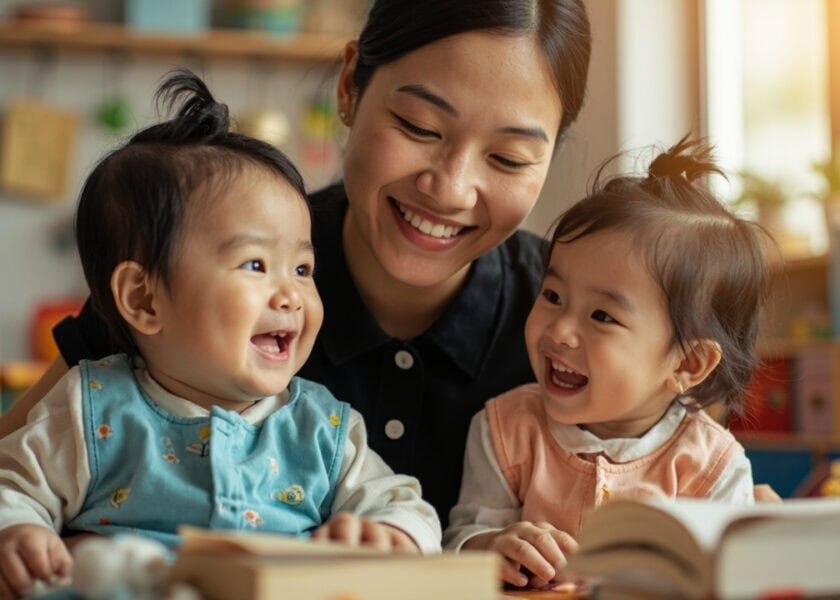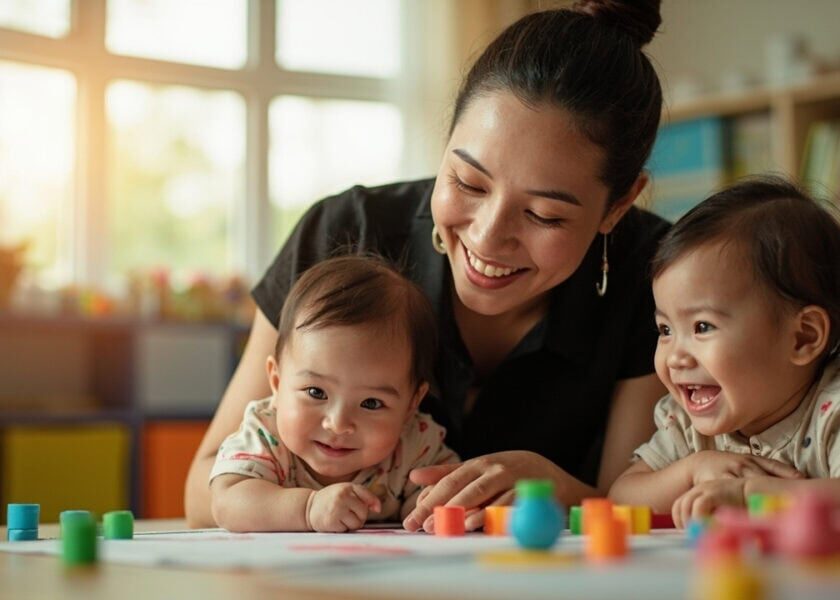
The Village That Raises Your Child Now Includes More Than Family
That Moment When Someone Asks, “Are You Sure About This?”
There is a moment—perhaps you have lived it—when someone you love looks at you and says, are you sure about this?
It might be your child’s grandmother, holding your baby’s hand a beat too long, asking quietly whether you have truly considered what it means to place such a small person in someone else’s care. It might be a domestic helper who has cared for your home for years, surprised that you would choose outside help when she is right there. It might be a well-meaning friend, almost casual in the way these things are delivered—oh, you’re going back to work so soon?—the Singapore way of saying something that lands heavily anyway.
And in that moment, something inside you shifts. Not because you doubt your choice. But because you wish you did not have to hold it so tightly on your own.
If you have felt that, this article is for you. Not because we have all the answers. But because we have sat with enough parents in Singapore to know that the weight you are carrying is not about childcare logistics. It is about love. It is about whether the choice you are making for your child is being seen clearly by the people who matter most.
What This Article Covers
- Why Singapore parents feel judged for their childcare choices—and why that judgment often comes from love, not criticism
- What decades of attachment research actually tell us about quality care versus physical proximity
- What genuine quality infant care looks like in practice
- How your child benefits from a trusted care ecosystem beyond your immediate family
- How to choose quality care with confidence—and stop apologizing for your decision
Where the Weight Comes From—and What Research Actually Says
In Singapore, we have a particular way of loving our children. It is intensive, invested, and often carried by multiple generations in a way that is genuinely beautiful.
Our grandmothers remember a time when a mother’s presence was not just expected but assumed—the natural architecture of early childhood. Our mothers watched us grow up with full-time care that came from someone in the family, usually a grandmother, and the memory of that has become a quiet benchmark against which every modern arrangement is measured.
When a young parent today makes a different choice, it does not arrive simply as a logistical decision. It arrives in a room full of history. Full of love. Full of worry that has not yet learned to trust what the research now tells us.
The guilt you feel is not irrational. It is inherited. It comes from a genuine place of care—from grandparents who genuinely believe they know what is safest for your child, from helpers who feel their years of service are being overlooked, from friends whose tone carries concern rather than judgment even when the words land differently.
Understanding where the weight comes from does not make it lighter. But it might make it easier to hold alongside something else: the knowledge that you have made this choice thoughtfully, and that the research supports you more clearly than you might realize.
What the research tells us
Decades of developmental psychology—from attachment theory first articulated by John Bowlby to contemporary longitudinal studies in early brain development—tell us something that should quietly reframe this entire conversation.
Secure attachment, the emotional foundation your child needs to grow into a confident, emotionally intelligent person, is not manufactured by physical proximity alone.
It is forged in the quality of responsiveness, consistency, and attuned care that a child receives. It is built when a child feels safe. When their needs are met not just physically but emotionally. When they learn, in those first crucial years, that the world is a place where someone notices them, responds to them, and holds meaning for them.
The word that matters is not quantity. It is not hours in a day. It is quality—the quality of presence that a child experiences in those hours. And quality, we know, is something that trained, attentive, emotionally attuned caregivers provide with extraordinary effectiveness, particularly in the earliest years when the architecture of the brain is being built faster than it ever will again.
So when your mother-in-law says, but who will love your child the way we do?—the answer is not no one. The answer is that your child will be loved by people who are trained to love them with their full attention, in a ratio that allows that attention to be real and unhurried, in a setting designed to respond to every cue a developing infant is sending.
That is not a compromise. That is a different kind of love—one that complements yours rather than replacing it.
The feeling that is not the same as the fact
The feeling that your child needs you and only you, at every hour of every day, comes from the most authentic place. It is the voice of a parent who would cross oceans for their child.
But it is also a feeling that, left unexamined, can keep us small—not just as parents, but as people who have careers, ambitions, financial realities, and futures we want to build alongside our children.
The research does not ask you to choose between being a good parent and being a whole person. It asks you to trust that your child can thrive in an environment of quality care, and that your own wellbeing—the ability to show up as your best, most present, most emotionally available self—is itself one of the greatest gifts you give your child.
What Quality Care Actually Looks Like
Quality is a word used so often it can start to feel like a slogan. In the context of infant care—particularly in those first thousand days, when the brain forms more than one million new neural connections every second—quality care means a few non-negotiable things.
It means a caregiver who is trained in infant development. Someone who understands the difference between a cry of hunger and a cry of overstimulation. Someone who can read the cues that precede frustration before frustration arrives.
It means ratios that make attention possible. Not one adult managing six newborns, but a deliberate, intentional structure where every child is seen. In the first year especially, the difference between a one-to-one and a one-to-three relationship is not just logistical. It is neurological. It is the difference between a child who is responded to and a child who learns to wait.
It means communication that closes the distance. Real-time updates, consistent sharing of your child’s day, and wherever deployed, transparent measures that allow you to feel present even when you are not physically there. Because presence is not only about location. It is about connection.
When you can see your child’s day, you can participate in it emotionally, even from across the island.
What Your Child Actually Gains in Quality Care
Here is something that gets lost in the noise of guilt and second-guessing: when your child is in a quality care setting, they are not simply being kept. They are learning.
- They are learning to be with other people
- They are learning to navigate social cues and read responses
- They are learning to share attention and understand that the world contains more than one responsive adult
- They are building the early scaffolding of emotional regulation
- They are developing the quiet resilience that will carry them into preschool and beyond
This is not a small thing. It is one of the most important things your child will ever learn—and they learn it not from books or screens but from the lived experience of being in a warm, capable, attentive environment.
Your child does not lose something when they gain quality care. They gain something.
The Village That Raises a Child Does Not Have to Be Blood
Singapore families have a particular strength: the multi-generational web of care that surrounds a child. Grandparents, helpers, extended family—all contributing to a child’s sense of security and belonging.
What we gently offer is the invitation to expand that definition. A village can include trained, caring professionals who bring expertise and intentionality to every interaction with your child. A village can include a community of parents who are navigating the same tensions, making the same choices, holding the same hopes.
When quality care steps into your home or welcomes your child into a centre, it is not replacing anyone. It is joining the ecosystem. It is adding to the village.
The grandparents who worry, the helpers who feel overlooked, the relatives who have opinions—they come from a place of love. We do not dismiss that. What we offer in return is respect for their love, combined with the trust that a broader village can serve your child in ways that complement rather than compete with what family already provides.
EduNanny Singapore: Built Around This Understanding
We want to be honest about what EduNanny Singapore is, because trust begins with honesty.
We are part of the ECDA Childminding Pilot, which means our framework is grounded in regulatory oversight and pedagogical intentionality. Our care operates within Singapore’s own regulatory landscape, with accountability structures designed to give parents real confidence.
Our approach includes:
- Home-based childminding pathways—care that comes to your child in the environment where they feel most settled
- Community and centre-based options—for families who prefer them
- Infant ratios designed around attentiveness—not throughput, because attention is not scalable
- Monday through Friday care blocks—matched to the rhythms of a working family’s day
- Pilot fee structures—designed to make quality care a realistic option rather than a luxury
- CDA and Baby Bonus acceptance—so the systems Singapore has put in place to support you can actually reach you
We know that the hardest part of leaving your infant in someone else’s care is the distance—the not knowing. So we have invested in the infrastructure of trust: open communication channels, consistent updates, and wherever deployed, transparent measures that allow you to feel present in your child’s day even when you are physically apart.
For parents navigating questions at two in the morning, doubts on Sunday evening, or moments when you need reassurance from someone who understands both the science and the soul of what you are doing—EduNanny developed Thomas, our AI-powered chatbot. A tool designed to walk alongside you, answering questions with grounded, practical guidance so you never feel like you are navigating this alone.
This is who we are. Not a service that processes your child. Not a facility that checks boxes. A partner who understands that the decision to entrust your child’s early years to quality care is one of the most personal, most vulnerable, most significant decisions you will ever make—and who has built every part of our model around that understanding.
Addressing Your Concerns—and Choosing Quality Care with Confidence
“Will my child feel abandoned?”
Children are remarkably attuned to emotional states. What they feel from you is not guilt or hesitation—it is the calm confidence of a parent who has made a thoughtful choice. When you drop your child at a quality care setting with genuine trust in that environment, your child reads that trust. They learn that the world contains reliable, responsive adults who will notice them. That is the foundation of security, not the number of hours you spend physically together.
“What will people say?”
The apology still slips out—sorry, I have to drop them off early, sorry I’m back at work, sorry we made this choice—as if the choice itself requires defense. Here is what we want you to understand: the apology is not serving you. It is keeping you in a story about inadequacy that has no basis in evidence, in research, or in the actual wellbeing of your child.
The day you stop apologizing is the day you reclaim the narrative. Not defensively. Not with bravado. But with the quiet, grounded confidence of a parent who has done the research, felt the feelings, and made a choice they genuinely believe in.
“Am I being selfish?”
Singapore parents are some of the most committed, most reflective, most self-critical parents we have ever encountered. Somewhere in that beautiful, exhausting commitment, many of us have absorbed a story that says the best parent is the one who does it all—who works, who parents, who manages the household, who never falters, who never needs help.
That story is not just false. It is harmful. It is harmful to you, and it is harmful to the child watching you model what adulthood looks like.
The parent who recognizes their limits. The parent who says, I need support, and I have found a quality care environment that I trust completely. That parent is not failing. That parent is demonstrating something extraordinary. They are showing their child that love is not about control or martyrdom. It is about creating the conditions in which everyone—parent and child alike—can grow.
Questions to ask any care provider
- What is the caregiver-to-infant ratio, especially in the first year?
- What training do caregivers have in infant development and attachment?
- How do you handle different cry types and infant distress signals?
- What does daily communication look like? How will I know what my child’s day was like?
- What is your approach to feeding, sleeping, and soothing—does it align with our family’s values?
- Are you regulated or part of any pilot or framework that provides oversight?
Signs of genuine quality
- Caregivers who can articulate why they respond to infants in specific ways
- Ratios that allow for individual attention, not just supervision
- Transparent communication systems that keep parents informed
- A culture that welcomes questions and ongoing conversation
- Staff who speak about your child as an individual, not a task to be managed
Signs to proceed with caution
- Vague answers about training or ratios
- Resistance to questions or parent visits
- Emphasis on keeping infants quiet or “managed” rather than engaged and stimulated
- No clear communication pathway between caregiver and parent
You Chose This. You Researched It. You Chose It Again.
Let us return, one last time, to that moment.
Someone you love looks at you and says, are you sure about this?
And for the first time, instead of shrinking, instead of apologizing, instead of defending a choice you have already made with your whole heart—let us try something different.
Let us say: yes. I am sure. Because I have found a place where my child is safe, and seen, and loved in a way that expands what our family can offer. I am sure because the research supports what my instincts told me—that my child needs quality, not just proximity. And I am sure because I finally stopped apologizing for being a parent who needs support, because that is not weakness. That is wisdom.
You do not have to defend your choice anymore. You chose it. You researched it. You felt it. And you chose it again.
EduNanny Singapore is here because we believe that every parent in this city deserves to make that choice without shame, without apology, and without the weight of other people’s stories about what parenting should look like.
We are here because the first thousand days of your child’s life matter—not as a slogan, but as a fact—and because children who are raised in quality care environments built on trust, attunement, and safety do not merely survive those days. They flourish in them.
You came to this moment wanting to do what is right. And you did. Not the right thing by your grandmother’s standard. Not the right thing by your neighbour’s expectation. The right thing by your child—the one that only you, with your knowledge of their temperament, your understanding of your family’s needs, and your willingness to look honestly at what you can sustain—could ever truly know.
That is not abandonment. That is the most courageous kind of love there is.
EduNanny Singapore is proud to walk this road with you.
To learn more about EduNanny Singapore and our approach to quality childminding, visit our homepage or read about our story. If you have questions or would like to speak with our team, we welcome you to reach out to us.