How Singapore Parents Bridge the Generational Childcare Divide
The Unspoken Tension in Singapore Families
When a parent chooses professional care, they are not choosing against their parents. They are not rejecting the wisdom of generations. They are not suggesting that what worked before is no longer good enough.
They are doing something far more complicated and far more courageous. They are trying to honor two truths at once: the deep value of family, and their own conviction about what their child needs now.
To understand why this tension exists so acutely in Singapore, we need to understand what we ask of families here. Singapore has one of the highest rates of multigenerational involvement in childcare decisions anywhere in Asia. Our parents and grandparents are not peripheral figures in the raising of our children. They are central.
They have invested decades of love and sacrifice into their families, and that investment has not stopped at the threshold of parenthood. It has deepened.
When a grandparent looks at a grandchild, they see not just a small person, but a continuation of something they helped create. Their parenting choices, their instincts, their ways of soothing and teaching and protecting, are not distant memories. They are living convictions.
To question those convictions—even gently, even unintentionally—can feel like a quiet betrayal of everything they have given.
And yet. The world that Singapore parents are raising their children in is not the world their parents raised them in. It is not better or worse. It is simply different.
The pace is different. The demands are different. The information is different. What we understand now about early childhood development, about the importance of the first thousand days, about how infants form attachments and learn language and build the foundations for everything that comes after, has grown in ways that were not available to earlier generations.
Parents today are not rejecting their parents’ wisdom. They are adding to it. They are working with a new layer of knowledge and asking, genuinely: What is the best way to care for this child in this time, in this place, with these resources?
This is not arrogance. This is evolution. And it is exactly what every generation of parents has done before them.
Quick Summary: Bridging the Generational Gap in Childcare
- The tension is real. Many Singapore parents feel caught between respecting their parents’ expectations and choosing care that reflects their own values.
- This is not failure—it’s love. Grandparents push back because they care. Parents choose professional care because they care too. Both impulses deserve to be honored.
- The goal is alignment, not conflict. You are not choosing between family and quality care. You are looking for care that feels like an extension of your family’s values.
- Grandparents need to see warmth and trust. They do not need to understand modern childcare pedagogy. They need to see their grandchild safe, loved, and genuinely cared for.
- Communication opens the door. A genuine invitation into your decision-making process can transform skepticism into support.
- Quality care is possible. With the right approach, grandparents can look at your childcare arrangement and say, “Yes. I can trust this.”
Reframing the Goal: Alignment, Not Conflict
Here is what we have learned, watching Singapore families navigate this terrain: the tension between generations is not evidence of failure. It is evidence of love.
It is evidence that everyone involved cares deeply about this child and wants the best for them. Grandparents push back on professional childcare because they want to be involved. Parents choose professional childcare because they want their children to have more, to be more, to have the support they need to thrive.
Neither of these impulses is wrong. They are simply pulling in different directions, and what families need is not a winner, but a way to pull together.
The goal is not to choose between family and quality care. The goal is to find a care arrangement that feels like an extension of family values, not a replacement for them.
The goal is to find a place, or a person, or an approach that grandparents can look at and say:
“Yes. I can trust this. I can see why you chose this. I can feel good about this.”
That is not a small thing to ask. But it is a reasonable thing to ask. And it is entirely possible—when the right elements are in place.
Widening the Circle
This is not about winning an argument. It is about widening the circle. It is about saying to your parents: You are still part of this. Your role has not ended. It has changed, and it is still essential.
Because here is a truth that is easy to forget in the anxiety of the decision: children do not suffer when they have more people who love them. They suffer when those people are in conflict. They suffer when they sense that the adults in their lives are at odds about them, even quietly, even without words.
The gift of aligned caregiving is not just logistical. It is emotional. It is the gift of growing up in a family that pulls together, even when pulling together is complicated.
What Grandparents Actually Need to See
Here is something that may not be obvious at first glance: grandparents do not need to understand everything about modern childcare pedagogy to trust it. They do not need to read the research or know the terminology.
What they need is something simpler and more fundamental. They need to see that their grandchild is safe. They need to see that their grandchild is loved. They need to see that the people caring for this child are paying attention, are present, are treating this small person with the seriousness and tenderness that they themselves would bring.
The Small Moments That Build Trust
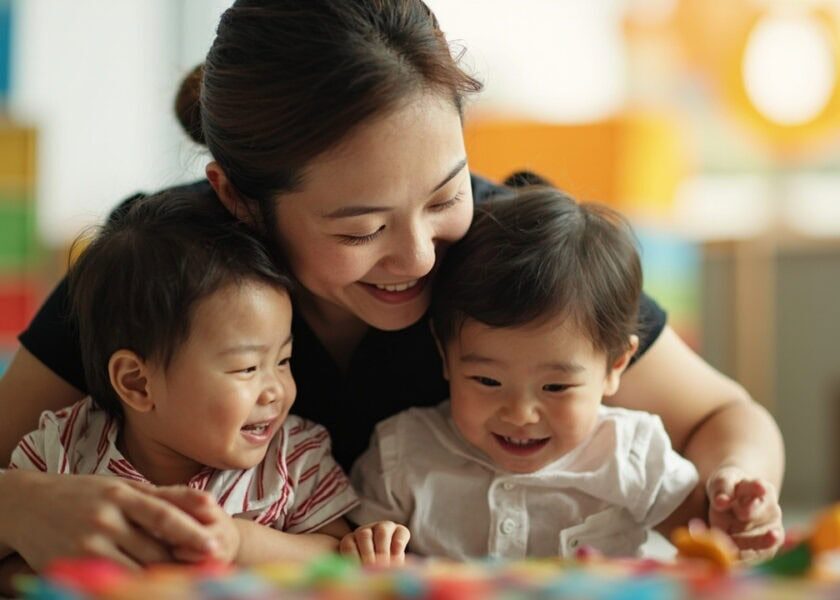
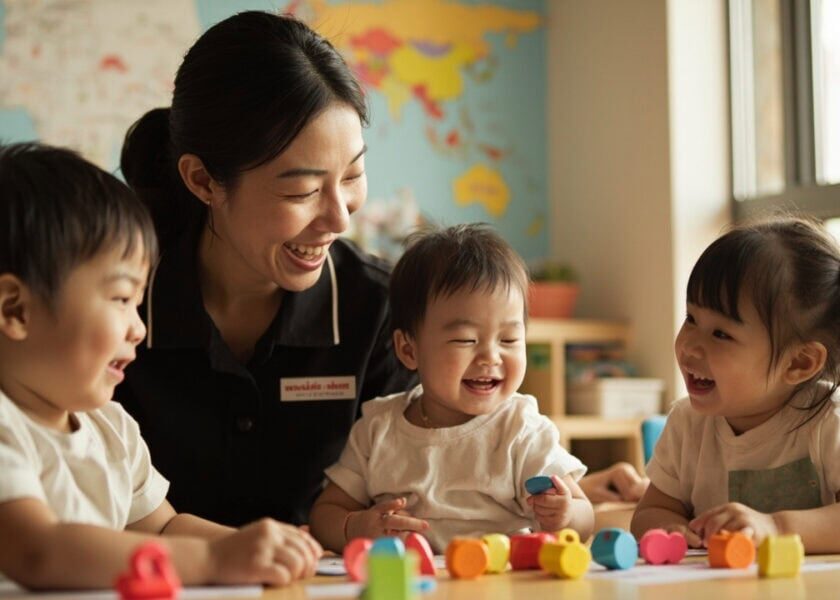
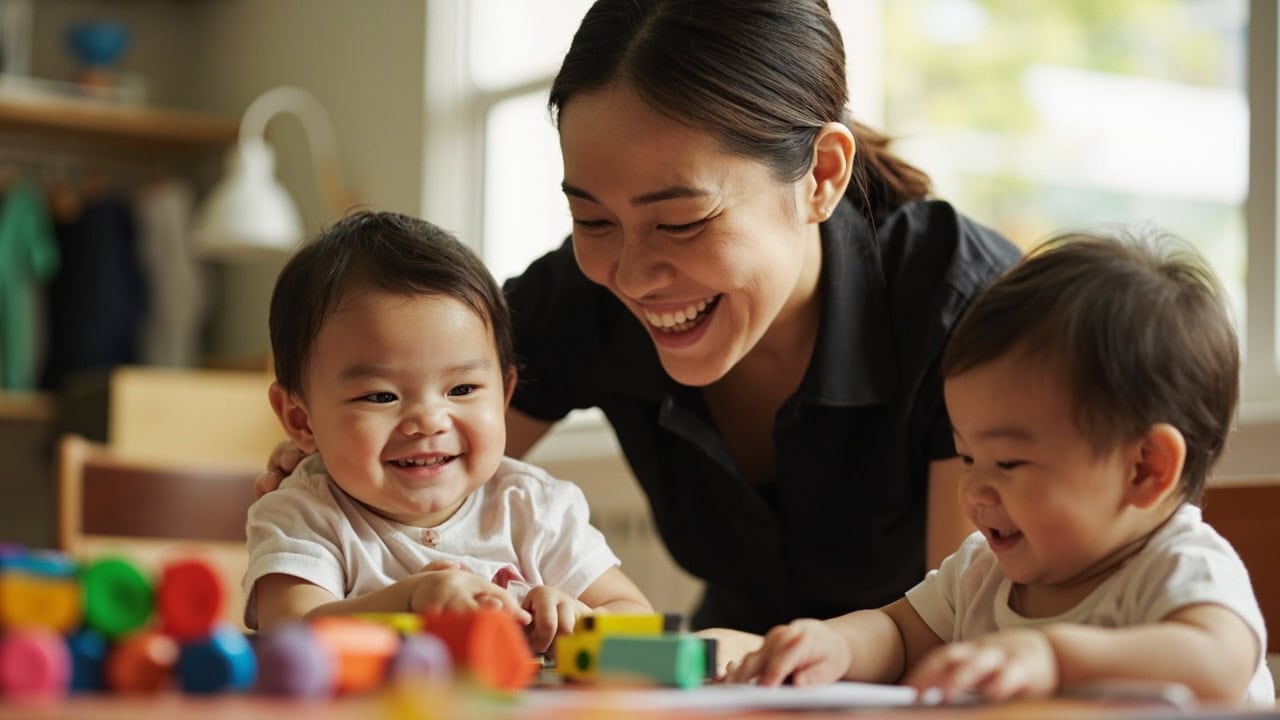
When a grandparent walks into a space and sees warmth, when they see a caregiver kneel to meet a child’s eye, when they see a child reaching for someone with easy familiarity—something shifts.
The anxiety that comes from the unknown softens. The suspicion that professional means detached begins to dissolve.
What grandparents are looking for is not perfection. They are looking for genuine care. They are looking for evidence that someone else can love this child the way they do.
The Questions That Linger
There are practical questions too—questions that grandparents may not ask out loud but that matter deeply to them:
- What is the ratio? Will my grandchild be one of many, or one who matters?
- Is it affordable? Is this a choice this family can sustain?
- Is it consistent? Will my grandchild have the same person day after day, building the predictability that makes them feel safe?
- Is it legitimate? Is this recognized, regulated, part of something real?
When these questions can be answered honestly and reassuringly, the practical objections that stand between skepticism and acceptance begin to fall away.
What Quality Childminding Actually Looks Like
Not all professional care is created equal. For parents navigating this decision—and hoping to bring their own parents along in that decision—it matters what the care actually looks like on the ground.
The Environment
Quality childminding is warm rather than institutional. It is a space where a grandparent can visit and feel welcomed, where they can observe their grandchild thriving in an environment that feels cared for.
It is a space where children are not just supervised but truly engaged—where caregivers kneel to meet a child’s eye, where small names are known and used, where the rhythm of the day feels nurturing rather than transactional.
The Ratio
In home-based and community-based care, the ratio of caregivers to children is critical. Fewer children means more attention for each one. It means that when an infant cries, they are not waiting. When a toddler takes their first uncertain steps, there is someone right there. When a child needs comfort, there is an arm that knows how to hold them.
Consistency
Infants and young children build security through predictability. They need to see the same faces, experience the same rhythms, know that the world is reliable. Quality care provides that consistency—day after day, week after week.
Communication
Parents need to know what is happening in their child’s day. Grandparents, when they are involved, need pathways to feel connected even when they are not the primary caregivers. Communication is not optional—it is the thread that keeps families feeling like a family, even when they are apart.
EduNanny’s Approach: Built for Three Generations
When EduNanny by BUTLER welcomes a family, we are not just welcoming the parent who signs the agreement. We are welcoming three generations: the infant who will spend their days in our care, the parent who has made a considered choice, and the grandparents who may not have been part of the decision-making process but whose trust matters, whose peace of mind matters, whose relationship with this child and with their own child matters deeply.
Our Framework
EduNanny operates within the ECDA Childminding Pilot, a framework that reflects Singapore’s own commitment to raising the standards of home-based and community-based care.
This is not just a regulatory designation. It is a commitment to meeting national standards, to operating with transparency, and to being part of something that Singapore itself recognizes as important for families.
What Families Find Here
Within this pilot, families benefit from carefully considered ratios, with up to one to three infants in our care, ensuring that every child receives attentive, responsive support.
Our care blocks run Monday through Friday, offering the consistency that infants need to build security and the reliability that parents need to plan their lives.
Fees are structured to be affordable within the pilot’s framework, because quality care should not be a privilege reserved for those who can afford premium private arrangements.
And for families using their child’s CDA or Baby Bonus, these funds are directly applicable, removing yet another barrier between families and the care they need.
Addressing Common Questions
Parents need honest answers grounded in what we actually offer:
- Is the ratio safe? Our home-based care maintains ratios designed for responsiveness. When an infant cries, they are attended to. When a toddler explores, they are supported. This is the standard we hold ourselves to.
- Is it affordable? Our fee structure within the ECDA Childminding Pilot is designed to be accessible, and CDA and Baby Bonus funds can be applied directly.
- Is it consistent? Monday through Friday care blocks provide the predictability that infants need to build attachment and security. Consistency is not optional in early childhood—it is foundational.
- Is it legitimate? Yes. We operate within the ECDA Childminding Pilot, meeting Singapore’s national standards for home-based and community-based care.
Transparency and Trust
We understand that parents need to trust what they cannot see. That is why our arrangements include communication and transparency measures that allow parents to feel connected even when they are apart.
Where they are deployed, CCTV measures provide an additional layer of reassurance for families who want it. We do not hide behind closed doors. We welcome scrutiny, because we are proud of what we offer.
Our caregivers are vetted, trained professionals who understand that the work they do is not just childcare. It is the scaffolding of a human life.
Supporting Every Family’s Reality
There is another layer to this that deserves to be named. For some families, the grandparent involvement in childcare is not a cultural preference. It is an economic reality.
Singapore is expensive. For many families, having a grandparent provide care is not a choice; it is the only financially viable option. And for those families, the conversation is not about choosing between family care and professional care. It is about how to supplement, how to support, how to access quality care in ways that work alongside what grandparents are already giving.
EduNanny’s flexible pathways are built with this reality in mind. We are not here to replace the grandmother who has rearranged her life to help. We are here to give families options when those options are needed.
Whether that means full-time placement, part-time support, or simply having a trusted professional to turn to when questions arise, we want to be part of the solution that fits each family’s specific situation.
Because alignment is not the same as uniformity. Families do not need to do things the same way. They need to feel that their ways are not in opposition. They need to trust that the child’s wellbeing is the shared priority, even when the approaches differ.
The Conversation That Changes Everything
For parents navigating this decision, there is also the conversation you need to have with your own parents.
We want to be careful here not to suggest that parents owe their parents an elaborate defense of their choices. They do not. But we also know that silence often makes things worse.
When parents choose professional care and do not explain it, grandparents fill the silence with their own stories. They assume rejection. They assume criticism. They assume that their way of raising children has been found wanting. And in families where respect for elders is a core cultural value—as it is in so many Singapore households—this assumption can wound everyone.
Not a presentation, not a defense, but a sharing. A genuine invitation into the decision:
- Tell them what you were looking for. Not what was wrong with their approach, but what you were hoping to find. Tell them about the child you want to raise, and why you believe this path will help you get there.
- Show them the space. If they are open to it, let them see what you see. Let them feel what you feel.
- Introduce them to the caregiver. If that is appropriate, let them meet the person who will be part of their grandchild’s daily life.
- Listen to them. Not to be swayed, necessarily, but to understand. Ask them what they are worried about. Ask them what they wish they had known when they were raising you. There is wisdom in their concerns. There is love in their pushback. Honor that, even as you move forward with your choice.
Finding the Care That Earns Trust
If you are a parent in Singapore reading this, navigating the tension between what your instincts tell you and what your parents expect, we want you to know: you are not alone. This tension is real, and it is worth taking seriously.
You do not have to choose between respecting your parents and trusting yourself. The right care arrangement can honor both.
What you are looking for is possible. A space where your child is safe and loved. A space where your parents can visit and see warmth instead of suspicion. A space where the words “professional childcare” stop sounding like a rejection and start sounding like what they actually are: an expansion of the village, not a replacement for it.
Every child in Singapore is born into a web of relationships that existed before them and will outlast them. The child does not experience these relationships as separate categories. They experience them as their world.
And the quality of that world—its warmth, its consistency, its sense of safety—is one of the most powerful predictors of the kind of person that child will become. Children thrive when the people who love them are aligned. When they do not have to sense conflict or choose sides or carry the weight of generational tension. When the adults in their lives are pulling together, each contributing what they have to give.
If EduNanny sounds like it might be part of your family’s story, we invite you to take the next step. Not because we are the only answer, but because we have thought deeply about exactly this challenge—and we are here to be part of the solution, not just for parents, but for three generations at once.
A Simple First Step
If you are ready to explore what aligned, quality care looks like for your family, we welcome the conversation. Reach out to learn more about our approach, our framework, and how we might support your family in building the village your child deserves.
We are honored to be part of so many Singapore families’ stories. And we are committed every day to being worthy of that trust—not because we are perfect, not because childcare ever is, but because we believe in what we are doing and in the families who have trusted us with the most important work there is.
The conversation in Singapore homes is ongoing. It is sometimes awkward, sometimes emotional, sometimes quieter than it should be. But it is a conversation worth having.
And we are grateful to be part of it, in whatever way we can.