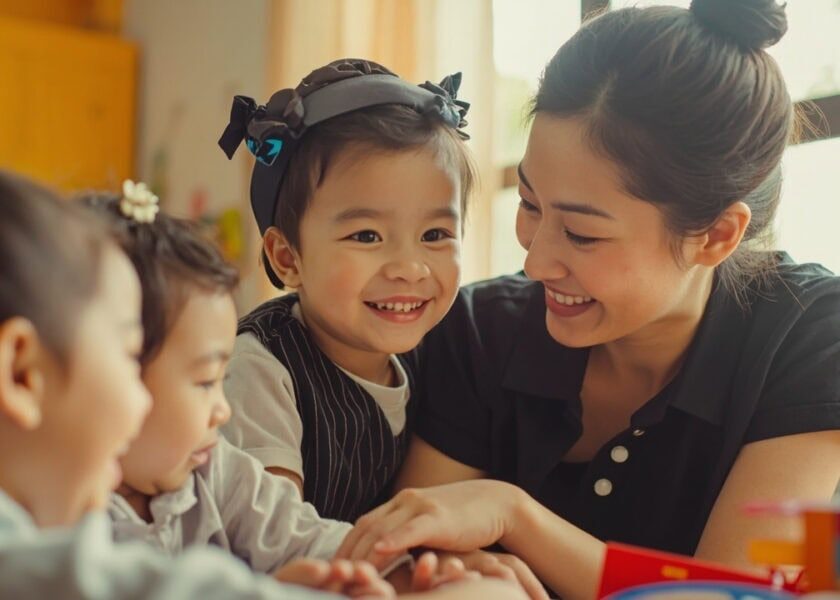
The Science Behind Your Child’s First Childcare Transition
What Is Actually Happening Inside Your Child’s Brain
Every child is born with an exquisite internal compass for attachment. From the very first weeks of life, your baby is not merely passive — not merely a bundle of reflexes and needs. They are already reading you: your voice, your face, the rhythm of your breathing, the way you hold them when they are distressed and the way you smile when they are calm.
This is not metaphor. This is neuroscience. The infant brain is specifically designed to form what developmental psychologists call a secure base — a relationship so reliable that it becomes an internal map for understanding the world. When a child has a secure base, they can explore. They can be curious. They can venture out, because they know, deep in their bodies, that they can always return.
When you introduce a new caregiver — whether at home or in a centre — you are asking your child to extend their secure base to include someone new. That is not a small ask. It is, in fact, one of the most significant social and emotional tasks your child will undertake in their early years.
Here is what the research consistently shows: the way this transition is handled matters enormously. Children who experience a gradual, emotionally attuned transition — where their distress is acknowledged, where the new caregiver is introduced with warmth and consistency, where the parent leaves with confidence and returns as promised — these children do not just survive the transition. They thrive through it. Their secure base expands. They learn that new people can be trusted, that new places can be safe, that growth and change do not mean abandonment.
Your Emotional Journey: The Quiet Superpower
But here is the harder truth, the one we rarely say aloud because it feels so raw: the person who often struggles most with this transition is not the child. It is you.
There is a particular kind of courage required to walk out of a room while your child reaches for you. It is not the courage of indifference — it is the courage of trust. Trust in your child, who is more capable than you fear. Trust in the process, even when it feels unnatural. Trust in the caregiver you have chosen, and in the months of work you have done to prepare for this moment.
The way you speak about childcare in the weeks before it begins, the calm confidence you carry into that first morning, the way you say goodbye — all of this sends profound signals to your child’s developing brain. Children are exquisite emotional translators. They do not need you to pretend that nothing is changing.
They need you to say, with your words and your presence and your steady voice: This is hard, and it is okay. I love you, and this person will love you too. I will come back.
That is not a platitude. That is attachment science, made human.
When you walked into your child’s life for the first time — whether through birth, adoption, or any other path — you did not know what you were doing. And yet you learned. You learned your child’s cry, your child’s smile, your child’s particular way of asking to be held. You learned that you were capable of a kind of love that reorganised your entire life. And you did this not because you had no doubts, but because you moved through the doubts with your child anyway.
That capacity has not left you. It has grown. So yes — prepare your child with rituals and language. Prepare your home with routines that will carry forward. Prepare your caregiver with the information that only you have.
But also, quietly, prepare yourself. Ask yourself what you need to feel ready. Perhaps it is a conversation with other parents who have walked this path. Perhaps it is a morning walk alone, before the transition begins, to sit with the bigness of what you are about to do. Perhaps it is simply giving yourself permission to feel sad about this change, even as you move toward it.
You do not have to be fearless. You have to be present.
Preparing Your Child: Age by Age
Age-appropriate preparation begins earlier than most parents expect.
For Infants Under 18 Months
Preparation is less about conversation and more about consistency. In the weeks before childcare begins, try to establish routines that will carry through — predictable sequences for feeding, sleeping, and play. When a child’s world has rhythm, they can tolerate more change in environment because the underlying structure remains familiar.
For Toddlers and Older Preschoolers
Words become powerful tools. You might say, in simple and honest terms:
“Mummy and Daddy are going to find ways to take good care of you, and we have found a wonderful person who is going to help. We will go together first to see where you will play and learn. And every day, after nap time, Mummy or Daddy will come to get you.”
Notice what this language does. It is not vague. It does not promise that everything will be easy. It does not say you will have fun if you are not sure that is true. It says: this is who will care for you, this is what it will look like, and this is when I will return.
Specificity is not rigidity. It is a gift to a child’s developing sense of time and trust.
The First Goodbye: Setting the Relational Tone
There is a ritual, simple and quietly profound, that many of Singapore’s most experienced caregivers and early childhood educators swear by: the first goodbye. Not the dramatic, tearful, escape-through-the-parking-lot goodbye that many parents dread, but a deliberate, brief, and loving one.
Here is what it looks like:
- You kneel to your child’s level.
- You hold their face gently in your hands.
- You say, “I love you. The teacher will take care of you today. I will come back after your snack and your morning play, and I will be here when you wake up.”
- Then — and this is the hardest part — you hug them, you kiss them, and you leave.
Not quickly, not slowly. Just clearly.
Because what your child needs most in that moment is not a prolonged goodbye that grows in intensity with every passing minute. They need you to show them, through your calm and your conviction, that leaving is not the same as abandoning.
You will wonder if you should linger. You will wonder if one more hug will help. Research and experience both suggest that the opposite is true. The longer the departure ritual, the more a child’s nervous system registers: something is wrong, and the person who knows how to fix it is leaving.
A clean, loving, confident goodbye — even when your own eyes are blurring — is one of the greatest gifts you can give your child in that moment.
The First Weeks: Signs of Healthy Adjustment
In those early days, your child may fluctuate dramatically. They may cry at drop-off and then settle quickly. They may seem perfectly fine in the morning and fall apart in the afternoon. They may eat less than usual, sleep differently, become clingier in the evenings.
All of this is within the range of normal. The young brain does not experience transitions linearly. It processes them, integrates them, and shows signs of adjustment in waves.
Signs of Healthy Adjustment
What you are watching for, across the first two to three weeks, is a general trajectory:
- Is your child moving, overall, toward greater ease?
- Are the goodbyes getting marginally shorter?
- Is there a moment, even a brief one, where your child becomes interested in a toy, a caregiver, a playmate?
- Is there a flicker of curiosity beneath the caution?
These are the signals of a healthy transition. Not the absence of struggle, but the presence of movement.
Signs That Deserve Attention
There is another category of signals — the ones that deserve attention and perhaps a conversation with your caregiver or your paediatrician:
- Your child is not eating at all after several days.
- Sleep disturbances persist and intensify rather than settle.
- Your child seems not just sad but fundamentally dysregulated — shutting down, withdrawing, or showing signs of physical distress.
These are not things to wait out alone. You know your child better than any checklist does. Trust that knowledge, and act on it.
Building Partnership with Your Caregiver
This is why the relationship with your caregiver matters so deeply in these early weeks. You chose childcare not because you wanted a stranger, but because you wanted a partner in your child’s care.
That partnership begins on day one. Ask questions. Share what soothes your child, what frightens them, what their particular rhythms and preferences are. The best caregivers do not just accept this information — they actively seek it, because they know that a child who feels known settles faster than a child who feels processed.
Singapore parents tell us, again and again: it is not enough to know that their child is safe. They need to know how their child is. Whether they smiled today. Whether they made eye contact with the caregiver. Whether they said a new word or discovered a new way of playing.
This transparency is not a luxury — it is the currency of trust in those early weeks.
What Quality Childminding Actually Looks Like
Before you choose a care arrangement, it helps to understand what you are really looking for — beyond the checklist of certifications and ratios. Quality childminding is not just about supervision. It is about whether your child is being seen.
Consider these questions when evaluating any care option:
- Does the caregiver notice the small shifts — a change in cry, a hesitation at the edge of play, the moment before a meltdown?
- Is there space for your child’s individual temperament, not just compliance with a schedule?
- Is there time for handoff conversations between caregiver and parent, not just a wave at the door?
- Does the arrangement feel relational, or purely transactional?
In home-based settings with small ratios — up to one to three infants — a caregiver can give attention to the individual cues that matter. These are the moments that shape a child’s experience of childcare, and they are difficult to catch in a room of fifteen.
In community and centre-based pathways, the same principles apply through structured transition visits, caregiver handoff conversations, and clear communication rhythms that keep you informed not just of logistics but of your child’s emotional weather.
EduNanny was built on a recognition that the transition into childcare is not a logistical problem to be solved. It is a relational process to be guided. In the ECDA Childminding Pilot, this philosophy is not a tagline — it is embedded in how care is structured from the very first conversation a family has with their caregiver.
What does that look like in practice? It begins with you. With your family’s particular rhythms, your child’s temperament, your own concerns and hopes for this next chapter. EduNanny’s caregivers are trained not just in child development and safety — though those are foundational — but in the art of attunement. They understand that a child’s adjustment is not separate from the family’s adjustment, and they make space for your questions, your worries, and your need to feel that this choice was right.
EduNanny’s approach to communication reflects this. Regular updates, transparent sharing of observations, and an open channel for parents to ask not just how was nap time but how is my child really doing? This is what genuine partnership looks like in infant care. Not a passive handoff, but an active, ongoing collaboration between the people who love your child most and the professionals who care for them each day.
Practical matters matter too. EduNanny’s pilot fee structures are designed to be accessible for families navigating the real costs of quality care. CDA and Baby Bonus funds are usable within the programme, because care should not only be for families with unlimited resources. Monday to Friday care blocks provide the consistency that children need to build trust, and the flexibility within those blocks reflects the reality of how Singapore families actually work.
These details are not peripheral. They are part of what makes a transition sustainable — when the practical and the emotional are both tended to, families can breathe. And a family that breathes is a family that can show up for their child with patience and presence.
The Long Arc: From First Goodbye to Confident, Thriving Child
There is a long arc to this story, and it is worth holding.
The first goodbye you ever make, in this new chapter, feels enormous. It feels like the most important moment, because in that moment, it is. But this is not the only goodbye. It is not even the hardest, if you trust the process and the people around you.
There will be first days and last days, first friendships and first tumbles, first words spoken to a caregiver and first moments when your child runs toward the classroom door rather than clinging to your leg. These moments, taken together, are not a series of separations. They are the slow, beautiful process of your child’s world getting bigger.
And here is what all of this adds up to, over months and years: a child who knows that love does not disappear when it is out of sight. A child who has experienced, firsthand, that trusted adults can be added to their constellation without replacing the ones already there. A child who has learned, through your calm and your courage and the consistency of caregivers who showed up with care, that the world is large and kind and full of people ready to receive them.
That is not a small gift. That is the work of early childhood, done well.
EduNanny was built for this moment. Not the moment of registration, but the moment before — when a parent sits quietly in the evening, holding their child’s sleeping hand, wondering if they are ready.
We believe they are. We believe you are.
We believe that the transition into childcare, handled with wisdom and warmth and genuine partnership, is not an ending to the intimacy of early parenthood. It is a beginning — of a new layer of care, a new set of trusted hands, and a new chapter for your family that can be as beautiful as you allow it to be.
The first goodbye is not the end. It is the first step of a long, rewarding, sometimes challenging, always worthwhile journey.
And we would be honoured to walk it with you.
Explore more about who we are or get in touch to begin your family’s next chapter with a trusted partner.