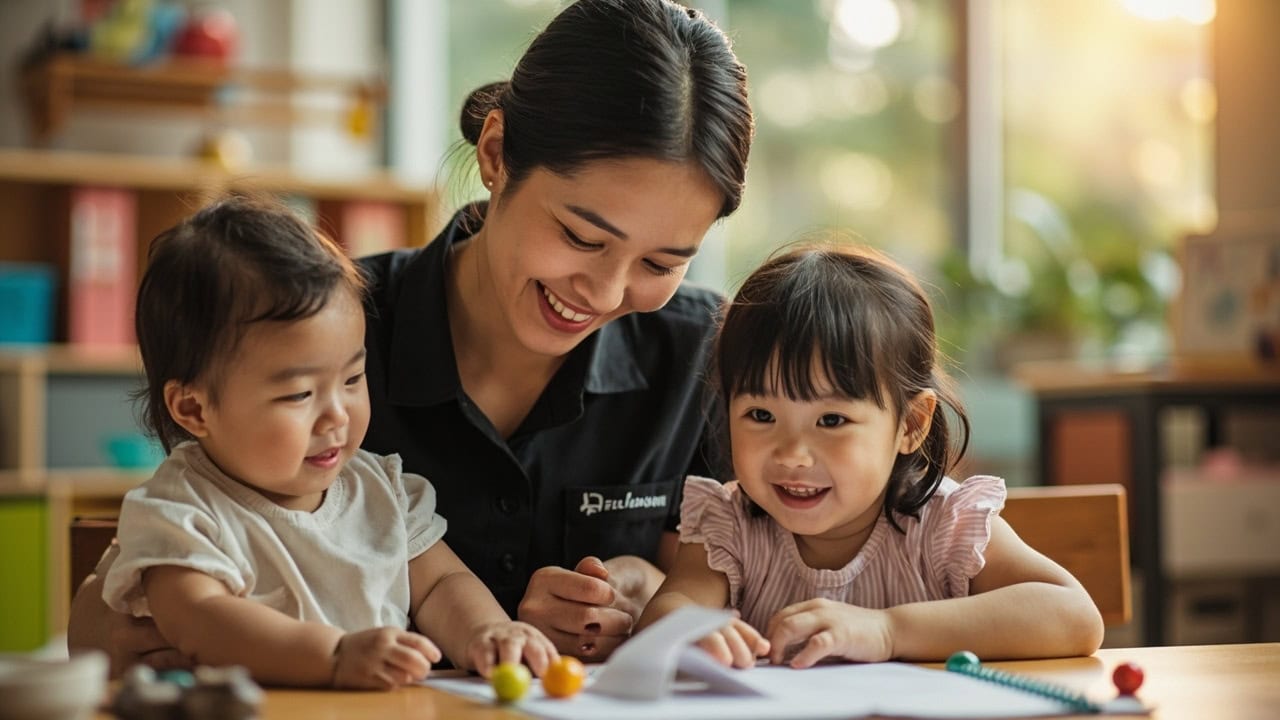
The Unseen Work: How Intentional Care Shapes Your Child’s Early Development
Reactive Supervision Versus Intentional Care
Let us begin with the distinction that sits at the heart of everything else: what separates intentional care from reactive supervision.
When a child is reactively supervised, they are kept safe. They are fed. They are changed. They are perhaps played with when there is time. Their immediate needs are met, often promptly and competently.
This is not nothing. Safety matters. Competence matters. But reactive supervision is, by its nature, responsive only to what is immediately present. It does not build anything over time. It does not have a direction.
Intentional care is different. It begins with observation. A quality caregiver watches a child with purpose — not just to keep them safe, but to understand them. What holds this child’s attention? How do they respond when frustrated? What makes them laugh? What is easy for them, and what is hard?
These observations are gathered over days and weeks, recorded in some form, and used to shape the environment and the interactions that follow.
You, as a parent, may not see the notes that are taken, the plans that are made, or the small adjustments that happen because a caregiver noticed something and responded to it. But those notes and plans are there — and they are building a picture of your child that is deeper and more detailed than any single parent’s view can be, because your child is seen across more hours, in more contexts, with more variety of companions and challenges.
What Quality Looks Like in Practice
Let me make this concrete. Imagine a fourteen-month-old boy who has been in a new childcare setting for two weeks. He cries at drop-off, as many children do. He clings to his caregiver when other children are noisy.
A reactive supervisor might interpret this as a difficult child who needs more patience. But an intentional caregiver observes more carefully. They notice that the crying happens specifically when other children approach quickly. They notice that the child is more settled in the quieter corner of the room. They notice that he watches other children from a distance before engaging.
And they begin to understand: this is not difficulty. This is a child who is processing a new, overwhelming social environment. He needs space and proximity rather than pressure. So the caregiver creates that space. They do not force interaction. They allow the child to observe from his corner. They narrate what is happening in gentle language: “Theo is building with blocks. He is smiling.” They give this little boy a framework for understanding what he is seeing — and they give him time.
A month later, this boy approaches another child on his own. He says a word that he learned from hearing the caregiver narrate social moments. He reaches out to touch a block another child is using. He is taking a social risk — a small one, but it is real.
If you, as his parent, were not told about any of this, you might not understand where that came from. But the caregiver knows. They have been building toward this moment, carefully, day by day.
Three Pillars of Quality Care
Observation is the foundation. But intentional care also rests on three interconnected practices that shape your child’s development in the hours you are not there.
Language-Rich Interaction
For young children, development happens through care. The diaper change that includes naming body parts and counting fingers and toes. The feeding routine that becomes a conversation about colours, textures, and preferences. The transition from one activity to the next, managed with language, predictability, and acknowledgment of the child’s feelings.
Language is not something taught in a lesson. Language is absorbed — every waking moment, from every interaction. A quality caregiver speaks to children as full human beings with thoughts and feelings worth acknowledging. They use full sentences. They repeat back and expand on what the child says. They describe the world in words, so that the child’s understanding and ability to talk about it grow together.
Developmental Milestone Tracking
Quality programmes do not simply watch children develop. They track that development in structured, documented ways. When a caregiver knows that a child is approaching a language leap, they provide more rich language input. When they notice a child working on gross motor skills, they offer appropriate challenges. When they see a child developing social interest, they create moments for peer interaction that feel natural rather than forced.
The documentation also means that progress is visible over time. You might notice that your child has started using two-word phrases and feel proud and surprised. But the caregiver has a record. They can tell you when the first two-word combination appeared, what preceded it, and what the child’s eyes looked like when they said it for the first time. This record tells the story of growth in a way that memory alone cannot.
The Daily Curriculum in Plain Sight
There is no moment in a quality infant care setting when learning is “switched on” and care is “switched off.” For infants and toddlers, these are the same thing.
The caregiver who responds to a baby’s cry with warmth and descriptive language — “I hear you. You are feeling tired. Let me hold you gently” — is not interrupting learning. They are delivering it. They are teaching the child that words carry meaning, that their voice matters, that the world responds to them with respect.
Every routine moment is an opportunity. This is the daily curriculum that runs quietly beneath the surface of a well-designed programme.
Recognising Quality: What to Look For and What to Ask
Quality is not about facilities. A centre with gleaming floors and a brand-new playground may or may not be providing quality care. What differentiates quality is harder to see — it is the ratio of caregivers to children, the training and values of those caregivers, and the culture that determines how they spend their time when no parent is watching.
Why Ratio Matters
When an infant programme maintains a ratio of one caregiver to three infants, that ratio is not arbitrary. It is the difference between a caregiver who can respond to each child individually throughout the day, who can observe and note and plan — and a caregiver who is managing a group, keeping children safe and comfortable but without the bandwidth for deeper work.
EduNanny, operating as part of the ECDA Childminding Pilot, maintains small ratios and structured observation practices. This is a design choice that reflects a philosophy: that every infant deserves individual attention, and that the hours in the first thousand days are building something that will last a lifetime.
Questions That Tell You More Than a Tour
When you understand what quality care looks like, you can ask better questions:
- Instead of: “What did you do today?” Ask: “What did Maya seem most interested in today? Did she try any new words? How did she handle the transition to nap time?”
- Instead of: “Is my child happy?” Ask: “How does Kai respond when he is frustrated? What have you noticed about the way he plays with other children?”
- Instead of: “Is the programme good?” Ask: “Can you tell me about a moment this week when a caregiver responded to something your programme noticed about my child?”
These questions invite the kind of thoughtful, specific response that tells you whether your child is in a place where development is being noticed and supported — or where they are simply being kept safe and entertained.
Concerns Singapore Parents Actually Have
Will my child miss me? Yes. This is a sign of healthy attachment, and quality caregivers understand it. A good programme does not try to rush your child past this. Instead, caregivers work to create a secondary attachment that feels safe and warm — one that allows your child to explore and grow while you are away.
How do I know what’s actually happening during the day? The best programmes have communication systems in place — regular updates, observation notes, milestone documentation — that close the gap between the hours you are there and the hours you are not. These tools serve the relationship, not the other way around. The goal is partnership.
Is home-based care as good as centre-based care? This depends entirely on the quality of the specific arrangement. Home-based care, when it is quality care, offers intimacy, individualisation, and flexibility attuned to your child’s rhythms. The question is whether the specific arrangement operates with intentionality, observation, and developmental rigour.
What about the cost? The ECDA Childminding Pilot offers structured fee arrangements that make quality care more accessible. CDA and Baby Bonus funds can often be used. Care blocks run Monday to Friday, aligned with the rhythm of working parents across Singapore. These are practical enablers — but the point is not affordability alone. It is access to care that is actually doing the work your child needs.
The People Who Are Paying Attention
There is a tendency to treat the caregiver as a service provider — someone you hire to watch your child. And while this is, in a sense, accurate, it misses something essential.
The caregivers in quality early childhood programmes are doing work that requires skill, knowledge, patience, and love. They are not replacing parents. They are doing something that is genuinely their own: creating an environment of safety and stimulation, building relationships with children who are not their own, tracking development across time, and making hundreds of micro-decisions every day about how to respond in ways that support growth.
This work is demanding — emotionally, intellectually, and physically. The best childcare programmes understand this. They invest in their caregivers. They train them in observation and responsive caregiving. They create structures that allow caregivers to do their work well — without rushing, without cutting corners, without burning out.
When you choose a childcare arrangement, you are not just choosing a service. You are choosing a team of people who will shape, alongside you, the earliest experiences of your child’s life. That deserves more than a transaction. It deserves a partnership.
What the First Thousand Days Actually Mean
In the first thousand days of a child’s life, the architecture of the brain is being built at a pace that will never be matched again. The connections being formed, the pathways being carved, the emotional patterns being established — these are the foundation on which everything else is built. This is not a metaphor. It is neuroscience.
The experiences that shape this architecture are not limited to the hours spent with parents. They include the hours spent with caregivers, with peers, with the physical environment, with language and sound and texture and social interaction of every kind.
What this means is that the people who care for your child in those first thousand days are participating in the making of a human being. That is an extraordinary responsibility — and it deserves to be taken seriously.
Your Role: From Outsider to Informed Partner
Understanding what quality care looks like changes your role. It shifts you from an outsider wondering what happens on the other side of the door, to an informed partner who can see what is happening, ask the right questions, and recognise quality when it is in front of you.
You can release the quiet anxiety — not because you have stopped caring, but because you understand what is happening. Understanding does not eliminate the emotional complexity of leaving your child in someone else’s care. That complexity is real, and it is valid. But understanding transforms it. It takes the unknown and makes it knowable. It takes the invisible work and makes it visible.
So the next time you pick up your child and they say something unexpected — the next time they show you something new, or do something that makes you pause and wonder where they learned it — see that moment not as a mystery but as evidence.
Evidence that the unseen curriculum is real. Evidence that the hours between drop-off and pickup are not empty hours. Evidence that someone, somewhere, was paying attention.
And feel, in that moment, not just the warmth of your child’s growth, but a quiet confidence. You chose well. You asked good questions. You found people who are doing the work with you.
How to Start: A Practical Path Forward
- Visit with intention. When you tour a centre or meet a childminder, go beyond the facilities. Ask about their observation practices, how they document development, and how they individualise care for each child.
- Ask specific questions. Use the framework from this article. Ask about ratios, language practices, and how transitions are managed. Specific questions yield specific answers — and specific answers tell you whether you are looking at intentional care or reactive supervision.
- Look for the daily curriculum. Quality care should be able to tell you how language, development, and relationship-building are woven into ordinary moments — diaper changes, meals, arrivals, departures.
- Consider home-based options. If your family values intimacy, flexibility, and individualised attention, the ECDA Childminding Pilot through EduNanny may be worth exploring. It offers the structure of a quality programme with the warmth of a home environment.
- Trust your instincts — and your knowledge. You have now read about what quality looks like. You know what to listen for. Trust that understanding.
The best care is not the care that answers all your questions with reassurance. It is the care that answers your questions with specificity — because specificity is only possible when the work is actually being done.
Every family deserves to feel confident in the people who care for their child. At EduNanny, we believe that confidence comes from knowing the work is being done — thoughtfully, consistently, and with genuine attention to your child’s development. We welcome the chance to answer your questions and help you explore whether our approach is the right fit for your family.