Beyond One Bond: What Science Tells Us About Children Forming Multiple Secure Attachments
Understanding Caregiver-Child Attachment
- Children are biologically wired to form secure attachments with multiple consistent, warm caregivers—not just their parents
- Attachment formation follows a predictable path from initial caution to genuine trust and security
- Observable signs like shortened crying at drop-off and positive eye contact signal a healthy bond forming
- Quality infant care prioritises relationship depth alongside safety and stimulation
- Your own attitude toward the caregiver-child relationship directly supports its development
The Science of What Feels Like Intuition
When we work with families at EduNanny Singapore, we recognise that choosing care is rarely simple. For many parents, it is the first real act of letting go that parenthood demands. There is something uniquely vulnerable about placing your infant in someone else’s arms and believing—truly believing—that your child will be held with the same tenderness you provide.
That belief is not naive. It is foundational. And it is exactly what quality childminding approaches are built around.
Developmental psychology has understood something for decades that parenting culture often overlooks: in the first years of life, your child is learning something far more fundamental than physical growth or cognitive milestones. Your child is learning what it feels like to trust another human being.
This learning happens through hundreds of small interactions every single day. The way a caregiver responds when your infant fusses. The tone of voice when your toddler spills something. The patience required when your child is tired, hungry, or simply overwhelmed by big feelings they cannot yet name.
These interactions are not incidental. They are the architecture of your child’s emotional world—building the internal model your child will carry into every future relationship, telling them whether the world is safe, whether people are reliable, whether they are worthy of care.
What Research Tells Us
Attachment is not a soft, abstract concept. It has measurable outcomes in brain development, stress hormone regulation, and the capacity for empathy and emotional resilience later in life.
| Early Attachment Security Leads To: | Long-Term Benefits: |
|---|---|
| Consistent caregiver responsiveness | Stronger emotional regulation |
| Predictable, warm interactions | Healthier peer relationships |
| Secure base exploration | Higher academic engagement |
| Multiple secure relationships | Greater overall resilience |
A child who forms a secure attachment in the early years is not simply happier in the moment. That child is building a neurological foundation that influences how they navigate relationships, handle challenges, and understand themselves for decades to come.
Your Child Is Wired for More Than One Bond
Here is what many parents in Singapore already sense but rarely hear articulated clearly: attachment is not limited to parents. Children can and do form secure attachments with multiple caregivers, provided those caregivers offer consistent, responsive, warm interaction over time.
This is not a consolation prize. This is not parents settling for less. This is how human development actually works.
Your child is not wired to attach to only one person. Your child is wired to recognise and bond with whoever consistently meets their needs with care and attunement. This is an evolutionary design feature, not a bug. Human societies have always relied on multiple caregivers contributing to child wellbeing.
The anxiety many parents feel—that deep worry that their child will somehow be diminished by the care of another—dissolves when we understand what attachment actually is. It is not a finite resource. It is not a competition. It is a capacity that grows richer the more it is exercised in safe, reliable relationships.
When your child forms a secure bond with their caregiver, they are not taking something away from you. They are gaining something for themselves. And that is something to be grateful for, not guilty about.
From Stranger Anxiety to Secure Trust
So what does this look like in practice? How does a relationship form between your child and their caregiver, and how can you recognise when that relationship is becoming something real and meaningful?
The Early Days: Building Associations
For very young infants, the relationship begins in a fundamental way. Your baby communicates needs through crying and body language. A caregiver responds. Over time, your baby learns that this particular voice, this particular face, this particular way of being picked up means safety.
This is why consistency matters so much in the early weeks. A caregiver who is present regularly, who responds in similar gentle ways, who develops recognisable patterns becomes a figure your infant can start to predict and trust.
The Stranger Stage: A Sign of Health
For older infants and toddlers who have already formed strong attachments to parents, the process is slightly more complex. These children often show stranger anxiety—a normal developmental stage where unfamiliar adults are treated with caution.
When you first introduce your child to a caregiver, you may see hesitation, clinginess, or even distress. This is not a sign that the arrangement is wrong. It is a sign that your child’s attachment system is working exactly as it should.
Your child has learned to distinguish between the people who are reliably present and those who are not. That discrimination is a sign of health, not dysfunction.
The Turning Point: When Presence Becomes Comfort
A skilled caregiver does not force connection. They offer presence. They offer consistency. They offer the same kind of patient, attentive responsiveness that characterises the best parenting.
They learn your child’s rhythms, their preferences, their particular ways of expressing joy and frustration. They notice when your child is tired before the yawn comes. They know which songs calm a particular child down.
Over days and weeks, you will begin to notice changes. The crying at drop-off may shorten. Your child may look toward the caregiver when they enter the room rather than only toward you. You might see a smile directed at the caregiver, not just at the toys. These are not just signs of familiarity. They are signs of the first tentative threads of trust being woven.
The Secure Base: Active, Dynamic Trust
By a few months in, for children in consistent, quality care, something remarkable often happens. Your child begins to use their caregiver as what attachment researchers call a secure base.
This means the caregiver becomes a person your child can venture away from, knowing they can return to. In free play, you might see your child move confidently across the room, exploring, testing, engaging with the environment, while occasionally glancing back at the caregiver for reassurance.
This is not a passive relationship. This is active, dynamic trust. Your child is organising their world around it.
What Quality Childminding Looks Like
Quality care is not just about keeping children safe, though safety is foundational. It is not just about stimulating them with activities and toys, though engagement matters. It is about the quality of human relationship, the consistency of attunement, and the depth of connection that allows a child to feel genuinely held, even in your physical absence.
Key Elements of Quality Care
- Small ratios: One caregiver to a small number of infants allows for the individualised attention that attachment formation requires. When a caregiver has only a few children, they can notice subtleties—a slight change in mood, a pattern emerging, a need not yet expressed in words.
- Trained responsiveness: Caregivers who understand attachment science can interpret infant and toddler cues accurately and respond in ways that build trust rather than confusion.
- Consistent presence: The same caregiver seeing your child regularly, over months, allows the relationship to deepen beyond surface familiarity.
- Warmth without intrusion: Respecting your child’s pace, not forcing interaction, allowing connection to develop organically.
How EduNanny Singapore Supports This Process
At EduNanny Singapore, this understanding shapes everything we do. We are part of the ECDA Childminding Pilot, a government-recognised initiative that takes seriously both the developmental needs of children and the practical realities of Singapore families.
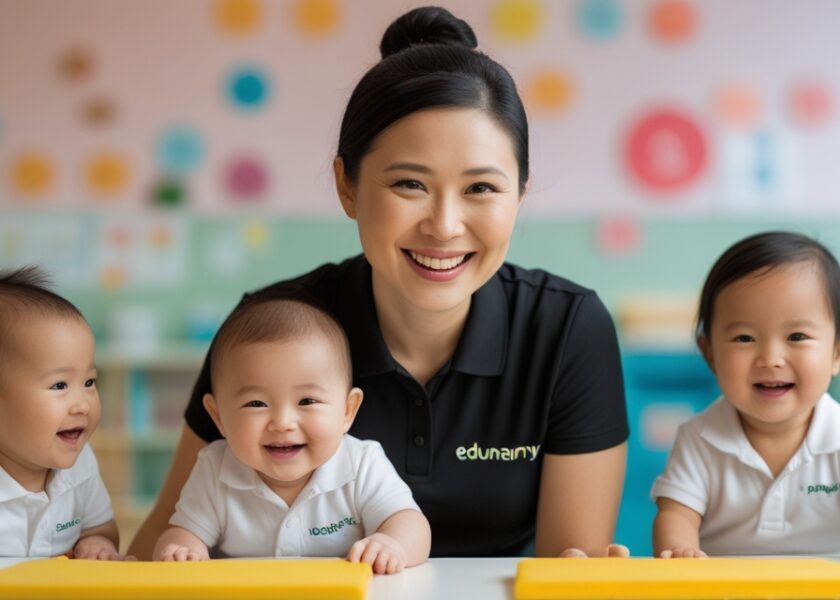
Our approach to infant care begins with ratios that allow for genuine relationship formation. With up to one caregiver to three infants in our care, we ensure that each child receives the responsive, individualised attention that attachment science tells us is essential in the early years.
Our caregivers are trained professionals who understand the science of attachment and the art of responsive caregiving. They know how to read a child’s cues, how to match their energy, and how to create moments of genuine connection within the rhythms of a care day.
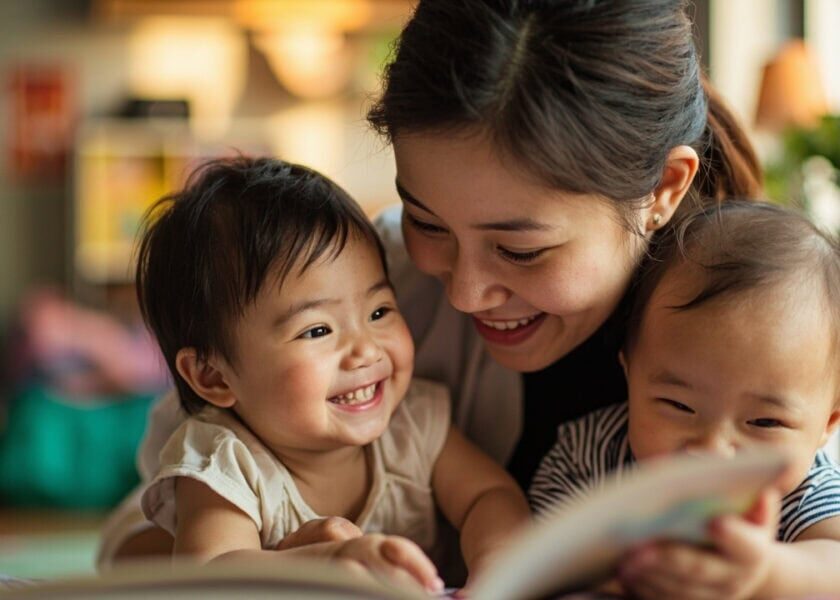
They talk to infants, even before those infants can respond in words, because they understand that language, warmth, and presence begin building relationships from the very first days of life. They hold toddlers with patience when separation is hard. They celebrate small victories—whether it is a new word spoken or a new skill attempted—because these moments of shared joy are the currency of relationship.
Addressing Common Parent Concerns
Will my child feel abandoned?
When care is responsive and warm, children do not experience the caregiver’s presence as a replacement for yours. They experience it as an expansion of their safe world. The child who runs to greet their caregiver at drop-off and then plays confidently is generalising what they learned from you—that certain people are safe, that the world contains trustworthy adults.
What if my child cries every time I leave?
Some crying at separation, especially in the beginning, is normal and expected. What matters is what happens after you leave. A child who cries briefly and then settles, who is comforted by the caregiver’s presence, who gradually shortens their crying episodes over weeks—this is a healthy pattern of adjustment.
If your child remains highly distressed for extended periods, or if distress increases rather than decreases over time, these are conversations to have with your caregiver and with us.
How do I know the bond is real and not just familiarity?
There is a meaningful difference between a child who has learned to tolerate a caregiver and one who has formed a genuine attachment. Look for these signs:
- Your child seeks proximity to the caregiver, not just accepts it
- Your child uses the caregiver for comfort when upset, not just for entertainment when happy
- Your child shows specific positive emotions toward the caregiver—joy on seeing them, relief when distressed and then soothed
- Your child explores away from the caregiver and returns, showing trust in their responses even in new situations
Can I afford quality care?
We know that for many Singapore families, practical considerations shape the landscape of possibility. Childcare costs can feel overwhelming, and the stress of balancing work and family life is real.
EduNanny is designed to be accessible within the framework of the Childminding Pilot, with fee structures that aim to make quality care a realistic option rather than a privilege. For families eligible for the Child Development Account and Baby Bonus schemes, these resources can be applied.
We also recognise that trust must flow in multiple directions. That is why transparency is built into how we operate. Depending on the specific service arrangement, we maintain communication practices that keep you connected to your child’s day—regular updates, photographs, and narrative reports about your child’s experiences. These are extensions of the trust you place in our caregivers, tools that help you see what we see.
Your Role in Supporting the Caregiver-Child Bond
One of the questions we are asked most often is how parents can reinforce the caregiver-child relationship from their own end. The answer lies in something that may feel counterintuitive at first.
You can support this relationship by taking an interest in it, by treating your child’s caregiver as a genuine collaborator in your child’s life rather than as a service provider you evaluate at arm’s length.
- Ask your child about their day. Use the caregiver’s name in your conversations at home, so that the relationship exists in your child’s mind not just at the care setting but as part of their broader world.
- Respond with genuine interest when your child mentions positive experiences with their caregiver. When your child expresses happiness about something the caregiver did, respond with warmth, not with jealousy or dismissal. These moments are opportunities to validate the significance of your child’s relationships.
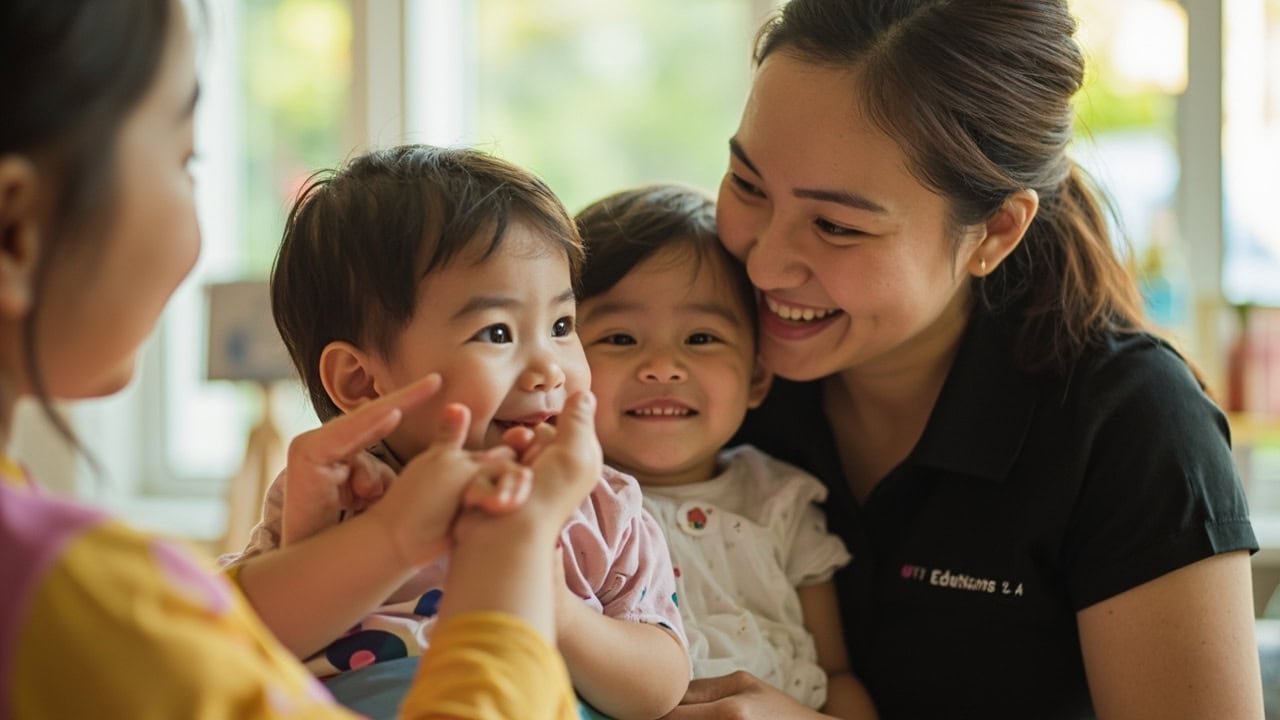
- Let moments of connection happen. When you pick your child up and they run to show their caregiver something, let that moment happen. Witness it. Celebrate it. That child running toward their caregiver with joy is not a child who has forgotten you. That child is a child who has learned that the world contains trustworthy people.
- Share information generously. Tell the caregiver about changes at home, about what your child has been enjoying, about any disruptions or stresses that might affect your child’s mood. This flow of information helps the caregiver remain attuned.
There is also something profoundly reassuring in understanding that you are not absent from this process even when you are physically away. The conversations you have with your child about their day, the questions you ask, the interest you show—these are active participation in your child’s meaning-making.
You are helping your child articulate their experience, which builds emotional literacy. You are showing your child that their relationships matter to you, which reinforces the security they feel in those relationships. You are weaving yourself into the narrative rather than feeling erased from it.
Moving Forward With Confidence
When your child runs into the arms of their caregiver at the start of the day, when that same child looks back at you with a smile before turning to play, when you receive a message about how your child laughed at something or conquered a small fear or fell asleep peacefully in someone else’s arms—what you are witnessing is not just childcare.
You are witnessing the first chapter of your child’s social world being written. You are seeing your child learn that people outside your family can be safe, can be kind, can be trusted. That is not a small thing. That is enormous.
We live in a world that sometimes reduces early childhood to metrics. Developmental milestones achieved on schedule. Skills acquired. Futures secured. And while these things matter, they are not the heart of it.
The heart of it is the look on your child’s face when they feel genuinely known. The sound of your child’s laughter when a caregiver plays alongside them. The way your child settles into a routine because they have learned to expect warmth and consistency. These moments are not incidental to what quality care provides. They are what quality care means.
If you are a parent wondering whether what you are considering for your child is truly right, I want you to know that your instinct to care deeply about this is not a weakness. It is not overprotectiveness. It is the most fundamental expression of what it means to love your child.
EduNanny Singapore exists because we believe every child deserves to feel held, every family deserves to feel supported, and every caregiver deserves recognition as a meaningful figure in a child’s life. We are proud to be part of a system, through the ECDA Childminding Pilot, that takes this belief seriously enough to invest in the ratios, the training, the frameworks, and the oversight that make it possible.
We are here to honour your love for your child by partnering with you, by caring for your child with the same attention and warmth you would provide, and by building with you a relationship that makes the invisible work of early childhood visible, understandable, and trustworthy.
Your child is not just being cared for. Your child is being known. And that changes everything.
If you would like to learn more about how EduNanny Singapore supports caregiver-child attachment through the ECDA Childminding Pilot, we invite you to schedule a conversation with us. We are happy to answer your questions, walk you through our approach, and help you think through what quality infant care might look like for your family.