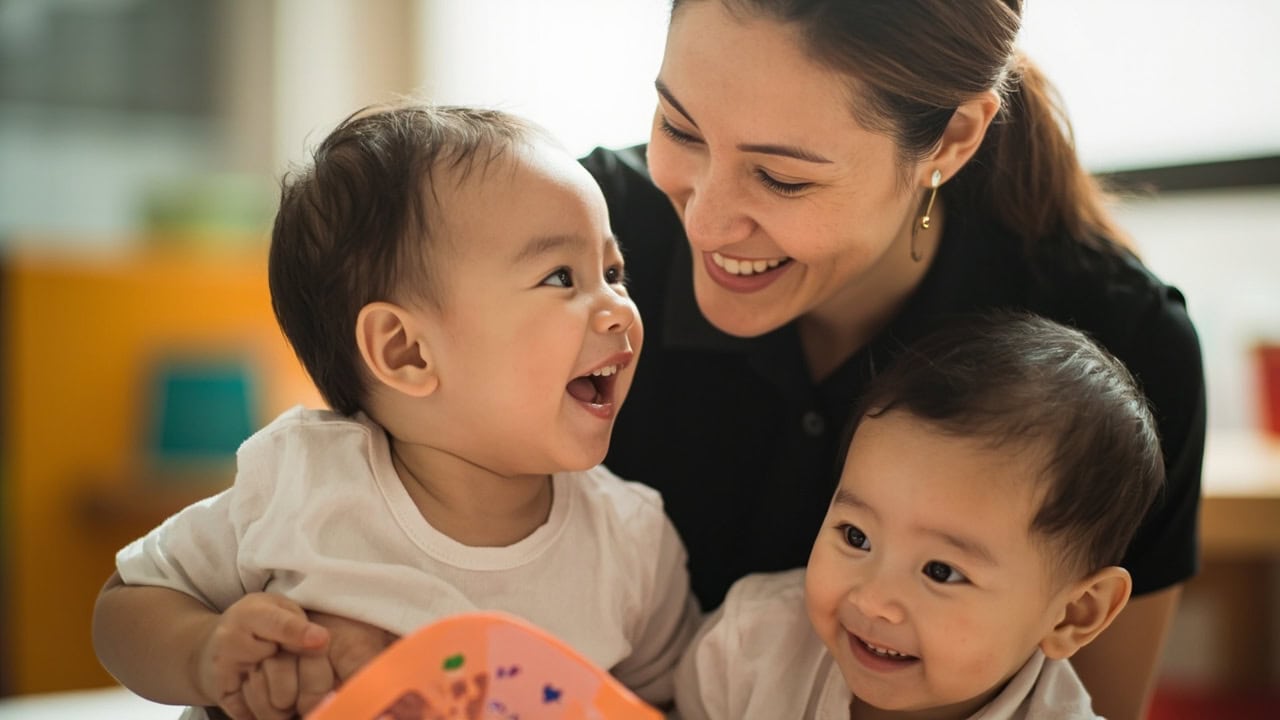
What Singapore Parents Should Actually Look For in Childcare
The Moment Every Singapore Parent Dreads: Walking Into a Childcare Centre With No Idea What to Look For
There is a particular kind of quiet anxiety that visits you the moment you step through the doors of a childcare centre. You have done the research. You have read the reviews. You have made the appointment. And yet, standing there in a brightly painted room surrounded by impressive facilities and smiling caregivers, you realize you have no idea what you are actually looking at.
This is the moment I want to talk about today. Not the moment of doubt itself, but what happens after it. The moment when a parent like you learns to see what is really there.
Singapore parents are some of the most engaged, most invested parents in the world. You approach the decision of who will care for your infant with the same seriousness you would bring to any major life choice. You ask questions. You request tours. You take notes. You go home and compare and cross-reference and worry.
And yet, despite all of this effort, there remains a nagging uncertainty. A sense that you are evaluating surfaces when what matters most lives somewhere deeper.
This is not a failure of your instincts. It is a gap in vocabulary. There is a difference between knowing that good care matters and knowing how to recognize it in the moment you are standing inside it. That difference is what I want to help you close today.
What Quality Childcare Actually Looks Like: A Framework for Seeing
Most parenting guidance assumes that quality childcare is something you feel—something that reassures you at the gut level. Your gut is not irrelevant. But the gut alone, without framework, without language, can be easily deceived by a beautiful paint palette and a well-rehearsed welcome.
What I am offering you here is something more durable. A way of seeing. Once you know what quality looks like, you do not have to rely on hope. You can recognize it.
Here are the key indicators you will learn to identify in the sections that follow:
- Caregiver speech reveals whether individual children are known by name, preference, and rhythm—not just greeted by template
- Children’s bodies tell you about emotional safety: relaxed shoulders, unhurried hands, presence rather than vigilance
- Language is everywhere—not just instructions, but conversation, narration, and back-and-forth that builds thinking
- Purposeful materials that children actually use signal an environment designed for learning, not just display
- Quality is in the texture of hundreds of small interactions, not in any single polished moment
Inside the Room: Learning to Observe
The Sound Beneath the Noise
The first thing I want you to notice is not the room itself. It is the sound. Not the overall noise level, which can be managed and manipulated, but the texture of the adult voices in the space.
Listen for how caregivers speak to children individually. There is a vast difference between a voice that performs warmth and a voice that embodies it.
The caring voice does not say things in a singsong tone for the benefit of visiting parents. The caring voice says a child’s name before making a request. It acknowledges what a child is doing before redirecting. It uses specifics.
Not just “good job” but “you figured out how to fit that in the container.”
Not just “be gentle” but “watch how softly you can touch the baby’s hair.”
When you hear a caregiver speak this way, you are hearing evidence of something important. You are hearing a relationship. You are hearing a person who has taken the time to know this child, not as a group member, but as an individual with preferences, rhythms, and responses that are particular to them.
That individual knowledge is the foundation of everything else. Without it, care is just supervision. With it, care becomes something your child can grow inside.
What Children’s Bodies Tell You
Now look at the children themselves. Not at whether they are happy, which is too broad a question, but at how they are holding their bodies.
A child who feels safe in an environment does not need to be performing safety. You will not necessarily see joy radiating from every face. Children in high-quality care get frustrated. They negotiate. They have hard moments.
What you will see is the absence of a particular kind of tension. The shoulders are not hunched. The eyes are not scanning the room for an exit. The hands are not fisted.
When a child is emotionally safe, there is a kind of ease in how they inhabit the space. They are not bracing for something. They are simply present.
This is one of the most reliable indicators of quality that exists, and it is also one of the least discussed. Parents are told to look for engaged children, curious children, active children. These are not wrong metrics. But a child can appear engaged while still carrying quiet anxiety underneath.
What you are looking for is not performance. You are looking for evidence that the child’s nervous system feels held by the environment. That is a different and more important question.
Decoration Versus Purposeful Materials
Notice the materials around you. Not the decorations on the wall, which are there partly for you, but the objects that children are actually using.
Purposeful materials invite thinking. A shelf of wooden blocks at the right developmental stage is not decoration. It is an invitation to spatial reasoning, to cause and effect, to collaboration when a second child joins. A basket of natural objects—shells or pinecones or pieces of cloth with different textures—is not filler. It is sensory work that builds neural pathways in the first thousand days when those pathways form most rapidly.
Here is the distinction I want you to internalize: decoration communicates that someone has thought about how the space looks to adults. Purposeful materials communicate that someone has thought about how the space works for children.
When you visit a centre, ask yourself where the materials are that children are actually interacting with. Are they accessible? Are they varied? Are they changed regularly?
A room where everything is behind glass or locked away, where the shelves hold perfect rows of objects no child has touched, is a room designed for tours, not for children. Quality care environments are always, in some visible way, slightly used. A little worn. Actively in use.
That messiness is not a sign of neglect. It is a sign of life.
The Language Environment: Why Conversation Matters More Than You Think
Children in the first three years are acquiring language at a rate they will never match again. Every conversation they hear, every response they receive, every back-and-forth exchange with a caregiver is literally building the architecture of their thinking.
In a high-quality infant care environment, you should hear language everywhere. Not just instructions. Not just labels. You should hear conversation.
A caregiver kneeling beside a child holding up an object and narrating: “You found the blue lid. It goes round and round. Can you find where it came from?”
This is not idle talk. This is cognitive scaffolding. This is an adult treating a child’s experience as worthy of shared attention, which is precisely what builds the capacity for sustained focus later.
Listen also for how children’s communication is received. When a twelve-month-old points and babbles, does the caregiver respond as if the child has said something meaningful?
A high-quality caregiver will interpret, expand, and reflect back. “You want the ball? The red ball? Here it comes.”
That response teaches the child that communication works, that their attempts land, that the world responds to them. In a less intentional environment, that same babble might be acknowledged with a distracted nod or redirected without interpretation.
The child still gets care. But the language-rich environment is doing something the other one cannot. It is building minds.
Why One Visit Cannot Tell You Everything (And Why It Still Matters)
Quality in childcare is never a single moment. It is never the tour when everyone is on their best behavior. It is not the welcome packet or the promotional video.
Quality is the texture of hundreds of small interactions accumulated over time. It is the way a caregiver speaks when no parent is watching. It is the third hour of the day when energy dips and patience must compensate. It is the child who is having a meltdown and how the room responds.
Quality reveals itself in the unguarded moments, in the ordinary days, in the routines that happen the same way every day because consistency is how infants learn to trust the world.
This is why a tour, by itself, cannot tell you everything. But a tour can give you information if you know what to look for. And knowing what to look for is the difference between choosing with your heart alone and choosing with your heart informed by your eyes.
Your Observation Checklist: What to Look For on Your Next Visit
Before you go, decide that you are not just touring. You are observing.
- Watch the caregivers already engaged with children, not just the one who greets you
- Listen to the actual sound of the room, not just what you are told about the curriculum
- Notice whether children approach caregivers freely or hang back
- Notice whether supervision interrupts play or protects it
- Watch how transitions happen—they reveal the stress tolerance of an environment
- Look for repair—quality environments are not perfect, but they mend quickly
Trust what you see. Not because it is perfect. Quality environments are not perfect. Children still argue. Caregivers still have hard days. But in a quality environment, you will see warmth that does not switch off when the visit begins. You will see knowledge of individual children embedded in the way adults speak to them. You will see an environment that feels not just safe but genuinely conducive to growth.
EduNanny by BUTLER: Where Quality Becomes Structural
If this way of seeing resonates with you, I want to introduce you to a model that was designed with exactly these principles in mind.
EduNanny by BUTLER operates within the ECDA Childminding Pilot, and this matters because it means the framework you have just learned to recognize is not aspirational for EduNanny. It is structural. It is built into the model itself.
The Ratio That Makes Individual Knowledge Possible
In infant care, the ratio of caregivers to children is not a bureaucratic footnote. It is the precondition for everything we have been discussing.
EduNanny maintains ratios of up to one caregiver to three infants. This is not a marketing claim. It is a number that makes individual knowledge possible. It is what allows a caregiver to notice that this child is fussier today, to know that child’s favorite song, to respond with specificity rather than template.
In an environment with too many children and too few adults, the best intentions collapse under the weight of numbers. EduNanny has chosen a structure that makes the quality we have been discussing achievable, not just desirable.
Two Pathways, One Standard
EduNanny offers both home-based and centre-based pathways, understanding that every family has a context that belongs to them.
For some families, the intimacy of home-based care is what they need. For others, the community dimension of centre-based care aligns better with their values. Both pathways within EduNanny are held to the same standard of intentional observation, language-rich interaction, and emotional attunement.
You are not choosing between philosophy and practicality. You are choosing a model that has already integrated them.
Consistency, Accessibility, and Staying Connected
Monday to Friday care blocks provide the consistency that young children need to build trust and attachment to routine.
Because EduNanny participates in the ECDA Childminding Pilot, the fee structures are designed to be accessible. CDA and Baby Bonus funds are usable, which means the financial dimension of this decision does not have to add another layer of anxiety to an already demanding process.
And then there is the question that matters beyond the daily experience: how do you, as a parent, stay connected to what is happening while your child is in care?
EduNanny answers this with genuine transparency. Communication channels are open and active. Where deployed, monitoring measures provide an additional layer of assurance without replacing the human relationships that are at the core of quality care.
These are not features added to impress. They are tools that support the trust that must exist between the family and the caregiver. Because quality care is not something that happens to you. It is something you participate in.
Questions Singapore Parents Ask Before Enrolling
“How do I know if the caregiver will really know my child?”
Ask to observe how a caregiver speaks to children during your visit. Notice whether they use names, reference specific behaviors, or speak with the kind of particularity that comes from genuine attention. Low ratios make this kind of knowing possible.
“What if the centre looks impressive but the care is surface-level?”
Impressive facilities can deceive. Return to what you now know to look for: caregiver speech patterns, children’s body language, materials that show signs of actual use, language that goes beyond labeling. The room itself is not the answer. The interactions within it are.
“Can I really assess quality in a single visit?”
A single visit cannot tell you everything, but it can tell you something real. You are not looking for perfection. You are looking for evidence that the adults in this space know children as individuals, that the environment serves them, and that warmth is structural rather than performed.
“Is home-based care as quality-conscious as centre-based care?”
The question is not the setting. The question is the intentionality within the setting. EduNanny holds both pathways to the same observational and interactional standards, because quality is not about square footage. It is about whether your child is seen.
The Decision You Are Really Making
The decision you are facing is not really about childcare. It is about something older and more fundamental than that.
It is about whether your child, during the years when their brain is forming faster than it ever will again, will be in an environment that sees them. Not just watches them. Not just keeps them safe. Sees them. Knows them. Responds to them with specificity and warmth and intention.
Every parent in Singapore deserves to feel confident walking into a childcare decision, not because the options are all the same, but because they have learned to recognize the difference.
You now have language for what you were already feeling. You know that caregiver speech reveals individual knowledge. You know that children’s bodies tell you about emotional safety. You know that purposeful materials signal intentional pedagogy. You know that language richness is not optional in the first thousand days. You know that quality is in the texture, not the highlight reel.
When you visit EduNanny, visit as someone who sees. And notice what you see.
The work of raising children in this city is demanding. It asks everything of you and then asks for more. The choice of who will stand beside you in that work, who will spend hours with your child while you are apart, is one of the most consequential choices you will make.
But you are no longer approaching it without a map. You understand what matters. You know how to look.
EduNanny by BUTLER is an environment that does not shrink from your scrutiny. It invites it. Because quality that can be seen is quality that can be trusted.
Your child deserves to be known. You deserve to know that they are known. And now, you have the eyes to find exactly that.
Explore EduNanny’s infant care options and discover what quality looks like when you know how to see it.
EduNanny by BUTLER is a trusted infant care and childminding service for families in Singapore. Learn more about our approach or get in touch to begin your visit.