Why Your Child Deserves More Than Just Supervision: A Science-Based Guide for Singapore Parents
Beyond Safety: What Quality Childcare Really Does
We talk so often about what childcare provides: safety, schedules, peace of mind for working parents. These things matter enormously. But they are the floor, not the ceiling.
What we do not discuss enough is what becomes possible in a child’s life when the childcare they attend is not merely adequate, not merely safe—but a place that understands, down to its bones, how children grow.
This article is about the extraordinary developmental journey that unfolds when children are in the right environment. And how you, as a parent in Singapore, can recognize that journey, celebrate it, and ensure your child has every condition necessary to flourish within it.
The Science of Early Childhood Development
Let us begin with the child themselves—because the story of quality childcare is, first and foremost, the story of what a child is becoming.
In the first years of life, a child’s brain forms more than one million new neural connections every second. This is not a slow, steady process. It is a burst of creation unlike anything that will happen again. The pathways that form in these years—the language circuits, the emotional regulation systems, the social navigation networks, the foundations of executive function—these are not just preparing your child for school. They are preparing them for everything: for how they will handle frustration at forty, for how they will form relationships at twenty, for how they will learn new skills at sixty.
Here is what many of us were never told: this architecture does not build itself. It builds from experience. The brain is not waiting passively for instruction. It is watching, absorbing, responding to every interaction, every environment, every moment of warmth or stress, every word spoken in its presence or withheld from it.
The child is not a vessel to be filled. The child is an architect, and every experience is material.
This is not a comfortable idea if you are a parent who has ever left your child in someone else’s care. But it is a hopeful one. It means that what happens in those hours matters—not as a substitute for your love, but as a complement to it. The brain does not ask whether the hands that nurture it belong to a parent or a professional. It asks only: is this environment rich with what I need to build myself?
The difference between being cared for and being cultivated is the difference between providing water and providing sunlight, rich soil, and room to grow. A child who is merely cared for survives. A child who is cultivated thrives.
What Cultivation Looks Like in Practice
Now, what does that cultivation look like? What actually changes in a child who spends their early years in a quality environment?
Language Development
Language is often the most visible transformation. Children in language-rich settings do not simply acquire more words. They acquire the architecture of thought itself. Vocabulary grows—but so does the ability to sequence, to narrate, to ask questions, to sustain a conversation beyond immediate needs. A child who has been spoken to, read to, sung to, and listened to throughout their early years arrives at kindergarten not just knowing more words, but thinking more complexly.
Social Skills
Social development follows a parallel path, though it is often harder to see. Children in quality settings learn the grammar of human connection: how to read a face, how to wait for a turn, how to negotiate, how to repair a friendship that has frayed. These are not instincts. They are skills, and like all skills, they develop with practice. A child who has had consistent, responsive interaction with adults and peers learns that other people have inner lives, that relationships require attention, that they themselves have something to contribute.
Motor Development
Motor development is transformed—not just in the crude sense of big muscles learning to run and climb, but in the finer sense of hands learning to pour, to build, to manipulate, to create. The brain’s hand area is intimately connected to its language and social areas. A child who develops fine motor control through purposeful play is simultaneously building the neural foundations for writing, for managing tools, for solving physical problems, for expressing ideas through making.
Confidence
And then there is confidence—the quiet, durable kind. Not bravado, but the deep sense that the world is explorable, that challenges are manageable, that failure is not final. This confidence is not taught. It is earned through experience. A child who has been given safe opportunities to test their abilities, to fall and get back up, to try again, to succeed after difficulty—this child carries something precious forward into every new situation they will ever face.
Recognizing Healthy Development in Your Child
How do you know when these transformations are actually happening? The answer is not always obvious. Many parents watch for the wrong things—academic readiness, letters, numbers, the ability to recite facts. These have their place, but the most meaningful indicators are often more subtle.
Observe your child after a day in care. Do they initiate conversation with you? Not just respond, but introduce topics, share observations, ask questions? This is a profound sign of language development—the ability to use words not just reactively, but proactively, to share an inner world.
Watch how they handle frustration. A child who has been in a quality environment has had countless small opportunities to experience manageable challenges and find ways through them. They have learned that effort matters, that problems can be solved, that grown-ups can help without rescuing. This resilience is visible in the body as much as in words—a looseness, a persistence, a refusal to collapse at the first sign of difficulty.
Notice their play. When children play in ways that are genuinely developmental, you will see imagination, complexity, and sustained engagement. They will create narratives, assign roles, solve problems within the play itself. They will not need constant entertainment from adults. They will generate their own challenges and find their own solutions.
Pay attention to their awareness of others. Does your child notice when another child is upset? Do they show signs of empathy, of shared concern, of wanting to help? This social-emotional attunement is one of the clearest markers of healthy development.
Listen for the questions. A child who asks “why” and “how” is not just being curious. They are building causal understanding, the foundation of scientific and logical thought. Every question is a building block. A child who has been in a language-rich, responsive environment asks questions constantly—about the world, about people, about themselves. This hunger for understanding is one of the most beautiful gifts quality care can nurture.
What Quality Environments Look Like
All of this—the language, the social skills, the motor development, the confidence, the curiosity—does not happen by accident. It happens in environments that have been thoughtfully designed to make it possible.
The Caregiver’s Role
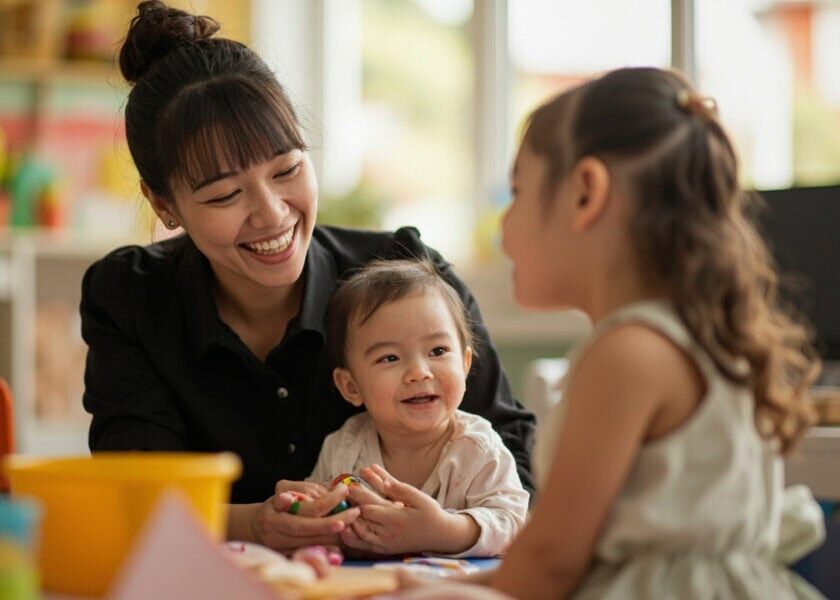
In quality environments, caregivers do not simply watch children. They observe them, respond to them, scaffold their learning, and stretch them just slightly beyond what they could manage alone. They are not entertainers or supervisors. They are partners in development—warm, attentive, and deeply knowledgeable about how children grow.
The Physical Space
The physical space itself teaches. Materials are chosen not for their shininess but for their developmental utility. There are opportunities for gross motor play and fine motor work, for solitary exploration and social interaction, for quiet reflection and energetic movement. The environment speaks a language of possibility.
Routine and Flexibility
Routine is not a straitjacket but a scaffold. Children thrive on predictability because it gives them the security to explore. They know what comes next, so they can invest their energy in learning rather than in anxiety. But within that predictability, there is always room for spontaneity—for following the child’s lead, for seizing the teachable moment as it arises.
The Presence of Language
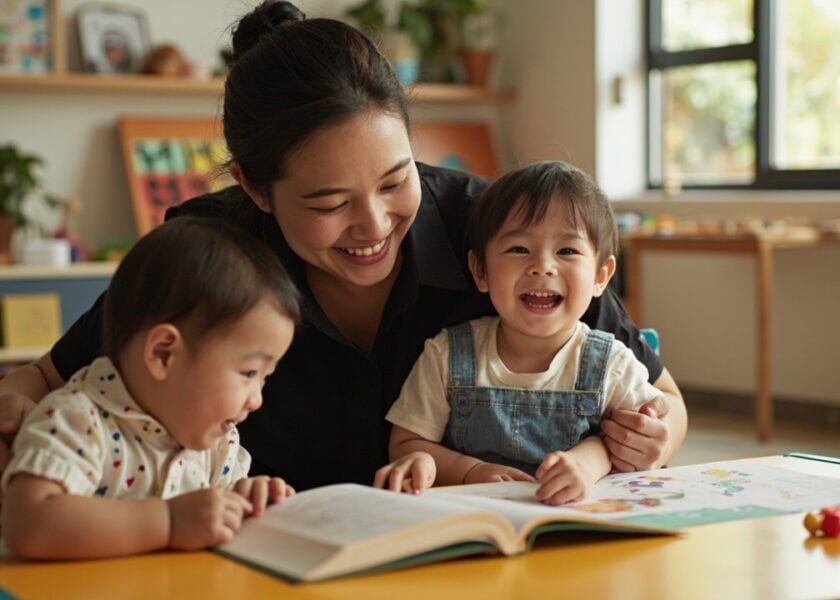
Language is everywhere. Adults narrate what is happening. They extend children’s sentences, modeling richer forms of expression. They read books not as tasks but as invitations to imagination. They ask open-ended questions that invite thinking rather than just correct answers. Language is not a subject taught at certain times. It is the medium through which the entire day flows.
This is what intentional care looks like. It is not a checklist of activities or a schedule of lessons. It is a philosophy made visible in every interaction, every material, every decision about how the day unfolds. It is the understanding that every moment with a young child is an opportunity for growth.
How EduNanny Supports Your Child’s Development
EduNanny was built on this understanding. Not as an abstract principle, but as a daily practice. EduNanny is not in the business of finding someone to watch your child. It is in the business of finding people who understand what your child needs to grow—and creating the conditions for them to provide it.
This distinction matters. It is the difference between a transaction and a calling.
Professional Standards
EduNanny participates in the ECDA Childminding Pilot, which means its caregivers are part of a structured, quality-assured pathway that brings professional standards to the role of the childminder. The training, the oversight, the culture of continuous improvement—these are not luxuries. They are necessities.
Infant-to-Caregiver Ratios
In EduNanny’s care settings, the infant-to-caregiver ratio is never allowed to become a statistic. Up to one-to-three ratios in infant care are the practical expression of a belief that every infant deserves not just supervision but attention—the kind of attention that notices the first stirrings of a new skill, that responds to distress before it becomes despair, that creates the security from which exploration can safely grow.
Pathways for Singapore Families
EduNanny offers pathways that recognize the diversity of Singapore families. Home-based care brings the warmth and individualized attention of a family setting, with a caregiver who becomes a trusted extension of your household. Centre-based care offers structured environments designed with developmental principles in mind, where children benefit from peer interaction and specialized resources. Both pathways share the same foundational commitment: that every child in EduNanny’s care is treated as a whole person whose potential is worth cultivating.
Accessible Quality Care
This care is accessible. The pilot fee structures are designed to make quality care a realistic option for more families, not just those with unlimited resources. CDA and Baby Bonus funds are usable, reducing the financial burden at a time when families need every resource they can access. This is not charity. It is a conviction that the children who benefit most from quality care should not be determined by their parents’ income alone.
Communication and Transparency
What happens in these settings every day is visible to you. EduNanny’s communication protocols are built on a simple belief: you should not have to wonder what your child is doing. Whether through digital updates, direct conversations, or documentation of milestones, you are kept informed about your child’s experiences, their progress, their joys, and their challenges. In settings where CCTV measures are deployed, this transparency extends to the physical environment itself. Trust is not assumed. It is built, day by day, through consistent, honest communication.
A Framework for Evaluating Any Childcare Provider
If you are weighing your childcare options, here is a framework that will serve you no matter which provider you ultimately choose.
| Ask About | What to Look For |
|---|---|
| Development philosophy | Do they articulate a clear understanding of how children grow? Or do they focus only on supervision and entertainment? |
| Caregiver training | Are caregivers trained in child development, not just safety protocols? Do they receive ongoing support? |
| Staff-to-child ratios | Will your child receive genuine attention, or be one among many? Can caregivers respond to individual needs? |
| Individual recognition | Does the setting treat children as individuals with unique needs, or as a group to be managed? |
| Communication | Will you know what your child is doing each day? Are updates provided proactively? |
| Environment | Is the space designed with developmental purpose? Do materials support learning through play? |
| Typical day | Is there a balance of structure and flexibility? Room for children’s own initiatives? |
| Parent involvement | Do they welcome your questions and presence? Or do they seem to discourage involvement? |
Ask not just whether a childcare setting is safe or clean or conveniently located. Ask what they believe children need to grow. Ask to see the environment and to observe an interaction. Ask what a typical day looks like and whether there is room for children’s own initiatives within it.
These questions will not always receive satisfying answers. But they will tell you something important: whether the people caring for your child have thought carefully about what they are doing and why.
Your Child’s Story Is Already Being Written
You want your child to flourish. Not just survive the early years, but genuinely flourish. You want them to arrive at school ready to learn, to make friends, to ask questions, to believe in themselves. You want them to grow into someone who can navigate the world with competence and kindness, with curiosity and resilience.
That is not too much to want. It is exactly what every child deserves—and what quality care can help make possible.
The early years are not a rehearsal. They are the performance itself, happening now, while your child is building the person they will become. Every moment counts. Every interaction shapes. Every opportunity seized or missed leaves its mark.
In the right environment, with the right support, your child will not just be cared for. They will be cultivated. Their language will bloom. Their social world will expand. Their bodies will master new movements. Their minds will light up with understanding. Their confidence will grow from a seed into something visible and durable.
And you will see it. Not in a single dramatic revelation, but in the quiet accumulation of small changes that add up to a transformation. The words they learn to say. The friends they learn to make. The challenges they learn to face. The questions they learn to ask. The person they are becoming, day by day, in the hands of those who have made their growth their purpose.
At EduNanny, this belief is not just a philosophy. It is a daily practice. Every interaction, every decision about how to care for the children entrusted to us, every moment of attention and intention—we work to make quality childminding real, one child at a time.
Your child is lucky to have you. And with the right support, their future is brighter than you can yet imagine.
To learn more about how EduNanny supports Singapore families with quality, development-focused childcare and childminding, visit our about page or get in touch with our team.