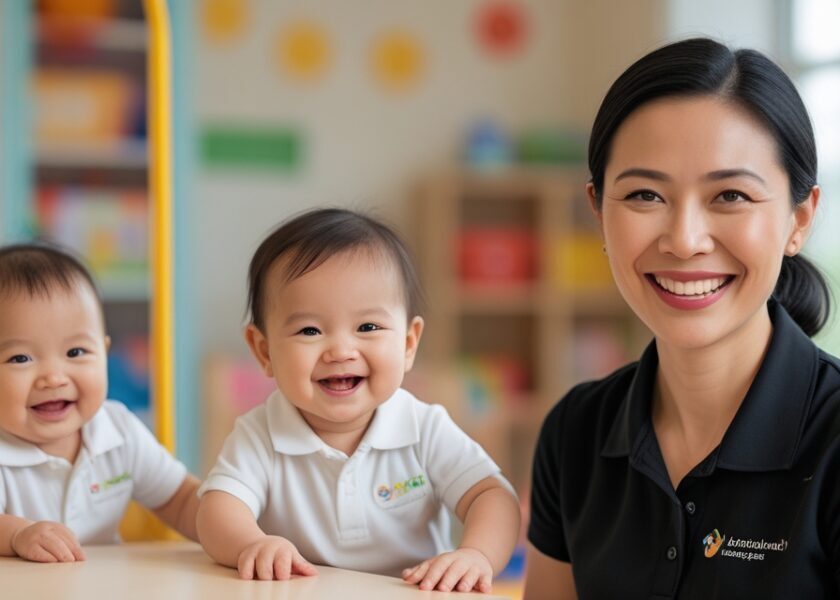
The Hours That Shape Your Child More Than You Know
What Your Child Is Becoming While You’re Apart
There is a question that most parents in Singapore never quite ask out loud, but one that lives somewhere quiet and persistent behind every morning handover, every gentle reassurance at the door, every quiet moment in the car or at the desk wondering how the day is unfolding on the other side of those walls.
That question is simple in its shape, though anything but simple in its weight: What is my child actually doing and becoming during the hours that we are apart?
You dress them in the morning. You kiss their forehead. You tell them you’ll be back. And then you step through the door, and for the next eight or nine hours, your child’s world is largely a mystery. Not an uncomfortable mystery, perhaps, if you have trusted the people you’ve left them with. But a mystery nonetheless.
You send them into someone else’s hours, and you hope—fervently, deeply—that those hours are not just passing. That they are building. That somewhere in the rhythm of another person’s day, your child is not merely being watched, but being shaped.
This is the question that EduNanny Singapore was built to answer. Not just with reassurances, but with intention. Not just with warmth, though warmth matters enormously, but with a philosophy that every single hour in quality childcare is a designed opportunity for growth.
The Difference That Matters: Supervision Versus Development
There is a difference, and it is a significant one, between a childcare arrangement that provides supervision and one that provides development.
Supervision keeps a child safe. It keeps them clean and fed and within arm’s reach. Supervision is necessary and it is a legitimate service, and we do not diminish the value of any caregiver who offers it with care.
But development is something else entirely.
Development is the deliberate, trained, responsive use of every interaction, every object, every moment of play, every transition between activities, to strengthen the architecture of a growing brain. Development is:
- Noticing when a toddler is on the verge of a language explosion and filling the environment with rich, reciprocal conversation
- Recognizing that a baby is working hard to master the pincer grasp and offering the exact texture and size of object that will help them get there
- Understanding that when a two-year-old is struggling to share a toy, this is not a behavioral problem to be stamped out but a social-emotional milestone to be gently scaffolded
EduNanny Singapore operates within the ECDA Childminding Pilot, a regulated framework that recognizes childminding as a legitimate, dignified, and professionally supported form of early childhood care. For parents in Singapore, this opens practical doors: eligible families can utilize the Child Development Account (CDA) and Baby Bonus schemes to help offset costs.
This is the gap that separates adequate from excellent in infant and childminding care. And it is the gap that EduNanny Singapore was designed to close—not through gimmicks or promises, but through structure, training, and genuine professional commitment to developmental science.
Infant Care: The Science of the First Year
The Power of Small Ratios
In EduNanny’s infant care arrangements, the ratio of caregiver to infant is never more than one to three. Let us sit with that number for a moment.
One caregiver. Three infants.
That is not a number chosen at random. It is a number that reflects what developmental science tells us about the quality of attention that infants require to form secure foundations. When a caregiver is responsible for only three infants at a time, she can:
- Notice when one is frustrated before that frustration escalates
- Recognize when another is on the edge of fatigue and help them settle
- Respond in real time when a third is reaching for a new kind of engagement
- Narrate the world to a baby who is just beginning to understand that sounds carry meaning
She can be present in a way that one-to-six or one-to-ten simply does not allow. This is not a logistical convenience. It is a developmental decision.
Language, Motor Skills, and the Intentional Environment
Consider what happens in a language-rich infant environment on any given morning at EduNanny Singapore.
A caregiver is changing a six-month-old, and she speaks to the baby throughout—not in baby talk, but in the full, unhurried cadence of real conversation.
“I’m going to lift your legs now so I can wipe underneath. You kicked so hard last time, I nearly lost my balance. Oh, you have the most remarkable laugh.”
The baby is not yet speaking. But the baby is listening. The baby is absorbing the rhythm, the tone, the musicality of language. The baby is building neural pathways that will, in a matter of months, become the scaffolding for their first words, their first sentences, their first capacity to express need and wonder and joy.
Now consider what happens when that same baby begins to crawl. A developmentally intentional caregiver has already thought about this. The environment includes textures to explore under hand and knee—different fabrics, cool tiles, warm wooden floors. There are objects at varying distances that require effort and determination to reach. There are caregivers who get down on the floor and model movement, who cheer the smallest attempt, who create safe obstacles that ask the baby to problem-solve, to plan, to persist.
This is what it looks like when play is understood as the medium through which infants build their brains. It is not entertainment. It is not distraction. It is carefully considered, professionally executed early education, delivered in the most natural and joyful form imaginable.
Toddler Care: Identity in Motion
As children move into the toddler years, the developmental terrain shifts and becomes more complex. Toddlers are working on identity. They are discovering that they are separate beings from their parents, and this discovery is exhilarating and terrifying in equal measure.
The Independence-Security Tension
A toddler wants independence and needs security. They want to do it themselves and they need you to stay close. This is not contradiction—it is development.
In quality toddler care, this tension is understood and honored. Caregivers create environments where toddlers can make real choices—between two activities, between two snacks, between two songs—and where the consequences of those choices are real but safe.
Co-Regulation and Social Foundations
When frustration rises—as it does several times a day in any toddler’s world—caregivers narrate the toddler’s emotions back to them with calm, grounded language:
“I see you are feeling very frustrated right now. The tower fell down, and that makes you feel upset. I’m here with you.”
This is not permissive. It is not ignoring the behavior. It is what developmental psychologists call co-regulation—teaching a toddler that feelings are manageable, that adults can hold space for big emotions, and that the world does not end when things do not go their way.
In a group toddler setting, caregivers also facilitate the earliest forms of peer interaction. They do not expect toddlers to share spontaneously—that developmental capacity does not typically emerge until well into the third year. But they do:
- Model turn-taking with patience and repetition
- Offer language for claiming and releasing objects (“I am using this now; you can have it when I am done”)
- Step in when social frustration threatens to overwhelm a child’s still-maturing nervous system
These small, daily scaffolding moments are laying the groundwork for the social competencies that will serve your child throughout school, through friendships, and through every collaboration and conflict they will ever navigate.
Preschool Care: Building the Thinking Child
When we move into the preschool years, from roughly three to six, the developmental agenda expands further. At EduNanny Singapore, creative and exploratory engagement becomes increasingly central—not as an afterthought, not as a reward for finishing academic work, but as a core pillar of cognitive development.
Open-Ended Art and Executive Function
A child who is encouraged to experiment with open-ended art—who can choose their medium, their colors, their approach, who is not corrected or directed but simply supported in their inquiry—is building executive function. They are learning to:
- Plan and make decisions
- Persist when things get difficult
- Tolerate frustration when the painting does not look like what they imagined
- Make decisions and revise them when needed
These are the skills that neuroscientists tell us are among the most predictive of long-term success, more than any particular knowledge or academic content.
Dramatic Play and Symbolic Thinking
A child who is engaged in dramatic play—who is pretending to be a doctor, a mother, a builder, a dragon—is building symbolic thinking. They are learning that one thing can stand for another, that imagination is a tool for understanding the world, that narrative and sequence and character matter.
These capacities are directly linked to later reading comprehension, mathematical reasoning, and the ability to understand another person’s perspective.
Unstructured Outdoor Play
A child who is given time and space for unstructured outdoor play is building the proprioceptive and vestibular systems that underpin coordination, balance, and body awareness. They are also building the capacity to manage risk—to climb a little higher, to jump a little further, to test the boundaries of what their body can do in an environment where failure is safe and trying is celebrated.
None of this happens by accident. It happens because trained caregivers understand that play is the work of childhood, and that their role is not to direct it but to curate it—to create the conditions, provide the materials, ask the open-ended questions, and step back at exactly the right moment to let the child lead.
What to Look For and What to Ask
Parents often ask how they can know whether a childcare arrangement is genuinely developmental or merely adequate. Before you enroll your child, ask to observe—not just the physical space, but the interactions.
- Language: Watch how caregivers speak to children. Is the language rich and reciprocal, or is it mostly commands and corrections? Do caregivers narrate what is happening? Do they respond to children’s attempts at communication with engagement?
- Environment: Watch what children are doing. Is there a variety of materials available—open-ended toys, art supplies, books, sensory experiences—or is the environment mostly screens and passive entertainment?
- Rhythm: Watch the rhythm of the day. Is there a predictable structure that gives children security? Is there also flexibility within that structure that allows children to follow their own interests?
Ask about the caregivers’ training. At EduNanny Singapore, caregivers are supported within the ECDA Childminding Pilot framework, which means access to professional development, guidance, and ongoing support. This is what allows caregivers to recognize developmental milestones as they emerge, to know when a child is ready for a new challenge, and to respond to individual differences with expertise rather than guesswork.
Ask how you will know what your child did today. At EduNanny Singapore, transparency is prioritized. Parents receive regular updates, and in arrangements where CCTV measures are deployed, there is an additional layer of visibility and trust. These are not surveillance tools—they are partnership tools, allowing parents to feel connected to their child’s day even when they are physically apart.
These questions are not accusatory. They are the questions of a parent who takes their child’s development seriously. And any quality provider should welcome them.
The Hours Apart: Why They Matter More Than They Feel
The research on early childhood development is unambiguous: the first years of life represent a window of extraordinary neuroplasticity, a time when the brain is building itself at a speed it will never again achieve.
What happens in these years—what stimulations are offered, what relationships are formed, what language is heard, what challenges are posed and supported—leaves a lasting imprint. Not an immutable one, because children are resilient and development is always possible, but a significant one that compounds over time.
Day after day, month after month, these experiences build into the child who will one day walk into a primary school classroom, raise their hand with a question, sit with a group of friends at lunch, and face the world with whatever level of confidence and curiosity and resilience you helped them develop.
For parents in Singapore navigating long work hours and demanding schedules, EduNanny offers Monday to Friday care blocks that align with the rhythm of working family life. The cost structures within the ECDA Childminding Pilot are designed to be accessible, and eligible families can utilize government schemes to ease the financial weight.
Which is why choosing childcare is not simply a logistical decision. It is a developmental decision. One of the earliest and most consequential choices you will make as a parent, and it deserves to be made with both heart and mind engaged.
A Partnership Built on Trust
Here is what we want you to carry with you from this article, if nothing else.
Your child is doing something important in the hours apart from you. They are building themselves. They are reaching for language and learning to move and discovering how to be with others and asking questions the answers to which will shape who they become.
And the environment in which they do this—the people, the materials, the rhythms, the responsiveness—matters. It compounds.
EduNanny Singapore is here to be part of that building. Not as a replacement for your love or your influence, but as an extension of it—a professionally designed, developmentally informed complement to the family you are creating together.
We cannot be with your child in the way you are with your child. But we can be present in a way that honors the trust you have placed in us.
We can notice your child’s discoveries and celebrate them. We can respond to their frustration with skill and patience. We can fill their hours with the kind of rich, purposeful engagement that deserves to be called what it is: education. The earliest, most foundational, most important education they will ever receive.
This is the promise we make. Not perfectly, because humans are involved and perfection is not the right standard. But earnestly, professionally, and with genuine care for the children and families who entrust us with these hours.
The hours apart matter. The hours apart are building your child.
And we would be honored to help build them well.
EduNanny Singapore — where every hour is designed for the child your family hopes to raise.
If you would like to learn more about how EduNanny supports families through the ECDA Childminding Pilot, or if you have questions about finding the right fit for your family, we welcome the conversation. Visit our website or reach out to us directly.